
Deep pages dominate QR destination behaviour
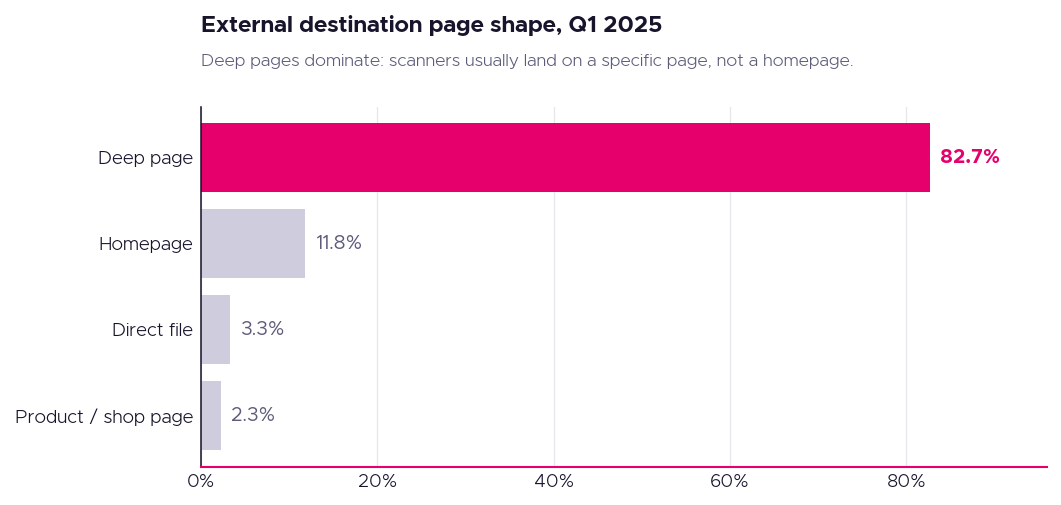
When someone scans a QR code, they almost always land on a specific, intentional page — not a generic homepage. In a Q1 2025 creation sample of 63,691 classifiable external QR destinations on the QRStuff platform, 82.7% were deep pages, 11.8% were homepages, 3.3% were direct file links, and 2.3% were product or shop pages.
Of external QR destinations in the Q1 2025 QRStuff sample pointed to deep pages — specific URLs with meaningful path components such as forms, documents, product listings, and event registration pages.
Source: QRStuff destination analysis, Q1 2025 (n=63,691 external destinations). Platform data.
"Deep page" in this analysis means a URL with a non-trivial path component — for example, a registration form, a product PDF, a social media profile, or an event landing page — as opposed to a domain root (homepage). The 82.7% figure is a creation-weighted measure: it reflects the distribution of newly created QR codes in Q1 2025, not a scan-weighted average. High-traffic QR programmes behave differently: among the top 1,000 most-scanned short URLs in January 2025, 61.3% linked to deep pages and 31.5% to homepages, suggesting that mass-reach campaigns sometimes prefer simpler entry points.
The destination classifier used in this analysis is deterministic (rule-based, URL structure), not ML-inferred. Deep-page labels have been signed off by editorial review. Full methodology is in the PDF report Chapter 5.
outputs/public/destination_external_page_shape_2025_q1_100k.jsonWhat kinds of destinations do QR codes link to?
Breaking the destination sample into functional categories reveals the breadth of QR use cases. The largest category — owned/general websites at 65.8% — confirms that most QR codes drive traffic to the creator's own digital property. Social platforms (9.6%) and cloud documents (8.7%) round out the top three. Forms and surveys, at 5.9%, represent the fastest-rising category across the 2025 monthly samples.
- Owned/general website: 65.8% — the default QR destination
- Social profiles: 9.6% — Instagram, LinkedIn, Facebook, WhatsApp
- Cloud documents: 8.7% — Google Drive, Dropbox, PDFs
- Forms/surveys: 5.9% — rising trend across 2025 monthly samples
- Media: 3.3% — video, audio, image assets
- Direct file download: 3.2%
- E-commerce: 2.3%
Use-case stability was tested across four monthly samples (January, April, July, October 2025). Documents/files (11.2–13.9%), forms/lead capture (7.5–11.0%), and video/media (8.8–13.0%) remained stable or rose. Real estate tours showed a sharp January spike (12.3%) that collapsed in other months — a case-study segment rather than a year-round trend.
How high-traffic codes differ from the average
The creation-weighted sample captures what a typical new QR code links to. A separate scan-weighted analysis of the top 1,000 most-scanned short URLs in January 2025 shows a different profile: more homepages (31.5% vs 11.8%) and — critically — more campaign tracking (12.5% vs 3.9%). This pattern suggests that the most mature QR programmes deliberately instrument their highest-reach codes with attribution tags, while most codes are created without them.
Nearly all external destinations (97.7%) used HTTPS, indicating that basic security hygiene is largely normalised on the QRStuff platform.
Report figures
Charts & Visualizations
Figure 1 · External QR Destination Page Shape

Bar chart showing deep page, homepage, direct file, and product page distribution in the Q1 2025 destination sample.
Deep pages dominate QR destination behaviour
When someone scans a QR code, they almost always land on a specific, intentional page — not a generic homepage. In a Q1 2025 creation sample of 63,691 classifiable external QR destinations on the QRStuff platform, 82.7% were deep pages, 11.8% were homepages, 3.3% were direct file links, and 2.3% were product or shop pages.
Of external QR destinations in the Q1 2025 QRStuff sample pointed to deep pages — specific URLs with meaningful path components such as forms, documents, product listings, and event registration pages.
Source: QRStuff destination analysis, Q1 2025 (n=63,691 external destinations). Platform data.
"Deep page" in this analysis means a URL with a non-trivial path component — for example, a registration form, a product PDF, a social media profile, or an event landing page — as opposed to a domain root (homepage). The 82.7% figure is a creation-weighted measure: it reflects the distribution of newly created QR codes in Q1 2025, not a scan-weighted average. High-traffic QR programmes behave differently: among the top 1,000 most-scanned short URLs in January 2025, 61.3% linked to deep pages and 31.5% to homepages, suggesting that mass-reach campaigns sometimes prefer simpler entry points.
The destination classifier used in this analysis is deterministic (rule-based, URL structure), not ML-inferred. Deep-page labels have been signed off by editorial review. Full methodology is in the PDF report Chapter 5.
outputs/public/destination_external_page_shape_2025_q1_100k.jsonWhat kinds of destinations do QR codes link to?
Breaking the destination sample into functional categories reveals the breadth of QR use cases. The largest category — owned/general websites at 65.8% — confirms that most QR codes drive traffic to the creator's own digital property. Social platforms (9.6%) and cloud documents (8.7%) round out the top three. Forms and surveys, at 5.9%, represent the fastest-rising category across the 2025 monthly samples.
- Owned/general website: 65.8% — the default QR destination
- Social profiles: 9.6% — Instagram, LinkedIn, Facebook, WhatsApp
- Cloud documents: 8.7% — Google Drive, Dropbox, PDFs
- Forms/surveys: 5.9% — rising trend across 2025 monthly samples
- Media: 3.3% — video, audio, image assets
- Direct file download: 3.2%
- E-commerce: 2.3%
Use-case stability was tested across four monthly samples (January, April, July, October 2025). Documents/files (11.2–13.9%), forms/lead capture (7.5–11.0%), and video/media (8.8–13.0%) remained stable or rose. Real estate tours showed a sharp January spike (12.3%) that collapsed in other months — a case-study segment rather than a year-round trend.
How high-traffic codes differ from the average
The creation-weighted sample captures what a typical new QR code links to. A separate scan-weighted analysis of the top 1,000 most-scanned short URLs in January 2025 shows a different profile: more homepages (31.5% vs 11.8%) and — critically — more campaign tracking (12.5% vs 3.9%). This pattern suggests that the most mature QR programmes deliberately instrument their highest-reach codes with attribution tags, while most codes are created without them.
Nearly all external destinations (97.7%) used HTTPS, indicating that basic security hygiene is largely normalised on the QRStuff platform.