


Where QR Codes Send People: Destination Benchmarks
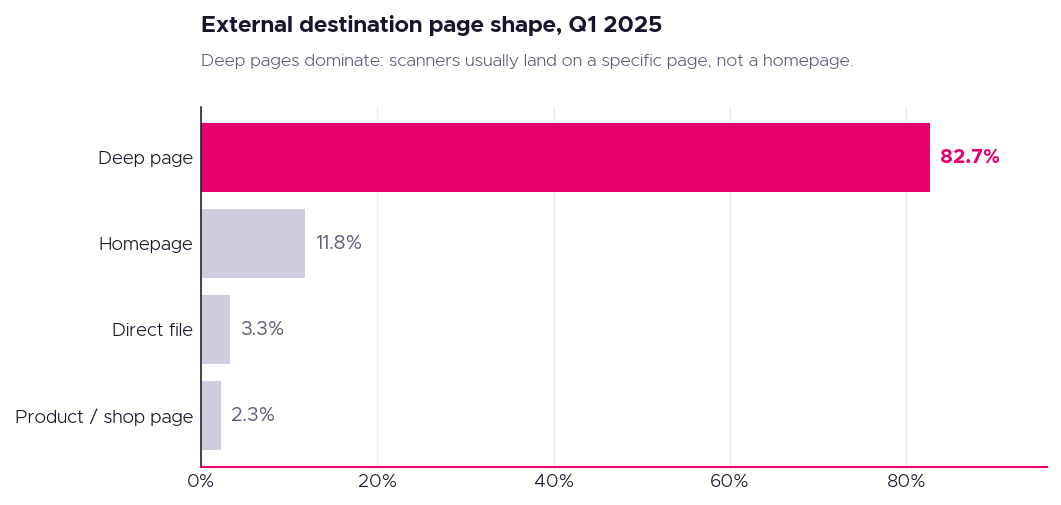
82.7% of 63,691 external QR destinations sampled in Q1 2025 were specific deep pages. QR codes are precision tools — not generic web entry points.
Deep pages dominate QR destination behaviour
When someone scans a QR code, they almost always land on a specific, intentional page — not a generic homepage. In a Q1 2025 creation sample of 63,691 classifiable external QR destinations on the QRStuff platform, 82.7% were deep pages, 11.8% were homepages, 3.3% were direct file links, and 2.3% were product or shop pages.
Of external QR destinations in the Q1 2025 QRStuff sample pointed to deep pages — specific URLs with meaningful path components such as forms, documents, product listings, and event registration pages.
Source: QRStuff destination analysis, Q1 2025 (n=63,691 external destinations). Platform data.
"Deep page" in this analysis means a URL with a non-trivial path component — for example, a registration form, a product PDF, a social media profile, or an event landing page — as opposed to a domain root (homepage). The 82.7% figure is a creation-weighted measure: it reflects the distribution of newly created QR codes in Q1 2025, not a scan-weighted average. High-traffic QR programmes behave differently: among the top 1,000 most-scanned short URLs in January 2025, 61.3% linked to deep pages and 31.5% to homepages, suggesting that mass-reach campaigns sometimes prefer simpler entry points.
The destination classifier used in this analysis is deterministic (rule-based, URL structure), not ML-inferred. Deep-page labels have been signed off by editorial review. Full methodology is in the PDF report Chapter 5.
outputs/public/destination_external_page_shape_2025_q1_100k.jsonWhat kinds of destinations do QR codes link to?
Breaking the destination sample into functional categories reveals the breadth of QR use cases. The largest category — owned/general websites at 65.8% — confirms that most QR codes drive traffic to the creator's own digital property. Social platforms (9.6%) and cloud documents (8.7%) round out the top three. Forms and surveys, at 5.9%, represent the fastest-rising category across the 2025 monthly samples.
- Owned/general website: 65.8% — the default QR destination
- Social profiles: 9.6% — Instagram, LinkedIn, Facebook, WhatsApp
- Cloud documents: 8.7% — Google Drive, Dropbox, PDFs
- Forms/surveys: 5.9% — rising trend across 2025 monthly samples
- Media: 3.3% — video, audio, image assets
- Direct file download: 3.2%
- E-commerce: 2.3%
Use-case stability was tested across four monthly samples (January, April, July, October 2025). Documents/files (11.2–13.9%), forms/lead capture (7.5–11.0%), and video/media (8.8–13.0%) remained stable or rose. Real estate tours showed a sharp January spike (12.3%) that collapsed in other months — a case-study segment rather than a year-round trend.
How high-traffic codes differ from the average
The creation-weighted sample captures what a typical new QR code links to. A separate scan-weighted analysis of the top 1,000 most-scanned short URLs in January 2025 shows a different profile: more homepages (31.5% vs 11.8%) and — critically — more campaign tracking (12.5% vs 3.9%). This pattern suggests that the most mature QR programmes deliberately instrument their highest-reach codes with attribution tags, while most codes are created without them.
Nearly all external destinations (97.7%) used HTTPS, indicating that basic security hygiene is largely normalised on the QRStuff platform.



 English (UK)
 Spanish (ES)
 French (FR)