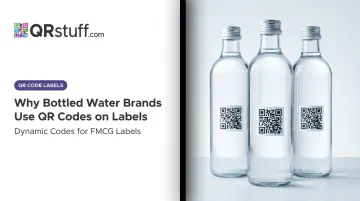
The problem: physical label space on a cylindrical water bottle is extremely limited. Legal requirements eat most of it — brand name, volume, source, expiration, nutritional information. That leaves almost no room for the things modern consumers increasingly want to see: sourcing details, quality test results, sustainability certifications, recycling guidance.
Meanwhile, 76% of U.S. grocery shoppers consider product transparency important, up from 69% in 2018. And more than 80% say they'd use a QR code, app, or website to find more product details. QR codes have become the practical solution that bridges the gap between a constrained physical label and rising consumer expectations.
Key Takeaways
- QR codes give water brands a scannable link to quality data, sourcing info, and certifications that won't fit on a physical label
- Dynamic QR codes let brands update promotions and content without reprinting labels, cutting per-run costs
- South Korea's 2026 mandate to replace plastic labels with cap-based QR codes signals where global regulation is heading
- Scan analytics reveal geographic, device, and behavioral data that sharpens distribution and campaign decisions
- Brands without QR codes are capped at what their label can say — a direct competitive disadvantage
What Is a QR Code on a Bottled Water Label
A QR code on a water bottle is a scannable matrix code printed on the label or cap that links a consumer's smartphone camera to a digital destination — no app required. Point your camera, tap the notification, done.
In the water category, that "digital destination" can mean a lot of things:
- A live water quality report showing TDS, pH, and filtration method
- A source location map
- A recycling guide or sustainability certification
- A loyalty program sign-up
- A seasonal promotion or reorder link
The QR code itself is neutral — it routes a scan to wherever the brand points it. What determines whether that scan converts into trust, loyalty, or a repeat purchase is the quality of what's waiting on the other end.
A code pointing to a generic homepage does nothing. One pointing to a real-time quality report — with test parameters updated batch by batch — gives the consumer a concrete reason to trust what they're drinking.
Key Advantages of QR Codes on Bottled Water Labels
These three advantages are specific to bottled water: consumer trust is the primary purchase driver, label space is unusually constrained, and sustainability regulation is already reshaping packaging requirements in major markets.
Advantage 1: Water Quality Transparency That Builds Consumer Trust
Bottled water is sold almost entirely on safety and purity. Unlike juice or soda, where flavour and brand personality carry significant weight, water buyers want to know: where did this come from, what's in it, and how was it tested?
The challenge is that a 500ml bottle label can't tell that story. TDS levels, pH, filtration methods, third-party certifications, source coordinates — none of it fits alongside mandatory regulatory content.
A QR code solves this by linking directly to a live quality page. The clearest real-world example: BookWater, a Chennai-based water delivery startup, embeds IoT-linked QR codes on every water can. Scanning reveals TDS, pH, calcium, magnesium, manufacturing date, and reuse count — all updated in real time. Consumers scan before they drink. That's a functional trust mechanism, not a marketing tactic.
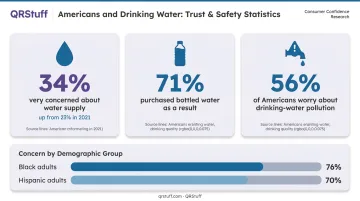
This matters most in markets where tap water confidence is low. A 2023 WQA survey of 1,412 U.S. adults found 34% were very concerned about their water supply — up from 23% in 2021 — and 71% purchased bottled water as a result. Gallup reported that 56% of Americans worry a great deal about drinking-water pollution, with that figure rising to 76% among Black adults and 70% among Hispanic adults.
For a brand operating in those markets, a QR code linking to verifiable quality data doesn't just answer a consumer question. It removes a purchase objection.
KPIs this moves:
- Consumer trust scores
- Repeat purchase and subscription conversion rates
- Retailer shelf performance (some grocery buyers favour brands with verifiable quality claims)
Advantage 2: Label Space Optimization and Sustainability Credibility
A water bottle label is small, curved, and legally crowded. Once brand name, volume, source, and nutritional info are in place, there's almost nothing left for sustainability messaging, certifications, or recycling guidance — the content that eco-conscious consumers increasingly expect.
QR codes act as a release valve. Brands can maintain a minimal physical label while housing extended content digitally: carbon footprint data, refill programme details, recycling instructions sorted by local council area, sustainability certifications. Less ink, potentially a smaller label, and far more information accessible to anyone who wants it.
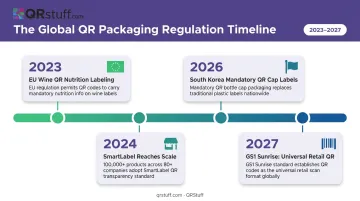
The regulatory dimension here is no longer theoretical. South Korea's Ministry of Environment mandated that all domestically sold bottled water must move to label-free, QR-based packaging from January 1, 2026. QR codes are applied to bottle caps or outer packaging instead. The official estimate: this will eliminate approximately 2,270 tonnes of plastic waste annually, based on 5.2 billion bottles produced in 2024.
South Korea isn't an outlier. The EU already permits wine brands to deliver full nutritional and ingredient information via QR code rather than physical label. The U.S. SmartLabel programme — now covering more than 100,000 products across 80+ companies — demonstrates voluntary industry appetite for the same model. GS1's Sunrise 2027 initiative is pushing QR codes as the standard retail-scannable format across all consumer packaging categories.
Brands building this infrastructure now can treat compliance as a competitive signal rather than a scramble — water brands that adopted South Korea's QR-based model before the mandate used the transition to launch consumer-facing quality pages that drove measurable engagement.
KPIs this moves:
- Packaging material cost
- Plastic waste output
- Regulatory compliance readiness
- Brand perception scores among eco-conscious consumers
Advantage 3: Dynamic Campaigns and Reorder Flows Without Reprinting Labels
Static QR codes are permanently tied to a single URL. Print one on a label, and it points to that destination forever, until the label is reprinted. That's a real operational constraint for brands running seasonal campaigns, retailer-specific promotions, or testing different digital experiences.
Dynamic QR codes work differently. The code encodes a short redirect URL, and the actual destination can be changed at any time through the management platform, with no changes to the printed code. A water brand can print a full production run once, then redirect that same code from a summer hydration challenge to a loyalty sign-up to a back-to-school promotion, all within the same label's lifespan.
FDA estimates for packaged-food relabelling put annualized costs at $66 million–$154 million across the industry. While bottled water label reprints are a fraction of that at the individual brand level, the per-unit economics at scale are meaningful — especially when a content change (not a regulatory update) is the trigger.
Coca-Cola — a QRStuff customer — demonstrated this model with its 2025 Share a Coke campaign relaunch, using on-pack QR codes as the gateway to a digital hub where consumers access personalised experiences, customise packaging, and engage with the Memory Maker feature. The QR code on the bottle is a persistent channel, not a one-time promotion.
For water brands, the same mechanics apply to reorder flows, subscription sign-ups, or loyalty programmes — managed through a single printed code across an entire production run.
KPIs this moves:
- Campaign flexibility and speed to market
- Cost-per-label-update (near zero with dynamic codes)
- Consumer lifetime value
- Scan-to-conversion rate for promotions
What Happens When Bottled Water Brands Skip QR Codes
A brand without a QR code is capped at what its physical label can communicate. In a category where consumers increasingly expect digital depth — quality data, sourcing transparency, recycling guidance — a label-only brand risks appearing less transparent than competitors offering scannable reports.
The competitive gap is growing. A 2024 GS1 consumer survey found 79% of shoppers were more likely to buy products with a scannable barcode or QR code that provides desired product information. Brands not offering this are simply less likely to win the undecided buyer.
Regulatory pressure adds another layer. Markets like South Korea have already mandated the transition, and brands entering without QR infrastructure face compliance-driven implementation under time pressure — the worst possible conditions for getting it right.
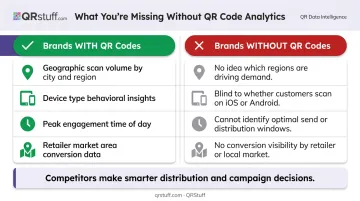
The data loss is the least visible cost — and often the most consequential. Every scan a competitor collects is a data point they're using to make smarter decisions:
- Which city and region is driving volume
- Which device types their buyers use
- Which time of day sees peak engagement
- Which retailer's market area is actually converting
That feeds better distribution, sharper campaign targeting, and clearer insight into which SKUs engage buyers post-purchase. Brands skipping QR codes aren't just losing scans — they're handing that intelligence to competitors.
Real Bottled Water Brands Using QR Codes on Labels
QR codes on water packaging aren't speculative. Brands have deployed them with clear strategic intent:
BookWater (Chennai) — IoT-linked QR codes show TDS, pH, calcium, magnesium, manufacturing date, and reuse count in real time. Consumers scan before drinking — the clearest quality-transparency use case in the category.
Evian — Has introduced label-free bottle formats and uses QR codes in consumer-facing activations, including a Wimbledon campaign where attendees scanned packaging as part of an interactive experience.
Coca-Cola — The 2025 Share a Coke relaunch uses on-pack QR codes to reach a digital hub with personalized packaging and the Memory Maker experience, anchoring a full campaign through one printed code.
SmartLabel participants — More than 1,000 brands across 80+ companies use SmartLabel QR codes, generating nearly 22 million page views in 2024. Beverage brands use them to surface extended product information that can't fit on the label itself.
What these brands have in common: every QR code destination reinforces something specific — real-time quality data, a sustainability story, or an interactive campaign. None of them lead to a generic homepage.
How to Get the Most Value from QR Codes on Water Bottle Labels
A QR code on a label is only as valuable as what it links to — and whether the brand is tracking what happens after the scan.
Three Operational Principles
Use dynamic codes — not static ones. Static codes lock you into a single destination permanently. Dynamic codes, like those available through QRStuff, let you update the destination without touching the label. That means one production run can support unlimited content updates across the bottle's entire shelf life.
Link to a single, mobile-optimized action. The landing page behind the scan should have one clear purpose: a quality report, a loyalty sign-up, a recycling guide. Multiple competing actions on the same page reduce conversion. The scan destination deserves the same strategic attention as the label design itself.
Review scan analytics regularly. QRStuff's platform reports geographic location (country and city level), device type, scan time, and unique versus repeat scan counts in real time, all exportable as CSV or PDF. For a water brand, this answers concrete questions:
- Which retail regions are most engaged?
- Which SKUs drive the most scans?
- Is a seasonal campaign landing where expected?
Technical Basics Brands Often Miss
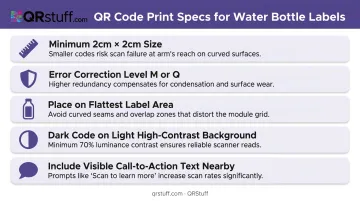
Getting a QR code printed on a water bottle is easy. Getting it to scan reliably in real-world conditions requires attention to a few specifics:
- Minimum size: At least 2cm × 2cm for simple URL codes; GS1 guidance specifies an x-dimension minimum of 0.396mm for GS1 Digital Link codes on consumer units
- Error correction: Use level M (15% damage recovery) or Q (25%) on bottle labels — higher correction handles condensation, scratches, and slight distortion on curved surfaces better than the default level L
- Placement: Position the code on the flattest part of the label; the GS1 symbol placement guidelines specifically warn that code extremes can disappear around a curve
- Contrast: Dark code on a light background; avoid inverted colours — many older smartphone cameras struggle with them
- Call-to-action: A visible CTA near the code ("Scan to see your water quality report") significantly improves scan rates
QRStuff also supports GS1 Digital Link QR codes — the Sunrise 2027 compliant format that carries GTIN, batch, and expiry data while simultaneously linking consumers to product pages. For brands selling into markets where digital product passports are on the regulatory horizon, this is the format to build on now.
Conclusion
QR codes on bottled water labels solve three real problems at once: the transparency gap consumers expect to be filled, the physical label constraints that make brand storytelling nearly impossible, and the static packaging problem that makes every content update an expensive reprint decision.
Brands that build QR infrastructure now accumulate scan data, refine their digital content, and build consumer habits around scanning — while positioning ahead of regulatory requirements already reshaping packaging in South Korea and signaling change in the EU and beyond. The compounding effect is real: early movers gain months of behavioral data that late adopters have to rebuild from scratch.
The brands getting the most from QR codes treat the scan destination with the same strategic attention they give the label design itself. Source transparency, loyalty touchpoints, and real-time content updates — those are what turn a scan into a relationship. Platforms like QRStuff make that possible without touching the label: update the destination, track the data, and adapt without a single reprint.
Frequently Asked Questions
How do you scan a QR code on a water bottle?
Open your smartphone's native camera app, point it at the QR code, and tap the notification that appears on screen. No separate app is required on modern iPhones or Android devices. The whole process takes under five seconds.
Are QR codes on water bottles required by law?
It depends on the market. South Korea mandated QR-based packaging for all domestically sold bottled water from January 1, 2026. The U.S. and EU have no equivalent mandate yet, though voluntary programs like SmartLabel are widely adopted and regulatory momentum toward digital labeling is building.
What information can a QR code on a water bottle contain?
Brands can include water source location, TDS and pH levels, filtration method, third-party certifications, recycling instructions, loyalty sign-ups, seasonal promotions, and reorder links. With a dynamic QR code, any of this content can be updated at any time without reprinting the label.
Do QR codes on water bottle labels expire?
Static QR codes don't expire but can't be updated once printed. Dynamic QR codes — available through platforms like QRStuff — don't expire on paid plans, and brands can change the destination URL at any time without reprinting the label.
How do small water brands benefit from adding QR codes to their labels?
Smaller brands can link to quality certifications, sourcing stories, and loyalty programs — building credibility without an expensive label redesign every time content changes. With a dynamic QR code, the label is printed once while the digital content evolves alongside the brand.
What makes a QR code on a water bottle actually get scanned?
Scan rates improve when the code has a visible call-to-action nearby (such as "Scan to see your water quality report"), links to content that's genuinely useful rather than promotional, and is placed in a high-contrast, flat position on the label rather than on a curved or dark section of the packaging.