The bigger issue isn't just waste. It's that professionals continue stacking their networking strategy on a tool that offers no way to follow up, no way to update outdated information, and zero visibility into whether anyone engaged at all.
Digital business cards solve each of those problems — and then some. This article covers 8 concrete benefits with real operational impact, plus a practical guide on how to embed digital cards into your existing workflows.
Key Takeaways
- Digital business cards are updatable online profiles shared via QR code, short URL, or direct message — giving contacts always-current information instead of a static printed card
- Key benefits include cost savings from eliminated reprints, always-current contact details, real-time scan analytics, and multimedia content integration
- They work across networking events, email signatures, sales outreach, and social profiles — not just face-to-face meetings
- Dynamic QR codes serve as the physical-to-digital bridge: one scan opens the full profile, and the underlying content can be updated without changing or reprinting the code
- Every scan is tracked — you can see who engaged, when, and from where, turning each card share into actionable contact data
What Is a Digital Business Card?
A digital business card is an online profile containing your contact details, social links, portfolio URLs, booking links, and multimedia content — all accessible via a QR code scan, short URL, NFC tap, or direct message.
Unlike a printed card, a digital card lives in the cloud. Edit it once in your dashboard, and every past and future scan automatically reflects the updated information. No reprinting, no redistributing, and no tracking down contacts to share a new number.
QR codes are the most practical delivery mechanism because they work everywhere: on printed materials, email signatures, conference badges, and phone screens. QRStuff's vCard and Digital Business Card QR code types are designed specifically for this use case, turning any surface into a contact-sharing touchpoint.
Dynamic versions of these codes let you update the underlying profile at any time without generating a new code. A card printed six months ago still delivers current information today.
8 Key Benefits of Digital Business Cards
These benefits are practical and measurable. They affect cost, follow-up rates, brand perception, and operational efficiency — not just convenience.
Benefit 1: Real Cost Savings Over Paper
Paper business cards carry ongoing costs most organisations underestimate. There's the initial design fee, the per-batch print cost, and then the full reprint cycle triggered every time someone changes roles, updates their number, or the company rebrands.
With the U.S. Bureau of Labor Statistics reporting a median employee tenure of just 3.9 years — and even shorter effective periods between title or contact changes — reprints aren't occasional. For distributed sales teams or high-growth companies, they're routine budget items.
Digital cards break that cycle. QRStuff's platform allows users to update their card details centrally, with changes reflected instantly across all previously distributed QR codes — no reprint, no redistribution required. One version of the card, always current, at no additional print cost.
When this matters most:
- High-growth teams where roles change frequently
- Companies undergoing a rebrand or restructure
- Large distributed sales forces managing cards across regions
Benefit 2: Always Up-to-Date Contact Information
A paper card becomes a liability the moment any detail changes. The recipient has no way of knowing the phone number is wrong, the email bounced, or the job title no longer applies. Every failed follow-up attempt traces back to static information that couldn't keep pace with reality.
Dynamic digital cards eliminate this problem at the source. When a QRStuff user updates their vCard or Digital Business Card profile, the change is reflected immediately across every existing share — including codes already printed on physical materials. The QR code itself doesn't change. Only the information it points to does.
This matters for both directions of the relationship. Past contacts who scan an old code still reach current information. New contacts always get the latest version without any action required from either party.
When this matters most:
- Professionals in real estate, consulting, or sales where role changes are frequent
- Any team mid-rebrand or post-acquisition
- Individuals managing multiple professional identities or roles
Benefit 3: Trackable Engagement and Real-Time Analytics
Paper cards offer zero post-handoff visibility. You have no idea whether the card was kept, photographed, or discarded. Digital cards close that gap.
QRStuff's dynamic QR code analytics track:
- Total and unique scan counts — distinguishing new contacts from repeat engagements
- Geographic data — country and city-level location of each scan
- Device type — mobile vs. desktop, iOS vs. Android
- Time and date of each scan — useful for identifying peak engagement windows
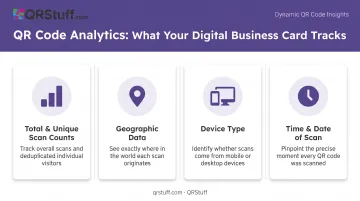
Data is available in real time via the dashboard, with export options in CSV, Excel, or PDF format for reporting or CRM integration.
Timing data also sharpens follow-up strategy. An MIT/InsideSales study found that contacting a lead within 5 minutes made firms 100x more likely to connect than waiting 30 minutes. When you can see that a contact just scanned your card, you know exactly when to reach out.
When this matters most:
- Sales teams tracking outreach performance across events
- Marketers attributing lead generation to specific channels
- Enterprise teams monitoring card engagement across distributed regions
Benefit 4: Reduced Environmental Footprint
The paper consumption numbers add up fast. The U.S. EPA reports that 67.4 million tons of paper and paperboard entered U.S. municipal solid waste streams in 2018, with 17.2 million tons sent to landfill. Business cards are one small contributor to a large systemic problem.
A peer-reviewed life cycle assessment published in Procedia Computer Science directly compared paper-based and software-based business cards, finding software-based cards to be more environmentally favourable at larger-scale use across energy consumption, GHG emissions, and toxic releases.
For enterprises, this connects to something more immediate than environmental principle. KPMG's 2024 Survey of Sustainability Reporting found that 95% of G250 companies now publish carbon-reduction targets and 82% include sustainability information in annual reports. Reducing paper output is a visible, easy-to-document action that supports ESG commitments without operational sacrifice.
When this matters most:
- Companies with public sustainability commitments
- Industries under formal ESG reporting requirements
- Client-facing teams where brand values are part of the pitch
Benefit 5: Rich Multimedia and Content Integration
A paper card caps out at name, title, phone number, and maybe a logo. A digital card removes that ceiling entirely.
QRStuff's Digital Business Card supports links to:
- Portfolio galleries and work samples
- Video introductions
- Social media profiles
- Appointment booking links
- Payment links
- Website and LinkedIn profiles
This depth changes the quality of first contact. A prospect who watches a 60-second intro video or browses a portfolio before responding is a warmer lead than one who only has a name and number. Wyzowl's video marketing research found that 85% of consumers say a video convinced them to buy a product or service, and 89% say video quality directly impacts their trust in a brand. Embedding that content into your first point of contact compresses the credibility-building process before a response ever comes in.
When this matters most:
- Creatives, consultants, and real estate agents whose work sells itself
- Sales professionals who need to establish credibility before a response
- Anyone whose service quality is hard to convey in a name and job title
Benefit 6: Flexible Customisation for Brand Consistency
Generic cards undermine the impression networking is meant to create. Digital cards support full brand alignment — logos, custom colour palettes, font choices, and branded QR code design — across every card in your organisation.
QRStuff extends this to team-wide control. Enterprises can apply consistent templates across all employee cards, use custom short URL domains (e.g., links.yourbrand.com), and manage branding centrally rather than leaving design decisions to individual employees. The result is every card — from the CEO to a new sales hire — reflects the same visual identity.
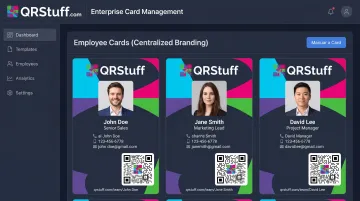
This also solves a compliance problem at scale. Instead of each employee creating their own card with inconsistent quality, a centrally managed template ensures uniformity without requiring ongoing creative oversight.
When this matters most:
- Enterprises managing cards for dozens or hundreds of employees
- Companies with strict brand guidelines or recent rebrands
- Client-facing roles where the first impression establishes the professional standard
Benefit 7: Instant, Cross-Platform Sharing
"I left my cards in the car" is not an excuse anyone needs when the card lives on their phone.
Digital business cards are shareable via:
- QR code scan (in person or on screen)
- SMS or WhatsApp
- Email or LinkedIn direct message
- Zoom or Teams chat
- Social media bio link
The same card, the same information, across every context — no modification needed. QRStuff supports both the QR code and short URL sharing routes, meaning the card works whether you're at a trade show, a virtual meeting, or a cold outreach sequence.
When this matters most:
- Remote and hybrid teams without consistent in-person contact
- Sales professionals working across multiple channels simultaneously
- Anyone attending a mix of virtual and in-person events
Benefit 8: Scalable for Teams and Enterprises
At scale, paper cards create a management problem. Inconsistent designs, outdated information on individual employee cards, no centralised view of what's out there, and no data on how any of it is performing.
QRStuff's Enterprise plan (£185/month) addresses this directly:
- 100 Digital Business Cards included in the base allocation
- Bulk generation with unlimited batch processing for full-team deployment
- API access enabling integration with HR systems for automated card creation during onboarding
- SSO via SAML 2.0 and OpenID Connect for secure, frictionless employee access
- Role-based permissions for multi-user management across departments
- Centralised analytics with per-card-holder scan data visible from a single dashboard
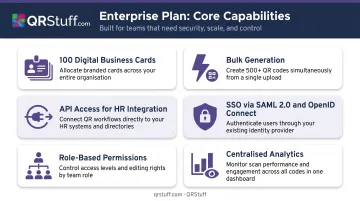
For organisations onboarding large cohorts, API integration means new employee cards can be created programmatically as part of the existing HR workflow — no manual setup required.
QRStuff is trusted by over 495,000 businesses globally, including enterprises like Deloitte, JP Morgan, and Google, with a 99.9% uptime guarantee backing reliability for client-facing use.
What Happens When You Skip the Digital Upgrade
Sticking with paper has real, compounding consequences.
Contacts go cold because follow-up depends entirely on whether they kept a card. Updated information never reaches the recipient — they call the old number, it fails, and the connection is lost. Printing costs accumulate with every personnel change, and there's no way to quantify what any of it produced.
The invisible cost is the analytics gap. Without scan data, every networking event, conference, or outreach effort becomes unattributable spend. You know you distributed 200 cards at an event. You have no idea how many led to anything.
Brand perception is also at stake. Research from TrustRadius found that 78% of B2B buyers select products from vendors they had already heard of before beginning their research. Familiarity and credibility matter before the first conversation even starts.
A polished, branded digital profile sends a different signal than a standard printed card. It shows that the professional behind it manages their presence intentionally.
How to Use Your Digital Business Card Effectively
Digital business cards work best when integrated into existing workflows — not treated as a paper replacement that only comes out at trade shows. Here are four high-impact contexts to build them into your routine.
At Networking Events and Conferences
Display a QR code on your conference badge, booth banner, or phone screen. Contacts scan and save your details without manual entry. Each scan also logs the interaction, giving you a timestamped record of who engaged and when — useful for post-event follow-up prioritization.

In Email Signatures
An email signature QR code turns every outbound message into a passive networking touchpoint. QRStuff's Gmail integration makes this straightforward — recipients can save your contact details directly from their inbox without needing to ask for a card separately.
In Sales and Marketing Outreach
Share your digital card via LinkedIn message or cold outreach, then let scan analytics do the qualifying work:
- Identify engaged prospects by tracking who opened your card and when
- Time follow-ups to actual behavior, not guesswork about who might be interested
On Social Media Profiles and Digital Portfolios
Embed a consistent QR code or short link in your LinkedIn bio, social profiles, and portfolio sites. This creates a single destination consolidating all contact and professional information, reducing friction for anyone who discovers you through content, search, or referral.
Conclusion
Digital business cards change how professionals manage, share, and track their contact strategy — and the operational benefits go well beyond replacing a paper card.
Each scan generates data. Profile updates reach all past recipients automatically. When connected to analytics or sales workflows, networking becomes a measurable, repeatable process rather than a passive exchange of details.
That measurability is only useful if acted on. Professionals and teams who treat digital cards as an active practice — updating content regularly, reviewing scan data, and refining how they share — consistently get more from them than those who configure a card once and leave it static.
Frequently Asked Questions
What are the benefits of a digital business card?
The core benefits are measurable: no printing or reprint costs, always-current contact details, real-time engagement analytics, multimedia content integration, and instant sharing across any channel. The value compounds over time, as every scan adds data and every update reaches past contacts automatically.
What do you do with a digital business card?
Share it via QR code at events, embed it in email signatures, send it via LinkedIn or WhatsApp, or link to it from your social profiles. Use scan analytics to identify who engaged and time your follow-ups based on actual behavior rather than guesswork.
How is a digital business card different from a paper business card?
Paper cards are static, single-use, and untrackable. Digital cards are updatable in real time, shareable across any channel or device, and generate engagement data every time they're accessed, including geographic location, device type, and time of scan.
Can I use a QR code for a digital business card?
Yes — QR codes are the most versatile sharing method. A single scan opens the full profile on any device. Dynamic QR codes, like those from QRStuff, allow the underlying contact details to be updated at any time without changing or reprinting the code itself.
Are digital business cards suitable for large teams and enterprises?
Yes. Enterprise platforms like QRStuff support centralised card creation, bulk generation, API-driven onboarding, role-based access controls, and team-wide analytics — ensuring brand consistency across all employee cards without manual coordination.
How do I keep my digital business card information current?
Any update made in the platform dashboard is reflected instantly across every existing share — including codes already printed on physical materials. No reprinting, no redistribution, and no manual contact required.