QR codes and 2D barcodes solve this by turning a small printed square into a dynamic information hub. Scan it, and a consumer can access a full nutritional panel, recycling instructions, recipes, or a loyalty program — none of which needed to be crammed onto the physical label.
This guide covers everything food brands need to know: the different barcode formats used on packaging, what content to put behind your QR code, how to create and design codes that actually scan, and what GS1 Sunrise 2027 means for your packaging strategy.
Key Takeaways
- 2D barcodes carry far more data than traditional UPC/EAN barcodes — enough to encode URLs, GTINs, batch numbers, expiry dates, and allergen data simultaneously
- Dynamic QR codes let you update destination content without reprinting labels, making them essential for recalls, regulatory changes, and seasonal promotions
- US QR code scanning hit 99.5 million users in 2025 (eMarketer), making consumer-facing codes a mainstream channel
- GS1 Sunrise 2027 requires retailers to accept 2D barcodes at checkout by end of 2027, and food brands that start preparing now will avoid a last-minute scramble
- Choose a platform that supports dynamic codes, scan analytics, bulk generation, and GS1 Digital Link — these aren't optional features for food packaging
QR Codes vs. 2D Barcodes on Food Packaging: What Food Brands Need to Know
1D vs. 2D: The Fundamental Difference
1D barcodes — UPC and EAN formats — encode data in vertical bars only. They're designed for a single job: identifying a product at checkout. That works fine for POS scanning, but the format can't hold much more than a 12-digit product number.
2D barcodes encode data both horizontally and vertically, using a matrix of dots or squares. The practical result: far greater data capacity in a smaller footprint. A single 2D barcode can carry a URL, a GTIN, a batch number, an expiry date, and allergen flags — all at once.
The Barcode Formats on Food Packaging
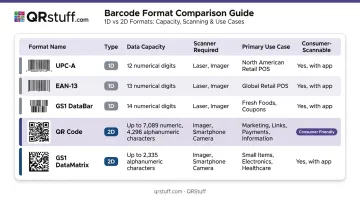
Not all 2D barcodes work the same way, and food packaging typically uses several distinct formats:
| Format | Type | Data Capacity | Scanner Required | Primary Use Case | Consumer-Scannable |
|---|---|---|---|---|---|
| UPC-A | 1D linear | 12 digits | Retail POS laser | Checkout identification | No (POS only) |
| EAN-13 | 1D linear | 13 digits | Retail POS laser | Checkout identification (international) | No (POS only) |
| QR Code | 2D matrix | Up to 177×177 modules (Version 40) | Smartphone camera | Consumer-facing digital content, GS1 Digital Link | Yes — native camera app |
| GS1 DataMatrix | 2D matrix | Up to 3,114 numeric / 2,334 alphanumeric characters | Image-based/CCD scanner | Supply chain, traceability, healthcare, batch/expiry | Not commonly |
| GS1 DataBar | 1D linear family | Up to 74 numeric / 41 alphabetic characters | Retail POS | Fresh produce, variable-weight items | Not standard |
How They Work Together on a Single Package
Most food packaging today uses both: a 1D barcode (UPC or EAN) for point-of-sale checkout and a QR code for consumer-facing content. The QR code is supplementary — it doesn't replace the checkout barcode.
GS1 Sunrise 2027 aims to change this. By end of 2027, the goal is for a single 2D barcode carrying a GS1 Digital Link URL to serve both functions: checkout scanning and consumer information access.
Why the Food Industry Is Moving to QR Codes and 2D Barcodes
Consumer Demand for Transparency
Innova Market Insights reports that 58% of consumers emphasise clear information on ingredients and sourcing — and that number has been climbing. Shoppers want to know what's in their food, where it came from, and how to dispose of the packaging.
QR codes give brands a way to surface this information without cluttering the label. A consumer who wants the deep dive can scan and get it; a consumer who doesn't can ignore the code entirely.
Consumer Engagement and Brand Building
That transparency function opens the door to something broader: QR codes that turn passive packaging into an active brand touchpoint. The two most common destinations for food brand QR codes:
- Extended product information — full ingredient lists, allergen data, certifications (organic, non-GMO, kosher)
- Loyalty and engagement programs — recipes, sweepstakes, coupon redemptions, brand stories
A 2022 Cornell University study found that over 60% of customers chose QR-coded milk cartons, with QR codes helping communicate freshness and drinkability in ways static labels couldn't. Practical, useful content — not just promotional links — is what keeps consumers scanning.
Regulatory Compliance
Several regulatory frameworks now explicitly support or require digital label access:
- USDA Bioengineered Food Disclosure (mandatory since January 1, 2022) — permits electronic or digital link disclosure for BE ingredients
- EU wine and spirits labelling — Regulation (EU) 2021/2117, effective December 8, 2023, allows required nutritional and ingredient information by electronic means
- FDA FSMA 204 traceability rule — doesn't mandate a specific technology, but FDA has confirmed Traceability Lot Codes can be embedded in a QR code or GS1 Digital Link
Dynamic QR codes are especially valuable here: when regulations change, the destination content can be updated without a packaging redesign.
Supply Chain Traceability and Recall Management
2D barcodes encoded with lot numbers, batch data, and expiry dates enable end-to-end product tracking. In a recall scenario, that precision matters enormously — the difference between pulling one batch and pulling an entire product line.
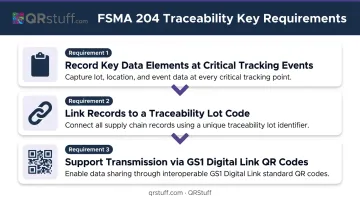
The FDA's FSMA traceability rule (compliance currently extended to July 20, 2028) applies to foods on the Food Traceability List. Key requirements include:
- Recording Key Data Elements at each Critical Tracking Event
- Linking those records to a Traceability Lot Code carried in the supply chain
- Supporting transmission via QR codes encoded with GS1 Digital Link URLs
Sustainability and Recycling Information
7 in 10 consumers check packaging to understand recyclability, according to The Recycling Partnership's Recycle Check program with General Mills. The challenge: recycling rules vary by ZIP code, and they change frequently.
QR codes linked to location-aware recycling guidance — like the Recycle Check platform that gives consumers a yes/no curbside answer based on their ZIP code — solve this problem in a way printed labels simply can't.
What to Put in a Food Packaging QR Code
The content behind your QR code determines whether consumers scan again or ignore it. Here's what works:
Nutrition, Ingredients, and Allergen Data
The highest-value destination for food QR codes. A QR code can link to:
- Full nutritional panel with extended serving size information
- Complete ingredient list with sourcing details
- Allergen warnings and cross-contamination disclosures
- Certifications: organic, non-GMO, kosher, halal
Products sold across multiple markets can serve different regulatory destinations dynamically — one physical label, no reprinting required.
Product Origin and Traceability
Sourcing transparency differentiates premium products. Options include:
- Farm-to-shelf journey maps
- Batch and lot traceability records
- Third-party lab results (especially relevant for supplements, CBD products, or functional foods)
- Supplier certification documents
Recipes, Usage Tips, and Content Marketing
Practical content keeps scan rates high over the product's shelf life. Linking to recipes for the specific product — not a generic brand recipe page — gives consumers a reason to scan at home, not just at the shelf. Effective content options include:
- Step-by-step recipes using the exact product
- Preparation or usage tips specific to the variant
- Video tutorials or pairing suggestions
Promotions, Loyalty Programs, and Sweepstakes
Time-sensitive offers, coupon redemptions, or competition entries turn packaging into an active marketing channel. The key advantage of dynamic QR codes here: promotional destinations can be swapped without reprinting the code. Run a summer campaign, then switch to a back-to-school offer — same printed code, new destination.
Sustainability and Recycling Guidance
Location-based recycling instructions, carbon footprint data, and packaging take-back programs all require content that changes too frequently for a permanent printed label. Dynamic QR codes let brands update this information by region or season — no reprint needed.
How to Create QR Codes for Food Packaging (Step by Step)
Step 1 — Choose Static vs. Dynamic
This is the most consequential decision in the process — get it wrong and you may have to reprint thousands of units.
- Static QR codes encode the destination directly into the pattern. Once printed, the destination cannot change. If a recall happens, a regulation changes, or a promotion ends — you can't update it.
- Dynamic QR codes store a short redirect URL. The printed code never changes, but the destination can be updated anytime through your QR platform.
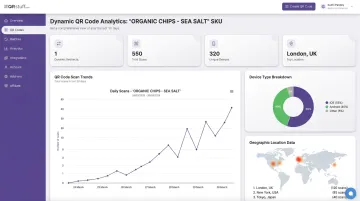
For food packaging, dynamic is strongly recommended. QRStuff supports dynamic QR codes across its paid plans, with full scan analytics tracking volume, device type, geographic location, and time-based trends — giving food brands visibility into how consumers engage with each SKU.
Step 2 — Decide on GS1 Registration
Once you've chosen dynamic, the next question is whether this code needs to work at retail checkout — because that determines whether GS1 registration applies:
- Consumer engagement only (supplementary to an existing UPC/EAN): No GS1 registration required. The QR code just links to a URL.
- Retail checkout scanning (GS1 Sunrise 2027 compliance): Requires a GS1 Company Prefix and GTIN to encode a GS1 Digital Link URL. QRStuff supports GS1 Digital Link QR code generation through its Enterprise plan.
If you're a small brand, note that these are two distinct use cases with different technical requirements — don't conflate them.
Step 3 — Select Content Type and Build Your Destination
For food packaging, the most useful QR code content types are:
- URL — links to a web page (product page, recipe database, sustainability portal)
- PDF — downloadable lab reports, compliance certificates, or detailed product sheets
- Landing page — purpose-built destination with nutrition info, sourcing details, or promotional content
QRStuff supports 40+ content types across these categories. Brands managing multiple SKUs can use the Bulk QR Code Generator — up to 500 codes per batch on the Full Suite plan, with unlimited batch processing on Enterprise.
Step 4 — Test Scannability Before Printing
Before sending artwork to the printer:
- Test at the actual printed size on both iOS and Android camera apps (no third-party app required)
- Verify the quiet zone — QR codes require 4 modules on all sides, per GS1 implementation guidance
- Test in varying lighting conditions, including the fluorescent lighting common in retail environments
- Check that the code works at an angle, since consumers rarely hold packaging perfectly flat
Step 5 — Integrate Into Packaging Artwork
Placement and print quality both affect scannability:
- Position: Lower right of the back panel is the industry standard. Avoid seams, folds, curved surfaces, and heat-sealed edges.
- Contrast: Dark code on light background. Avoid glossy or reflective surfaces — matte finishes scan more reliably.
- File format: Request SVG or EPS from your QR platform for print workflows. QRStuff exports both vector formats (SVG, EPS) and high-resolution PNG (minimum 300 DPI), suitable for professional packaging print production.
QR Code Design and Placement Tips for Food Packaging
Size, Contrast, and Quiet Zone
GS1 guidelines specify that QR code size should be calculated from module count plus an 8-module quiet zone addition — not a fixed physical dimension. The right minimum size depends on your specific code version and printing method. Three rules apply regardless of code version or printer:
- Quiet zone: 4 modules on all sides. Never crop it.
- Contrast: The code must be clearly distinguishable from the background. Low contrast is the leading cause of scan failure on packaging.
- Verification: Test the printed code before full production runs, not just the digital file.
Custom Design for Brand Alignment
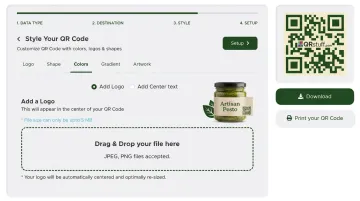
Plain black-and-white QR codes are no longer the only option. Custom colors, logo integration, and brand patterns are all achievable — with one condition: error correction level must be set to Q (25%) or H (30%) when design elements partially obscure the code. This preserves scannability even when up to 30% of the code surface is covered.
QRStuff handles this automatically for food packaging designers:
- Uploading a logo triggers an automatic error correction adjustment
- Real-time preview confirms scannability before files are downloaded
- No manual error correction settings required
GS1 Sunrise 2027: What Food Brands Need to Know
GS1 Sunrise 2027 is a global retail initiative requiring all point-of-sale scanners to be capable of reading 2D barcodes by end of 2027. Specifically, QR codes and DataMatrix codes carrying GS1 Digital Link URLs — which encode GTINs, batch numbers, serial numbers, expiry dates, and more in a web-compatible format.
What this does not mean: UPCs are not disappearing on December 31, 2027. GS1 US has been explicit that the UPC barcode is not going away immediately. The transition will involve a period of dual-marking (1D and 2D side by side) while retailer point-of-sale infrastructure upgrades.
What food brands should do now:
- Audit your current barcode setup and understand what data you're currently encoding
- Familiarize yourself with GS1 Digital Link URL structure (GTINs, batch qualifiers, expiry date encoding)
- Test 2D barcodes in your print workflow before the deadline pressure hits
- Evaluate whether your QR platform supports GS1 Digital Link formatting — QRStuff's Enterprise plan includes this capability
Starting this audit in 2024 or early 2025 gives you time to test, iterate, and align with your print suppliers — rather than compressing all of that into a six-month window before the deadline.
Frequently Asked Questions
What is a QR code for food packaging?
A food packaging QR code is a 2D barcode printed on a product label that consumers scan with a smartphone camera to access extended product information such as nutrition data, allergen details, recipes, sustainability information, or brand promotions. It lets brands share far more than fits on a physical label without a packaging redesign.
What is the difference between 2D barcodes and QR codes?
QR codes are one specific type of 2D barcode — the most widely recognized consumer-facing format, standardized under ISO/IEC 18004. The broader "2D barcode" category also includes DataMatrix (ISO/IEC 16022) and GS1 DataBar. All 2D barcodes encode data both horizontally and vertically; QR code refers specifically to the square matrix format developed by Denso Wave.
Which QR code platform is best for food packaging?
Look for dynamic QR codes, per-SKU scan analytics, bulk generation, and GS1 Digital Link support for Sunrise 2027 readiness. QRStuff covers all of these — 40+ code types, custom design, and Enterprise API access for batch or lot-level code generation.
Do I need a GS1 number to add a QR code to my food packaging?
Only if the code will serve as a retail checkout identifier under GS1 Sunrise 2027, which requires a GS1 Company Prefix and GTIN in a GS1 Digital Link URL. For consumer-facing codes that supplement an existing UPC or EAN, no GS1 registration is required.
Can I change the content of a QR code after it's been printed?
With a dynamic QR code, yes. The printed code pattern stays the same, but the destination URL can be updated at any time through your QR platform — so you can redirect consumers to recall notices, updated regulatory content, or new promotions without reprinting. For food packaging, dynamic codes are the only practical choice.
What information should a food packaging QR code contain?
The most effective destinations are full nutrition and allergen data, ingredient sourcing, recipes, recycling guidance, and loyalty programs. The right mix depends on your brand: artisan products tend to lead with provenance, while CPG brands typically prioritize promotions and sign-ups.