Introduction
If your non-profit doesn't sell products at retail checkout, GS1 standards probably feel like someone else's problem. For most organizations, that instinct is correct. Still, "mostly irrelevant" isn't the same as "completely irrelevant," and where that gap sits depends on what your organization actually does.
Food banks operate within GS1-compliant supply chains. Healthcare NGOs distributing medicines must navigate FDA regulations built on GS1 serialization. Organizations with no supply chain involvement at all can still learn from how GS1 connects physical codes to digital information.
This article draws a clear line between the minority of non-profits that genuinely need GS1 compliance and the vast majority that simply need a smart QR code strategy. According to the US Census Bureau, 89 million Americans scanned a QR code in 2022 — up 26% from 2020 — with 100% task success in usability testing. Understanding which approach fits your organization is the first step to reaching them effectively.
Key Takeaways
- GS1 is a global non-profit standards body — most non-profits don't need its membership or barcodes
- Non-profits in food distribution, healthcare, or retail product sales may face GS1 requirements through partners or regulation
- QR codes work for any non-profit — fundraising pages, events, volunteer sign-ups, and outreach campaigns all run without GS1 compliance
- Dynamic QR codes let you update destinations without reprinting and track scan data to demonstrate campaign impact
GS1 Standards and QR Codes: The Basics Every Non-Profit Should Know
What GS1 Actually Is
GS1 is a global, neutral, non-profit standards organization — a peer organization, in a sense. It introduced the barcode in 1974 and now supports over 2 million companies enabling more than 10 billion daily transactions. Think retail scanning, logistics labels, pharmaceutical serialization, and food traceability: all underpinned by GS1 standards.
Its best-known output is the UPC barcode. Its newest priority is transitioning global retail to 2D barcodes, including QR codes.
GS1 QR Codes vs. Standard QR Codes
These are not the same thing, and the distinction trips people up constantly.
- A standard QR code encodes any URL or text — a donation page, a volunteer signup form, a Google Doc
- A GS1 QR code encodes a GS1 Digital Link URI — a structured web address carrying standardized product identifiers (GTINs), batch numbers, expiry dates, and other data attributes following GS1's Application Identifier system
The format (QR code) is identical. The difference is entirely in what's encoded inside. A GS1 QR code is recognizable to supply chain systems; a standard QR code is not.
Sunrise 2027: Relevant Context, Not a Non-Profit Priority
GS1 US's Sunrise 2027 initiative is pushing US and Canadian retail point-of-sale systems to read data-rich 2D barcodes — including QR codes — by 2027. Major brands like Procter & Gamble and Wegmans are already involved.
For non-profits without retail product lines, this is largely irrelevant. But for any non-profit that sells branded merchandise or food products through retail, it's a transition worth tracking.
Do Non-Profits Need GS1 Compliance?
The short answer: most don't.
GS1 membership and GS1-compliant barcodes are primarily required when selling products through retail channels or major e-commerce platforms. If your organization doesn't manufacture or sell retail products, a GS1 Company Prefix isn't necessary.
What GS1 Membership Actually Costs
GS1 US pricing (retrieved May 2026):
| Need | Initial Fee | Annual Renewal |
|---|---|---|
| Single GTIN | $30 | $0 |
| 10 barcodes | $250 | $50 |
| 100 barcodes | $750 | $150 |
| 1,000 barcodes | $2,500 | $500 |
For resource-constrained organizations, these costs are worth avoiding unless genuinely required.
When Non-Profits DO Need GS1 Identifiers
A non-profit needs GS1 identifiers when it:
- Manufactures and sells branded products (merchandise, food items, medical supplies) through retail stores
- Lists products on Amazon or Walmart Marketplace, which validate UPCs against GS1 records and flag non-matching codes as invalid
- Distributes regulated healthcare products where GS1 serialization is legally required
The Gray Area: Receiving and Redistributing Products
Food banks, thrift stores, and disaster relief organizations handle GS1-barcoded products constantly, but that doesn't require creating their own GS1 identifiers. The practical approach: scan and preserve existing GTINs from manufacturer products. Third-party inventory software handles this without any GS1 membership.
Decision Framework
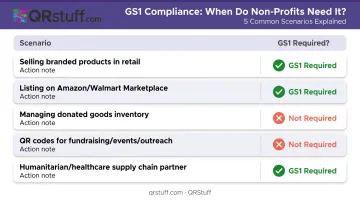
| Scenario | GS1 Required? |
|---|---|
| Selling branded products in retail | Yes — obtain GTIN |
| Listing products on Amazon or Walmart Marketplace | Yes — platforms validate against GS1 |
| Managing donated goods inventory | No — scan existing barcodes |
| QR codes for fundraising, events, outreach | No — standard QR codes sufficient |
| Humanitarian/healthcare supply chain partner | Likely not required — review partner requirements |
When GS1 Standards Do Matter for Non-Profits
Food Banks and Food Distribution
Food banks often sit alongside GS1-compliant distributors and retailers in the same supply chain. Understanding GS1's GTIN-plus-batch/lot identification system helps these organizations manage expiry-sensitive inventory, respond to product recalls, and meet FDA Food Safety Modernization Act (FSMA) traceability requirements for foods on the Food Traceability List.
No GS1 membership is required — but understanding how GTINs and batch codes work improves safety and recall readiness significantly.
Healthcare and Humanitarian NGOs
Organizations distributing prescription medicines in the US encounter the Drug Supply Chain Security Act (DSCSA), which requires a standardized product identifier — including serial number, lot number, and expiry date — encoded in a 2D data matrix barcode on each package. GS1 DataMatrix is the standard implementation format used across pharmaceutical supply chains.
NGOs classified as covered trading partners under DSCSA need GS1-compliant serialization. This includes:
- Manufacturers
- Repackagers
- Wholesale distributors
- Dispensers
Organizations further downstream — distributing pre-packaged, already-labeled medicines — should understand the standard without necessarily generating their own identifiers.
Non-Profits with Retail Operations
Goodwill-model thrift stores, non-profit pharmacies, or social enterprises selling through Amazon or Walmart Marketplace need to take GTIN requirements seriously. Both platforms verify product identifiers against the GS1 database. Products with UPCs that don't match GS1 records will be flagged as invalid — meaning the product can't be listed until the issue is resolved.
GTIN exemptions exist on these platforms, but non-profits must request them individually by product category. Brands that GS1 identifies as having GS1 barcodes are not eligible for exemptions.
High-Impact QR Code Applications for Non-Profits (Beyond GS1)
This is where virtually every non-profit, regardless of supply chain involvement, can get practical value.
Fundraising and Donation Campaigns
QR codes on mailers, posters, and event signage create a direct path from printed material to donation page. The key advantage isn't the QR code itself — it's using a dynamic QR code, which allows the destination URL to be updated at any time without reprinting.
M+R Benchmarks 2026 reports that average non-profit online revenue increased 15% in 2025, with one-time giving up 17%. Printed materials with QR codes that link directly to donation pages can feed that momentum — but only if the code still works when someone picks up a mailer six months after it was printed.
QRStuff's dynamic QR codes allow destination URL changes at any time. If a fundraising platform changes, a campaign ends, or a donation page moves, the printed code keeps working with the updated destination.
Event Management and Volunteer Check-In
QR codes on tickets, badges, and wristbands speed up check-in dramatically. QRStuff supports dedicated attendance codes linked to Google Sheets for automatic data collection, as well as Eventbrite integration for event registration and ticketing.
For volunteers specifically: QR codes on briefing packs can link to shift schedules, digital waivers, or onboarding videos — all updatable without reprinting if logistics change.
Asset and Inventory Tracking
Non-profits managing physical assets (AV equipment, vehicles, office supplies, medical devices) can use dynamic QR codes as asset labels. Each code links to a URL with the asset's maintenance history, ownership record, or check-out log. When records update, the destination updates — the physical label stays the same.
Getting started requires no GS1 compliance and no barcoding expertise:
- Works for any asset count, from a dozen items to several hundred
- QRStuff's Full Suite supports 250 dynamic codes
- Enterprise handles unlimited codes with bulk generation
Donor Engagement and Transparency
Charity Navigator research found 79.8% of surveyed donors preferred a charity with strong accountability and transparency ratings. And Independent Sector reported in 2025 that 57% of Americans have high trust in non-profits — a number worth protecting.
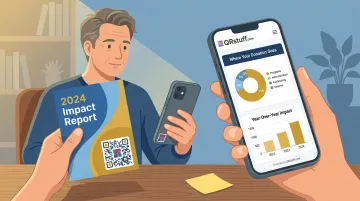
QR codes on annual reports, impact statements, and direct mail can link to financial transparency pages, program dashboards, or video updates from the field. The underlying logic mirrors what GS1 does for consumer products: connect a physical touchpoint to richer digital information, applied here to donor relationships rather than retail shelves.
Community Outreach and Program Delivery
QR codes on community flyers, resource packets, and bulletin boards can link to multilingual content, service locators, eligibility checkers, or appointment booking tools. The CDC's Clear Communication Index recommends pairing every QR code with a direct call to action. A label like "Scan to find services near you" removes friction for community members who may be less familiar with scanning behavior.
How to Get Started with QR Codes at Your Non-Profit
Choose the Right QR Code Type
| Type | Best For | Limitation |
|---|---|---|
| Static | One-time use (single event, fixed URL) | Cannot be edited; no analytics |
| Dynamic | Ongoing campaigns, printed collateral, asset tags | Requires active subscription |
For most non-profit applications — fundraising mailers, event signage, asset labels — dynamic codes deliver better return on the printing investment.
Select a Platform with the Right Analytics
Non-profits need to demonstrate impact. QRStuff's dynamic QR codes provide:
- Geographic data — country and city-level scan location
- Device breakdowns — iOS vs. Android, mobile vs. desktop
- Time-based data — scan volume by day, week, or custom date range
- Unique vs. total scans — distinguishes new audience reach from repeat engagement
- Exportable reports — CSV downloads and PDF summaries for board presentations
The Full Suite (£15/month, with QRStuff's non-profit discount applied proportionally) supports 250 dynamic codes with unlimited monthly scans — enough capacity for most small-to-medium non-profits running several campaigns at once. QRStuff offers a doubled subscription period for qualifying 501(c)(3) organizations; contact support@qrstuff.com after setting up an account to request it.
Design and Deploy Effectively
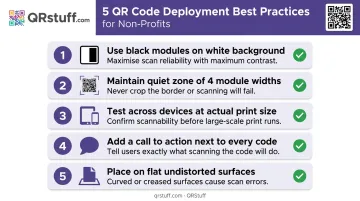
Once your platform is set up, follow these rules before committing to a print run:
- Use black modules on a white background — highest contrast for reliable scanning
- Maintain a quiet zone of at least 4 module widths on all sides
- Test across multiple devices and at the actual print size before committing to a print run
- Add a brief call to action next to every code ("Scan to donate," "Scan to register")
- Place codes on flat surfaces — avoid folds, edges, or surfaces that distort the code geometry
Frequently Asked Questions
Are QR codes GS1 compliant?
Not automatically. A standard QR code encodes any URL or text. A GS1 QR code encodes a GS1 Digital Link URI containing structured product identifiers organized under GS1's Application Identifier system. Compliance is determined by the data structure inside the code, not the QR format itself.
What is the GS1-128 standard?
GS1-128 is a 1D linear barcode (a subset of Code 128) that encodes GS1 Application Identifiers such as GTINs, lot numbers, expiration dates, and serial numbers in a single barcode. It's common on shipping labels and healthcare packaging — distinct from QR codes, which are 2D.
What is the ISO standard for QR codes?
ISO/IEC 18004:2015 defines the QR code symbology specification, covering structure, encoding modes, and error correction. The standard is maintained by ISO/IEC JTC 1/SC 31, the committee overseeing automatic identification and data capture. GS1 participates in that committee, and ANSI serves as its secretariat.
Do non-profit organizations need GS1 membership?
Generally, no. GS1 membership is relevant when a non-profit manufactures or sells products through retail channels requiring GTINs, or operates within a regulated supply chain (such as pharmaceuticals under DSCSA). Non-profits using QR codes for communications, fundraising, and program delivery don't need it.
Can non-profits use QR codes for fundraising and donations?
Yes. QR codes on mailers, event signage, and merchandise provide a direct path to donation pages. Dynamic QR codes are worth considering: the destination URL can change without reprinting, and scan analytics show funders exactly how much reach your printed materials generated.
What is the difference between a GS1 QR code and a regular QR code?
The difference is in what's encoded. A regular QR code links to any URL. A GS1 QR code encodes a structured GS1 Digital Link URI with standardized product identifiers that supply chain systems can interpret. For fundraising, events, and outreach, a regular QR code is entirely sufficient.