Against that backdrop, QR codes tend to get dismissed as a consumer marketing gimmick. That's the wrong frame. In clinical environments, a well-deployed QR code is an operational tool: it connects a physical surface—a wristband, a medication label, a discharge summary—to a live digital resource. No app, no manual lookup, no transcription step.
This article covers the practical, measurable impact of QR codes in healthcare settings—patient safety, administrative efficiency, and patient education—along with what happens when facilities skip them.
Key Takeaways
- QR codes bridge physical materials and digital systems with a single scan—no dedicated hardware needed
- Dynamic QR codes update their destination in real time—no reprinting required when protocols change
- Scan-based verification reduces medication administration errors and supports Joint Commission patient identification requirements
- Administrative tasks like intake, scheduling, and feedback collection move from paper to digital without workflow disruption
- Deployment with scan analytics transforms QR codes into a measurable, repeatable operational tool
What Are QR Codes in Healthcare?
A QR code is a scannable 2D code that connects any physical surface to a specific digital resource—readable by any smartphone camera, no dedicated scanner needed.
In healthcare, that surface can be almost anything:
- Patient wristbands — linking to live EHR records or current medication lists
- Medication packaging — linking to dosage instructions, video guides, or authenticity verification
- Discharge paperwork — linking to PDF care plans, follow-up booking, or post-visit instructions
- Waiting room signage — linking to intake forms, feedback surveys, or wayfinding
- Medical equipment — linking to usage guides or maintenance logs
What makes all of those use cases practical is the choice between static and dynamic QR codes. Static codes embed a fixed URL directly in the code—change the destination, and you need to print a new code. Dynamic codes use a redirect layer, so the destination updates at any time without touching the physical code. For healthcare, that distinction has real consequences: a wristband printed at admission can keep pointing to a patient's current records throughout their entire stay.
That flexibility is what separates QR codes from static signage or printed handouts—and it's why healthcare facilities are deploying them across patient-facing and operational workflows alike.
Key Advantages of QR Codes in Healthcare
The advantages below are grounded in operational outcomes—the metrics healthcare administrators actually track: error rates, admin time, patient compliance, and cost per encounter. They compound when QR codes are applied consistently across departments rather than tested in isolation.
Patient Safety and Medication Error Reduction
Medication errors are among the most preventable adverse events in healthcare—and among the most expensive. AHRQ estimates measurable medical errors cost $17.1 billion annually in hospitalized patients alone.
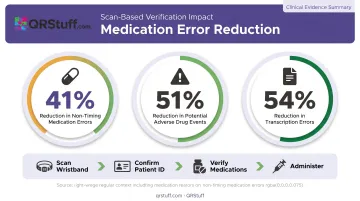
A foundational NEJM study on scan-based medication administration found that barcode verification reduced non-timing medication errors by 41%, potential adverse drug events by 51%, and transcription errors by 54%. QR codes extend this same verification principle—with the added advantage that they don't require a dedicated scanner.
How it works in practice: A QR code on a patient wristband links to their live EHR record. A nurse scans the wristband at medication administration, confirms the patient's current medications, allergies, and dosage, and proceeds—all without verbal confirmation or manual chart lookup.
With dynamic QR codes, that record updates in real time as the patient's condition changes, without generating or reprinting a new wristband.
The Joint Commission's National Patient Safety Goals require at least two patient identifiers before providing care. QR-linked wristbands support this requirement while removing the manual steps that create error exposure during shift changes.
KPIs affected:
- Medication error rates
- Adverse drug event frequency
- Patient safety scores
- Compliance audit outcomes
The impact is most pronounced in ICUs, emergency departments, and surgical wards, where multiple providers interact with the same patient across shifts.
Operational Efficiency and Administrative Cost Reduction
Administrative spending accounts for 15–30% of US healthcare spending. Physicians spend 9 of their 15.5 weekly admin hours specifically on EHR documentation—roughly 58 hours a month pulled away from direct care.
QR codes convert paper-based touchpoints into self-service digital workflows:
- Patients scan a code at check-in and complete digital intake forms on their phone
- Appointment reminders link directly to scheduling or rescheduling systems
- Discharge instructions open as PDFs patients can access at home
- Post-visit feedback is collected automatically, no paper forms required
Each eliminated manual step reduces labor time and data entry error risk. At scale—across a multi-location practice or high-volume outpatient facility—this frees clinical and administrative staff for direct care rather than transcription.
Platforms like QRStuff support bulk QR code generation across departments simultaneously. The Enterprise tier allows generating codes for patient intake stations, individual rooms, and equipment tracking in a single batch, processing 500+ codes in one session without requiring a separate workflow per location.
KPIs affected:
- Time per patient encounter
- Staff hours on administrative tasks
- Data entry error rates
- Cost per intake
Patient Education, Engagement, and Health Literacy
According to KFF, just over half of US adults turn to social media for health information. When patients can't easily access provider-approved guidance after leaving a clinical setting, they fill the gap elsewhere—often with unreliable sources.
A widely cited adherence study found that 33–69% of medication-related hospitalizations were attributable to non-adherence. QR codes on discharge materials give patients immediate access to the verified instructions most likely to change that outcome.
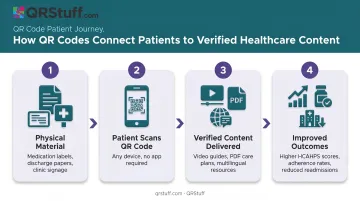
QR codes on prescription packaging, discharge summaries, and clinic signage put verified content directly in patients' hands:
- A code on a medication label opens a short video explaining dosage and side effects
- A code on a discharge summary links to a PDF care plan the patient can reference at home
- A code in the waiting room links to multilingual educational materials
With dynamic QR codes, that content can be updated without reprinting the physical materials—essential when protocols change or seasonal guidance needs updating.
KPIs affected:
- HCAHPS scores (Discharge Information, Communication about Medicines)
- Medication adherence rates
- 30-day readmission rates
- Patient feedback response rates
The impact is most significant for patients managing complex self-care regimens—chronic condition patients, elderly patients on multiple medications, and multilingual populations where a single printed handout rarely covers the full range of need.
What Happens When QR Codes Are Missing or Ignored
Healthcare facilities running on paper-only processes pay a measurable price—across patient safety, staff workload, and retention.
- Without scan-based verification, providers fall back on verbal handoffs and manual chart review during shift changes—the conditions that produce wrong-patient and wrong-dose events.
- Paper-based intake generates transcription errors downstream, creating compliance risk and slowing patient throughput.
- Patients discharged without accessible instructions are more likely to misuse medications, miss follow-ups, and return with preventable complications—directly affecting 30-day readmission rates tied to CMS reimbursement.
- 43.2% of physicians reported at least one burnout symptom in 2024, and 22.5% logged more than 8 after-hours weekday hours on EHR work. Workflows that add manual steps instead of removing them make this worse.
- Accenture research found that 78% of patients who switched providers cited poor administrative experiences or inadequate digital solutions. Digital convenience is now a retention factor, not a bonus.
How to Get the Most Value from QR Codes in Healthcare
QR codes deliver compounding value when they're part of a deliberate system, not scattered across departments as one-off additions to printed materials.
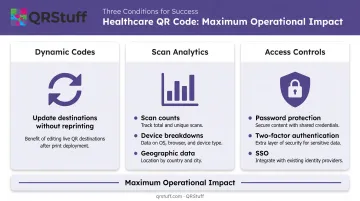
Three conditions for maximum impact:
1. Use dynamic codes, not static ones. Dynamic codes allow destination updates without reprinting. A medication label, wristband, or discharge handout printed months ago can still point to current information. For healthcare environments where protocols change frequently, static codes create a maintenance burden that dynamic codes eliminate entirely.
2. Track outcomes through scan analytics. Without data, QR codes are invisible. Knowing which codes are scanned, when, at what volume, and on which devices tells administrators where information is actually reaching patients, and where gaps remain. QRStuff's analytics platform surfaces real-time scan counts, device breakdowns, and geographic data — giving administrators the reporting they need to identify where outreach is working and where it isn't.
3. Apply access controls where content is sensitive. Not every QR code needs a password, but codes linking to PHI-adjacent resources — patient portals, clinical protocols, staff resources — should be secured. Password-protected QR codes restrict access per code, and combined with two-factor authentication and SSO at the platform level, they meet the layered security requirements of regulated healthcare settings.
For organizations deploying at scale, QRStuff's API supports programmatic QR code generation. That means auto-generating a unique dynamic code for each new patient admission without manual steps.
The platform holds GDPR and SOC2 compliance certifications. For HIPAA-regulated workflows, compliance also depends on the destination systems and endpoints — not just the QR code generator itself.
Conclusion
QR codes aren't a novelty in healthcare—they're infrastructure. Their value shows up in specific, measurable places: fewer medication errors when wristband verification replaces verbal handoffs, less administrative time when patients complete intake digitally, better follow-through when discharge instructions are a scan away rather than a paper handout that gets lost.
The impact compounds over time when codes are dynamic, tracked, and kept current. The difference between a one-time deployment and a functioning system comes down to three things:
- Active management: updating codes as protocols, medications, and patient resources change
- Scan analytics: monitoring which codes get used, by whom, and when — so gaps become visible
- Governance: assigning ownership so no code goes stale or points to outdated information
The technology is low-cost. The operational discipline around it is what makes it worth deploying in the first place.
Frequently Asked Questions
What does QR mean in a hospital?
QR stands for "Quick Response." In hospitals, QR codes give staff and patients instant access to digital resources—medical records, medication details, discharge instructions, equipment guides—by scanning a code with any smartphone camera. No dedicated hardware or app is required.
What's replacing QR codes?
No single technology is replacing QR codes at scale. NFC tags offer an alternative for short-range, tap-based interactions, but QR codes remain dominant in healthcare because they work with any smartphone camera, cost nothing to deploy on printed materials, and don't require the reader to have NFC hardware.
Are QR codes HIPAA compliant in healthcare settings?
QR codes are access mechanisms, not compliance frameworks. HIPAA compliance depends entirely on what the code links to and how that destination is secured. Any code pointing to PHI must use encrypted, access-controlled endpoints — destination-level security is what regulators evaluate, not the QR generator itself.
How are QR codes used for patient identification?
QR codes on patient wristbands link to EHR records, allowing nurses and providers to confirm patient identity, current medications, and treatment plans with a single scan. This supports the Joint Commission's two-identifier requirement and reduces wrong-patient errors during medication administration and procedures.
What are the security risks of QR codes in healthcare?
The primary risk is QR code spoofing, where malicious codes redirect users to fraudulent sites to harvest credentials. HHS HC3 has formally identified this as a threat to the healthcare sector. Mitigation involves using codes from trusted platforms, applying password protection to sensitive resources, and training patients to verify URLs before entering any information.
Can QR codes replace traditional barcodes on patient wristbands?
Yes, with meaningful advantages. QR codes store far more data than 1D barcodes, scan from any angle without a dedicated reader, and when dynamic, can link to records that update without reprinting. QRStuff supports GS1 Digital Link, the healthcare and pharmaceutical standard for encoding product identifiers, batch numbers, and expiry data in a single scannable code.