Introduction
Guerrilla marketing creates moments people remember — but memory fades. A clever street stunt might stop fifty people in their tracks, generate genuine excitement, and then disappear without a trace. No leads. No data. No way to know it worked.
QR codes fix that. They're the bridge between a physical moment and a measurable digital action, turning a fleeting encounter into a trackable brand interaction. Someone spots your mural, scans in five seconds, and lands on your campaign page — all while you capture the scan event, location, and device type in real time.
This post covers everything you need to run a guerrilla QR campaign that goes beyond buzz:
- Five creative tactics that actually stop people
- Real campaigns from brands that ran them successfully
- A step-by-step launch playbook
- Design, legal, and placement essentials
- How to measure ROI when your materials are already in the field
Whether you're a solo marketer on a tight budget or managing campaigns for an enterprise brand, every tactic here comes with a way to track whether it's working.
Key Takeaways
- QR codes turn one-time physical encounters into measurable digital engagements
- Dynamic QR codes let you update destinations mid-campaign without reprinting
- Brands like Klarna and Glossier show guerrilla QR placements can reliably bridge offline moments to online action
- Outdoor codes need at least 2×2 inches for close-up scanning, 6×6 inches or larger for distance reads
- Unique codes per placement reveal which locations drive the most scans
Why Guerrilla Marketing and QR Codes Are a Natural Fit
The Transience Problem
Guerrilla marketing's biggest weakness is time. A flash mob lasts four minutes. Street art gets photographed and forgotten. A pop-up installation draws a crowd that disperses in twenty minutes. The emotional impact is real — but without a mechanism to capture it, that energy evaporates.
QR codes solve this with almost no friction. A person who'd never fill out a form or remember a URL will scan a code in under five seconds. That single action bridges the physical moment and a digital experience, converting a passerby into a trackable lead, follower, or customer.
Measurability Changes Everything
Traditional guerrilla marketing has always been hard to justify in a budget meeting. You know the stunt was cool. You might have some photos. But concrete performance data? Rarely.
QR codes change the accountability equation entirely. Each scan generates a timestamp, location, device type, and unique user count — the kind of granular data that traditional stunts never produced. US smartphone users scanning QR codes were projected to grow from 83.4 million in 2022 to 99.5 million by 2025, according to Business Insider citing Insider Intelligence.
Platforms like QRStuff turn that raw data into actionable insight:
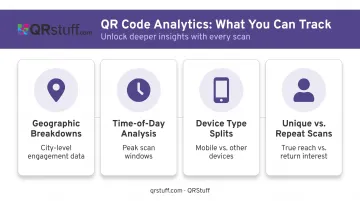
- Geographic breakdowns down to the city level, showing where engagement concentrated
- Time-of-day analysis to identify peak scan windows for future placements
- Device type splits revealing whether your audience skews mobile-first
- Unique vs. repeat scan counts to gauge true reach vs. return interest
That's what transforms guerrilla from a gut-feel tactic into an optimizable channel.
The Cost Angle
QR codes add zero marginal cost to physical materials. A sticker, mural, or coffee sleeve becomes significantly more valuable with a code printed on it — turning a one-time impression into an ongoing digital touchpoint. For guerrilla campaigns operating on lean budgets, that's a hard equation to argue with.
5 Creative Guerrilla QR Code Tactics That Stop People in Their Tracks
Interactive Street Art and Murals
Embedding a QR code into a mural or chalk installation transforms static art into a living campaign. The code can link to an AR experience, a behind-the-scenes video of the artist creating the piece, or an exclusive brand story that extends the visual narrative beyond the wall.
The key is integration — the code should feel like part of the artwork, not an afterthought. Custom-designed QR codes (with brand colors, shapes, and subtle logo elements) blend into creative installations far better than a generic black-and-white square bolted onto the corner.
Flash Mob Follow-Up Codes
Flash mobs create a peak emotional moment. The crowd disperses, the performance ends, and most brands are left with nothing but some shaky smartphone footage.
A smarter approach: have performers hand out cards, wear printed bibs, or hold up signs featuring a QR code in the final moments of the performance. That code captures the emotional high and redirects it — to a social community, a behind-the-scenes video, or a time-sensitive offer that expires in 24 hours.
Stealth Discovery Placements
High-dwell locations are underused. Bathroom mirrors, elevator panels, café napkin dispensers, bar coasters, and coffee sleeves all get sustained attention from exactly the audience you want to reach.
The discovery element matters. When someone finds a QR code somewhere unexpected and scans it out of curiosity, the reward feels earned. That emotional trigger — mild surprise followed by a payoff — is far more memorable than a conventional ad placement.
Placement formats that consistently outperform standard signage:
- Bar coasters and coffee sleeves linked to exclusive content or discounts
- Elevator panels in office buildings targeting commuter dwell time
- Café napkin dispensers with loyalty rewards or daily specials
- Restroom mirrors running ambient brand storytelling or product demos
QR Code Treasure Hunts
Gamification turns passive spectators into active participants. A series of QR codes placed across a neighborhood, campus, or event venue can guide participants through clues, with each scan revealing the next location and a final reward for completion.
Why this works:
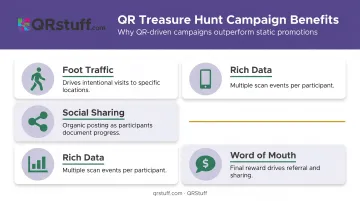
- Drives intentional foot traffic to specific locations
- Creates organic social sharing as participants post their progress
- Generates multiple scan events per participant, building richer data
- The reward at the end justifies the effort and drives word-of-mouth
Dynamic QR codes are the right choice for treasure hunts — if clues need updating, a destination URL changes, or you want to extend the hunt, you can make those changes without touching a single piece of physical material.
Pop-Up Activation Codes
Temporary brand installations and surprise activations are perfect QR code environments. Attendees are already engaged and curious — a QR code on signage, product packaging, or a staff member's lanyard captures that engagement before they walk away.
These codes can drive app downloads, collect emails for a loyalty program, or invite people into an exclusive community. The in-person energy does the hard conversion work; the QR code just captures it.
Real-World Campaigns That Got It Right
Klarna's Interactive Murals (UK, 2021)
Klarna placed murals across London, Manchester, Birmingham, and Liverpool, with each one embedding a QR code that directed people to an online gallery and interactive myth-busting game. The campaign also included chalk stencils and a Waterloo station domination.
According to The Drum's awards case study, the campaign drove over 160,000 visits to the online gallery, with 45,000 people completing the brand myth challenge. Brand trust increased significantly per Brand Vue FS tracking.
What made it work: the murals were visually compelling enough to earn attention independently, and the QR code unlocked a genuinely interactive experience rather than just a product page.
Rémy Martin's Mixtape Street Art Museum (2023)
To celebrate hip-hop's 50th anniversary, Rémy Martin placed QR-embedded murals in New York, Los Angeles, Chicago, Atlanta, and San Francisco. Each code connected passersby to stories about featured DJs and offered entry to Rémy Martin Mixtape celebration events.
The campaign nailed the hardest part of QR-led guerrilla marketing: matching the digital destination to the cultural weight of the physical installation. The murals celebrated an authentic cultural moment; the QR experience extended that story rather than pivoting to a sales pitch.
Glossier and Shop's Shoppable Treasure Hunt (2024)
Glossier and Shopify placed shoppable posters across New York, Los Angeles, and Chicago to promote the Boy Brow Arch launch. Fans who found posters could scan a QR code and access early purchase through Glossier's store inside Shopify's Shop app — turning a street-level discovery into a direct purchase opportunity.
The mechanic rewarded effort with genuine exclusivity: early access that wasn't available through normal channels.
Transferable Lessons
Each of these campaigns succeeded for different reasons, but three principles run through all of them:
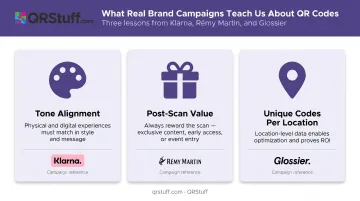
- Tone alignment between physical and digital. Klarna's playful myth game matched the murals' irreverent visual style. A mismatch kills post-scan engagement.
- Post-scan value, every time. Exclusive content, early access, event entry — not a homepage.
- Unique codes per location. You can't optimize what you can't measure. Location-level data tells you which placements earn their keep.
How to Launch a Guerrilla QR Code Campaign: A Step-by-Step Playbook
Step 1 — Define your goal and match it to a QR code type. The desired action should drive the code type you select. App downloads, social follows, lead capture, and landing page traffic all call for different destinations. QRStuff supports 40+ data types — URL, social media, vCard, app download links, coupon codes — so the goal-to-code match is straightforward.
Step 2 — Choose your guerrilla environment and audience touchpoints. Identify where your target audience naturally lingers. High-foot-traffic areas work for reach; high-dwell locations (café seating, transit platforms, gym locker rooms) work for engagement. Map out exact placement points before production.
Step 3 — Design the code for the guerrilla context. Outdoor and unexpected placements have specific requirements:
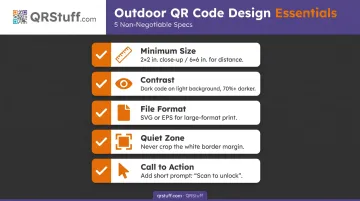
- Minimum size: 2×2 inches for close-up scanning (stickers, sleeves); 6×6 inches or larger for distance viewing (murals, banners)
- Contrast: Dark code on light background; dots at least 70% darker than the background
- File format: SVG or EPS for large-format printing to prevent pixelation
- Quiet zone: Never crop the white border — scanners need it to detect the code boundary
- Call-to-action: Add a short line near the code ("Scan to unlock") — guerrilla encounters happen fast and people may hesitate without a prompt
QRStuff's custom design options (colors, shapes, logo embedding) let codes blend into creative installations while remaining fully on-brand.
Step 4 — Build a compelling post-scan experience. The landing page must immediately justify the scan. Think exclusive offers, behind-the-scenes video, or a gamified challenge: something that rewards the curiosity it took to pull out a phone. The page must be mobile-optimized and fast-loading; guerrilla locations often have variable signal.
Step 5 — Use dynamic QR codes so you can adapt mid-campaign. Once materials are printed and placed, static codes lock you in. Dynamic codes — available on QRStuff's paid plans — let you update the destination URL at any time without reprinting. If a landing page changes, a product goes live early, or you want to A/B test two destinations, dynamic codes let you adapt without reprinting.
Design, Placement, and Legal Considerations
Design and Placement Best Practices
- Test scanning in multiple lighting conditions before deployment (bright sun, low light, indoors)
- Place codes on flat, non-reflective surfaces at eye level — folds and curved surfaces distort the pattern
- Use weatherproof materials for outdoor placements that need to survive rain, UV, or heavy foot traffic
- Time deployment to coincide with peak audience activity at each location
- Generate a unique code per location (or append unique UTM parameters) for location-level tracking
Getting placement right physically is only half the equation. The legal side can shut a campaign down entirely — or worse.
The Legal Reality
Turner Broadcasting paid $2 million after its guerrilla campaign for Aqua Teen Hunger Force — placing blinking electronic signs around Boston — triggered a bomb scare and a city-wide emergency response. That single unauthorized deployment cost more than most annual marketing budgets.
Key rules vary by city but follow a consistent pattern:
- New York City: NYC Administrative Code Section 10-119 prohibits posting on public property including lamp posts, bus shelters, hydrants, and trees
- Los Angeles: LAMC Section 28.04 bans affixing signs to sidewalks, street posts, hydrants, and utility poles
- Chicago: Municipal Code Section 10-8-320 prohibits commercial advertising matter on public property
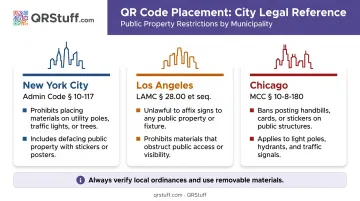
Before any deployment:
- Research local ordinances for every city on your list
- Prefer removable materials — chalk or adhesive stickers placed on property you own
- Partner with local businesses to place codes on private property with explicit consent
- Apply for permits; most cities offer them for temporary installations
Measuring the Impact of Your Guerrilla QR Code Campaign
Metrics That Matter
| Metric | What It Tells You |
|---|---|
| Total scans | Overall reach and awareness |
| Unique scans | Distinct individuals engaged (not inflated by repeat scans) |
| Scan-to-conversion rate | How well the post-scan experience converts |
| Geographic distribution | Which locations drove the most engagement |
| Time-of-day peaks | When your audience is most active at each placement |
| Device type breakdown | Informs mobile UX and landing page optimization |
Real-Time Optimisation
The data advantage of QR codes isn't just post-campaign — it's during the campaign. If one location generates significantly more scans than another in the first 48 hours, you can redirect budget and future activations accordingly.
QRStuff's analytics dashboard populates in real time as scans occur, with geographic data at the city level, time-based breakdowns, and device splits. For marketers managing multiple simultaneous placements, that granularity makes the difference between guessing and knowing.
Connecting Scans to Business Outcomes
Raw scan volume tells you how many people pointed their camera — nothing more. The useful question is: what did those scans actually produce?
UTM parameters appended to destination URLs (supported natively in QRStuff) connect scan data to Google Analytics behavior — bounce rate, pages per session, goal completions, conversions. That chain of attribution (physical placement → scan → landing page → conversion) is what turns a guerrilla campaign into a measurable, ROI-positive channel.
Where that chain breaks down is equally revealing. High drop-off on the landing page despite strong scan volume usually signals a mismatch between the stunt's tone and the post-scan experience. That's a fixable problem, but only if you have the data to see it.
Frequently Asked Questions
Are QR codes effective for marketing?
Yes. QR codes bridge offline and online experiences with minimal friction, and the audience is already there — US QR scanner usage was projected to reach 99.5 million by 2025. In guerrilla contexts specifically, they solve the longstanding problem of physical impact with no measurable follow-through.
What makes a guerrilla marketing QR code campaign go viral?
Virality comes from the post-scan experience being genuinely worth sharing — not just the stunt. Exclusive content, a gamified challenge, or an early-access reward gives people something to post about. Building a campaign hashtag and social sharing prompt directly into the landing page amplifies organic reach.
What size should a QR code be for outdoor guerrilla placements?
At least 2×2 inches for close-up placements like stickers or coffee sleeves. Codes viewed from a distance — murals, banners, signage — should be 6×6 inches or larger. Always test scanning from the expected viewing distance before deployment, and print in SVG or EPS format for large-scale applications.
How do I track which guerrilla QR code locations are performing best?
Generate a unique QR code for each location, or append unique UTM parameters to each placement's destination URL. Analytics then show exactly which locations drive the most engagement, enabling real-time optimization of active campaigns.
Do I need permits to run a QR code guerrilla campaign in public spaces?
Regulations vary by city. Affixing materials to public property — lamp posts, walls, sidewalks — typically requires a permit in most US cities. Placements on private property with owner consent are generally fine without one. Always verify local ordinances first and use removable materials to reduce legal exposure.
What's the difference between static and dynamic QR codes for guerrilla marketing?
Static codes have a fixed destination that cannot be changed after creation and provide no analytics. Dynamic codes let you update the destination URL at any time without reprinting — critical when materials are already deployed in the field. For campaigns where messaging may shift mid-run, dynamic codes are worth the investment.