Introduction
Print and digital marketing rarely talk to each other. A flyer goes out, a billboard goes up, a product ships — and that's where the brand interaction ends. No click, no conversion, no data. QR codes change that equation with a single scan.
When used strategically, QR codes turn static materials into live touchpoints — bridging physical campaigns to digital experiences without friction. U.S. smartphone users scanning QR codes were forecast to reach 99.5 million by 2025, up from 83.4 million in 2022, confirming QR scanning is now a mainstream consumer habit — and a real marketing channel worth optimizing.
This guide covers the QR code marketing strategies that actually drive engagement — from product packaging and event promotion to post-purchase feedback — plus design rules, the dynamic vs. static debate, and how to use scan analytics to improve campaigns over time.
Key Takeaways
- QR codes connect physical touchpoints to digital experiences, reducing friction in the customer journey
- Placement and a clear call-to-action determine whether a code gets scanned or ignored
- Scan analytics track device type, location, and scan time — so you can refine what's working and cut what isn't
- Dynamic QR codes let you update destinations and run A/B tests without reprinting
- A single QR code can drive sales, collect feedback, grow social audiences, or reward loyalty — often all at once
What Is QR Code Marketing?
QR code marketing is the deliberate use of scannable codes across physical and digital touchpoints to connect audiences with online content, promotions, or experiences. Placement alone isn't a strategy. What makes it one is knowing what the code links to, where it lives, and what action you want someone to take after scanning.
How QR Codes Work
A smartphone camera reads the code's encoded pattern and instantly redirects the user to a URL, form, video, vCard, or other content type. No app required. iOS has supported native QR scanning since iOS 11, and Android devices handle it through the built-in camera app. Point, scan, done. That simplicity is what makes QR codes effective as marketing connectors.
A MobileIron survey of 2,100+ U.S. and U.K. consumers found 84% had scanned a QR code, and 32% had done so within the past week. Customers already know how to use them. Your job is simply to give them a reason to.
5 High-Impact QR Code Marketing Strategies to Boost Engagement
QR codes perform in proportion to the strategy behind them. Placement, destination, and audience context all determine whether a scan becomes a conversion. Here are five approaches that consistently deliver results.
Product Packaging and In-Store Experiences
Packaging is one of the most underused marketing surfaces a brand has. A QR code on a label, box insert, or shelf tag turns a one-time purchase into an ongoing interaction.
Practical destinations by category:
- Food and beverage brands — nutritional detail pages, recipe collections, ingredient sourcing stories (the SmartLabel format is built for exactly this)
- Retail and fashion — style guides, complementary product recommendations, size and care instructions
- Consumer goods — sustainability certifications, warranty registration, how-to video libraries
Campbell's ran a campaign where QR codes on soup cans linked to artist playlists, recipes, and behind-the-scenes content in partnership with Universal Music Group. That's a tangible example of packaging doing more than just holding product.
For brands with retail distribution, QRStuff supports GS1 Digital Link QR codes — encoding a product's GTIN in a format that's scannable at POS checkouts (Sunrise 2027 compliant) while simultaneously linking consumers to product pages, sustainability data, and more from a single code.
Event Promotion and Ticketing
Event marketers deal with a familiar problem: attendees lose paper programmes, miss sign-up deadlines, and queue at check-in. QR codes solve several of these at once.
Use cases across the event lifecycle:
- Pre-event — codes on posters, flyers, and social graphics linking directly to registration pages, removing the friction of typing a URL
- At the door — embedded QR codes in confirmation emails for hands-free check-in (both Cvent and Eventbrite include this natively in their platforms)
- During the event — exclusive content unlocks for attendees who scan, creating a two-stage engagement loop before and during
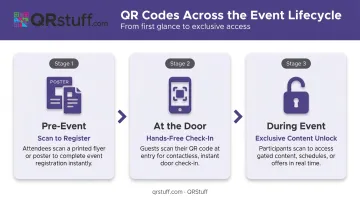
Scan-to-unlock content works especially well for trade shows and branded activations where standing out on the floor actually matters.
Discounts, Coupons, and Loyalty Programs
QR codes make redemption frictionless and attribution precise. Instead of asking customers to type a promo code, a scan delivers the offer instantly — on a receipt, a direct mail piece, or in-store signage.
What makes this approach valuable for marketers isn't just convenience. It's trackability. When you generate unique QR codes per campaign or customer segment, you can attribute redemptions precisely — knowing whether a coupon was redeemed via the direct mail drop, the in-store shelf talker, or the product insert.
QRStuff supports bulk QR code generation and campaign tagging, so running simultaneous variations across channels and comparing their performance is manageable at scale.
Social Media Growth and Audience Building
Every business card, trade show stand, storefront window, and branded package is a potential follower acquisition point — if there's a QR code on it.
Two formats cover most use cases here:
- Direct profile codes link to a specific social platform without requiring anyone to search for you. QRStuff supports dedicated generators for Instagram, Facebook, LinkedIn, TikTok, YouTube, Twitter/X, Snapchat, and others.
- Multi-link landing pages (QRStuff's Social Link Pages) consolidate everything into one scannable destination: your Instagram, newsletter signup, website, and latest promotion. Useful on business cards and merchandise where space is limited.
This also works in reverse: placing QR codes in video content, email signatures, and presentations pulls audiences from one channel into the broader digital ecosystem.
Customer Feedback and Post-Purchase Engagement
Getting customers to leave a review or complete a survey is a volume problem. Most brands lose the majority of post-purchase moments because the path to leaving feedback has too many steps.
A QR code on a receipt, packaging insert, or follow-up mailer removes that friction entirely. It links directly to a review platform, NPS survey, or feedback form with no searching required.
The retention angle here is underused. The landing page a feedback QR links to doesn't have to be just a survey — it can be a thank-you page with a next-purchase discount, combining response collection with re-engagement in the same interaction. Platforms like SurveyMonkey and Qualtrics both support QR-based survey distribution, making setup straightforward.
QR Code Design Best Practices That Drive More Scans
A well-placed code that fails to scan is worse than no code at all — it creates friction right when you need a frictionless experience. These rules separate codes that perform from ones that get ignored.
Size, Contrast, and Scannability
Minimum print size: Nielsen Norman Group recommends at least 2 cm × 2 cm (approximately 0.8" × 0.8") for standard print materials. For larger formats — billboards, banners, window graphics — scale proportionally so the code can be read from the expected viewing distance.
Contrast is non-negotiable. Dark pattern on a light background is the standard for a reason. Best practice calls for dots at least 70% darker than the background. Inverted codes (light pattern on dark background) create compatibility issues across device and scanner types — NN/g advises against them for the same reason.
Branding Without Breaking Functionality
Custom colours, logos, and shapes can strengthen brand recognition on printed materials. Over-customisation, though, reduces scan reliability — especially on older devices.
Practical rules to follow:
- Keep embedded logos below 20% of the QR code area (15% is the safer target)
- Use higher error correction levels (Q or H) when adding logos or custom elements — QR codes support error correction at L (7%), M (15%), Q (25%), and H (30%) restoration capacity
- Maintain the quiet zone — a blank margin of at least 4 modules wide on all sides — so scanners correctly detect code boundaries
- Test custom-branded codes across multiple device types before committing to print
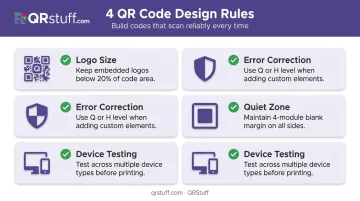
QRStuff's platform handles logo placement automatically when uploaded through the dashboard, positioning it at an optimal size and location to maintain scan reliability.
Always Pair QR Codes with a Clear Call-to-Action
A QR code without context is just a pattern. Always include a short, benefit-driven CTA that tells users exactly what they'll get:
- "Scan to unlock 20% off your next order"
- "Scan to watch the how-to video"
- "Scan to register in 30 seconds"
The landing page must be mobile-optimised, load fast, and deliver exactly what the CTA promised. A mismatch between promise and destination kills trust immediately.
Test before deploying. Test across iOS and Android devices at actual print size, in varying lighting conditions, and from multiple angles before any materials go live.
Dynamic vs. Static QR Codes: Which Should Marketers Use?
Static QR codes encode the destination directly into the pattern — once printed, that destination cannot be changed.
Dynamic QR codes store a short redirect URL. The printed code never changes, but you can update where it points from a dashboard at any time, as many times as needed.
For marketing, the choice is almost always dynamic. Here's why:
| Feature | Static | Dynamic |
|---|---|---|
| Update destination after printing | ✗ | ✓ |
| Scan analytics | ✗ | ✓ |
| A/B test landing pages | ✗ | ✓ |
| Extend campaign lifespan | ✗ | ✓ |
| Redirect expired promotions | ✗ | ✓ |
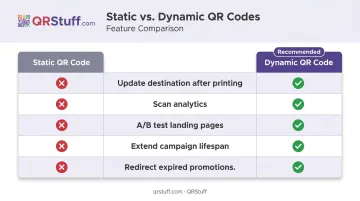
With dynamic codes, a seasonal campaign poster doesn't become dead inventory when the promotion ends — you redirect it to your next offer. An expired product page link gets fixed without pulling materials from shelves.
QRStuff's dynamic QR codes support real-time URL editing from the dashboard, with changes taking effect immediately. Paid plans include no-expiry codes, scan analytics, and access to 40+ QR code types — covering everything from URLs and vCards to payment links and GS1 Digital Link.
How to Track and Optimize Your QR Code Campaigns
Running a campaign without scan data is running on instinct. Analytics are what separate one-off QR code experiments from campaigns you can actually improve.
Key Metrics to Monitor
QRStuff's analytics dashboard tracks:
- Total scans — overall campaign reach
- Unique scans — distinct individuals engaging, separated from repeat visits
- Device type — iOS vs. Android, mobile vs. desktop
- Geographic data — country and city level, useful for regional campaign planning
- Time-based data — scans by hour and day of week
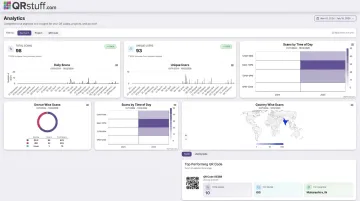
That last point is frequently overlooked. If your direct mail campaign generates the most scans on Thursday evenings, that's a timing signal you can act on for the next distribution cycle.
Using Data to Iterate and Improve
The most underused QR tactic in print marketing is A/B testing. Create two dynamic QR codes pointing to different versions of a landing page — different headline, different offer, different layout — then track which drives higher post-scan conversions.
QRStuff supports this natively. Each dynamic code tracks independently, and the platform's UTM parameter support means you can push scan data directly into Google Analytics or Adobe Analytics for downstream behavior analysis. That includes bounce rate, pages per session, and goal completions, without relying solely on the QR dashboard.
For multi-channel campaigns, QRStuff's campaign tagging functionality lets you organize codes by campaign, channel, or audience segment and compare performance side by side. All tracking is handled natively within the dashboard, with CSV export available for deeper analysis in external BI tools. No third-party setup required to get started.
Frequently Asked Questions
What is QR code marketing?
QR code marketing is the practice of embedding scannable QR codes into physical or digital materials to connect audiences with digital content instantly via smartphone. Destinations include websites, promotions, videos, and forms. The goal is to remove friction between exposure and action — converting static materials into direct engagement.
What types of QR codes work best for marketing campaigns?
Dynamic QR codes are the stronger choice for most marketing applications. They allow destination updates without reprinting, support scan tracking and A/B testing, and can serve multiple content types (URLs, vCards, forms, social profiles) depending on campaign goals.
How do I get people to actually scan my QR codes?
Three factors drive scan rates: visible placement in high-dwell locations, a clear CTA that states the benefit of scanning, and a destination that delivers genuine value. Drop any one of them and scan rates suffer.
What should my QR code link to for maximum engagement?
The best destination depends on your goal : product info pages, discount landing pages, video content, feedback forms, and social profiles all work well. Whatever the destination, it must be mobile-optimized, load quickly, and match exactly what the CTA promised.
How do I track QR code campaign performance?
Dynamic QR code platforms like QRStuff provide built-in analytics dashboards showing total scans, unique scans, device type, geographic location, and time-based data. Optional UTM integration pushes that data into Google Analytics for conversion tracking beyond the initial scan.
Are dynamic QR codes worth it for small businesses?
Yes. Dynamic codes eliminate reprinting costs when content changes, enable campaign optimisation through analytics, and support multiple content types from one printed code. QRStuff's Lite Suite starts at £4/month and includes 50 dynamic codes with no expiry, making it a practical starting point for small businesses running active campaigns.