Introduction
Missed service visits. Technicians arriving on-site with no record of what was last replaced. Paper logs stuffed in a binder nobody can find. These aren't edge cases — they're daily friction points for HVAC teams and facility managers running reactive maintenance operations.
The cost compounds quickly. According to the DOE Better Buildings program, following O&M best practices for commercial HVAC can save organizations 5%–20% annually on energy bills. Most facilities don't capture those savings because their maintenance execution is inconsistent.
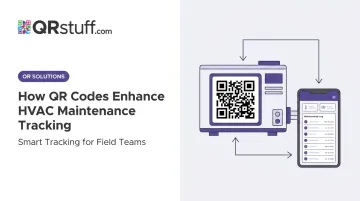
QR codes address the root cause: information access at the point of service. A technician scans a label on the unit and immediately sees service history, the current PM checklist, and relevant documentation — no phone calls, no binder searches, no delays.
This article covers the operational advantages QR codes deliver in HVAC maintenance, what poor tracking costs you, and how to build a system that holds up in practice.
Key Takeaways
- QR codes on HVAC units give technicians instant access to service history, manuals, and checklists from any smartphone.
- Dynamic QR codes let you update linked content without reprinting labels, keeping PM schedules current at no extra cost.
- Time-stamped scan data serves as verifiable proof of service visits for warranty claims and compliance audits.
- Consistent PM execution, enabled by QR-linked checklists, directly reduces unplanned breakdowns and energy waste.
- Accumulated scan data reveals recurring failure patterns, enabling proactive repairs before breakdowns occur.
What Are QR Codes for HVAC Maintenance?
A QR code for HVAC maintenance is a scannable label placed on a unit that connects directly to its digital maintenance profile — service logs, manuals, inspection checklists, warranty details, and refrigerant records.
Where They Live on the Equipment
QR codes are typically affixed in locations a technician checks first:
- On the equipment's exterior panel or access door
- On the manufacturer's service tag
- Near the electrical disconnect or control board
The physical placement matters. If a technician has to search for the code, the workflow breaks down.
The Code Is the Access Point, Not the Record
The QR code itself doesn't store data. It connects the physical unit to a living digital record that updates in real time.
Static QR codes link to a fixed document — once printed, the destination can't change. Dynamic QR codes work differently: they use a short redirect URL, so the destination can be updated anytime from a dashboard without touching the physical label. When a service procedure changes, a manual is revised, or a seasonal checklist replaces the previous one, the update happens in the background.
For HVAC units that go through multiple service cycles annually with different contractors, dynamic codes are the only format that stays accurate over the equipment's lifespan. QRStuff's dynamic QR codes handle this directly — update the destination URL from the dashboard, and every label already on the equipment points to the current record automatically.
Key Advantages of QR Codes for HVAC Maintenance Tracking
Advantage 1: Instant Access to Full Equipment History at the Point of Service
When a technician scans the unit, they get the complete picture immediately: last inspection date, parts replaced, known recurring issues, and upcoming PMs. No pre-job research required, no calls back to the office.
Each unit has a persistent digital identity tied to its label. A technician arriving on-site gets full context in under 10 seconds — no preparation needed.
Why this translates directly to lower costs:
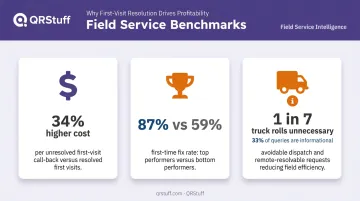
According to Aquant's 2025 Field Service Benchmark Report, when a service issue isn't resolved on the first visit, total resolution cost increases by an average of 34%. Top field-service performers achieve an 87% first-time fix rate compared to just 59% for bottom performers. The gap isn't talent — it's information access.
Technicians who know what was previously attempted don't duplicate work or chase the wrong root cause. Aquant also reports that 1 in 7 truck rolls are unnecessary, and 33% of service queries are simple informational requests. QR-linked records address both: technicians arrive informed, and basic questions get answered before the truck rolls.
KPIs directly impacted:
- First-time fix rate
- Number of repeat service visits
- Technician time-on-site per unit
- Average repair cost per call
When this matters most: Multi-unit buildings where different technicians service the same equipment across shifts or seasons. Also high-value during technician onboarding, when new hires lack historical context for the equipment they're servicing.
Advantage 2: Accurate, Audit-Ready Compliance and Warranty Documentation
Every scan that opens a maintenance record creates a time-stamped, device-logged entry. There's no ambiguity about whether a PM was completed or when a filter was last changed — the digital log is the source of truth.
Meeting ASHRAE and EPA Requirements
ASHRAE/ACCA Standard 180-2018 requires commercial HVAC maintenance programs to include an inventory where each piece of equipment is uniquely identified, along with documented maintenance tasks and frequencies. QR codes serve as practical unique identifiers that connect the physical asset to its compliant record.
For refrigerant-heavy commercial systems, EPA Section 608 requires owners of appliances with 50+ lbs of ozone-depleting refrigerant to maintain records of service date, service type, and refrigerant quantity added. A 125% leak threshold triggers formal EPA reporting. QR-linked records make this documentation accessible and auditable without manual assembly.
Warranty Protection
Manufacturer warranty terms — including those from Trane and AAON — specify that coverage depends on normal use, maintenance conditions, and qualified service. When a warranty claim is submitted, the supporting documentation needs to show a consistent, verifiable service history. QR-tracked logs provide exactly that: time-stamped entries per unit, per visit, per task.
Paper logs routinely fall short — incomplete entries, misfiled folders, or illegible handwriting all undermine a warranty claim. A QR-linked record arrives at the claim review intact, timestamped, and verifiable.
Documentation KPIs impacted:
- Warranty claim success rate
- Audit pass rate
- Documentation completeness rate
- EPA compliance status for covered refrigerant assets
Advantage 3: Consistent Preventive Maintenance Execution and Accountability
Inconsistent PM execution is one of the leading causes of premature HVAC failure and inflated energy costs. QR codes address this by linking each unit directly to the exact checklist for that service interval — filter sizes, refrigerant specs, torque values, seasonal adjustments — so nothing depends on memory or a printed handout someone forgot.
The system logs completion digitally, creating accountability without micromanagement.
Dynamic Checklists That Evolve With the Equipment
ASHRAE 180-2018 specifies that maintenance frequencies should be reviewed after two successive unacceptable condition findings and may be reduced after three successive acceptable ones. That means PM schedules aren't static — they should change as equipment condition data accumulates.
Static printed checklists can't reflect this. Dynamic QR codes can. When a PM schedule is updated in the system, every technician who scans that unit gets the current version automatically.
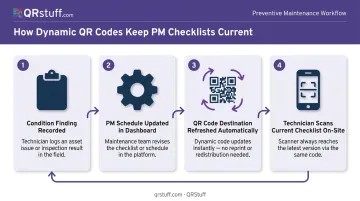
Platforms like QRStuff support this through Multi-URL QR codes and dynamic URL redirects — a single scan can surface a landing page linking to the service log, a PDF manual, and the current PM checklist simultaneously. No reprinting, no redistribution.
Scan Analytics as Proof of Execution
QRStuff's dynamic QR codes log each scan with timestamp, device type, and geolocation data. For facility managers overseeing contract maintenance staff, this means scheduled inspections can be verified without being on-site. If the scan record shows a technician was at the rooftop unit at 9:47 AM on a Thursday in March, that's documented.
Uptime and efficiency KPIs impacted:
- PM completion rate
- Equipment uptime
- Energy consumption per unit (DOE estimates 5%–20% energy savings from consistent O&M)
- Mean time between failures (MTBF)
When this matters most: High-density scenarios — apartment complexes, commercial office buildings, hotels, industrial facilities — where the volume of PMs makes manual oversight impractical.
What Happens When QR Code Tracking Is Missing
Without a structured tracking system, the problems are predictable:
- Technicians arrive without context, repeat previous mistakes, and miss PMs because nothing flagged them
- Warranty claims get denied when documentation can't prove a service history
- EPA recordkeeping obligations for refrigerant assets go unmet
- Supervisors have no way to verify whether scheduled visits actually occurred
Repeat service visits already inflate total resolution costs by 34% on average. Without documented service trails, warranty protection evaporates. And with no scan analytics, there's no way to verify that scheduled visits actually happened.
The problem scales badly. A facility manager overseeing 50+ HVAC units across multiple properties can't rely on manual tracking to stay compliant. Every new unit and every new technician adds another failure point — and those failures accumulate faster than any spreadsheet can catch them.
How to Get the Most Value from QR Code HVAC Tracking
QR code tracking delivers its strongest return when deployed as a system, not a one-time setup.
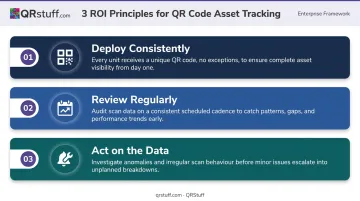
Three principles that determine long-term ROI:
- Deploy consistently — every unit gets a code, no exceptions. Gaps in coverage create gaps in data.
- Review regularly — scan data and service logs should be audited on a set cadence, not just stored. Patterns only become visible when someone looks for them.
- Act on the data — one unit requiring unusually frequent filter changes isn't just a log entry; it's a signal worth investigating before it becomes a breakdown.
Choosing the Right QR Code Setup for Scale
For facilities managing dozens to hundreds of HVAC units, the QR code platform needs to match the operational scale:
| Facility Size | Recommended Approach | Key Features Needed |
|---|---|---|
| Single building, <20 units | Full Suite | Dynamic codes, scan analytics, PDF linking |
| Multi-building, 20–100 units | Full Suite or Enterprise | Bulk generation, multiple seats, CMMS integration |
| Large portfolio, 100+ units | Enterprise | Unlimited batch processing, API access, SSO |
QRStuff's Enterprise tier supports up to 1,000 dynamic QR codes, unlimited batch generation, API integration with existing CMMS platforms, and role-based access for multiple technicians. For organizations running a maintenance management system, the API connection keeps QR scan data and work order records in sync without manual entry.
Password protection adds a practical security layer for commercial facilities, restricting sensitive maintenance records or refrigerant logs to authorized technicians only.
Conclusion
QR codes address HVAC maintenance at the point of failure: technicians get accurate information the moment they need it, documentation stays current without manual effort, and PM schedules actually get followed. Each outcome builds on the others — and all three compound over time.
The return grows as the data does. Service histories accumulate, failure patterns surface earlier, and audit documentation writes itself. Teams that build QR tracking into standard workflow — scanning at every visit, updating records in real time — end up with an asset that gets more useful with every service call, not less.
Frequently Asked Questions
What is a QR code for HVAC maintenance?
A QR code for HVAC maintenance is a scannable label attached to a unit that links technicians to its digital record — service history, manuals, PM checklists, and warranty details — accessible from any smartphone. The code itself doesn't store data; it connects the physical unit to a live, updateable digital profile.
What is an HVAC maintenance checklist?
An HVAC maintenance checklist is a standardized list of tasks completed at each service interval: filter replacement, refrigerant checks, coil cleaning, thermostat calibration, and more. QR codes link directly to the correct checklist for a specific unit, ensuring the right tasks are completed regardless of which technician is on-site.
Can QR codes replace traditional paper maintenance logs?
QR codes don't replace the log itself — they replace the friction of accessing and updating it. Paper logs can be digitized and linked through a QR code, making them instantly accessible from the unit and eliminating the risk of loss, misfiling, or illegible entries.
How do dynamic QR codes help with HVAC tracking?
Dynamic QR codes allow the linked maintenance record, checklist, or manual to be updated at any time without reprinting the physical label. When PM schedules change seasonally, units are upgraded, or documentation is revised, the update happens in the platform — the label on the unit stays the same.
Do QR codes on HVAC units help with warranty claims?
Yes. QR-tracked service records provide a time-stamped, verifiable log of every maintenance activity on a unit — exactly the documentation manufacturers require when evaluating warranty claims. A consistent digital service trail is far more defensible than reconstructed paper records.
How do I create QR codes for my HVAC units?
Using a platform like QRStuff, generate a dynamic QR code linked to a maintenance record or document URL, then export it as an SVG or high-resolution PNG for durability. Affix it to the unit in a visible spot and use a dynamic code so the linked content can be updated without reprinting the label.