Introduction
Picture this: a customer sees your beautifully designed QR code on a product package, scans it, and their phone flashes a preview URL — qr1.be/ABCD. Not your brand. Not your domain. A stranger's URL from a platform they've never heard of.
That split-second moment of confusion can cost you the scan. Research from Ivanti found that 31% of respondents had scanned a QR code that led to a suspicious website or unexpected action. That hesitation is precisely what white label QR codes are designed to prevent.
White label QR codes replace the platform provider's domain with your own branded domain, so every scan touchpoint — from the URL preview to the landing page — reinforces your identity instead of someone else's.
This guide covers what white label QR codes actually are (and what they're not), how they differ from visual customization, the key benefits, must-have platform features, a setup walkthrough, and which businesses need them most.
Key Takeaways
- A white label QR code uses your own branded domain (e.g.,
qr.yourbrand.com) as the redirect URL instead of the QR platform's default domain - It requires a dynamic QR code — static codes cannot be white labelled
- Visual customization (colors, logos) and domain branding are two separate things — professional deployments need both
- White labelling builds trust, supports agency reselling, and enables detailed scan analytics
- On QRStuff, white label and custom domain features are available on the Enterprise plan
What Is a White Label QR Code?
A white label QR code is a dynamic QR code where the embedded redirect URL uses your own custom domain — for example, qr.yourbrand.com/ABCD — instead of the QR platform's default domain like qr1.be/ABCD. "White label" here refers specifically to domain and branding ownership, not visual design.
How the Technical Mechanism Works
When a user scans a white label QR code, the URL that previews on their phone screen belongs to your domain. Behind the scenes, this works through a CNAME record — a DNS configuration that points your chosen subdomain (e.g., qr.yourbrand.com) to the QR platform's servers. The platform handles all redirect logic while your domain name remains visible throughout.
This is why white labelling only works with dynamic QR codes, not static ones:
- Static QR codes permanently encode the destination URL — no redirect layer exists to replace with a custom domain
- Dynamic QR codes route scans through a configurable intermediary URL, making both the destination and the redirect domain fully configurable
Two Layers of White Label Branding
Full white labelling covers two distinct touchpoints:
| Touchpoint | What the User Sees | What Gets Branded |
|---|---|---|
| Scan preview (phone screen) | Short redirect URL | qr.yourbrand.com/ABCD |
| Browser address bar (after redirect) | Landing page URL | yourbrand.com/campaign |
Both need to reflect your brand for a seamless experience. Partial white labelling — where the redirect is branded but the landing page still shows a third-party domain — undercuts that consistency at the final destination.
White Label QR Code vs. Custom QR Code: What's the Difference?
The distinction comes down to where the branding lives — on the code itself, or behind the scan.
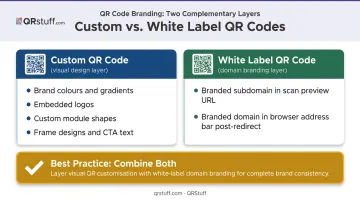
Custom QR code = visual design changes to the QR image itself:
- Brand colours and gradients
- Embedded logos
- Custom module shapes (round, dots, square-outlined)
- Frame designs and call-to-action text
White label QR code = domain-level branding behind the scan:
- Your subdomain in the scan preview URL
- Your domain in the browser address bar post-redirect
A QR code designed in your brand's colours is not white labelled if the redirect URL still points to qr1.be or any other third-party domain. White labelling requires a separate DNS configuration step — the visual design and the domain setup are independent of each other.
The strongest QR deployments combine both: a visually branded code that matches your identity, and a domain-branded scan experience that confirms your legitimacy at every step. QRStuff supports both approaches — visual customisation options like hex colours, logo embedding, and custom module shapes, paired with custom domain configuration for Enterprise users.
Key Benefits of White Label QR Codes
Builds Brand Trust and Recognition
When a user scans your QR code and sees qr.yourbrand.com in the URL preview, they know exactly where they're going. When they see qr1.be/ABCD, they don't — and the FTC explicitly advises consumers to inspect the URL after scanning and look out for spoofed sites.
That advice cuts both ways. Legitimate brands suffer when their QR codes are indistinguishable from phishing attempts. A branded domain acts as a visual trust signal — it tells the user that the scan destination is affiliated with a company they recognize.
Every scan that shows your branded subdomain reinforces recognition, making QR campaigns an asset to long-term brand equity rather than a one-off convenience feature.
Improves Scan Rates and Campaign Performance
Consumer hesitation around unknown URLs is a documented behaviour. Abnormal AI's 2024 threat research found 89.3% of QR code attacks were used for credential phishing — context that makes users understandably cautious when an unrecognised domain appears after a scan.
Branded redirect URLs reduce that hesitation by visually confirming the destination belongs to a known organisation. The same logic applies to the landing page: users who arrive at yourbrand.com/offer after scanning feel far less friction than users who find themselves on an unexpected third-party domain mid-journey.
Enables Dynamic Editing and Real-Time Flexibility
White label QR codes are dynamic, meaning you can update the destination URL at any time without reprinting the physical code. A retail brand placing QR codes on seasonal window displays, for example, can push a new promotion to the same printed code each quarter.
That eliminates reprinting costs and lead times — a real saving on large-format or high-volume print runs.
Unlocks Reselling Opportunities for Agencies
Marketing agencies can offer QR services entirely under a client's domain. The client sees their own branded URL at every touchpoint, with no mention of the underlying platform. That positions the agency as a full-service provider rather than a tools reseller, supporting client confidence and creating grounds for recurring subscription revenue.
Strengthens Campaign Analytics
White label dynamic QR codes include scan tracking that ties performance data to your own branded system. QRStuff's analytics, for example, track:
- Total and unique scan counts
- Device type and operating system (iOS, Android, mobile vs. desktop)
- Geographic location down to country and city level
- Time and date patterns across daily, weekly, or custom date ranges
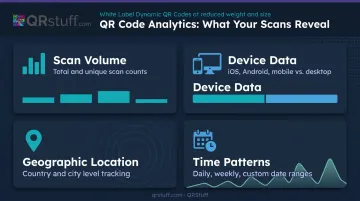
This data helps prove campaign ROI, optimise future deployments, and — for agencies — demonstrate value to clients. Scan data involving IP addresses and geographic identifiers constitutes personal data under GDPR, so platforms should support data minimisation, retention controls, and privacy notices for EU audiences.
Must-Have Features in a White Label QR Code Platform
Not all QR platforms offer genuine white label functionality. Here's what to evaluate:
Custom domain setup: Look for CNAME-based subdomain support (e.g.,
qr.yourbrand.com) covering both redirect URLs and landing pages, with in-platform DNS verification — propagation typically takes 24–48 hours after configuration.Visual QR customization: The platform should handle logo embedding, brand color palettes, gradient types, custom module shapes, and frame design in one place — so visual and domain branding don't require separate tools. QRStuff supports hex color inputs, radial/vertical/diagonal gradients, and PNG/JPG logo uploads with automatic error correction.
Dynamic QR codes with editable destinations: Confirm the platform supports real-time destination URL edits without regenerating the QR image. Without this, any reprint triggers a new code — breaking existing materials.
Comprehensive scan analytics: Look for total and unique scan counts, device/OS breakdowns, city-level geographic data, and time-based patterns. QRStuff covers all of these, with dashboard visualizations and Excel/PDF export for client reporting.
Enterprise security and compliance: GDPR compliance and SOC2 certification are the baseline for any platform handling customer data. QRStuff holds both, and supports HIPAA-compliant information sharing for healthcare organizations managing patient data.
API access and bulk generation: Agencies managing large QR volumes need programmatic creation and batch export. QRStuff's API supports multi-format downloads (PNG, SVG, EPS, PDF) and analytics endpoints, with Enterprise plans providing higher rate limits for scale.
How to Set Up a White Label QR Code: Step-by-Step
Before you begin, confirm you have:
- A paid plan that includes white label/custom domain features (on QRStuff, this is the Enterprise plan at £185/month or £2,000/year)
- Access to your domain host's DNS settings
- A subdomain chosen for your branded links (e.g.,
qr.yourbrand.com)
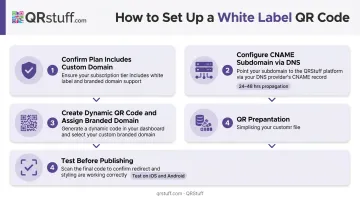
Confirm your plan includes custom domain support. Most platforms restrict white label to enterprise tiers — verify this before proceeding.
Configure your custom subdomain via CNAME. In your domain host's DNS settings, create a CNAME record pointing your subdomain to the QR platform's server address. Verify the subdomain inside the platform, then wait 24–48 hours for DNS propagation.
Create a dynamic QR code and assign your branded domain. Select the dynamic QR code type, enter your destination URL, and choose your verified custom domain as the short URL base. Customise the design (logo, colours, shapes, frame) and download.
Test before publishing. Scan the code yourself — confirm the preview URL shows your branded domain and the destination loads correctly. Test on both iOS and Android before deploying.
Who Benefits Most from White Label QR Codes?
Marketing Agencies and Consultants
Agencies managing QR campaigns for multiple clients benefit most from white labeling. The client sees their own domain throughout the entire scan journey — the agency's tool vendor stays invisible. This supports client confidence, simplifies reporting, and positions the agency as a capable full-service provider rather than a middleman passing through third-party tools.
Enterprise Brands and Retail Businesses
Large brands in retail, hospitality, food and beverage, and consumer goods use white label QR codes to maintain seamless brand consistency across packaging, in-store displays, and print collateral. A branded scan experience reinforces the premium image consumers expect. With U.S. QR code scanner usage projected to reach 99.5 million users by 2025, enterprise QR deployment is no longer a novelty — it's infrastructure, and it needs to look the part.
Healthcare and Finance Providers
Regulated industries have additional reasons to prioritize white labeling. In healthcare, branded URLs reduce patient confusion and reinforce institutional trust. This matters most when patients are scanning codes for appointment check-ins or prescription instructions, where an unfamiliar third-party domain can raise immediate concern.
Compliance is a parallel issue. Tracking technologies embedded in QR analytics may trigger HIPAA obligations when they interact with protected health information, so the platform behind the code matters as much as the code itself.
For finance, the risks are equally concrete. The World Bank's payments research identifies QR replication and identity impersonation as key fraud vectors — making branded, verified domains a security requirement, not just a branding preference.
Both industries should prioritize platforms that hold relevant compliance certifications. Key criteria include:
- Verified domain branding to reduce phishing and identity spoofing risk
- Analytics that comply with data privacy regulations (GDPR, HIPAA)
- Audit trails and access controls for enterprise accountability
QRStuff holds GDPR and SOC2 compliance credentials, making it a credible option for organizations in regulated sectors.
Frequently Asked Questions
What is a white label QR code?
A white label QR code is a dynamic QR code where the redirect URL and landing page URL use the business's own custom domain instead of the QR platform provider's domain. It gives the full appearance of an in-house solution, with no visible reference to the underlying software.
How can I customize my QR code?
QR code customization works on two levels: visual design (logo embedding, brand colors, custom shapes, frame text) and domain branding (white labelling, where the scan redirect URL uses your own subdomain). Platforms like QRStuff support both within a single interface.
Can you scan a white QR code?
A QR code with a white or light background can be scanned successfully — the key is sufficient contrast between the code modules and the background. A pure white QR code on a white background cannot be scanned; there's no contrast for the scanner to detect.
Do white label QR codes work with static QR codes?
No. White labelling requires dynamic QR codes. Static codes permanently encode the destination URL into the code pattern itself and cannot be redirected through a custom domain.
What is the difference between a white label QR code and a custom-designed QR code?
A custom-designed QR code refers to visual changes — colors, logos, shapes. A white label QR code refers to domain-level branding: your own subdomain serves as the redirect URL. They're distinct features that work best when used together.