Introduction
What started as a pandemic workaround has become operational infrastructure. QR codes at restaurant tables now handle far more than menu browsing: ordering, checkout, tipping, loyalty redemption, and post-meal engagement — all from a single scan.
The pressure on restaurant operators is real. Food-away-from-home prices rose 3.6% year over year in April 2026, margins are thinning, and diners — especially younger ones — expect fast, self-directed payment experiences.
Restaurants still relying on paper bills and traditional POS-only checkout are now visibly behind peers reporting faster table turns and stronger review volumes.
This article covers four QR payment trends redefining restaurants in 2026, the forces driving adoption, and the operational shifts operators are already seeing, plus signals worth watching as the technology continues to evolve.
Key Takeaways
- QR payments now cover the full dining journey — ordering, loyalty, and guest engagement, not just checkout
- 44% of guests say they'd appreciate AI-driven menu recommendations at the point of scan
- Security compliance and branded QR codes are baseline expectations for any credible restaurant payment setup
- Post-payment prompts (reviews, surveys, loyalty sign-ups) drive measurable reputation and revenue gains
- Dynamic, analytics-capable QR systems give restaurants a clear edge over static-code setups
Trend 1: AI-Powered Personalization at the Point of Scan
What It Looks Like in Practice
A returning guest scans the table QR code. The system recognizes their loyalty profile, greets them by name, surfaces their usual order as a quick-reorder option, and suggests a wine pairing based on previous visits — all before a server has taken a drink order. No app download. No friction.
This isn't a chain-only capability anymore. Cloud-based machine learning infrastructure has become affordable for independent operators, and smartphones now handle the data handshake between QR platforms and customer profiles natively.
Toast's 2026 Restaurant Dining Trends report found 44% of guests would appreciate AI-driven menu item recommendations. Deloitte's 2025 AI in Restaurants study reinforces the operator side: 8 in 10 restaurant executives expect AI investment to increase, and 63% are already using AI daily for customer experience.
Why It's Accelerating in 2026
For operators, the benefits show up immediately:
- Reduced server cognitive load — AI handles upselling at the screen, freeing staff for hospitality tasks
- Higher attachment rates — contextual suggestions (add-ons, pairings) outperform generic prompts
- Automatic loyalty recognition — discounts and rewards surface at checkout without diners remembering codes or cards
- Personalized interfaces — returning guests see a different screen than first-timers, cutting decision fatigue
What separates the leading implementations from basic "you might also like" prompts is specificity: recommendations built from a diner's actual order history, dietary preferences, and visit frequency — triggered at the moment of scan, not after checkout.
Trend 2: Integrated QR Ecosystems — From Menu to Payment to Loyalty
One Scan, the Entire Dining Journey
The most significant shift in 2026 isn't any single QR feature — it's the consolidation of the entire dining transaction into one code. Leading full-stack QR platforms now support:
- Real-time menu updates — daily specials, 86'd items, and pricing changes reflected instantly without reprinting
- Itemised bill preview — diners see exactly what they're paying for, with modifier details, before confirming
- Multi-party bill splitting — individual items or even-split options handled at the screen
- Loyalty earning and redemption — points accrue and rewards apply at checkout without a separate loyalty app
- Instant post-payment prompts — review requests and survey links trigger while the experience is still fresh
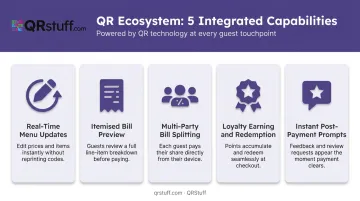
Each feature targets a specific friction point. Remove enough of them and the compounding effect shows up in table turn times, order accuracy, and repeat visit rates.
The Case for Dynamic Over Static
The NRA's 2024 Technology Landscape Report found that self-service order accuracy can reach below 1% error rates in full-service digital ordering setups — compared to the far higher error rates associated with verbal order-taking during busy service.
Static QR codes — those encoding a fixed URL directly — can't be updated without reprinting. For a restaurant running rotating specials, seasonal menus, or time-sensitive promotions, that's a real operational liability.
Dynamic QR codes solve this by routing through a redirect URL rather than encoding a destination directly. Operators update the linked menu, pricing, or payment destination from a dashboard — and the change propagates instantly. For a 40-table restaurant, that's every table updated simultaneously, with no reprinting and no version inconsistency. QRStuff's dynamic codes work exactly this way, letting operators push changes in real time without touching a single physical code.
Trend 3: Security, Compliance, and Consumer Trust as Baseline
The Fraud Problem Is Real
QR-related fraud has moved from niche concern to a documented threat. The FTC has explicitly warned that scammers place fake QR codes over legitimate ones in public locations — redirecting diners to phishing sites or malware delivery pages. ReliaQuest documented a 51% increase in QR phishing attacks in a single month in 2023 compared to the prior eight months combined.
For restaurant operators, this creates a direct reputational risk. A diner who gets stung by a fraudulent QR code at a table — even one placed by a third party — associates that experience with the restaurant.
What Baseline Security Looks Like in 2026
Informed diners and compliant operators now expect:
- Branded QR codes with a recognizable logo and color scheme — visual familiarity deters tampering and builds scan confidence
- Visible destination URLs before payment is initiated, so diners can verify where they're headed
- End-to-end encryption for all payment data in transit and at rest
- PCI DSS compliance from the payment processor
- GDPR compliance for any diner data captured through loyalty or survey flows
- Regular physical audits of table codes to check for tampering or unauthorized replacement
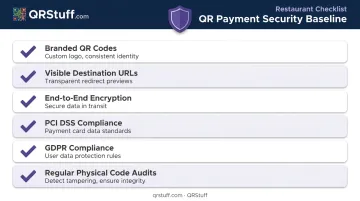
Meeting these criteria requires the right platform infrastructure. QRStuff is both GDPR and SOC2 compliant and supports branded, customizable QR codes — including logo overlays and brand-matched color schemes — that help diners recognize legitimate restaurant codes on sight. Password-protected codes and two-factor authentication are available for operator-facing administrative access.
Security posture has become a competitive variable. Restaurants that display their compliance credentials and use branded, audited codes give diners a concrete reason to scan with confidence — which, in a payment context, directly affects conversion at the table.
Trend 4: Post-Payment Engagement, Ethical Tipping, and Paperless Operations
The Checkout Moment as an Engagement Window
When a diner pays, their phone is already out and the meal is top of mind. That's a narrow window — and leading QR platforms are built to use it. Common post-payment prompts include:
- Google review prompts linked directly to the restaurant's review page
- Short satisfaction surveys capturing specific feedback
- Loyalty program sign-up flows with immediate reward incentives
- Social sharing links for diners who want to post about their visit
The key is timing and brevity. A single, well-placed prompt at checkout outperforms a follow-up email sent hours later.
Transparent Tipping and Digital Gratuity
Toast data shows that 66.6% of card and digital transactions included a tip in Q3 2023, up from 64.7% in Q3 2021 — with full-service restaurant tips averaging 19.4%. Digital prompts tend to drive higher participation rates than paper-based alternatives.
However, the design of the tipping interface matters. Diners respond negatively to high-pressure defaults. Best practice in 2026:
- Display preset options (18%, 20%, 25%) alongside a clearly visible custom amount field
- Show a no-tip option without burying it
- For restaurants that pool tips, consider displaying distribution transparency (e.g., how tips are split across front and back of house)
Paperless Operations and Sustainability Signaling
U.S. paper receipts consume over 3 million trees and nearly 9 billion gallons of water each year, according to Green America. Digital receipts delivered via QR checkout eliminate that waste entirely — and communicating that to diners ("you saved one printed receipt today") turns an operational decision into a brand asset.
Restaurants can lean into this further by displaying a running tally — total receipts saved this month, trees preserved — giving eco-conscious diners a tangible reason to return.
What's Driving QR Payment Adoption in Restaurants in 2026
QR payment adoption isn't just a trend — it's the result of four concrete pressures reshaping how restaurants operate:
Technology Enablement
Native QR scanning is built into every major smartphone camera — no separate app required. Combined with near-universal 4G/5G coverage and plug-and-play POS integrations, the friction barriers that slowed early adoption are gone. The Federal Reserve's 2025 Diary of Consumer Payment Choice found U.S. consumers averaged 11 mobile payments per month in 2024, up from just 4 in 2018.
Generational Shift in Expectations
Adults aged 18–24 used mobile devices for 45% of all payments in 2024 (Federal Reserve). The NRA found 85% of Millennials and 79% of Gen Z adults would order via smartphone app in a full-service restaurant, versus 33% of Baby Boomers. Restaurants targeting younger demographics are effectively required to offer digital payment options.
Margin Pressure and Automation
With food-away-from-home prices up 3.8% for full-service meals (April 2026 CPI data) and the NRA reporting 82% of operators cited higher food costs in 2025, automation of transactional touchpoints is a margin-protection tool, not a luxury.
Competitive Dynamics
The NRA found 41% of operators planned to invest in contactless ordering and payment in 2024, with 57% investing in loyalty systems. Restaurants that haven't yet adopted QR checkout are now catching up to peers, not getting ahead of them.
How These Trends Are Reshaping Restaurant Operations in 2026
Table Throughput
First Watch's QR pay-on-bill flow — deployed across 420 corporate-owned restaurants — reduced transaction time by 30 seconds per table and saved over 1,000 combined customer and employee hours in a single week, based on more than 125,000 QR payment transactions. That's the clearest documented operational metric available: faster bill settlement during peak service directly translates to more covers per period.
Revenue and Data Intelligence
Integrated QR ecosystems generate continuous transactional data that static systems can't capture. Key data points include:
- Peak dining hours and highest-margin item popularity
- Average spend by party size
- How diner behavior shifts by day of week
QRStuff's analytics dashboard surfaces real-time scan data, device breakdowns, geographic distribution, and campaign-level comparisons across multiple QR touchpoints — all exportable as CSV for integration with existing business intelligence tools.
That data advantage extends beyond revenue — it also changes how your team operates on the floor.
Staff Redeployment and Morale
When payment, tipping, and order collection move to the screen, front-of-house staff are freed from transactional interruptions. That time goes toward genuine hospitality — table presence, problem-solving, experience-building. Staff also tend to earn more through digital tipping, which has higher participation rates than cash gratuity. Better earnings and less administrative friction are meaningful retention factors in a tight labor market.
Future Signals for QR Code Payments in Restaurants
The QR payment landscape will keep moving. Three signals worth tracking over the next one to three years:
- Biometric authentication at the point of scan: Panera has already tested Amazon One palm payment linked to loyalty. As hardware costs fall, fingerprint and facial recognition will move from pilot to standard in both premium dining and QSR settings.
- Voice-confirmed payments (45% of delivery customers say they'd use voice-enabled ordering, per NRA data): voice confirmation is being tested in select markets and will expand as the UX matures.
- Stablecoin and crypto checkout: Chipotle accepted cryptocurrency at nearly 3,000 U.S. restaurants via Flexa. Reduced stablecoin volatility is making this operationally viable for tech-forward operators targeting digital-native guests.
Restaurants that build on dynamic QR infrastructure today — with editable destinations and open integrations — can activate these features as they mature without rebuilding from the ground up.
Frequently Asked Questions
How do I set up QR code payment solutions for a restaurant?
Choose a QR platform (such as QRStuff) and a payment gateway, then generate codes linked to your payment flow or digital menu and place them at tables or on bills. Brief staff on helping first-time users. Dynamic QR codes let you update linked content any time without reprinting.
Which payment gateways work best for restaurant QR code payments?
Popular options include Stripe, Square, Toast, and open banking providers. The best fit depends on your transaction fee structure, existing POS integration, and the payment types you need to support — card, digital wallet, or account-to-account.
What QR code payment systems are available for restaurants in 2026?
Options range from standalone QR generators with payment linking to fully integrated POS-QR platforms. Key considerations include dynamic update support, real-time analytics, loyalty integration, and compatibility with your preferred payment gateway.
Are QR code payments still effective and popular in 2026?
QR payments are now mainstream in restaurants of all types. Growth continues, driven by diner demand for contactless checkout and operator gains including faster table turns and higher digital tip rates.
What is replacing QR codes for payments?
Nothing is replacing them outright. QR codes are evolving and co-existing with NFC tap-to-pay and emerging biometric options. The industry is moving toward hybrid payment environments where multiple methods coexist, and no single technology is on track to displace QR codes anytime soon.