The businesses getting real value from QR codes treat them the way they treat any other brand asset — with deliberate design, strategic placement, and a destination worthy of the customer's attention. A well-executed QR code on product packaging can deepen loyalty. A poorly executed one on a storefront window can actively erode trust.
This guide covers the full process: what you need before creating a single code, how to design and deploy codes that reinforce your brand identity, where they work best, and how to measure whether they're actually building equity — not just generating scans.
Key Takeaways
- Brand equity from QR codes depends on design, destination, and placement all reinforcing the same identity.
- Use dynamic QR codes for all print deployments so you can update destinations without reprinting.
- Every scan is a brand touchpoint: the landing page must match the visual and messaging standards of the physical asset that prompted it.
- Track scan analytics — location, device, unique vs. returning — to see which touchpoints drive repeat engagement.
When QR Codes Work for Brand Building (and When They Don't)
Not every QR code is a brand-building tool. The difference comes down to context and destination quality.
A QR code adds brand value when it:
- Extends the physical medium's story (packaging that can't cover full ingredients or sourcing, a business card that can't convey personality)
- Reinforces visual identity through a branded, on-theme destination
- Collects meaningful data that improves future brand interactions
A QR code harms brand perception when it:
- Links to a generic homepage with no connection to where the scan originated
- Points to a broken URL or slow-loading, mobile-unfriendly page
- Appears as a plain black-and-white square with no CTA and no design intentionality
Research from the Journal of Business Research confirms this directly: scan intention is influenced by trust, informativeness, and perceived fit between the code and the surrounding brand context. A generic code placed in a premium brand environment signals carelessness, and that impression sticks.
The practical test is simple: if the physical touchpoint creates a question the medium can't answer on its own — how it's made, what it costs, where to buy more — a QR code earns its place. If it doesn't answer a real question, it's decoration.
What You Need Before Creating Brand-Building QR Codes
Skipping the prerequisites produces codes that are functionally fine but brand-neutral at best. Three things must be in place first.
Brand Assets
Your logo, color palette, and brand guidelines aren't just for your website — they're what transform a generic QR square into a visual brand element. Without them, the code becomes another anonymous black-and-white pattern indistinguishable from a competitor's.
A Quality Destination
The destination page must be mobile-optimized, on-brand in design, and offer genuine value — a discount, a product origin story, a how-to, a loyalty enrollment. A scan that leads to a slow-loading, generic page doesn't just disappoint; it signals inattention to quality.
QRStuff's platform includes customizable landing pages and Linkpages functionality across paid tiers, which means businesses can build brand-consistent destinations without relying entirely on external web development. The Full Suite plan includes 10 customizable landing pages; Enterprise offers unlimited.
A Platform That Supports Dynamic Codes, Custom Design, and Analytics
Any platform you use for brand campaigns needs to cover three capabilities:
- Update destinations after printing with dynamic codes — no reprinting required when campaigns change
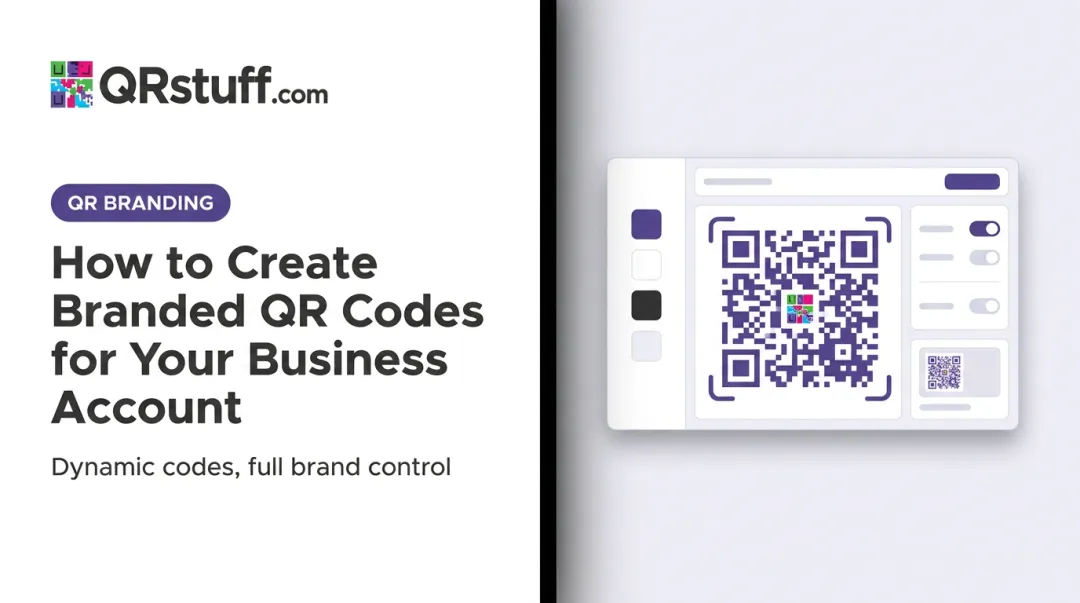
- Customize visual design: foreground colors (including gradients), logo embedding in PNG or SVG, and module, eye, and corner shape styling
- Track performance with scan analytics covering location, device type, time of scan, and unique vs. returning scans
QRStuff covers all three. Analytics — including country/city-level geolocation and device breakdowns — are available across all paid tiers for dynamic codes.
How to Use QR Codes for Brand Building: Step by Step
Define Your Brand Objective and QR Code Type
Before generating anything, identify the single action you want the scan to trigger. A code trying to do three things at once does none of them well.
Match objective to code type:
| Objective | QR Code Type |
|---|---|
| Drive social following | Social media / Social Link Page |
| Deliver brand story | URL → branded landing page |
| Enroll in loyalty program | URL → sign-up form |
| Professional networking | vCard |
| Product storytelling | Video / YouTube |
| Share credentials or specs | URL → product information page |
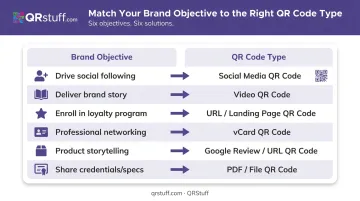
QRStuff supports 40+ data types across these categories. The critical point: mismatching type to intent creates friction that scan rates reflect immediately.
Design a QR Code That Reflects Your Brand Identity
A custom-designed QR code functions as a visual brand asset. Research from a vendor-sponsored survey distributed via Morningstar found 75% of consumers are more likely to scan a QR code that includes a brand logo, and 67% trust codes that use brand colors. The source is worth noting, but the principle is sound: a recognizable code builds scan confidence where a generic one doesn't.
Technical constraints that protect scannability:
- Contrast: Foreground modules should be at least 70% darker than the background. Avoid red modules — most scanners use 660nm red light and struggle to differentiate
- Quiet zone: Maintain a minimum border of 4X the width of a single module on all sides. Never crop it
- Logo coverage: Keep embedded logos below 20% of the code area (15% is the recommended sweet spot). QRStuff automatically centers and scales logos at an optimal size, and raises the error correction level to compensate
- Minimum print size: At least 2cm × 2cm for simple URLs; use SVG or EPS vector formats for anything larger than a business card
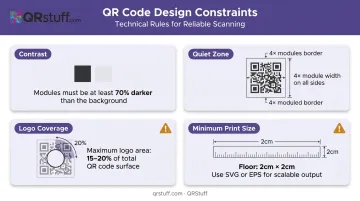
QRStuff's platform includes real-time preview and recommends scanning with multiple devices before finalizing any design. Test every code in its actual medium before deployment — a code that scans perfectly on screen may fail on a laminated menu or a curved bottle.
Create a Brand-Consistent Destination
The destination page is where brand building either happens or falls apart. A scan that takes a customer from premium branded packaging to a generic, slow-loading webpage destroys continuity — regardless of how well the code itself was designed.
The destination must match the tone, visual identity, and value proposition of the touchpoint that prompted the scan. A luxury product's QR code should open a page that feels luxurious. A playful food brand's code should land somewhere equally energetic.
Dynamic QR codes make this sustainable. Because the destination is held on a redirect server rather than encoded into the pattern itself, you can update it at any time without reprinting the physical material.
Marriott Aruba deployed this approach at scale: according to a Uniqode customer story (also cited by the U.S. Chamber of Commerce), the property generated over 150,000 QR code scans reaching 80,000 unique customers, while saving approximately $150,000 in printing costs — updating menus, gym schedules, resort maps, and amenity information in real time rather than reprinting.
On QRStuff, destination updates take effect immediately. The physical code stays the same — no reprinting required, no broken links.
Deploy QR Codes Across Brand Touchpoints
Placement determines whether a scan happens at all. QR codes perform when they appear at moments of natural curiosity — where a customer is already engaged with the brand but wants more than the physical medium can provide.
High-performing placement contexts:
- Product packaging (post-purchase curiosity is at its peak)
- Storefront windows (engaged, considering, not yet inside)
- Business cards (the moment of professional connection)
- Event materials (live context, high engagement)
- Menus and loyalty cards (captive, attentive audience)
Placement that underperforms:
- Interruptions in high-traffic environments where people aren't paused
- Contexts with no clear reason to scan
- Surfaces that make scanning physically awkward (curved, reflective, folded)
Every code needs a CTA — one CTA, written in your brand's voice. "Scan to See Our Story" works differently from "Unlock Your Exclusive Offer" — and both work differently from "Scan Here." Match the language to the brand tone and set clear expectations for what happens post-scan.
Monitor Performance and Optimize
Deployment is not the endpoint. QR codes provide something print marketing can't: a direct feedback loop between physical touchpoints and measurable behavior. QRStuff's dashboard makes that feedback loop actionable — surfacing total scans, unique scans, geographic breakdown (country and city level), device type (iOS/Android/desktop), and time-of-scan data, all in real time.
What the data tells you:
- High unique scans, low return scans → the touchpoint is driving discovery, not loyalty
- Strong geographic concentration → placement in specific locations is working; others aren't
- Peak scan times → tells you when customers are most engaged with that touchpoint
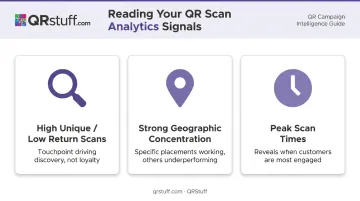
Use underperforming touchpoints as signals. The problem is usually one of three things: placement context (wrong moment), CTA copy (unclear value), or destination quality (not worth the tap). Fix one variable at a time. Enterprise users can export scan data as CSV or pull it via API into external dashboards, including integrations with Google Sheets, Meta Pixel, and Google Ads.
Where Businesses Use QR Codes to Reinforce Their Brand
Product Packaging and Labels
Packaging is the highest-verified brand-building touchpoint for QR codes. GS1 US research found 79% of consumers are more likely to purchase products with a scannable QR code that provides desired data, and 62% are willing to spend more for detailed product information. The customer is already physically holding the product — attention and intent are both high.
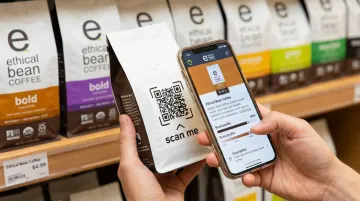
Applications that work here: brand origin stories, sustainability credentials, ingredient or nutritional breakdowns, how-to content, and loyalty enrollment. QRStuff is used by brands including Coca-Cola, PepsiCo, and Monster Energy for consumer packaged goods applications.
Print Marketing and Physical Locations
Posters, direct mail, business cards, storefront windows, and in-store signage all share one limitation: once printed, they can't be updated. Dynamic QR codes fix that — the physical material stays fixed while the destination evolves with campaigns, seasons, and offers.
For print production, follow these specs to avoid scan failures:
- Use SVG or EPS vector formats for clean rendering at any scale
- Minimum 300 DPI for raster files
- Test every code before the print run — not after
Events, Hospitality, and Service Environments
The National Restaurant Association's 2024 Technology Landscape Report found 59% of full-service customers and 57% of limited-service customers are likely to access menus via QR code. Comfort for ordering and payment is lower, so menu access remains the primary hospitality use case.
Hotels, salons, and event venues use QR codes to replace static printed collateral with fully updatable brand touchpoints — menus that change daily, local guides that stay current, and loyalty signups that carry consistent brand voice.
The Marriott Aruba deployment shows what this looks like at scale: a single QR infrastructure covering menus, maps, gym schedules, beach reservations, and marketing content, all refreshed without a single reprint.
Best Practices for Consistent Brand Impact with QR Codes
Consistency separates brands that build trust through QR codes from those that just use them. Keep these rules in place across every deployment:
- Assign each QR code exactly one destination and one CTA — multiple competing messages around a single code create decision paralysis and dilute brand clarity
- Deploy dynamic codes for all physical materials — static codes permanently lock the destination, meaning any URL change creates a broken experience with no fix short of reprinting
- Test in the actual medium before printing — a code that scans fine on screen may fail on a laminated card, a curved surface, or under low light; test with multiple devices first
- Close the loop after every scan — a branded confirmation (loyalty points earned, a welcome message, a thank-you screen) ends the interaction positively rather than dropping users onto an anonymous page
- Use password-protected codes for exclusive content — VIP loyalty access, private product previews, and invitation-only events all benefit from access control without requiring a separate authentication system
Frequently Asked Questions
How can businesses use QR codes?
Businesses use QR codes to connect physical touchpoints — packaging, print ads, menus, event materials, loyalty programs — with digital brand experiences. The goal is giving customers something worth scanning for: exclusive information, offers, or storytelling that the physical item alone can't deliver.
What is replacing the QR code?
NFC tags and image recognition are emerging alternatives, but QR codes remain dominant for marketing. They require no app, no special hardware, and work natively on every modern smartphone. NFC is gaining traction in contactless payments, but no comparable marketing adoption exists — QR codes have no clear replacement for most business use cases.
Do QR codes need to be redesigned every time I update my branding?
With dynamic QR codes, no. Updating the destination URL leaves the visual pattern, colors, and embedded logo completely unchanged — reprinting isn't required. Only a significant brand identity overhaul (logo redesign, color system change) would warrant redesigning the code's visual appearance.
Should QR codes include my logo and brand colors?
Yes. A vendor-sponsored survey found 75% of consumers are more likely to scan a branded QR code, and 67% report higher trust for codes using brand colors. Apply standard contrast and quiet zone rules to maintain scannability — a branded code that fails to scan is worse than a plain one.
How do I measure whether my QR codes are helping with brand building?
Use scan analytics to track total scans, unique scans, location, device, and time of day. Repeat scans from the same user are the clearest signal of brand loyalty behavior — they indicate the destination delivered enough value to bring someone back, not just curiosity from a first encounter.
What's the difference between a static and dynamic QR code for brand campaigns?
Static codes permanently encode a single destination and offer no analytics, on any plan or tier. Dynamic codes use a redirect URL, enabling real-time destination updates and full scan tracking. For any brand campaign that may evolve, static codes are rarely the right fit: they can't be updated and provide no performance data.