That's a costly oversight. The branding layer — logo, colors, custom shapes — isn't cosmetic. It directly affects whether consumers scan, whether they trust the destination, and whether they engage afterward. A generic QR code and a branded one can encode identical information, but they produce measurably different consumer behavior.
This article breaks down exactly what branded QR codes do differently, why the trust and engagement gaps are real, and what businesses lose every time they deploy a generic code instead.
Key Takeaways
- Branded QR codes embed logos, colors, and visual identity directly into the code — making the source recognizable before any scan occurs
- 31% of consumers are more likely to scan a QR code that displays visible branding or a logo
- 53% of users won't scan QR codes from unrecognized sources — and generic codes offer no way to signal legitimacy
- Every unbranded placement wastes a brand impression — no logo means no identity, no matter where the code appears
- Measurable outcomes include higher scan rates, stronger first-party data capture, better loyalty enrollment, and improved repeat engagement
What Are Branded QR Codes?
A branded QR code is a QR code customized with brand-specific elements — logo, colors, shapes, and patterns — so that it's visually identifiable to the audience before they scan it.
The branding isn't applied after the functional code is generated; it's integrated into the code itself. The result is a code that communicates brand identity at the moment of visual contact, not just after the destination loads.
Where branded QR codes appear:
- Product packaging and labels
- In-store point-of-sale (POS) displays and shelf signage
- Printed marketing materials and direct mail
- Event signage and conference collateral
- Business cards and branded stationery
- Digital ads and social media assets
- Hospitality and restaurant environments
The functional purpose — linking physical to digital — is the same as a generic code. What differs is the trust signal it sends before the scan. A branded QR code answers the consumer's implicit question — "who sent this and where does it go?" — before they've reached for their phone.
QRStuff applies this across all 40+ QR code types on its platform — from URL and vCard to social media, app download, and product packaging codes — with logo embedding, brand colors, custom shapes, and frame design all available at the point of creation.
Key Advantages of Branded QR Codes
The three advantages below connect directly to outcomes businesses can track — scan rates, trust signals, and long-term engagement.
Visual Differentiation That Drives Higher Scan Rates
In environments saturated with QR codes, a branded code interrupts visual noise. A logo at the center of a code, surrounded by corporate colors, registers as a brand asset — not an anonymous matrix. That recognition moves the consumer from "unknown link" to a brand they already know — before they consciously decide to scan.
The numbers support this. According to Uniqode's State of QR Codes 2026 — based on 188M+ scans and surveys of 1,000 US consumers — 31% of consumers are more likely to scan a QR code with visible branding or a logo, and 42% are influenced by whether the code looks legitimate and safe. Visual recognition reduces decision friction before the consumer consciously processes the choice.
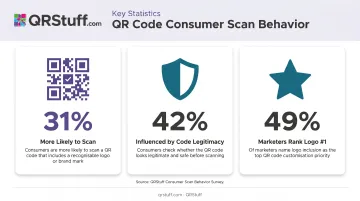
Among marketers, 49% identify adding a business logo as the single most valuable QR code customization element, per Bitly's 2025 data. That's not a preference for aesthetics — it's a recognized driver of performance.
KPIs impacted:
- Total scan volume
- Unique scans per placement
- Scan-through rate
- Scan conversion rate (scans resulting in a completed destination action)
When this matters most: High-density print environments where multiple QR codes from different brands compete for attention — product packaging, event collateral, out-of-home advertising. Brand recognition accelerates the scan decision when the consumer must choose which code to engage with.
Trust Signaling That Reduces Scan Hesitation
Consumer hesitation around QR codes is growing. Quishing (QR phishing) attacks increased 51% in a single month in September 2023 relative to the prior eight months combined, and the FBI issued warnings in 2025 about unsolicited packages containing malicious QR codes. The FTC has explicitly advised consumers to check QR destinations before scanning.
Against that backdrop, generic QR codes carry a structural problem: they're visually indistinguishable from malicious ones. A consumer has no way to assess destination safety from the code image alone.
A 2026 survey found that 53% of users won't scan QR codes from unrecognized sources. Uniqode's 2026 data shows 29% of consumers remain neutral on QR code safety — a segment that responds directly to visible branding, clear CTAs, and branded short domains as trust signals.
What branded codes provide that generic codes cannot:
- A recognizable logo that identifies the sender before the scan
- Brand-consistent colors that confirm the code belongs to a known entity
- A clear call-to-action (e.g., "Scan for nutritional info") that states the destination
- A branded short URL (e.g., qr.yourbrand.com) visible on preview
When a consumer sees all of these, they can answer the core trust question — "is this safe?" — without scanning. That pre-scan clarity is what turns hesitant consumers into active ones.
KPIs impacted: Scan conversion rate, bounce rate post-scan, first-party data capture volume, loyalty program enrollment rate
When this matters most: Healthcare, financial services, new product launches, direct mail to cold audiences, and any context where the brand is meeting the consumer for the first time. Also critical when the QR destination collects personal data — the trust signal at scan entry point is directly connected to form completion rates downstream.
Brand Reinforcement That Compounds Engagement Over Time
Every branded QR code functions as a micro brand impression — not just a prompt to scan, but a visual touchpoint. A consumer who sees a branded code on packaging, again on a receipt, and again on in-store signage builds a cumulative brand association. The code itself becomes familiar. Familiarity increases the willingness to scan on the next encounter.
This compounding effect has practical consequences for data capture. Uniqode's 2026 research found that 83% of consumers are willing to share personal information after scanning a QR code when there is transparency about its use — and branded QR codes create the transparency preconditions that drive that willingness. The brand identity on the code signals who's asking, which reduces the psychological friction around data sharing.
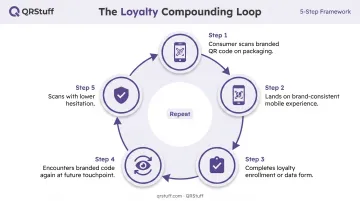
The loyalty compounding loop:
- Consumer scans a branded QR code on packaging
- Lands on a brand-consistent, mobile-optimized experience
- Completes loyalty enrollment or data form (trust is already established)
- Encounters the same branded code design in a future touchpoint
- Scans with lower hesitation because the prior experience was positive
Over 90% of marketers value QR codes for first-party data capture in direct customer interactions, per Uniqode's 2026 findings. Branded codes supply the trust signal that makes consumers willing to hand over that data in the first place.
KPIs impacted: Repeat scan rate, loyalty program enrollment, first-party data capture volume, customer lifetime value, brand recall scores
When this matters most: Brands with long product lifecycles, omnichannel retail presence, or permanent QR codes on physical packaging. The engagement advantage builds with every additional touchpoint. Unlike campaign-specific tactics, it carries forward across interactions.
What Happens When QR Codes Aren't Branded
Generic QR codes give consumers no information before they scan. Attackers exploit this by placing malicious codes over legitimate ones, using redirect chains and typo-squatted URLs that only reveal themselves after the scan. A generic code offers no visual signal to distinguish a safe brand destination from a compromised one.
The costs are concrete:
At the scan decision point:
- 53% of users won't scan from unrecognized sources — generic codes offer no recognition signal
- 42% of consumers consider whether a code looks legitimate before scanning — generic codes provide no legitimacy cue
After the placement:
- Every generic QR code on packaging, signage, or print is a missed brand impression — the placement cost is spent, but no identity value is created
- The same space that could reinforce brand recall simply reinforces anonymity
Post-scan:
- Nearly 4 in 10 users fail to complete a scan due to technical issues, according to recent scan behavior research
- 24% encounter slow loading or poorly optimized pages post-scan, compounding hesitation that began at the code itself
- Consumers who hesitate at scan are more likely to abandon forms, skip loyalty enrollment, and exit before completing any destination action
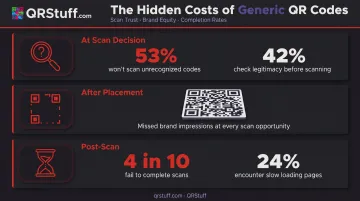
Every unbranded placement is a transaction with no return: the print or signage budget is spent, and the opportunity to build recognition disappears with it.
How to Maximize the Value of Branded QR Codes
Getting the most from branded QR codes comes down to three execution principles:
1. Apply brand elements with functional intent
The logo, colors, and shapes should mirror your established visual identity. A consumer should recognize the brand within two seconds, without reading surrounding copy. QRStuff's customization tools support logo embedding, brand color integration, custom shapes, and frames across its full range of QR code types.
For high-volume deployments, the bulk generation feature applies consistent brand elements across hundreds or thousands of codes simultaneously. This matters for product packaging runs or multi-location signage programs where visual consistency across every SKU or location is non-negotiable.
2. Carry the trust signal through the full scan journey
A branded QR code makes a promise. A poorly designed or slow-loading landing page breaks it. The destination must be mobile-optimized, HTTPS-secured, and visually consistent with the brand identity on the code itself.
Trust established at scan entry evaporates the moment the destination doesn't match expectations. QRStuff's dynamic QR codes let you update destination URLs at any time without reprinting. If a landing page changes — new promotion, corrected URL, updated content — the branded code stays in place and continuity holds.
3. Track scan analytics to optimize over time
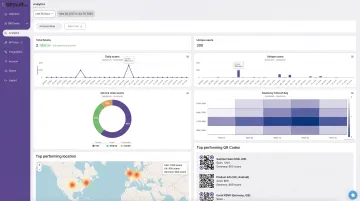
Branded codes only compound their advantage when placements and destination pages are measured and refined. QRStuff's real-time analytics dashboard provides:
- Total and unique scan tracking (distinguish reach from repeat engagement)
- Geographic data at country and city level
- Device and OS breakdowns (inform landing page optimization)
- Time-based insights (identify peak engagement windows)
- CSV export for integration with business intelligence tools
Monitor unique vs. repeat scan ratios across placements to identify which deployments drive the strongest engagement. Replicate those conditions across additional touchpoints to extend the trust signal further.
Conclusion
Branded QR codes outperform generic ones across the metrics that matter: scan rates, conversion data, loyalty enrollment, and first-party data capture. Visual differentiation drives the initial decision to scan. Trust signals reduce hesitation at the point of action. Consistent brand reinforcement turns one-time scanners into repeat engagers. Each of these outcomes is trackable.
Treating branded QR codes as a permanent brand asset — not a one-off campaign decision — is what lets these gains build over time. Every consistent, recognizable touchpoint on packaging, signage, receipts, or event materials makes the next scan easier to earn. Platforms like QRStuff make it straightforward to build that consistency at scale, with custom design controls, dynamic destination editing, and scan analytics to measure what's working.
Frequently Asked Questions
What is the significance of customer trust in branding?
Trust drives purchase decisions, loyalty, and willingness to share data. According to Salsify's 2025 research, 87% of shoppers will pay more for products from trusted brands — and consistent brand signals like branded QR codes reinforce that trust at every touchpoint.
How does QR code traceability drive consumer trust and transparency in supply chains?
QR codes on product packaging link consumers directly to verifiable supply chain data — ingredient sourcing, manufacturing certifications, sustainability credentials. GS1 US found that 66% of US adults would scan a QR code on food packaging for freshness and ingredient details, and branded codes increase that scan rate because visible brand identity signals legitimacy upfront.
Do branded QR codes get more scans than generic ones?
Yes. Uniqode's 2026 data shows 31% of consumers are more likely to scan a code with visible branding, and 42% factor in whether the code looks legitimate and safe. Generic codes provide neither signal, so scan rates depend entirely on luck.
What design elements make a QR code look more trustworthy to consumers?
Four elements work together to answer the consumer's core question — "who is this from?":
- Embedded brand logo that's immediately recognizable
- Brand-consistent colors that match packaging or materials
- Clear call-to-action stating what the scan delivers
- Matching destination — a landing page that reflects the brand on the code
Each element reduces hesitation independently; combined, they eliminate it.
Can adding a logo or custom design affect a QR code's scannability?
No, when applied correctly. QR codes have built-in error correction that allows up to 30% of the code pattern to be modified while remaining fully scannable. QRStuff automatically raises the error correction level when you upload a logo, and recommends keeping embedded images below 20% of the total code area as best practice for reliable scanning across all conditions.
How do I measure whether my branded QR code is improving customer engagement?
Track total vs. unique scans (to distinguish reach from repeat engagement), post-scan conversion rates (loyalty enrollment, form completions, review submissions), and geographic or device breakdowns. QRStuff's real-time analytics dashboard provides all of these metrics without technical integration, updating to the minute so you can monitor performance as campaigns run.