The digital business card market is projected to reach USD 1.03 billion by 2034, growing at 11.4% annually — a signal that something more durable is replacing the paper card as the default networking tool. According to that same research, digital card recipients are 55% more likely to retain contact information, and faster follow-up enabled by digital sharing drives a 14% higher conversion rate.
Digital cards tend to get dismissed as a novelty. They're not. Their real value shows up in metrics professionals actually track: leads captured per event, reprint costs avoided, follow-up conversion rates, and whether a first impression turned into a deal.
This article covers all 8 concrete benefits — grounded in day-to-day professional scenarios.
Key Takeaways
- Digital business cards are shareable contact profiles delivered via QR code, link, or NFC — always on you, always current
- Unlike paper, they never run out and update in real time without reprinting
- Scan and click analytics show exactly which contacts engaged and when
- Over 12 months, they cost far less than paper — especially for teams with frequent role or title changes
- Paired with a dynamic QR code, one card works across events, email signatures, print, and social media
What Is a Digital Business Card?
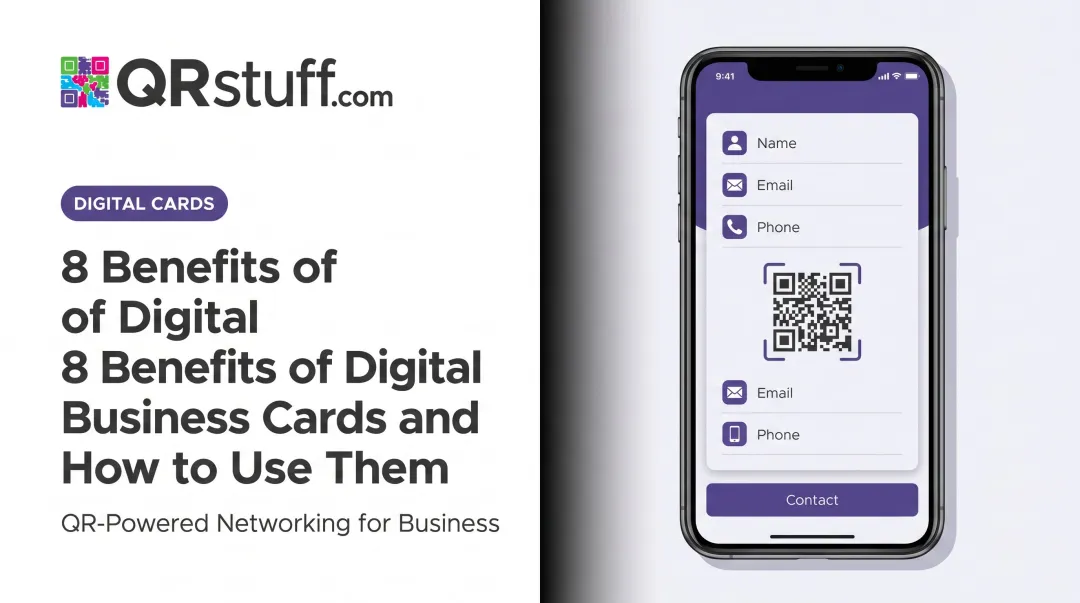
A digital business card is a mobile-accessible contact profile — containing your name, title, phone number, email, website, and social links — delivered to someone via a QR code scan, a short URL, or an NFC tap. No manual data entry required.
They show up in practical contexts you already use:
- In-person events — display your QR code on your phone screen for an instant scan
- Email signatures — every email becomes a networking touchpoint
- Printed materials — a QR code on a flyer or badge bridges physical and digital
- LinkedIn and SMS — share your profile link in any digital channel
The goal is straightforward: get accurate contact information to the right people, know whether they acted on it, and make sure your details don't get lost.
8 Benefits of Digital Business Cards
Each benefit below connects to a measurable outcome — cost, conversion, brand accuracy, or sustainability — not just a feature list.
Benefit 1: You Never Run Out
A digital business card lives on your phone and shares an unlimited number of times. Via QR code, link, or tap, there's no physical supply to deplete.
At a trade show or multi-day conference, running out of paper cards mid-conversation is a genuine problem. With a digital card, every prospect gets your information regardless of how many people you meet.
The practical impact: more contacts captured per event, fewer missed follow-up opportunities, and no scramble to reorder before the next day.
Benefit 2: Always Current — Real-Time Updates Without Reprinting
When your phone number changes, your title updates, or your website relaunches, a digital business card reflects those changes instantly. Every previous share — every QR code already printed or distributed — now points to the new information automatically.
This works because of how dynamic QR codes function. The code image never changes — only the destination it points to. Update your contact details in QRStuff's dashboard, and the code already on your printed card or email signature pulls current information at every scan.
The hidden cost of getting this wrong is real. A prospect who dials a disconnected number or hits a dead website URL doesn't follow up — they move on. Real-time updates eliminate that leak entirely.
According to the U.S. Bureau of Labor Statistics, median job tenure is just 3.9 years, with 22% of workers having been at their current employer for 12 months or less. For anyone in that category, static printed contact details become outdated fast.
Benefit 3: Trackable Engagement and Networking Analytics
Paper cards generate zero data after they leave your hand. Digital cards — particularly those shared via QR code — generate scan data: who engaged, when, from where, and which links they clicked.
In practice: a sales team returns from a conference and instead of guessing which leads are warm, they review scan frequency and click-through patterns. High scan counts and link clicks signal intent. Single passive scans don't.
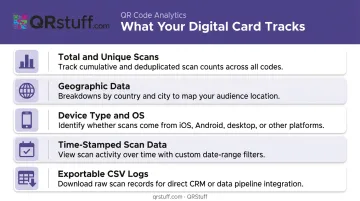
QRStuff's analytics dashboard tracks:
- Total and unique scans (new contacts vs. repeat engagement)
- Geographic data at country and city level
- Device type and operating system breakdowns
- Time-stamped scan data with daily, weekly, and custom views
- Exportable CSV logs for CRM integration
A 2025 B2B lead-scoring study achieved 98.39% accuracy identifying high-quality leads using engagement signals — with lead source among the most predictive features. Scan data from digital cards gives your team that same starting point for prioritization. Paper cards cannot.
Benefit 4: Significant Cost Savings Over Paper Cards
Paper card printing looks cheap per unit — but the real cost adds up across a team, especially when roles and branding change.
Current printer pricing gives useful anchors:
| Provider | Quantity | Price |
|---|---|---|
| Staples | 500 cards | $24.99 |
| GotPrint | 500 cards | from $24.85 |
| MOO | 1,000 cards | $263.00 |
Scale that across a 50-person team using premium cards, with one reorder per year per employee: you're looking at over $13,000 annually — before accounting for mid-year reprints triggered by title changes or rebrands.
A digital card setup covers unlimited sharing with zero reprint costs. For teams of 10 or more with any frequency of role changes, the cost-per-contact comparison shifts decisively within 12 months.
Benefit 5: Eco-Friendly and Aligned with Sustainability Goals
A comparative life cycle assessment of paper vs. digital business cards found that at scale — the realistic scenario for most businesses — digital cards are more environmentally friendly and more economical in energy consumption than their paper counterparts.
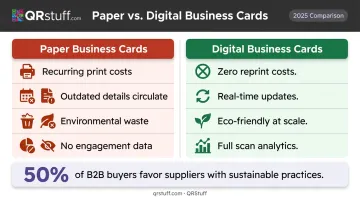
This goes beyond environmental conscience. According to Bain, 50% of B2B buyers currently assign more business to suppliers with sustainable practices, with that figure expected to rise to two-thirds within three years. Switching to digital cards isn't just a green choice — for enterprise sales, it's increasingly a procurement-relevant signal.
Benefit 6: Richer Content Than a Paper Card Can Offer
Digital business cards aren't limited to a name and phone number. They can include:
- Portfolio links and case study URLs
- Video introduction links
- Booking calendar integrations
- Multiple social media profiles
- Company overview pages
This is particularly valuable for designers, consultants, real estate agents, and speakers — anyone whose work is better shown than described. A prospect can sample your work before a follow-up call even happens.
Vidyard research found that video as a first sales touchpoint produced a 216% higher response rate and 37% higher click-through compared to standard outreach. The principle translates: a richer first impression increases the probability of a second conversation.
QRStuff's Digital Business Card option supports rich media links and multiple social profiles, making it the more comprehensive choice for professionals who need more than standard contact fields.
Benefit 7: Sharing Across Every Channel — Without Modification
Digital business cards work across every modern communication surface without any format changes:
- In-person events — display QR code on phone for a scan
- Email signatures — research from Exclaimer shows personalized signatures achieve an average 4% CTR, compared to 2.5% for mass email
- LinkedIn and social profiles — share your card link directly in your profile or DMs
- Zoom and virtual meetings — paste your link into the chat
- Printed materials — embed the QR code on a badge, flyer, or mailer
Paper cards work exactly one way: handed from one person to another, in person. Digital cards have no such limitation. This flexibility is especially relevant in hybrid work environments, where 55% of workers say meeting new people is better suited for the office — but not every professional relationship starts with an in-person handshake.
Benefit 8: Consistent Professional Branding at Scale
When each employee designs their own paper card, brand standards drift. Font choices vary, logos get stretched, and messaging diverges. Digital card templates fix this at the source.
QRStuff's platform allows enterprise administrators to:
- Set standardized templates with locked brand colors, logos, and messaging
- Enforce non-editable fields so core brand elements stay consistent
- Provision cards to new team members from a central asset library
- Access scan analytics per cardholder across the full team
For enterprise organisations, the Enterprise tier supports bulk provisioning of up to 1,000 dynamic QR codes, with role-based access and centralized management. Every employee presents the same branded profile — regardless of event, channel, or territory.
What Happens When Digital Business Cards Are Missing
Teams that rely exclusively on paper cards absorb a compounding set of disadvantages:
- Outdated contact information keeps circulating. A role change or number update has no correction mechanism — prospects encounter dead ends with no way to reach you
- Zero engagement visibility. No way to know if any card led to an actual follow-up or conversion
- Reprint costs accumulate. Every title change, rebrand, or team expansion triggers a new print run — multiplied across a team, this is significant recurring spend
- Cards run out mid-event. The awkwardness of having nothing to hand a prospect at the end of a conference is a real pipeline cost
- Competitors who've switched look sharper. How you share contact information shapes first impressions — handing over a QR code reads as prepared and current; fishing for a paper card does not
How to Get the Most Value from Your Digital Business Card
The highest-value setup pairs a digital business card with a QR code that can appear anywhere: email signatures, conference badges, printed collateral, phone screens, and LinkedIn profiles.
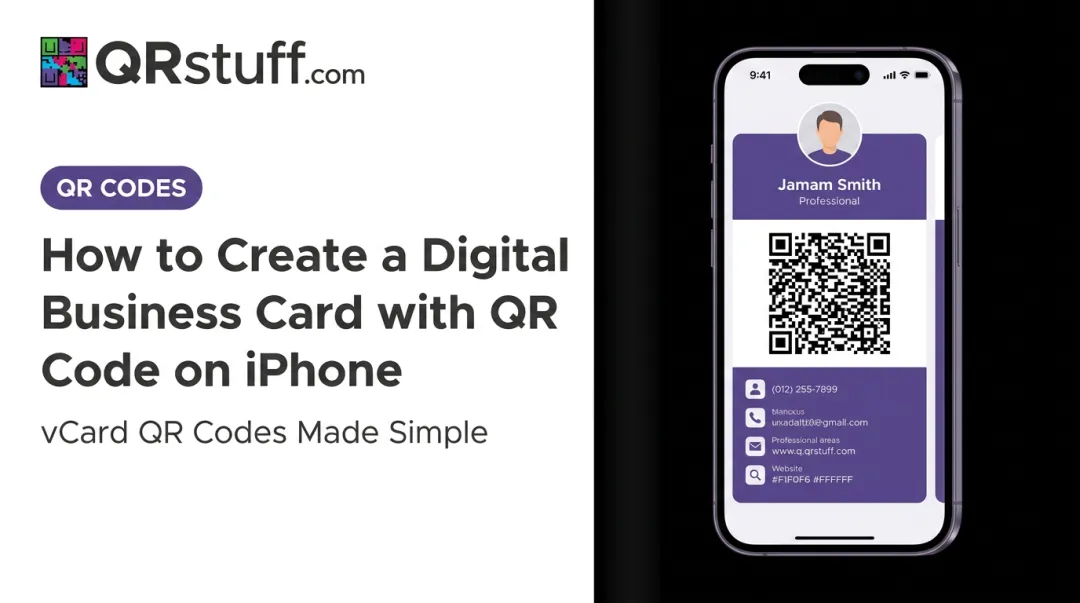
QRStuff's vCard QR codes encode a full contact profile into a scannable code that works across all these surfaces. Recipients scan it with any smartphone camera — no app download required — and the contact saves instantly.
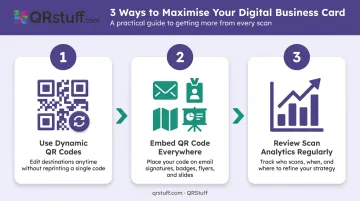
Three practices that maximize long-term value:
- Use dynamic QR codes, not static ones. Dynamic codes let you update the destination (your contact details) without reprinting the code. QRStuff recommends a dynamic vCard for any professional use case.
- Embed the QR code everywhere it belongs. Email signature, badge lanyard, back of a presentation slide, printed flyers — the more surfaces the code appears on, the more touchpoints you create from a single setup.
- Review scan analytics as an ongoing practice. Which events drive the most scans? Which email campaigns generate profile views? Reviewing QRStuff's dashboard regularly — daily, weekly, or after each event — turns your digital card into a feedback loop that informs where to show up next.
Frequently Asked Questions
What are the benefits of using a digital business card?
The core benefits: unlimited sharing that never runs out, real-time contact updates without reprinting, engagement tracking via scan analytics, significant cost savings over paper for teams, and reduced environmental impact. When delivered via QR code, digital cards also work simultaneously across physical and digital touchpoints.
What features should a digital business card include for professional networking?
Look for instant sharing via QR code or link (no app required for recipients), editable contact details that update in real time, scan and click analytics, multimedia link support, and brand customization. QR code-based cards add the specific advantage of working on printed materials as well as screens.
Are digital business cards better than paper?
For most professional use cases, yes. Digital cards cannot be lost or discarded, stay accurate without reprinting, generate engagement data, and cost less over time — unlike paper cards, which become obsolete the moment any detail changes.
How do I share a digital business card using a QR code?
Create a vCard QR code linking to your contact profile, then display it on your phone screen or embed it in printed materials. Recipients scan it with their smartphone camera to instantly save your details. No app download required.
Can I update a digital business card after I've already shared it?
Yes — with dynamic QR codes, the code image stays unchanged while the linked profile updates in real time. Any card, badge, or printed material already in circulation automatically reflects your latest contact information without being reprinted or reissued.
Are digital business cards eco-friendly?
Yes. They eliminate the paper, ink, and logistics of physical card printing entirely. A life cycle assessment found that at realistic business scale, digital cards are more environmentally friendly and more economical in energy use than paper alternatives.