Introduction
Packaging used to have one job: protect the product. Now it's expected to tell the brand story, prove sustainability claims, verify authenticity, run loyalty campaigns, and answer ingredient questions — all within a few square centimetres of label space.
That tension is real. Regulatory requirements, barcodes, and branding already compete for every millimetre. Yet 76% of consumers want more information to inform food purchases, according to a 2025 GS1 US survey — and they're increasingly reaching for their phones to find it.
QR codes resolve this contradiction. A single scannable square adds an unlimited digital layer to a fixed physical surface, turning a static label into a live information layer — without touching the print design.
What follows breaks down what QR codes can actually do on packaging, how they deepen consumer engagement, and what separates a smart implementation from a wasted print opportunity.
Key Takeaways
- QR codes extend packaging to deliver ingredient data, sustainability content, and promotions — no label redesign needed
- Dynamic QR codes let brands update linked content after printing, making them ideal for seasonal campaigns and evolving compliance requirements
- Every scan generates actionable data: location, device type, volume, and timing — none of which traditional packaging can provide
- Best results combine a clear call-to-action, a fast mobile-optimized destination, and ongoing scan analytics
Why Packaging Has Become a Digital Touchpoint
Physical labels face a structural problem. Mandatory regulatory disclosures, ingredient lists, allergen warnings, net weight, barcodes, and branding all share the same finite surface. There's no room left for the content modern consumers actually want before they buy.
That gap is widening. The same GS1 US survey found 71% of consumers are reading labels more closely due to rising food costs — and when the label can't answer their questions, many simply choose a competitor that can. Pew Research reports that 91% of U.S. adults own a smartphone, meaning the infrastructure for mobile-first packaging interaction is already in consumers' pockets.
A QR code sits on the existing label and links to unlimited digital content. The printed code stays constant; the digital destination can carry unlimited content — and change whenever needed.
What this means practically:
- Brands add a digital layer without reprinting or redesigning packaging
- Consumers get the depth of information they want, on demand
- Every scan creates a data event that static labels never generate
That last point — scan data — is what separates QR codes from every other packaging element: the label tells consumers something, but the QR code tells brands something back.
What QR Codes Can Actually Do on Packaging
The most common mistake brands make with packaging QR codes is treating them as a link to the homepage. The real opportunity is far broader.
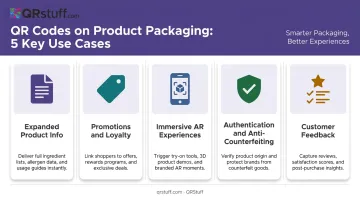
Expanded Product Information
The highest-value use case: give consumers the information that doesn't fit on the label. A 2021 SmartLabel study found the top content categories consumers wanted from scanned product information were in-depth nutritional data (42%), ingredient sourcing (39%), and ingredient definitions (38%).
Content that translates well to QR-linked pages includes:
- Detailed ingredient definitions and sourcing origins
- Full allergen data and nutritional breakdowns
- Usage instructions and storage guidance
- Certifications and third-party lab results
For food, health, and pharma brands, that depth of information is a genuine competitive differentiator.
Promotions and Loyalty
QR codes capture consumers at peak intent: product in hand. That moment is ideal for:
- Unlocking a discount or exclusive offer
- Entering a sweepstake or competition
- Connecting to a loyalty programme
- Delivering a coupon redeemable on the next purchase
The code doesn't require any separate app download — a native camera scan is enough.
Immersive Brand Experiences
Several major brands have used packaging QR codes to trigger AR experiences. Coca-Cola's 2025 Star Wars limited-edition packaging used scannable QR codes to launch an augmented reality experience. Jack Daniel's built an AR storytelling experience accessible directly from the bottle. These interactions keep consumers engaged long after they've left the store.
The AR packaging market was valued at $354.9M in 2024, projected to reach $510M by 2030, according to Grand View Research — which means brands that invest now are ahead of the curve, not chasing it.
Authentication and Anti-Counterfeiting
In cosmetics, spirits, and pharmaceuticals, QR codes linked to authentication records let consumers confirm a product is genuine before using it. Danone implemented dual QR codes on baby formula packaging: one outer code for production and expiry data, and a tamper-evident inner code for unique authenticity validation. The approach builds consumer trust and protects brand equity in high-risk categories.
Customer Feedback
A QR code can direct consumers to a short post-purchase survey immediately after use — when experience is fresh. This generates more actionable data than email surveys sent days later, and creates a direct channel from product to brand team without requiring any retail intermediary.
How QR Codes Drive Consumer Engagement and Brand Loyalty
The Post-Purchase Window
Most brand-consumer interaction ends at checkout. QR codes on packaging extend it into the home, often at the exact moment a customer uses the product for the first time.
Brands use this window to:
- Onboard new customers with setup guides or recipe content
- Share brand story videos and founder content
- Cross-sell complementary products
- Prompt social sharing with a specific hashtag or community tag
This post-purchase engagement is difficult to replicate through any other channel because the physical product creates the touchpoint.
Personalized Content From a Single Package
Dynamic QR codes can serve different content based on scan context — campaign parameters, geographic location, or device type — from the same printed code. A brand running separate campaigns in different regions doesn't need separate packaging runs. One code, multiple experiences.
This flexibility extends to A/B testing landing pages, rotating seasonal promotions, and localizing content for different markets, all without touching the physical package.
Social Proof at Scale
Personalized content also sets the stage for social proof. QR codes can direct consumers to review platforms, user-generated content galleries, or brand communities. Customers reached immediately post-purchase — while the experience is still fresh — are far more likely to leave reviews than those contacted days later through email.
The Data Feedback Loop
This is where QR codes outperform traditional packaging. Every scan generates:
| Data Point | What It Tells You |
|---|---|
| Scan volume | Overall campaign reach |
| Unique vs. repeat scans | Audience depth and loyalty |
| Geographic distribution | Regional performance and market penetration |
| Device type (iOS vs. Android) | Informs mobile page optimization |
| Time of scan | Identifies peak engagement windows |
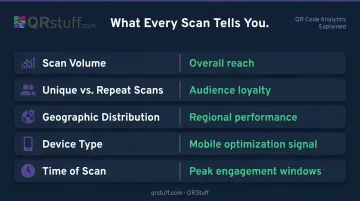
Traditional packaging generates zero data after it leaves the print facility. With QR codes, every interaction becomes a signal you can act on — adjusting campaigns, refining content, or identifying which markets need more attention.
QRStuff's analytics dashboard surfaces all of these metrics in real time, with flexible date range views, CSV export for external BI tools, and UTM parameter support for Google Analytics compatibility.
Using QR Codes for Sustainability and Traceability
The Sustainability Communication Problem
Sustainability claims on packaging suffer from a credibility gap. Vague statements like "eco-friendly" or "responsibly sourced" carry little weight with informed consumers — and carry legal risk in jurisdictions tightening greenwashing regulations.
A QR code solves this by linking to a regularly updated sustainability hub with specific, verifiable data: material certifications, carbon footprint calculations, recycling instructions, and third-party audit results. The label stays clean; the evidence lives online.
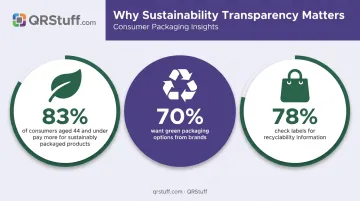
78% of consumers check packaging labels for recyclability information, according to a Consumer Brands Association and The Recycling Partnership study. The Recycle Check programme demonstrates this in practice — consumers scan a package QR code, enter their postcode, and receive localised recycling instructions specific to their area's facilities.
Traceability in Food and Pharma
Nestle's Zoegas coffee packaging allowed consumers to trace their coffee from specific growing locations through to the factory, including farmer details, harvest time, and roasting periods. Danone's Track & Connect system linked individual baby formula packs to full production and authenticity records.
NIQ data from 2022 found 83% of consumers aged 44 and younger would spend more on sustainably packaged products, and 70% wanted green packaging options. Traceability QR codes make this preference commercially actionable.
Regulatory Momentum
EU Regulation 2024/1781 defines Digital Product Passports as product-specific data accessible electronically through a data carrier — and explicitly supports QR codes on products, packaging, or documentation as the delivery mechanism. For EU-facing brands, packaging QR infrastructure is now a compliance requirement, not just a marketing option.
This is where GS1 Digital Link support becomes a practical advantage. QRStuff generates GS1-standard QR codes that meet both retail and regulatory needs in a single code:
- Encodes GTIN, batch number, expiry date, and serial data in one scannable unit
- Links to consumer-facing product pages for transparency and engagement
- Scannable at retail POS systems without additional infrastructure
- Structured to align with Digital Product Passport data requirements
Dynamic vs. Static QR Codes: The Key Distinction for Brands
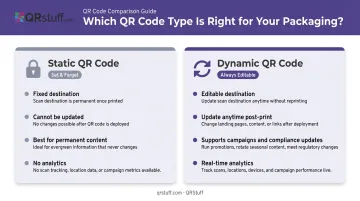
The choice between static and dynamic QR codes determines how much control a brand retains over its packaging after it ships — and the difference is significant.
Static QR Codes
The destination URL is permanently encoded at creation. Once printed, it cannot be changed. If the linked page moves, the campaign ends, or the content becomes outdated, the code on every unit in circulation becomes a dead end.
Static codes are appropriate for genuinely evergreen content — a permanent product manual URL, a fixed brand website — where the destination will never need updating.
Dynamic QR Codes
The printed code points to a short redirect URL. The final destination can be updated at any time, unlimited times, without touching the packaging.
What this makes possible:
- Swap a summer campaign for a winter promotion using the same printed code
- Redirect to updated recycling instructions when regulations change
- Correct a URL error discovered after a print run ships
- Rotate content based on time of year or product lifecycle stage
GS1's 2023 best-practices guide confirms that brands can update where a GS1 Digital Link URI redirects without changing packaging — directly supporting this flexibility.
Dynamic codes also enable real-time scan analytics. QRStuff's dynamic QR codes provide scan volume, geographic distribution, device breakdowns, and time-based data as standard. Each packaging unit becomes a live performance metric, not a fixed print asset.
For most packaging applications, dynamic codes are the practical choice. Reserve static codes for destinations that are genuinely permanent — everything else benefits from the flexibility to update.
Best Practices for QR Codes on Packaging
Design and Placement
Minimum size: QRStuff recommends a minimum of 2 × 2 cm for close-range scanning. For packaging viewed from greater distances — shelf-facing panels, outer cases — apply the 10:1 rule: a code scanned from 3 metres should be at least 30 cm wide.
Placement rules:
- Avoid edges, fold lines, seams, and curved surfaces where distortion occurs
- Maintain sufficient contrast — dark code on light background is the most reliable combination
- Keep clear of existing barcodes (GS1 UK guidance requires POS-intended QR codes to be within 50mm of the linear barcode centre)
- Always include a quiet zone on all four sides (minimum 4× the module size)
Call-to-action: A code without context gets ignored. "Scan to verify your product" or "Scan for a free recipe" consistently outperforms a bare code with no instruction. Tell consumers what they'll get before they scan.
QRStuff supports brand-matched QR code design — custom colours, logo embedding, and shape variations — all while maintaining scannability. Export codes as SVG or EPS at 300 DPI minimum for professional print applications.
The Mobile Experience
The QR code is only as good as the page it opens. Four things matter most:
- Mobile-optimised layout — assume 100% of scans come from smartphones
- Load time under 3 seconds — slow pages have high abandonment rates
- Immediate value on landing — don't redirect to a generic homepage
- No app download required — friction kills conversion
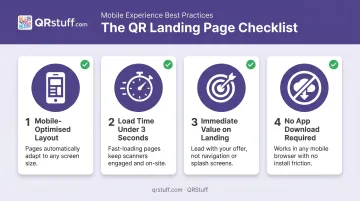
Every element above affects whether a first-time scanner becomes a repeat customer — or abandons the experience entirely.
Testing Before Print
Before committing to a production run, test every code at actual print size. QRStuff's platform lets you validate the destination URL before exporting, but physical testing is still essential. Run checks across:
- Multiple devices — both iOS and Android native cameras
- Real scanning distance — test at the distance consumers will actually hold their phones
- Varying conditions — different lighting levels and angles
Catching a broken URL or contrast issue pre-print costs nothing. Finding it on shelf costs a full reprint.
Frequently Asked Questions
How do you use QR codes on packaging?
Generate a QR code linked to your destination URL, then place it visibly on your packaging artwork with a clear call-to-action. Choose your destination, customize the code, test it at print size across multiple devices, and position it where consumers will see it. Dynamic codes let you update the destination after printing — no reprinting required.
What are the 4 C's of packaging?
The 4 C's are Containment, Convenience, Communication, and Consumer appeal. QR codes directly amplify the Communication dimension — extending the information and interaction a package can deliver well beyond what fits on the label.
What is the difference between static and dynamic QR codes for packaging?
Static codes have a fixed destination encoded permanently at creation — once printed, they cannot be changed. Dynamic codes use a redirect layer, allowing the linked URL to be updated at any time after printing. For packaging where campaigns evolve or content needs refreshing, dynamic codes are the practical choice.
Can QR codes on packaging replace printed product information?
No. QR codes should supplement, not replace, mandatory regulatory information — ingredients, allergens, expiration dates, and safety data must remain printed on-pack. QR codes are best used to extend beyond those required disclosures with richer, optional content that adds value without replacing compliance obligations.
How do I measure QR code success on packaging?
Key metrics include total scan volume, unique scans, geographic distribution, device type, and time of scan. QRStuff's analytics dashboard tracks all of these in real time, with CSV export and Google Analytics UTM compatibility for integration with existing reporting workflows.
What size should a QR code be on packaging?
The general minimum for close-range scanning is 2 × 2 cm. For packaging viewed from further away — outer cartons or shelf-facing surfaces — scale up proportionally using the 10:1 rule. Always test at actual print size before the production run.