The shift is measurable. According to Bitly's 2026 statistics report, over 90% of marketers now use QR codes, with 94% increasing usage in the prior 12 months. That's not a trend — that's a standard channel. What's changed is how marketers are using them: capturing first-party data, building attribution models, and connecting offline touchpoints directly to digital pipelines.
For teams still treating QR codes as a one-way redirect, this article covers four trends reshaping how codes generate and measure leads in 2026.
Key Takeaways
- Dynamic QR codes now hold 65% of market share and are replacing static codes as the default for any measurable lead gen campaign
- QR-triggered form submissions are emerging as a primary source of consent-based, intent-rich first-party data as privacy restrictions tighten
- Analytics now go well beyond scan counts: marketers track unique users, geographic distribution, device splits, and post-scan conversion rates
- CRM integration via UTM parameters, Zapier, and retargeting pixels is turning scan events into automated pipeline entries
Trend 1: Dynamic QR Codes Are Replacing Static Codes as the Lead Gen Standard
What's Actually Changing
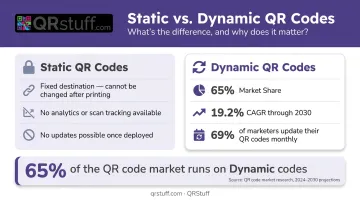
Static QR codes encode the destination permanently in the pattern itself. Once printed, you're locked in. Dynamic codes store a short redirect URL that you can update at any time through a dashboard, without touching the physical asset.
That distinction has a direct impact on lead generation. Bitly's data, citing Mordor Intelligence, shows dynamic codes held 65% of QR market share in 2024, growing at a 19.2% CAGR through 2030. Separately, 69% of marketers update or redirect their dynamic QR codes at least monthly — a sign that iterative optimization has become standard practice.
Why This Changes Lead Gen Campaigns
For lead generation, the advantages are concrete:
- A trade show banner can redirect to a post-event follow-up page the day the show ends, without reprinting
- A seasonal offer flyer can point to an updated landing page mid-campaign if conversion rates disappoint
- The same printed code can route different audiences to different pages based on destination updates, enabling segmented campaigns from a single print run
For lead generation specifically, the ability to swap landing pages without touching physical assets means you can A/B test destinations across a campaign's lifespan. On QRStuff, destination changes happen through the dashboard — marketers route scans to variant pages and compare conversion outcomes using UTM tags and analytics, with no dependency on reprinting.
The Analytics Layer Built Into Dynamic Codes
Beyond destination control, dynamic codes capture scan analytics that static codes cannot.
QRStuff's dynamic QR analytics capture:
- Total and unique scans — distinguishing new audience reach from repeat engagement
- Device and OS breakdown — iOS vs. Android vs. desktop, which informs landing page design
- Geographic data — country and city-level, useful for territory prioritization
- Scan timestamps — identifying peak engagement windows for follow-up timing
All of this populates in real time. For teams running time-sensitive campaigns, that immediacy matters — you can spot a drop in scan rate during a trade show day and investigate immediately, adjusting copy, destination, or timing before the campaign window closes.
Trend 2: QR Codes Are Becoming a Primary Channel for First-Party Data Collection
The Privacy Context (Without Overstating It)
Third-party cookies haven't disappeared entirely — Google's 2025 Privacy Sandbox update confirmed Chrome will maintain user choice rather than proceeding with full deprecation. But privacy fragmentation, browser restrictions, and tightening regulations are making third-party data signals less reliable across the board.
Econsultancy data cited by eMarketer shows 62% of brand marketers expect first-party data to become more important over the next two years. QR codes are emerging as one of the cleanest collection mechanisms — because the prospect made an active, physical choice to scan.
How QR-Triggered Data Capture Works
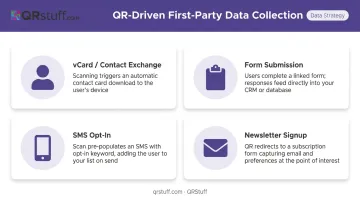
Brands are deploying codes on product packaging, in-store displays, out-of-home advertising, and event materials to route prospects into direct data collection flows:
- vCard/contact QR codes — prospect scans, contact details save directly to their device; platforms like QRStuff support two-way contact exchange where both parties share information
- Form submission codes — link directly to a lead form; QRStuff's built-in form functionality connects to Google Sheets for centralized data capture without requiring external tools
- SMS opt-in codes — pre-filled text triggers a subscription, capturing the prospect's mobile number
- Newsletter signup codes — dedicated QR type for email list building at events or on print materials
The JLO Beauty and Flowcode subway campaign in New York is one of the better-documented examples of physical media QR deployment at scale — codes placed across MTA shuttles routed users to a mobile experience where they could shop, view content, and share contact information directly.
The Compliance Advantage
A deliberate scan carries explicit intent, which matters when regulators come looking. Paired with GDPR-compliant form flows, that intent becomes documented, auditable proof of consent. QRStuff stores data on European servers, processes personal data under a consent-based model, and lets users withdraw consent at any time — with full audit trails to back it up.
For enterprise teams operating across multiple jurisdictions, this matters. As of January 2026, eMarketer reports 20 US states enforcing comprehensive privacy laws, with 8 new state laws taking effect in 2025 alone. For teams managing campaigns across those jurisdictions, QR-driven collection isn't just a marketing tactic — it's a compliance infrastructure decision.
Trend 3: QR Analytics Are Maturing — From Scan Counts to Full-Funnel Intelligence
What Marketers Are Actually Measuring Now
Early QR analytics were a single number: total scans. That's changed significantly. Bitly's research shows marketers now prioritize unique users (54%), post-scan conversion rate (52%), total scans (50%), and scan time/date patterns (50%) as their key QR metrics. Uniqode's 2026 State of QR Codes report adds that 22% of marketers now measure conversion and 12% track revenue directly attributable to QR campaigns.
The question has shifted from "how many people scanned?" to "which scans drove revenue?" — and the metrics frameworks below reflect that shift.
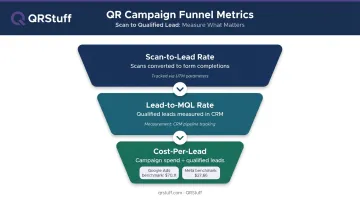
The Three Metrics Every QR Lead Gen Campaign Should Track
Scan-to-lead rate — percentage of scans resulting in a completed form or contact save. Bridge QRStuff scan data with landing page form data using UTM parameters to calculate this accurately.
Lead-to-MQL rate — whether QR-sourced leads meet your qualification criteria. This lives in your CRM and tells you if the scanning audience is the audience you want.
Cost-per-lead — total campaign spend divided by qualified leads. WordStream's 2025 data puts average Google Ads CPL at $70.11 and Meta lead campaigns at $27.66. No cross-industry QR CPL benchmark exists publicly, so measure against your own campaign economics.
Building the Attribution Model
QRStuff's analytics dashboard provides the first layer of this model: total scans, unique scans, geographic distribution by country and city, device/OS breakdown, and time-based patterns. For teams that need to push this data further, the platform offers:
- CSV and PDF exports for BI tool integration
- API access (Enterprise tier) with webhooks for real-time scan events, pulling data directly into existing pipelines
- UTM parameter support for tagging QR-sourced traffic by campaign, source, and medium in Google Analytics or CRM attribution
QRStuff tracks what happens at the code. Google Analytics or HubSpot tracks what happens after the click. Connecting both via UTM parameters closes the attribution loop.
Trend 4: QR Codes Are Being Embedded Into CRM, Retargeting, and Automation Pipelines
From Isolated Scan Events to Pipeline Infrastructure
The biggest historical weakness of QR-based lead gen wasn't the scan rate — it was what happened afterward. A prospect scanned, maybe visited a page, and then disappeared into the void with no follow-up trigger. That gap is closing.
In 2026, marketers are connecting scan events to downstream systems through several mechanisms:
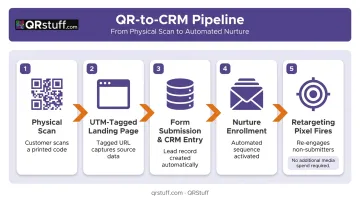
- UTM-tagged destination URLs that attribute QR traffic by campaign and source in Google Analytics and CRM platforms
- Zapier, Workato, and Make integrations (available on QRStuff's Full Suite and Enterprise plans) that connect form submissions to HubSpot, Salesforce, and other CRMs automatically
- Meta Pixel and Google Ads integrations that fire retargeting audiences from QR landing page visits — even when the form is not completed
The practical flow: prospect scans trade show banner → lands on UTM-tagged page → submits form that triggers a CRM entry and nurture enrollment → retargeting pixel fires to capture non-submitters for digital ad follow-up. That single physical touchpoint generates compounding digital reach — at no additional media spend.
What This Solves
The persistent challenge in QR-based lead gen has been attribution: proving what happens after the scan. When a scan triggers a CRM entry and a retargeting audience simultaneously, you have visibility into both the immediate conversion and the downstream follow-up — not just a raw scan count.
Synchrony's Direct to Device implementation illustrates the operational model well — customers scan an in-store QR code, access a custom credit application, and can complete a same-day purchase if approved. The QR code functions as a direct transaction step, not a passive brand touchpoint.
What's Driving These Trends — and What's Ahead
Three Forces Behind the QR Resurgence
Privacy pressure is making owned, consent-based data channels more attractive. With 20 US states now enforcing comprehensive privacy laws and enforcement actions increasing — California fined Honda $632,500 and Todd Snyder $345,178 for privacy violations in 2025 — marketers need data provenance they can defend.
Scanner familiarity has reached the threshold needed for mainstream campaigns. eMarketer projected the share of US adult smartphone users scanning QR codes would reach 42.6% by 2025, growing at an 8.7% CAGR. The friction of explaining what a QR code is has disappeared.
Easier integration has lowered the technical barrier. Forrester projected the low-code and digital process automation market could approach $50B by 2028, a sign of how accessible no-code CRM and form tools have become. Connecting a QR scan to a HubSpot enrollment now takes a Zapier workflow, not a development sprint.
Signals Worth Watching
The next two to three years will likely see QR use cases expand well beyond simple URL redirects:
- AI-adapted landing pages that adjust content based on scan context — device, location, time of day, or prior scan behavior from the same user
- Hyper-local QR campaigns using geolocation data from the scan event to trigger location-specific offers or routing
- Lifecycle QR applications that extend beyond acquisition into retention and upsell — codes triggered by ownership milestones, warranty registrations, or post-purchase events
As these use cases mature, compliance is becoming a harder procurement requirement — not just a checkbox. Enterprise procurement teams are asking for GDPR compliance, SOC2 certification, and documented audit trails before signing. QRStuff's certifications and European data storage options directly address what those checklists now require.
Conclusion
QR codes in 2026 are a measurable, scalable component of modern lead generation. Dynamic codes, first-party data capture, mature analytics, and CRM integration have collectively made them a legitimate pipeline tool — not a print-campaign afterthought.
The businesses gaining the most ground treat each scan as the start of a digital conversation. The infrastructure to support that approach — real-time analytics, automated follow-up, compliant data capture — is accessible at every business size, from independent retailers to enterprise teams.
The gap between brands using QR codes as decoration and those using them as pipeline infrastructure is widening. Closing that gap starts with one practical step: treat your next QR deployment as a data asset, not a shortcut to a URL.
Frequently Asked Questions
How do QR codes capture leads?
QR codes direct prospects to a digital action — a lead form, vCard save, email composer, or SMS opt-in — where contact details are collected. Dynamic QR codes add a second capture layer by recording the scan event itself, including device type, location, and timestamp, giving marketers both the form submission and the scan intelligence.
What is the difference between static and dynamic QR codes for lead generation?
Static codes permanently encode the destination and provide no analytics. Dynamic codes use a redirect URL that can be updated at any time and record scan data automatically, making them the right choice for any campaign that needs to be tracked, adjusted, or updated after printing.
How do I track conversions from QR code campaigns?
Conversion tracking combines two data sources: scan analytics from your QR platform and form completion data from your landing page tool. UTM parameters in the QR destination URL tag QR traffic by campaign source in Google Analytics or your CRM, linking both datasets automatically.
Can QR codes integrate with CRM systems like HubSpot or Salesforce?
QR codes connect to CRMs indirectly through the landing page or form they link to, using native integrations or tools like Zapier. QRStuff's Full Suite and Enterprise plans support Zapier, Workato, and Make, so every form submission from a QR scan can automatically populate the CRM and trigger nurture enrollment.
Are QR codes effective for B2B lead generation?
QR codes perform well in B2B contexts — trade shows, conference collateral, and direct mail are all strong placements. A prospect who scans a demo request or event registration code has already self-qualified, making them warmer than most leads captured through passive ad exposure.