Both formats have matured considerably. US QR code scanner adoption reached 83.4 million adults in 2022, while branded links have become a standard tool in email, SMS, and social campaigns. Yet most teams still deploy them interchangeably — which means leaving clicks on the table.
The format that drives more clicks isn't determined by the technology. It's determined by where your audience is standing when they encounter it.
Key Takeaways
- QR codes win in physical environments (packaging, signage, menus) where scanning beats typing
- Branded links win in digital channels (email, SMS, social) where one tap is already frictionless
- Branded links generate nearly 40% more clicks than generic short links — trust in the visible domain drives that gap
- QR codes hide their destination until scanned — a security concern that makes users hesitate before scanning
- Best of both worlds: encode a branded link inside a dynamic QR code for trust, flexibility, and full analytics
QR Codes vs Branded Links: At a Glance
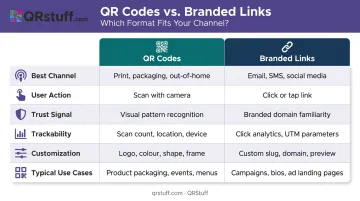
Before going deeper, here's how the two formats compare across the factors that actually affect clicks:
| Factor | QR Codes | Branded Links |
|---|---|---|
| Best channel | Offline/physical (print, packaging, signage) | Digital (email, SMS, social media) |
| User action | Scan with smartphone camera | Click or tap |
| Trust signal | None visible before scanning | Recognizable domain upfront |
| Trackability | Dynamic only (scan, device, location, time) | Yes (clicks, referrer, device, geography) |
| Customization | Visual design (colors, logos, shapes) | Custom domain, path, UTM parameters |
| Typical use cases | Menus, packaging, events, direct mail | Email campaigns, SMS, podcasts, social bios |
| Dynamic/editable | Yes (dynamic QR codes) | Yes |
A few things worth keeping in mind as you read:
- This comparison covers branded links specifically — not generic short URLs like random bit.ly strings. Domain-level trust changes click behavior in ways a random short link simply doesn't.
- Both formats support dynamic destinations (editable after deployment) and both deliver analytics.
- The real difference comes down to context: where your audience is and what action you need them to take.
What Are QR Codes?
QR codes are 2D barcodes that encode data — almost always a URL — readable by any modern smartphone camera. No app required. That frictionless scanning experience became mainstream after 2020, when contactless interactions replaced physical menus, check-ins, and payment flows across hospitality, retail, and healthcare.
Two types matter for marketers:
- Static QR codes — destination baked in permanently at creation; no tracking, no editing after printing
- Dynamic QR codes — destination managed through a redirect URL; fully editable post-deployment, with complete scan analytics
Static codes have no place in campaign work. Without tracking or the ability to update destinations, any mistake made at print time is permanent and invisible. QRStuff's platform reflects this clearly: analytics are exclusively a dynamic code feature, since static codes route users directly to the destination without passing through the tracking layer.
Dynamic QR codes on platforms like QRStuff capture scan count, unique scans, device type, operating system, geographic location (country and city), and time-of-day data — all in real time, exportable as CSV or PDF.
What QR Codes Can Encode
The format is far more versatile than most marketers use it for. Beyond URL redirects, QR codes can encode:
- PDF and file downloads
- App store links (iOS and Android)
- Wi-Fi credentials
- Payment flows (Venmo, Bitcoin, UPI, SEPA)
- vCard contacts and digital business cards
- Event registrations and RSVPs
- Video, audio, and social media profiles
QRStuff supports 40+ data types across these categories — useful when your campaign destination isn't a standard webpage.
Where QR Codes Consistently Outperform
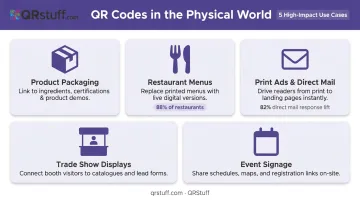
QR codes dominate wherever typing a URL is impractical:
- Product packaging — ingredient details, promotions, brand content
- Restaurant menus — 88% of restaurants were considering digital menus by 2021, per Restaurant Dive
- Print ads and direct mail — the ANA found 82% of direct mail campaigns now use online tracking mechanisms including QR codes
- Trade show displays — lead capture forms linked directly from booth signage
- Event signage — registrations, schedules, check-ins
Bitly reported a 326% increase in QR code scans in 2021 versus the prior year, with QR code creation growing 41% in H1 2023 alone. Restaurant and leisure verticals led growth at +187%.
What Are Branded Links?
A branded link is a shortened URL that uses a company's own domain rather than a shared third-party one. Instead of bit.ly/x7k2p, it's brand.co/summer-sale. That domain name in the URL functions as a trust signal the moment the recipient sees it.
This distinction directly affects click behavior. According to Rebrandly, branded links increase clicks by 39% compared to generic short links. Bitly puts the figure at nearly 40%. The mechanism is straightforward: users recognise the source, so hesitation drops.
What separates branded links from plain URL shorteners:
- Custom domain (your brand, not a shared service)
- Editable destination after deployment (when using a dynamic platform)
- UTM parameter support for Google Analytics attribution
- A/B testing capability across destination variants
- Analytics: clicks, referrer source, device type, geographic data, time patterns
Where Branded Links Deliver the Highest Engagement
Branded links outperform generic short links across the digital channels where trust and recognizability matter most:
- Email campaigns benefit directly — domain visibility in the link reduces hesitation before the click
- SMS promotions pair well with branded links; Klaviyo's 2025 benchmark put average SMS click rates at 5.76%, with top performers hitting 14.89%
- Social media bios and posts stay clean and on-brand with a custom domain rather than a generic shortener
- Influencer and podcast mentions gain a practical edge: a URL like
brand.co/dealcan be spoken aloud, recalled, and typed later — a QR code can't do that
Twilio's carrier guidance explicitly warns against shared public URL shorteners in SMS — carriers flag them as spam. Branded links on custom domains clear that filter. For SMS campaigns specifically, this is a deliverability requirement, not a preference.
Which Actually Drives More Clicks?
The honest answer: neither format universally outperforms the other. Channel context determines the result.
Offline: QR Codes Win
In print and physical spaces, QR codes eliminate the single biggest barrier to engagement: having to type a URL. A poster with a QR code will outperform the same poster with a branded link every time, because the user already has a phone in hand and scanning takes two seconds.
The engagement gap widens when the URL is complex. No one types brand.co/summer-campaign-2025?utm_source=print off a billboard. But they'll scan it.
Digital: Branded Links Win
In email, SMS, and social media, the user is already in a click-ready environment. Friction isn't the problem — trust is. A recognisable branded domain removes hesitation instantly. Generic short links raise suspicion; QR codes embedded in digital content add unnecessary steps.
Trust and Security: A Factor Worth Addressing
QR codes carry one meaningful disadvantage: the destination is invisible before scanning. Users can't verify where they're going. The evidence on consumer wariness is consistent:
- The FBI warned in 2022 that cybercriminals were tampering with QR codes to redirect victims to malicious sites
- The FTC issued similar consumer guidance in 2023
- MobileIron research found 71% of consumers couldn't distinguish a legitimate QR code from a malicious one
This doesn't make QR codes unsafe — it makes platform choice matter. QRStuff is both GDPR and SOC2 compliant, with encryption in transit and at rest, audit logging, and password-protected codes. Branded destination URLs reinforce trust further: when users see a familiar domain after scanning, hesitation drops.
Analytics: What Each Format Tells You
| Data Point | Dynamic QR Codes | Branded Links |
|---|---|---|
| Scan/click volume | ✓ | ✓ |
| Unique vs repeat | ✓ | ✓ |
| Device type & OS | ✓ | ✓ |
| Geographic location | ✓ (country + city) | ✓ |
| Time of day | ✓ | ✓ |
| Referrer source | Limited | ✓ |
| UTM/campaign tags | ✓ (via destination URL) | ✓ (native) |
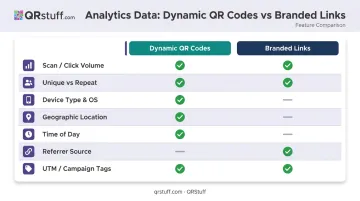
Neither format gives you a complete attribution picture on its own. The strongest campaigns use QR codes for offline reach and branded links for digital channels — combining both datasets into a single view of how audiences move from physical touchpoints to conversion.
When to Use QR Codes, Branded Links, or Both
Quick Decision Guide
| Situation | Use |
|---|---|
| Print ad, packaging, or signage | QR code (dynamic) |
| Email campaign | Branded link |
| SMS promotion | Branded link |
| Social media bio or post | Branded link |
| Trade show or event | QR code (dynamic) |
| Podcast or video mention | Branded link |
| Omnichannel campaign (print + digital) | Both |
The "Use Both" Strategy
Dynamic QR codes encode a destination URL — and that URL can be a branded link. Running both together gives you:
- Scan engagement captured from physical placements
- Brand trust reinforced the moment users land on your URL
- Unified analytics pulling from both the QR scan layer and the branded link click layer
- Editable destinations post-deployment, no reprinting required
For enterprise campaigns running across retail packaging, direct mail, and digital simultaneously, this is the practical architecture. QRStuff's dynamic QR codes support editable destinations, UTM parameter integration, and real-time analytics, so a single campaign can collect offline scan data and online click data in parallel.
QRStuff customers like Coca-Cola, Walmart, and Marriott operate exactly this kind of multi-touchpoint campaign — QR codes on physical products, branded links across digital channels, running simultaneously.
Conclusion
There's no universal winner here. QR codes and branded links solve different problems in different environments, and treating them as interchangeable costs clicks.
Match the format to the context:
- QR codes — when your audience is physically present and scanning is natural
- Branded links — when the channel is digital and trust visibility drives the tap
- Both — when your campaign spans physical and digital touchpoints
Encoding a branded link inside a dynamic QR code gives you full-funnel attribution without sacrificing performance in either environment. QRStuff's dynamic QR codes support exactly this setup — update the destination URL anytime without reprinting, while scan analytics flow back to a single dashboard.
The strongest campaigns don't debate the format — they pick the right tool for each touchpoint and let the data guide what comes next.
Frequently Asked Questions
Do QR codes or branded links get more clicks?
Neither wins universally. QR codes outperform in offline and physical settings where scanning eliminates URL-typing friction. Branded links drive higher CTR in digital channels like email and SMS, where domain visibility reduces click hesitation. Match the format to the environment.
Is a QR code more secure than a link?
Both carry security considerations. QR codes obscure their destination before scanning, creating phishing risk — the FBI and FTC have both issued warnings about tampered codes. Branded links show a recognizable domain upfront. A GDPR- and SOC2-compliant platform like QRStuff reduces exposure for both formats by encoding branded URLs as QR destinations.
Is there anything better than a QR code?
For offline-to-online bridging, QR codes remain the most frictionless option available. The most capable setup is a dynamic QR code with a branded link as its destination — combining editability, scan analytics, and brand trust in a single deployable asset.
Can I use QR codes and branded links together?
Yes. A dynamic QR code can encode a branded link as its destination URL. Users scan in physical spaces, and the branded domain is visible once they land. You capture scan data from the QR layer and click data from the branded link layer simultaneously.
Which format is better for tracking campaign performance?
Both support analytics when using dynamic or platform-based versions. Branded links capture clicks, referrer, device, and UTM data; dynamic QR codes capture scans, device OS, location, and time-of-day. Using both gives the most complete picture across offline and online touchpoints.
Are QR codes effective in digital marketing, or only for print?
QR codes are most powerful in physical and print contexts, but they do appear in digital formats like email or social posts. In purely digital environments, branded links typically offer lower friction and higher click rates — users are already in a clicking context, and adding a scan step creates unnecessary barriers.