The problem is choosing the wrong tool. Expired dynamic codes on printed materials. No way to measure campaign performance. Platforms that deactivate your codes the moment a trial ends. The Heinz ketchup incident — where a lapsed campaign domain redirected their bottle QR code to an adult site — is an extreme example, but the underlying failure is common.
This guide covers the five best QR code generators for businesses in 2026, evaluated on dynamic code reliability, analytics depth, security posture, scalability, and pricing transparency — so you can make a decision that holds up after printing.
Key Takeaways
- Dynamic QR codes let you update destinations without reprinting — essential for any printed campaign
- Free tools can deactivate dynamic codes after a trial, leaving physical materials with broken links
- Analytics depth, compliance certifications, and uptime guarantees vary significantly across platforms
- QRStuff leads this list for businesses needing a proven, scalable, all-in-one platform since 2008
- Each tool reviewed serves a distinct use case, so match the platform to your actual workflow
What to Look for in a QR Code Generator for Business
Static vs. Dynamic: Why It Matters
Static QR codes permanently encode the destination into the pattern itself. They're reliable, never expire, and cost nothing to maintain — but once printed, they can't be updated and collect no scan data.
Dynamic codes work differently. They encode a short redirect URL, and the actual destination lives on the generator's servers. That means you can fix a typo, update a campaign landing page, or swap a seasonal offer — without touching the printed material — and get full scan analytics in return.
For any business using QR codes on physical materials, dynamic codes are the only format that stays useful after print.
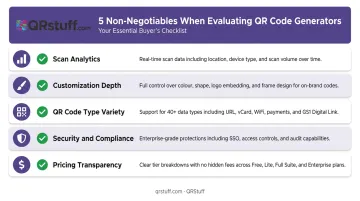
Five Non-Negotiable Criteria for Business Use
Before evaluating any platform, check these five things:
- Scan analytics — Does it track device type, geographic location, time of scan, and unique vs. repeat users? Or just total scan counts?
- Customization depth — Can you embed a logo, match brand colors, add frame CTAs, and download in vector formats (SVG/EPS)?
- QR code type variety — Beyond basic URLs, does it support vCard, WiFi, payments, file uploads, and events?
- Security and compliance — GDPR certification, SOC 2 documentation, password-protected codes, 2FA, and SSO for team accounts
- Pricing transparency — Do dynamic codes deactivate when a trial ends? What happens to analytics data if you downgrade?
That last point is where businesses get burned most often. Both QR Code Generator PRO and Uniqode document that dynamic codes deactivate after trial expiry, which means any printed materials pointing to those codes stop working immediately. Check this policy before you commit to a platform — especially if codes will appear on packaging or long-run print materials.
The 5 Best QR Code Generators for Business
These five platforms were selected based on business-grade reliability, feature depth, security posture, and real-world use across industries — not just headline features or UI aesthetics.
1. QRStuff
Background: QRStuff has been running since 2008, making it one of the longest-operating QR code platforms available. It serves 250,000+ businesses globally, including Fortune 500 companies across Coca-Cola, Amazon, Walmart, Google, Marriott International, JP Morgan, and Deloitte — spanning retail, hospitality, healthcare, education, and financial services.
Why it stands out: The breadth here is genuinely unusual. Key differentiators include:
- 40+ QR code types: URLs, vCard, WiFi credentials, PayPal, Bitcoin, UPI, Venmo, Zelle, and GS1 Digital Link for retail compliance
- Scan analytics: Total and unique scans, device type (iOS/Android), geographic location at country and city level, time of scan, and CSV export on Enterprise
- Security: Password-protected codes on all paid tiers, 2FA across plans, SAML 2.0 SSO on Enterprise, role-based access controls, and GDPR compliance with data stored on European servers
- Reliability: 99.9% uptime guarantee on all paid plans, with 99.968% actual uptime maintained since 2008
| Details | |
|---|---|
| Key Features | 40+ QR code types; dynamic codes with real-time editing; scan analytics (device, location, time, unique users); bulk generation up to 500 codes (Full) / unlimited (Enterprise); API access; password protection; 2FA; SAML 2.0 SSO; white-label and custom short URL domain; GS1 Digital Link support |
| Pricing (USD) | Free: $0 (10 dynamic codes, 30-day expiry, 50 scans/month) · Lite: $10/month · Full: $25/month · Enterprise: $250/month |
| Best For | Businesses of all sizes needing a reliable, secure, scalable all-in-one platform — especially enterprises running multi-channel campaigns, regulated industries requiring GDPR compliance, and teams needing bulk generation and API access |
One important note on code persistence: QRStuff's dynamic codes remain active for the full subscription duration. After expiry, they enter a 30-day grace period with a 10-scan/month cap — rather than immediate deactivation. Enterprise clients receive dedicated account managers, 24/7 support via live chat, Slack, phone, and email, plus onboarding assistance and a formal SLA.
2. QR Tiger
Background: QR Tiger is a widely adopted platform known for its large code-type library and accessible entry pricing. It's a popular starting point for marketing agencies and SMBs that need flexibility across diverse campaign types.
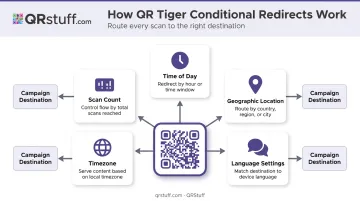
Why it stands out: QR Tiger's conditional redirect logic is its clearest differentiator. Dynamic codes can route users based on time of day, geographic location, language settings, timezone, or scan count — useful for multinational campaigns and time-limited offers.
Other notable capabilities:
- Canva integration for design-heavy marketing teams
- Google Analytics and UTM support (Advanced and Premium plans) for GA4 attribution
- Multi-URL routing and GPS heat maps on paid tiers
The free plan offers 3 dynamic codes with 500 scans each but includes a mandatory logo popup. Multi-URL routing and geo-location tracking require a paid subscription.
| Details | |
|---|---|
| Key Features | Dynamic codes with time/location/scan-count-based redirection; Google Analytics and UTM integration; multi-URL QR codes; Canva integration; GPS heat maps; static and dynamic code mix |
| Pricing | Free: 3 dynamic codes (500 scans each) · Regular: $7/month (12 dynamic codes, 1 user, 500 API requests) · Advanced: $16/month (200 dynamic codes, 3,000 API requests, bulk up to 3,000 codes) · Premium: $37/month (600 dynamic codes, 10,000 API requests) |
| Best For | Marketing agencies and growing SMBs needing conditional redirect logic, design-tool integrations, and diverse QR code types without enterprise pricing |
3. Uniqode
Background: Uniqode (formerly Beaconstac) is built specifically for organizations with strict compliance requirements. It's the platform to evaluate if HIPAA or ISO 27001 certification is a procurement requirement.
Why it stands out: Uniqode carries the deepest compliance stack of any platform on this list, all verified through a public Trust Center:
- Certifications: SOC 2 Type 2, GDPR, HIPAA, and ISO 27001:2022
- Analytics: 8+ data points per scan with anomalous scan detection to filter bot traffic
- Ad integrations: Meta Pixel and Google Ads support retargeting directly from QR scan events
- SSO: Okta, Azure, and Auth0 via SAML
The trade-off is cost. Pricing scales quickly, and custom domains run $2,000/year as an add-on on some plans.
| Details | |
|---|---|
| Key Features | SOC 2 Type 2, GDPR, HIPAA, ISO 27001:2022; 8+ analytics data points per scan; anomalous scan detection; Meta Pixel and Google Ads integration; bulk QR generation via CSV; SSO (Okta, Azure, Auth0); digital business cards; Zapier integrations |
| Pricing | 14-day free trial · Starter: $9/month (billed annually) · Core: $49/month (billed annually) · Enterprise: custom |
| Best For | Large enterprises and regulated industries — healthcare, finance, pharma — that need full compliance certification and CRM/ad platform integrations |
4. QR Code Generator PRO
Background: QR Code Generator PRO is part of the Bitly ecosystem, making it a recognizable choice for teams already using Bitly for link management. It's strongest for agencies and mid-market companies running high-volume QR campaigns with API requirements.
Why it stands out: Core capabilities worth noting:
- Clean analytics dashboard with CSV export on all plans
- Bulk creation via CSV upload (Advanced plan and above)
- Full design customization across colors, logos, and frames
- GDPR and SOC 2 compliance documentation available
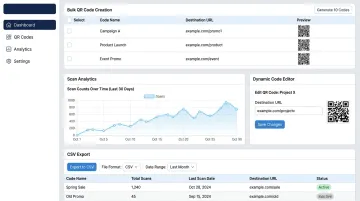
The Starter plan's limits (2 dynamic codes, 10,000 scans) aren't workable for active campaigns. Also worth verifying before committing: dynamic codes deactivate when a trial expires, pointing to a service page rather than the original destination. Static codes continue to function normally.
| Details | |
|---|---|
| Key Features | Dynamic and static QR codes; analytics dashboard with CSV export; bulk creation via CSV (Advanced+); API access; full design customization; GDPR and SOC 2 certified; multi-user support |
| Pricing | Starter: $15.99/month (2 dynamic codes, 10,000 scans, 2 users) · Advanced: $46.99/month (50 dynamic codes, unlimited scans, 3,000 API requests/month, bulk up to 100 codes) · Professional: includes 250 dynamic codes, unlimited scans, 5 users, 10,000 API requests, bulk up to 500 codes |
| Best For | Agencies and mid-market teams needing API-driven QR creation, bulk generation for campaigns, and a clean management dashboard |
5. Flowcode
Background: Flowcode is a privacy-first platform that differentiates on first-party data capture rather than sheer feature volume. It's built for marketers who want to convert offline scans into measurable leads without relying on third-party cookies.
Why it stands out: Flowcode treats the QR scan as the start of a conversion funnel, not the end. Key features supporting that approach:
- Conversion pixel: Tracks the full customer journey from scan to on-site action, turning QR codes into lead capture events
- Flowpage builder: Custom post-scan landing pages instead of a bare redirect URL
- Contact collection forms: Direct audience building without third-party data dependencies
Note: advanced geolocation data unlocks at the Growth tier ($250/month billed annually), and the conversion pixel appears gated to Enterprise. The free plan covers 2 dynamic codes with analytics for 500 scans.
| Details | |
|---|---|
| Key Features | First-party data capture via conversion pixels; Flowpage landing page builder; dynamic QR codes with editable links; real-time scan analytics; SOC 2 compliance documentation; visual customization |
| Pricing | Free: $0 (2 dynamic codes, 500-scan analytics) · Pro Plus: $25/month (50 codes, 6,000 scans) · Growth: $250/month (150 codes, 10,000 scans, advanced geolocation, API access) · Enterprise: custom |
| Best For | Direct-to-consumer brands and marketers focused on building first-party data assets and converting offline traffic into leads |
How We Chose the Best QR Code Generators
These tools were evaluated against criteria that reflect real business risk — not ease of sign-up or UI polish.
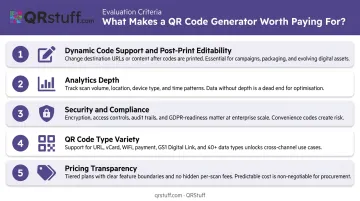
The Five Weighted Criteria
- Dynamic QR code support and post-print editability — Can destinations be updated after printing? What happens to codes after a plan downgrade?
- Analytics depth — Does the platform track location, device type, time, and unique scan identification? Are metrics exportable?
- Security and compliance — GDPR, SOC 2, password protection, 2FA, and SSO availability and tier placement
- QR code type variety — Does it cover the use cases your business actually needs beyond basic URLs?
- Pricing transparency — Do free or entry plans deactivate codes unexpectedly? Does analytics data persist through a plan lapse?
The Most Common Mistake
These criteria exist because of where businesses most often fail. Most teams pick a QR code generator based on a free trial or the lowest advertised price. Three months later, dynamic codes on their printed signage are broken because a subscription lapsed.
The questions to ask before committing to any platform:
- Do dynamic codes deactivate immediately when a subscription ends, or is there a grace period?
- Is analytics history retained if you downgrade?
- Can the platform handle high-traffic scan volumes without throttling or downtime?
None of these answers show up on the pricing page — but all of them affect what happens after your materials go to print.
Conclusion
The right QR code generator isn't necessarily the cheapest or the most feature-loaded — it's the one that fits how the codes will actually be used. A restaurant group printing table menus has different requirements than a pharmaceutical company needing HIPAA-compliant tracking.
Evaluate platforms on long-term operational fit: uptime guarantees, data retention policies through plan changes, whether dynamic codes survive a subscription lapse, and whether enterprise support is actually staffed — not just listed on a pricing page.
For businesses that need a platform with operational depth — GDPR and SOC2 compliance, 40+ code types, bulk generation, and a track record going back to 2008 — QRStuff offers a free tier to start and enterprise plans that scale as your use case grows.
Frequently Asked Questions
Which QR code creator lasts forever?
Static QR codes never expire because the destination is permanently encoded into the pattern itself, with no server dependency required. Dynamic QR codes depend on the generator's redirect servers and require an active paid plan. QRStuff guarantees dynamic codes remain active throughout any paid subscription, with a 30-day grace period after expiry rather than immediate deactivation.
What is the difference between static and dynamic QR codes for business?
Static codes are fixed at creation: no tracking, no editing, no corrections if you print the wrong URL. Dynamic codes use a redirect URL that can be updated after printing, letting businesses fix errors, refresh campaign destinations, and track scan performance.
Do I need a paid QR code generator for my business?
Free tools work fine for one-off static codes with no tracking requirements. Any business running marketing campaigns, printing at scale, or needing scan analytics and compliance features will need a paid plan. Many free dynamic code options expire after a trial, leaving printed materials pointing to broken links, which is the scenario most worth avoiding.
What should I look for in a QR code generator for marketing campaigns?
Verify these four essentials before printing anything:
- Dynamic codes so destinations can be updated without reprinting
- Scan analytics showing location and device data for campaign measurement
- Customization options to keep codes on-brand
- Stable pricing with no surprise scan limits or mid-campaign deactivations
Can QR code generators track scans and analytics?
Dynamic QR code generators track scan volume, device type, geographic location, time of scan, and unique users. Analytics depth varies by plan tier, with more advanced tools integrating with Google Analytics, Meta Pixel, and CRM systems for full attribution. Static codes track nothing.
Are free QR code generators safe for business use?
Reputable free generators from established providers are safe for creating static codes. For customer-facing or data-collecting use cases, verify HTTPS usage, GDPR compliance, and absence of ad injection or watermarks. Avoid free tools that lack clear data privacy policies: the FTC has warned that QR code scams are an active and growing threat, making platform trustworthiness a genuine business consideration.