But businesses aren't just tracking inventory anymore. They're running campaigns across physical and digital channels, managing seasonal promotions, and trying to measure what's actually working in print. For those use cases, the traditional one-dimensional barcode hits a wall fast. It can't update, it can't track, and it can't carry enough information to do much beyond identify a product.
QR codes are often lumped in with barcodes in conversation, but their operational differences are substantial. This article covers the three most consequential advantages QR codes hold over barcodes — and what staying barcode-only is actually costing businesses that haven't made the switch.
Key Takeaways
- QR codes store up to 7,089 numeric characters vs. 12 digits for a standard UPC barcode
- Dynamic QR codes let you update the destination URL anytime without reprinting — static barcodes are locked once printed
- Every QR code scan can be tracked by location, device type, time, and unique vs. repeat user
- Any modern smartphone camera reads QR codes — no dedicated scanning hardware needed
- For marketing, packaging, and customer engagement, QR codes offer capabilities barcodes simply weren't built for
QR Codes vs. Barcodes: What's Actually Different?
The core difference comes down to dimensions — literally.
A traditional UPC-A barcode is one-dimensional: it encodes data in a single horizontal direction. GS1 US confirms that UPC-A stores 12 digits, which is enough to identify a product by SKU but not much else. EAN-13 adds one more digit. That's the ceiling.
A QR code is two-dimensional — data is encoded both horizontally and vertically across a grid of modules. According to DENSO WAVE, the original developer of the QR standard, a QR code can hold up to 7,089 numeric characters or 4,296 alphanumeric characters. That's enough space for a full URL, a contact card, WiFi credentials, a payment link, or a product description — all within a single scannable image.
Where Each Format Belongs
| Format | Primary Use Cases | Data Capacity |
|---|---|---|
| 1D Barcode (UPC/EAN) | Retail POS, inventory SKUs, shipping labels | 12–13 digits |
| QR Code | Marketing, menus, payments, packaging, ticketing, traceability | Up to 7,089 characters |
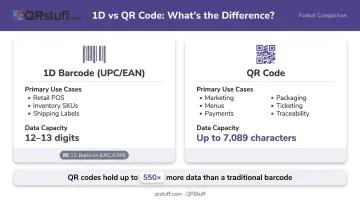
Barcodes identify. QR codes do the rest — they redirect, communicate, and adapt to whatever a campaign needs.
That distinction matters most when a business wants its packaging or printed materials to do something beyond registering a product in an inventory system. A barcode on a cereal box tells the checkout scanner what it costs. A QR code on the same box can link to a recipe video, a loyalty program sign-up, or a nutrition breakdown — without any additional print materials.
GS1 is already formalizing this shift. Its Sunrise 2027 initiative is a global transition from 1D UPC barcodes toward 2D codes like QR codes, with retailers working toward 2D barcode scanning at point of sale by 2027.
Key Advantages of QR Codes Over Barcodes
The three advantages below are operational and measurable — each one affects a business outcome you can track and improve.
Advantage 1: Dramatically Higher Data Capacity
A UPC barcode's 12-digit limit forces businesses to work around the code rather than through it. Want to direct a customer from packaging to a product page? You print a URL separately. Want to include a tutorial or registration link? Another printed insert. Each additional touchpoint is an extra material cost — and an extra drop-off point.
A QR code eliminates that friction by encoding the full destination directly into the scan action. One scan, one action, no manual typing required.
Nielsen Norman Group notes that QR codes are especially useful when users are mobile and the alternative is more time-consuming, such as typing a URL. The practical case for higher data capacity comes down to friction removed, not just bytes stored.
What higher data capacity enables in practice:
- A single QR code on product packaging can link to video tutorials, ingredient sourcing, loyalty programme registration, or a live product page
- Event marketing can trigger multiple actions from one code: registration, payment, navigation, schedule
- Healthcare applications can deliver patient instructions, consent forms, and appointment links touchlessly
- Platforms like QRStuff support 40+ data types including URL, vCard, WiFi credentials, payment links, GS1 Digital Link, and file uploads — all within a single scannable code
KPIs affected: Customer engagement rate, conversion from print media, cost per printed material, time-to-information for end users.
A 2024 GS1 US survey found that 79% of shoppers are more likely to buy a product when a scannable code provides the information they want. The barcode's 12-digit limit makes meeting that expectation structurally difficult.
Advantage 2: Dynamic Updatability — Change the Destination Without Reprinting
Static barcodes create a direct cost problem that most businesses don't anticipate until it hits them.
A static barcode encodes fixed data permanently. Once it's printed, nothing about it can change. If the URL on your packaging goes dead, the campaign it pointed to ends, or the product line gets updated — that barcode stays in market pointing nowhere useful.
Dynamic QR codes work differently. The physical code points to a short redirect URL, which can be updated at any time from a QR code management platform. The printed code never changes; the destination behind it does.
A practical example: A retailer prints QR codes on summer campaign packaging. The campaign ends. Instead of pulling inventory and reprinting, they update the destination in their QRStuff dashboard — the same code now links to a new promotion. No reprint, no waste, no operational disruption.
QRStuff's Bulk Update feature handles this at scale. Users export a spreadsheet of active dynamic codes, edit destination URLs across hundreds of codes, and re-upload — updating an entire campaign without touching a single print file.
Full Suite plans support batches of up to 500 codes; Enterprise plans offer unlimited batch processing.
When this advantage matters most:
- Retail and food packaging with rotating seasonal promotions
- Restaurant menus that change daily or weekly
- Large print runs where a mid-campaign URL change would otherwise require reprinting thousands of units
- Any business managing multiple active campaigns simultaneously
KPIs affected: Print and reprint costs, campaign turnaround time, time-to-update for product information, marketing agility.
The printed labels and packaging market was valued at $517.9 billion in 2024 according to Smithers. For businesses operating at even a fraction of that scale, the cost of avoidable reprint cycles is substantial — and dynamic QR codes remove that cost entirely.
Advantage 3: Scan Analytics — QR Codes Tell You Who Scanned, Where, and When
Traditional barcodes generate no customer-facing data. A scan at POS updates inventory — that's it. The brand learns nothing about the person who scanned, when they engaged, or from where.
QR codes, when managed through a platform like QRStuff, capture a full picture of engagement:
- Scan volume — total scans and unique scans (distinguishing new users from returning ones)
- Geographic data — country and city level location data
- Device information — mobile vs. desktop, iOS vs. Android
- Temporal data — exact scan time and date, enabling peak engagement analysis
- Campaign attribution — UTM parameters compatible with Google Analytics, plus Meta Pixel and Google Ads integrations
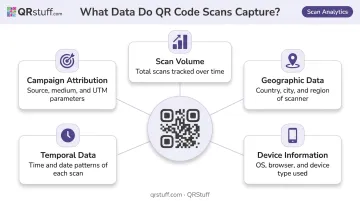
The campaign attribution point has real operational weight. QRStuff's analytics integrates directly with Google Analytics, letting businesses attribute website behaviour — bounce rate, pages per session, goal completions — back to specific QR code placements.
A poster in a retail location becomes a trackable channel. A direct mail piece with a QR code behaves like a digital ad, with measurable attribution.
The USPS confirms that QR codes and personalised URLs make it possible to track direct mail engagement including who scanned, where scans happened, operating system, and time spent on the resulting page. Without that capability, print marketing spend is largely unattributable.
What this changes for campaign management:
- A brand running QR codes across five cities can compare performance by location in real time
- A franchise business can see which locations drive the most engagement without waiting for campaign-end reports
- A limited-time offer can be optimised mid-campaign based on actual scan data — adjusting placement, messaging, or offer type across physical channels
KPIs affected: Campaign attribution accuracy, cost-per-engagement, scan-to-conversion rate, geographic performance data, customer retention signals.
QRStuff's analytics dashboard provides daily, weekly, and custom date range views, with CSV export for integration into any BI tool. Campaign tagging allows teams to group related QR codes and track aggregate performance across a single campaign — something impossible with barcodes.
What Businesses Miss Out On by Sticking with Barcodes Alone
A barcode-only approach to customer-facing materials is one-way communication by design. The code identifies the product. Nothing more happens.
Common symptoms of barcode-only approaches:
- Printed materials become obsolete the moment a URL, offer, or product detail changes — triggering reprint cycles that inflate costs with no flexibility
- No visibility into which print placements drive customer action, making print marketing spend difficult to justify or optimize
- No path from physical materials to digital touchpoints — loyalty programmes, tutorials, time-sensitive offers, and registration pages remain inaccessible from the physical world
None of that makes barcodes obsolete in their native context. The business case for barcodes in supply chain and POS scanning remains solid. GS1's Sunrise 2027 initiative isn't eliminating barcodes — it's adding 2D capability on top of existing barcode infrastructure. The gap is about context: barcodes aren't wrong, but they're the wrong tool when QR codes would deliver measurably better outcomes.
QRStuff supports GS1 Digital Link QR codes, which carry GTIN, batch, expiry, and serial data for supply chain scanning. At the same time, those same codes link consumers to product pages, allergen information, sustainability data, and more. One code satisfies the warehouse scanner and the customer's smartphone simultaneously — without compromise.
How to Get the Most Value from QR Codes
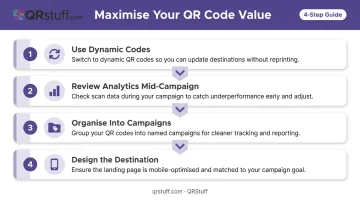
QR codes deliver the most value when treated as active, managed assets — not static print elements.
The businesses seeing the best results follow a consistent pattern:
- Use dynamic codes for any application where the destination may change — campaign pages, seasonal promotions, menus, event links
- Review scan analytics mid-campaign — not just at the end, so you can identify underperforming placements and adjust while it still matters
- Organize codes into campaigns or projects — QRStuff's campaign tagging lets teams track aggregate performance, compare A/B variants, and filter by initiative without sifting through individual code data
- Design the destination, not just the code — fast-loading mobile pages with relevant content and a clear next action are what convert a scan into an actual business outcome
Dynamic QR codes and scan analytics on QRStuff require a paid plan. Options include:
- Lite Suite (from £4/month) — 50 dynamic codes with basic analytics
- Full Suite (£15/month) — 250 dynamic codes, advanced analytics, unlimited scans
- Enterprise (£185/month) — unlimited batch processing, API access, SSO, and white-label capabilities for teams managing campaigns at scale
Frequently Asked Questions
Can QR codes completely replace barcodes?
Not entirely. Barcodes remain the standard for supply chain and retail POS systems — the infrastructure is too embedded to change quickly. QR codes are the better choice for customer-facing applications, marketing, and dynamic content. GS1's Sunrise 2027 initiative is pushing toward 2D codes that handle both functions simultaneously.
What is the difference between a static and dynamic QR code?
A static QR code permanently encodes its destination at the time of creation — once printed, it cannot be changed. A dynamic QR code points to a redirect URL that can be updated at any time through a management platform like QRStuff, making it far more practical for business applications where content evolves.
Is there a QR code for Square payments?
Square supports QR code-based ordering and payment flows, allowing customers to scan a code at a table or checkout to open an ordering page or complete a payment.
What happens to your phone when you scan a QR code?
Your phone's built-in camera decodes the embedded data and prompts an action — opening a URL, connecting to WiFi, or displaying contact information. No third-party app is needed on modern iPhones or Android devices; both handle QR scanning natively.
Do QR codes work without internet access?
The scan itself works offline, but most QR code experiences — landing pages, dynamic content, product pages — require an internet connection to load. Plain text or WiFi credentials encoded directly in the code can work without connectivity.
How much data can a QR code hold compared to a barcode?
A standard UPC barcode holds 12 digits. A QR code can store up to 7,089 numeric characters or 4,296 alphanumeric characters — enough for a full URL, contact card, payment link, or detailed product information in a single scannable image.