Introduction
Picture this: you leave a two-day conference with 30 paper business cards stuffed in your jacket pocket. By Monday morning, you've lost 10, misread the phone number on three more, and spent an hour manually typing the rest into your contacts. You follow up with maybe half of them — a week too late for most.
This is still how millions of professionals network, and the cost is real: missed connections, wasted time, and a growing pile of paper that rarely survives the week.
Professional networking in 2026 is shifting decisively toward digital alternatives — pushed by sustainability expectations at events, the normalization of hybrid and virtual conferences, and a demand for contact sharing that's instant and trackable.
According to PCMA's 2024 sustainability pulse check, 31% of event planners now include sustainability requirements in their RFPs, up from just 14% in 2019.
Going paperless isn't one tool — it's a set of solutions that cover every stage of networking. Here are the five most effective options in 2026.
Key Takeaways
- Paper-based networking tools create friction, waste, and missed follow-ups that digital alternatives eliminate.
- Five solution categories cover the full networking lifecycle: contact sharing, profile discovery, event access, smart cards, and follow-up management.
- QR code digital business cards lead the pack: scannable, brandable, trackable, and no app needed to receive them.
- Match your tool to your context — in-person events, virtual summits, or ongoing relationship management each call for a different approach.
Why Professional Networking is Going Paperless in 2026
"Paperless networking" means replacing physical business cards, printed portfolios, and paper sign-in sheets with digital tools that share, store, and track contact information instantly — from a phone screen, a badge, or a tap.
The urgency is real. According to a widely cited Adobe-sourced figure, 88% of paper business cards are discarded within a week — 63% simply because the recipient didn't need the service immediately. That's a steep return on a stack of printed cards.
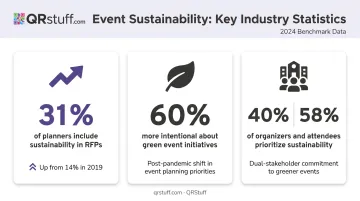
The shift is also being driven from the top down. Event sustainability is now an organizational priority:
- 31% of planners include sustainability in event RFPs (2024, up from 14% in 2019)
- 60% said they were more intentional about green event initiatives post-pandemic
- 40% of event organizers and 58% of attendees now prioritise sustainability at in-person conferences
That sustainability push has a natural counterpart in digital infrastructure. The virtual events market reached $119.62 billion in 2025 and is projected to hit $297 billion by 2030 — the platforms and tools for digital-first networking are scaling to match.
Going paperless means choosing the right tools for each context. The five solutions below address every scenario you're likely to face.
5 Paperless Solutions for Professional Networking in 2026
These five solutions are selected for their relevance across different networking contexts — in-person events, virtual summits, and ongoing relationship management — with an emphasis on ease of adoption, device compatibility, and data retention.
1. QR Code Digital Business Cards
A QR code digital business card is a scannable code that opens a contact page, vCard download, LinkedIn profile, or personal website directly on any smartphone camera — no app required for the recipient. It replaces the paper card entirely.
What separates QR-based contact sharing from other options is dynamic QR code functionality. Unlike static codes, dynamic QR codes let you update your contact information after the code is printed or displayed — no reprint needed. Change your job title, phone number, or employer, and the same physical code reflects the update instantly.
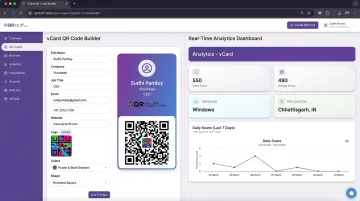
QRStuff's vCard QR code generator supports a full set of contact fields — name, job title, organization, email, phone, mobile, website, and physical address — and recipients can save the contact directly to their phone's address book in one tap. The platform also provides real-time scan analytics: total and unique scans, scan location (country and city), device type, and time of scan. For professionals who want to measure networking ROI, that data supports ROI measurement across campaigns and events.
Additional advantages of using QRStuff for digital business cards:
- Fully brandable — add your logo, custom colours, gradients, and shapes to match your identity
- Print-ready formats — SVG and EPS files for professional printing on badges, lanyards, and card stock
- Reliable at live events — 99.968% uptime since 2008, averaging less than 3 hours of downtime per year
- GDPR compliant — contact data is handled in accordance with international data protection requirements
| Best For | Individual professionals, freelancers, sales reps, and executives at in-person events |
| Key Features | Dynamic QR codes (editable after creation), vCard support, branded design, real-time scan analytics, no app required to receive |
| Accessibility | Display on phone screen or print on badge holders and lanyards; free tier available (10 dynamic codes, 30-day limit); Lite Suite from $10/month |
2. Digital Profile Sharing via Professional Networking Apps
LinkedIn has built QR-based profile sharing directly into its mobile app. Every one of its 1.2 billion members has a unique QR code that, when scanned, opens their full professional profile — work history, endorsements, recommendations, and portfolio links.
The key difference from a simple vCard is what the profile does over time: it updates automatically, creates a two-way digital connection record, and enables direct messaging without exchanging personal contact details.
For industries where reputation and endorsements carry weight — finance, consulting, tech, marketing — a LinkedIn profile connection is often more valuable than a phone number.
| Best For | Professionals in reputation-driven industries where endorsements and mutual connections matter |
| Key Features | Built-in QR code sharing, mutual connection visibility, profile-based trust signals, direct messaging, alumni and interest-based discovery |
| Accessibility | Free on mobile and desktop; full two-way benefit requires both parties to have an account |
3. Virtual and Hybrid Event Networking Platforms
Dedicated event platforms — such as Hopin, Whova, and Bizzabo — have replaced paper agendas, printed badges, and physical sign-in sheets with digital check-ins, attendee directories, and AI-matched networking sessions. Paper is eliminated across the entire event lifecycle.
For conference organizers and sponsors, the networking value extends beyond convenience. Whova's case studies show what's possible at scale: one World System Builder event connected 40,000+ attendees with exhibitors and generated 7,000+ leads. Another conference achieved a 95% app download rate among attendees. These aren't niche outcomes — they reflect what digital-first event infrastructure enables when implemented well.
Key capabilities that make these platforms stand out:
- QR-based digital check-in replaces printed tickets and manual sign-in
- In-app attendee directories allow pre-event outreach before you arrive
- Session engagement data gives organizers lead-capture insights paper forms simply can't provide
- Virtual breakout rooms extend networking beyond the venue
| Best For | Conference organizers, event sponsors, and attendees at trade shows, professional summits, and hybrid corporate events |
| Key Features | Digital check-in via QR code, attendee matchmaking, in-app messaging, paperless lead capture, virtual breakout rooms |
| Accessibility | Organizer-licensed platforms; attendees typically access via browser or mobile app at no cost |
4. NFC-Enabled Smart Contact Cards
NFC (Near Field Communication) smart cards contain a chip that, when tapped against a smartphone, opens a digital contact page, LinkedIn profile, or custom landing page — no scanning required. One card lasts years, its linked content is remotely updatable, and it works with approximately 95% of modern smartphones according to NFC Forum research.
For professionals who attend frequent in-person events, an NFC card makes a stronger first impression than handing over a paper card — and it's a one-time purchase rather than an ongoing print expense.
A few practical notes:
- Pairs well with a QR code on the reverse side for compatibility with older devices
- Pricing varies by vendor: standard cards from Mobilo start at $5 (promotional), dot.cards from $30; most pair with a subscription for profile management
- Works with iOS 13+ and Android 10+ without requiring the recipient to download any app
| Best For | Professionals at frequent in-person events who want a premium, sustainable alternative to paper cards |
| Key Features | Tap-to-share via NFC, updatable digital profile, optional QR code backup, no app required for recipient, long-term cost efficiency |
| Accessibility | One-time card purchase ($5–$75+ depending on material and vendor); subscription often required for profile management |
5. Digital Portfolio and Follow-Up CRM Tools
Most networking effort gets lost without a system to capture and act on new connections. Digital portfolio platforms — such as Notion, Bento, or a personal website — combined with lightweight CRM tools like HubSpot's free CRM or Contacts+ allow professionals to share work samples and credentials via a single link, then systematically follow up after events.
The follow-up timing matters more than most people realise. Research from InsideSales indicates that after 5 minutes, conversion rates drop by 8x — which means those paper notes and stray business cards sitting on your desk for three days are likely already cold.
What this category enables:
- Share your portfolio, credentials, and case studies via a single link
- Log new contacts immediately after an event conversation
- Set follow-up reminders so no connection gets buried in paper notes
- Track relationships across meetings, emails, and pipeline stages
HubSpot's free CRM includes contact management, email tracking, and meeting scheduling at no cost. Contacts+ offers business card scanning and contact syncing, with a free tier and Premium at $9.99/month.
| Best For | Freelancers, consultants, creatives, and business development professionals managing ongoing contact relationships |
| Key Features | Shareable digital portfolio link, contact tagging and notes, follow-up reminders, email integration, lead pipeline tracking |
| Accessibility | Free tiers available for most tools; full CRM features on paid plans |
How These Solutions Were Chosen
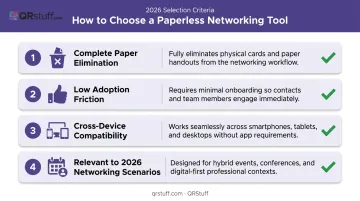
These five were selected based on four criteria:
- Complete paper elimination — not just reduction, but full replacement of physical materials
- Low adoption friction — usable without technical expertise; no specialist hardware required
- Cross-device compatibility — works across iOS, Android, desktop, and older devices
- Relevant to real 2026 networking scenarios — in-person events, virtual summits, and hybrid environments
Two mistakes consistently undermine otherwise solid choices:
- App-dependency on the recipient's side creates friction at the worst possible moment. Event app adoption rates sit at 20–30% without active promotion — meaning a significant portion of contacts may never engage. The best solutions work regardless of what's on the other person's phone.
- Choosing static over dynamic locks you into whatever you published at creation. A static QR code with outdated contact details is wrong forever — and untrackable. Dynamic solutions that allow post-creation editing are the better choice for anyone whose details or strategy might shift.
Each tool below clears all four criteria and avoids both pitfalls.
Conclusion
The right paperless networking tool depends on where and how you connect. Match the solution to the situation:
- For in-person events, a QR code vCard or NFC smart card covers most situations
- At conferences and trade shows, a dedicated event platform with digital check-in reduces friction
- For consultative or creative networking, a digital portfolio with a shareable link carries more weight
- For post-event follow-through, a CRM with reminders and contact logging keeps connections alive
For most professionals, a dynamic QR code digital business card is the fastest, lowest-friction place to start. You can create one in minutes, display it on your phone screen, print it on a badge, and start tracking who engaged with it from day one.
QRStuff's vCard QR code builder lets you build a branded, trackable digital business card with full customization — logo, colours, shapes — and update the contact details any time without reprinting. No reprinting, no outdated details, and scan analytics from the moment you share it.
Frequently Asked Questions
What are the top 5 document management systems?
The leading DMS platforms include DocuWare, SharePoint, Hyland OnBase, M-Files, and Laserfiche — all used for storing, retrieving, and managing digital documents at an organizational level. For professional networking, the equivalent is a digital contact management or CRM tool, which handles contact records rather than document archives.
Why are companies going paperless?
The primary drivers are cost reduction (printing consumes 1–3% of annual revenue according to Gartner, via Xerox), improved workflow productivity, stronger data security and compliance requirements, and growing sustainability commitments.
What companies have gone paperless at events?
Several major enterprises have adopted digital-first event networking. World System Builder generated 7,000+ leads across 40,000+ attendees using Whova's app-based system. QRStuff counts Google, Deloitte, JP Morgan, and Amazon among its enterprise users.
What is a digital business card and how does it work?
A digital business card is an online contact profile shared via a QR code, NFC tap, or direct link. Recipients view or save the contact information instantly on their device — no app required — and the sender can update the content at any time without issuing a new card.
Are QR code business cards effective for professional networking?
Yes. They work on any smartphone camera, require no special hardware, eliminate reprinting costs, and let you track scan activity and update your details in real time. The digital business card market is projected to grow from $350 million in 2024 to over $1 billion by 2034.
How do I share my contact information digitally at in-person events?
Display a QR code on your phone screen or printed badge for others to scan, tap an NFC smart card against their phone, or open the LinkedIn app and share your profile QR code directly. All three methods transfer contact details instantly with no paper exchanged.