The shift is measurable. Approximately 102.6 million people in the US are expected to scan a QR code in 2026, up from 83.4 million in 2022. That's not a niche behavior — it's mainstream consumer infrastructure.
For marketers and business leaders, the question is no longer whether QR codes belong in your strategy. It's which trends are defining best practice right now, and where investment will actually pay off.
Key Takeaways
- QR scans represent genuine consumer intent — one of the highest-converting physical-to-digital touchpoints available
- AI-powered dynamic QR codes deliver individualized post-scan experiences that update in real time — no reprinting needed
- 95% of businesses confirm QR codes help collect first-party data — critical as third-party tracking erodes
- Physical media — packaging, billboards, retail fixtures — are becoming live digital touchpoints that bridge the offline and online worlds
- QR use cases now extend deep into supply chain, healthcare, payments, and enterprise security
Key Trend 1: AI-Powered Personalization Takes QR Marketing to a New Level
The scan used to be the end of the story. You pointed your camera, hit a link, and landed wherever the brand decided everyone should go. That's changing fast.
AI is now shaping what happens after the scan — routing users to different experiences based on scan time, device type, location, and prior behavior. The result is a mass-personalization channel built on a single physical code.
Real Campaigns Showing What's Possible
Two 2025 campaigns illustrate how far this has come:
- Jameson Black Barrel placed unique QR codes on Father's Day gift boxes. Scanning opened an AI-powered song-making platform where buyers could record a message and generate a personalized song — turning a product purchase into an emotional, shareable moment.
- Coca-Cola's Share a Coke relaunch rolled out across 120+ countries with on-pack QR codes connecting to the Memory Maker hub, where users created personalized videos using templates, memes, and custom content.
Neither campaign required app downloads or account creation. The QR code was the entire entry point.
Dynamic QR Codes: The Infrastructure Behind It All
Personalized post-scan experiences only work reliably because dynamic QR codes decouple the physical code from the destination. The code itself stays unchanged after printing, but the destination URL can be updated anytime.
According to Uniqode's State of QR Codes 2025 report, 79% of businesses already use dynamic QR codes — a survey of 601 business leaders, over half from enterprises with 1,000+ employees.
Platforms like QRStuff are built on this model. When a QR code is printed on product packaging or an event banner, the destination remains fully editable. That means:
- Swap seasonal content without reprinting a single piece of collateral
- Correct mid-flight campaign errors before they compound
- Test different landing pages against the same physical code
- Redirect expired promotions to current offers automatically
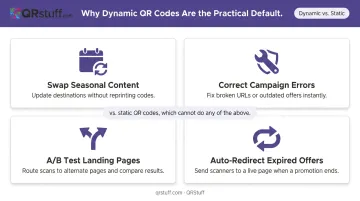
For a campaign running across thousands of printed materials, the cost and waste implications alone make dynamic codes the practical default.
AI Is Also Optimizing the Code Itself
Beyond post-scan experiences, AI now applies to placement and call-to-action decisions. Specifically, it helps marketers identify:
- Which physical surfaces generate the highest scan rates
- Which incentive copy converts better across different audience segments
- Which contexts — time of day, location, device — drive repeat scans
The result: campaign decisions informed by actual scan behavior, not assumptions — a feedback loop that simply didn't exist two years ago.
Key Trend 2: QR Codes Become Essential First-Party Data Tools
Third-party cookies aren't going away cleanly. Google has pivoted its Privacy Sandbox timeline multiple times, with its most recent 2025 update confirming it would maintain the existing third-party cookie choice architecture rather than deprecating cookies outright. The IAB noted Google's July 2024 announcement surprised nearly two-thirds of the advertising industry.
The net effect: marketers can't count on any single third-party tracking mechanism. First-party data strategies have gone from "good practice" to operational necessity.
Why QR Scans Are a Natural Data Collection Event
Every scan is a voluntary, deliberate action. The user chose to point their camera. That intent signal is valuable on its own — but it also creates a clean, consent-based data collection moment.
Uniqode's research found 95% of businesses confirm QR codes help them gather first-party data. Their 2026 report, covering 188 million scans across 796,000 QR codes, found 83% of consumers are willing to share data when consent is provided or an opt-out is available.
What QR Analytics Actually Captures
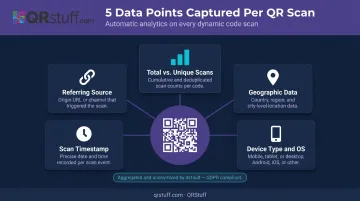
QRStuff's analytics dashboard surfaces the following data points automatically for every dynamic code scan:
- Total vs. unique scans — distinguishing new audience reach from repeat engagement
- Geographic data at country and city level
- Device type and OS — mobile vs. desktop, iOS vs. Android
- Scan timestamp — enabling peak-time analysis and campaign timing optimization
- Referring source — where digitally shared codes were discovered
This data is aggregated and anonymized by default. QRStuff does not store personally identifiable information from individual scanners, keeping the approach GDPR-compliant. QRStuff stores data on European servers, and businesses retain full control over retention and deletion.
Feeding Scan Data Downstream
The data captured at scan level becomes most powerful when it flows into broader systems. QRStuff's API supports real-time webhooks for scan events, enabling integration with CRM platforms, marketing automation tools, and analytics stacks without heavy custom development. UTM parameter support means scan traffic integrates directly with Google Analytics, attributing user behaviour back to specific campaigns.
For marketers building durable measurement infrastructure, that attribution chain — from physical touchpoint to campaign conversion — is exactly what first-party data strategy demands.
Key Trend 3: The Phygital Shift — Merging Physical and Digital Experiences
"Phygital" describes the seamless blending of physical and digital brand interactions. In 2026, QR codes are the primary mechanism making this possible at scale.
Any printed surface can now become a live digital touchpoint. No app download, no account creation, no special hardware. One scan.
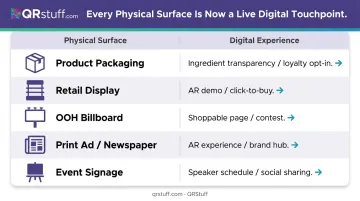
What Phygital QR Activation Looks Like in Practice
| Physical Surface | QR-Enabled Digital Experience |
|---|---|
| Product packaging | Ingredient transparency, how-to videos, loyalty opt-in |
| Retail display | AR product demo, live stock check, click-to-buy |
| OOH billboard | Shoppable landing page, contest entry, offer redemption |
| Print ad / newspaper | Immersive AR experience, brand content hub |
| Event signage | Speaker schedule, session feedback, social sharing |
Tata Tea Chakra Gold's April 2025 Tamil New Year campaign demonstrates how far this can go. A newspaper ad featured a QR code that launched a webAR experience — scanning brought a mirror element to life on the user's phone and revealed customised Puthandu greetings in Tamil. A print ad became an interactive cultural moment, requiring nothing beyond a smartphone camera.
That kind of engagement is showing up in the data too. According to Uniqode's 2026 statistics, the CPG sector generated 27.5 million scans in 2025, averaging 253 scans per QR code.
Why This Is Accelerating Now
Consumer expectations have shifted. A product package that doesn't tell its story feels incomplete. So does a billboard with no next step. Brands running phygital QR activations are setting the experiential standard, and competitors in the same category are under real pressure to keep up.
Key Trend 4: Branded, Gamified, and Immersive QR Experiences
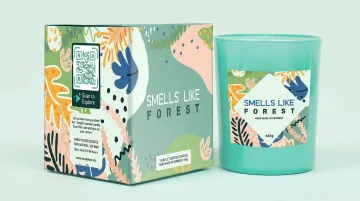
Plain black-and-white QR codes still work. But they blend into the background. In 2026, brands are treating the code itself as a creative element — with colours, logos, custom shapes, and patterns that make scanning feel intentional rather than obligatory.
Custom Design as a Conversion Driver
QRStuff offers comprehensive visual customisation: brand colours, logo embedding (auto-positioned for optimal scan reliability), custom module and eye shapes, gradient effects, and foreground/background image options. The platform's built-in error correction means a logo occupying up to 30% of the code area doesn't compromise scannability — though the practical recommendation sits around 15% for best reliability across all lighting conditions.
Visual differentiation matters because it changes the perceived value of the scan. A custom-designed code on premium packaging signals that something worth seeing is on the other side.
Gamification Turns Scans Into Brand Interactions
KiMs Denmark's 2025 summer campaign shows what gamified QR execution looks like in practice. Limited-edition chip bags were positioned as left and right "speakers." Scanning the QR code launched a surround-sound music experience with Martin Jensen, plus the chance to win prizes including a DJ session or festival tickets. The code wasn't an afterthought — it was the campaign mechanic.
Other gamification formats gaining traction:
- Instant-win overlays triggered post-scan
- Voting campaigns tied to limited-edition packaging variants
- AR experiences that unlock hidden brand content
- Loyalty program entry points replacing physical punch cards
Why Immersion Increases Business Value
An unexpected post-scan experience (an AR greeting, a personalised song, an interactive game) drives social sharing because people want to show others what they found. That organic reach extends campaign impact without additional media spend.
The effect on brand recall is just as valuable. Interactive experiences are remembered; static landing pages rarely are. That's what moves QR codes from functional infrastructure into something that actually builds brand equity over time.
Key Trend 5: QR Codes Expand Far Beyond Traditional Marketing
Marketing drove QR's resurgence, but operational adoption is now outpacing it in several sectors.
Operational Use Cases Gaining Ground
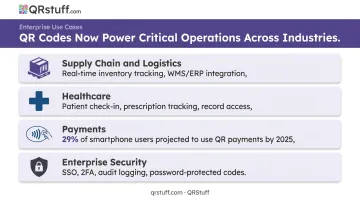
- Supply chain and logistics: QR codes on pallets, bins, and individual products enable real-time inventory tracking, automated check-in/check-out, and maintenance log access — connecting directly to WMS and ERP systems via webhook integrations
- Healthcare: Patient check-in, prescription tracking, and medical record access are being streamlined through QR — reducing administrative friction while maintaining compliance
- Payments: An estimated 29% of worldwide smartphone users are projected to make QR code payments by 2025, with adoption particularly concentrated in Asia-Pacific and expanding in retail contexts globally
- Enterprise security: Password-protected QR codes, SSO via SAML 2.0, two-factor authentication, and audit logging are turning QR into an enterprise identity tool
QRStuff supports each of these use cases directly, with API and webhook integrations for supply chain workflows, GS1 Digital Link for retail POS compliance, HIPAA-aligned deployment options for healthcare, and enterprise security features including audit trails and API key management.
Sustainability as a Business Driver
73% of organizations report reducing printed materials through QR codes, according to Uniqode's 2026 statistics. Replacing printed manuals, product inserts, and menus at scale delivers measurable ESG impact — and aligns QR deployment with corporate sustainability commitments in a way that's auditable and easy to report to stakeholders.
GS1 Sunrise 2027: The Regulatory Catalyst
The Sunrise 2027 initiative requires retailers globally to ensure point-of-sale systems can read and process 2D barcodes by 2027. GS1 Digital Link, which encodes a product's GTIN in a web-compatible URI format, allows a single code to handle both POS checkout and consumer-facing content simultaneously.
For brands in apparel, fresh foods, and general merchandise, this isn't a future consideration. Planning for 2D-capable packaging needs to start now, and QRStuff's GS1 Digital Link support provides a compliant path that doesn't require separate infrastructure.
What's Driving These QR Code Marketing Trends
Several forces are converging to make 2026 the most significant year yet for QR adoption. They're not operating independently — each one removes a barrier that used to slow brands down.
Four factors explain the acceleration:
- Native scanning is universal. Both Apple and Android devices scan QR codes through the default camera app — no dedicated scanner required. With roughly 102.6 million US users expected to scan in 2026, QR is no longer a specialist channel.
- First-party data pressure is real. GDPR and CCPA enforcement keeps tightening, and brands need consent-based collection methods that hold up to regulatory scrutiny. QR's voluntary scan mechanic fits that requirement directly.
- Marquee campaigns are forcing competitors' hands. When Coca-Cola, Jameson, and Tata Tea run high-production QR campaigns, every competitor in food and beverage is watching. Category-wide adoption waves follow — and brands without QR capability in their martech stack are scrambling to catch up.
- Enterprise integration no longer requires custom builds. Modern QR platforms connect into existing systems through REST APIs and native integrations with tools like Shopify, Google Ads, and Meta Ads. What once took bespoke development now takes a few configuration steps.
Together, these shifts mean QR has moved from "interesting experiment" to operational infrastructure for brands running at scale.
Future Signals for QR Code Marketing Beyond 2026
The evolutionary pressure on QR marketing isn't slowing. Key signals to watch over the next one to three years:
- Agentic AI integration: Post-scan experiences dynamically assembled in real time by AI agents based on full customer context, removing static landing pages entirely. Gartner and Forrester both flag this capability as approaching scalable deployment in 2026–2027.
- NFC/QR convergence: Products carrying both NFC chips and QR codes to serve different audience segments — NFC for contactless tap interactions, QR for camera-based scanning
- GS1 Sunrise 2027: 2D barcode readiness at retail POS becomes a baseline expectation, accelerating QR-enabled packaging across CPG, food, and apparel
- Design-native codes: QR codes embedded as intentional creative elements in packaging and physical brand assets from the outset, planned rather than added after the fact
Businesses that build dynamic, analytics-driven QR infrastructure now will be a full capability cycle ahead when these technologies reach mainstream deployment. The gap between brands running sophisticated QR programs and those treating it as an occasional campaign add-on is widening — and the window to catch up shrinks with each product launch cycle.
Frequently Asked Questions
What is the biggest QR code marketing trend in 2026?
AI-powered personalization combined with dynamic QR codes is the most impactful shift for conversion. Brands like Jameson and Coca-Cola demonstrated in 2025 that individualized post-scan experiences — personalized songs, memory-making hubs — drive significantly higher engagement than generic landing pages. Dynamic codes make it possible to update these experiences in real time without touching the printed code.
How are dynamic QR codes different from static QR codes for marketing?
Static codes embed a fixed destination directly into the visual pattern — once printed, that destination cannot change. Dynamic codes route through a managed short URL, which means marketers can update the destination, swap seasonal content, or correct errors anytime without reprinting materials. Only dynamic codes provide scan analytics.
Can QR codes help businesses collect first-party data legally and ethically?
Yes. QR scans collect behavioral data (location, timing, device type, scan frequency) from users who choose to engage voluntarily. GDPR and CCPA-compliant platforms like QRStuff aggregate this data without storing personally identifiable information — making it a sound foundation for first-party audience intelligence.
What industries are seeing the most QR code marketing growth in 2026?
Retail, food and beverage, hospitality, and consumer packaged goods lead on the marketing side. Healthcare, manufacturing, and financial services are driving significant operational growth — using QR for supply chain tracking, patient record access, authentication, and contactless payments.
How do I measure the ROI of a QR code marketing campaign?
Track scan volume, unique versus repeat scanners, geographic and device breakdowns, and conversion events post-scan. QRStuff's analytics dashboard captures all of these automatically — with UTM parameter support, Google Analytics integration, and CSV/PDF export for existing BI workflows.
What is the "phygital" trend and how do QR codes enable it?
Phygital describes the seamless blending of physical and digital brand experiences. QR codes are the most accessible bridge — any physical surface (packaging, signage, print, events) can connect consumers to digital content, offers, or interactions with a single scan and no app required. Tata Tea's AR newspaper campaign is a concrete example of what phygital execution looks like in practice.