The numbers reflect growing pressure to change. According to ASIS International, 39% of organisations still use manual systems — pen and paper or spreadsheets — to track temporary visitor credentials. Yet 41% of those same manual-system users said upgrading to a digital visitor management system is part of their near-term plans.
The gap is clear. QR codes already appear on restaurant menus and product packaging worldwide, but their role in visitor management remains underused. Most facilities either rely on outdated paper logs or haven't connected the digital tools they already have into a coherent check-in workflow — leaving security gaps and creating friction for visitors at the door.
This guide explains how QR codes actually function within a visitor management system: the mechanics of each stage, the real benefits, and the environments where this approach works best.
Key Takeaways
- 39% of organisations still use manual visitor tracking — paper logs that create security gaps, compliance exposure, and lobby bottlenecks
- Visitors pre-register online, receive a unique QR code, and scan it on arrival — no staff contact or shared surfaces required
- The system instantly logs the visit, notifies the host, and can trigger physical access control hardware
- Dynamic QR codes enable real-time scan tracking, time-bound expiry, and audit-ready reporting
- Corporate offices, healthcare facilities, educational campuses, and event venues all use this approach to eliminate manual check-in entirely
What Is a QR Code Visitor Management System?
A QR code visitor management system (VMS) is a digital platform that automates check-in using uniquely generated QR codes. It replaces paper logs, manual ID checks, and front-desk bottlenecks with a structured, contactless flow that begins before a visitor reaches your building.
Traditional sign-in methods create slow entry queues, poor security traceability, and compliance risk. A QR-based VMS addresses all three within the same workflow.
It's more than a digital sign-in sheet or a standalone scanner app. A QR code VMS connects several functions into one continuous process:
- Pre-registration and visitor invite generation
- Identity verification at the point of entry
- Access control and gate/door triggers
- Real-time host notification
- Automated data logging for compliance
Static vs. Dynamic QR Codes: Why the Distinction Matters
That connected process depends on one critical technical choice: the type of QR code you use.
| Feature | Static QR Code | Dynamic QR Code |
|---|---|---|
| Destination | Fixed, cannot be changed | Editable after generation |
| Scan tracking | None | Real-time analytics |
| Expiry control | No | Yes (time-bound windows) |
| Audit trail | No | Yes |
| Visitor credential updates | Requires reprinting | No reprint needed |
Static codes encode fixed data permanently. Dynamic codes — like those generated through QRStuff — route through a short redirect URL that logs the scan event (timestamp, device, location) before delivering the visitor to their destination. That redirect layer is where the audit trail lives.
For visitor management, dynamic codes are the only operationally appropriate choice.
Why Traditional Visitor Check-In Systems Fall Short
Paper-based visitor logs fail in ways that compound each other. The gaps show up across security, compliance, and daily operations:
- No real-time visibility: A handwritten log can be forged, lost, or left unattended — with no way to confirm who's currently on-site or alert staff when someone doesn't sign out. ASIS data reported by Facilities Dive found more than 90% of organizations experienced an access-control failure in the previous six months, with tailgating cited by 61% of respondents.
- Low confidence in accuracy: Only 51% of manual-system users believed their visitor tracking was effective, versus 70% among users of digital access-control technology. That gap reflects real risk, not just preference.
- Compliance exposure: HIPAA physical safeguard guidance requires documented visitor management procedures. For UK-based operations, GDPR Article 6(1)(f) permits processing visitor data for security purposes — but only under auditable, documented procedures. A paper log doesn't qualify.
- Concentrated front-desk burden: Staff managing manual sign-ins can't simultaneously welcome guests, notify hosts, and verify identities. The workload compounds with every additional visitor.
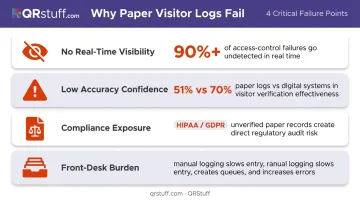
These aren't isolated inconveniences. Each failure point creates a vulnerability that compounds the others — and none of them are solved by simply switching to a digital form on a shared tablet.
How QR Codes Enable Touchless Visitor Management
QR-based visitor management runs through a series of automated stages — each one removing a friction point that traditional sign-in processes rely on staff or shared surfaces to handle.
Pre-Registration
The host — an employee, event organizer, or facility coordinator — sends a pre-registration link to the visitor before their visit. The visitor completes a digital form that typically captures:
- Name and organization
- Visit purpose and host details
- Compliance declarations (NDAs, health screenings, or site-specific requirements)
Shifting data entry upstream reduces lobby congestion and lets the system validate information before the visitor arrives on-site.
QR Code Generation
Upon form submission, the system generates a unique QR code tied to that visitor's credentials and visit window. The code is sent directly to the visitor's email or phone, and can be printed if needed.
Dynamic QR codes — such as those generated through QRStuff — allow organizations to:
- Track exactly when and where each code is scanned
- Set time-bound expiry windows for the visit
- Update visitor permissions without issuing a new code
- Maintain a real-time audit trail from first scan to exit
QRStuff's platform captures timestamp, geographic location, device type, and unique vs. repeat scan data for every dynamic code — all accessible through a real-time analytics dashboard and exportable as CSV for compliance reporting.
Arrival and Scan
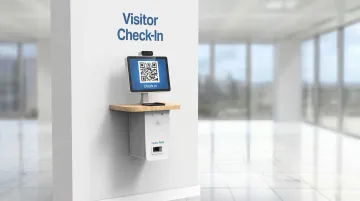
At the entry point, the visitor presents their QR code — on a phone screen or printed — to a wall-mounted scanner, kiosk camera, tablet, or turnstile reader. The scan takes milliseconds, with no staff interaction required.
The system verifies the code against its database in real time: confirming it's valid, within its active window, and matches an approved pre-registration before triggering the next step.
Access Control and Real-Time Logging
Upon a successful scan, several things happen simultaneously:
- Check-in is logged with a precise timestamp
- The host receives an automatic notification via SMS, email, or integrated platforms like Slack or Microsoft Teams
- Physical access is granted where hardware is integrated — door lock, gate, or turnstile
That log becomes the system of record. Facility managers can view live dashboards showing who is currently on-site, generate historical visit reports for audits, and receive alerts if a code is scanned outside expected parameters.
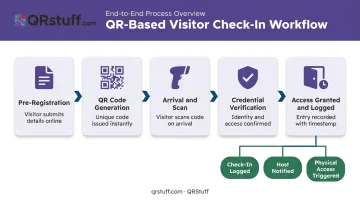
For organizations managing multiple sites, QRStuff's Enterprise tier supports centralised management across locations with role-based access controls, real-time webhooks for scan events, and API integration that allows a visitor management platform to auto-generate unique codes the moment a pre-registration form is submitted.
Key Benefits of QR-Based Touchless Visitor Management
Security and Access Control
Each QR code is uniquely tied to a registered visitor and a defined visit window. Unlike a paper log — where anyone can write any name — the system validates credentials before granting access.
The confidence data from ASIS is instructive here: 70% of digital access-control users believed their system was effective versus 51% for manual systems. That gap directly reflects what structured, verifiable check-in delivers over informal sign-in sheets.
Touchless Hygiene
Visitors using QR codes on their own phones never touch shared surfaces — no communal pens, sign-in tablets, or reception terminals. CDC guidance updated in 2024 identifies pens, counters, and touchpads as high-touch surfaces requiring regular cleaning. A 2021 peer-reviewed study found microbial contamination on up to 100% of touchscreens examined, with some public screens recording up to 60,000 CFU per surface.
Using a visitor's own device for check-in removes shared-surface contact entirely — a meaningful hygiene improvement, particularly in healthcare and food-safety-regulated environments.
Real-Time Visibility and Compliance
Digital check-in produces a timestamped, searchable audit trail. For organisations operating under GDPR or HIPAA, that trail is not optional — it's a requirement.
QRStuff is both GDPR and SOC2 compliant. Its analytics infrastructure is built to meet those standards directly:
- Scan data captured under documented security protocols
- User data stored on secure AWS infrastructure
- Right-to-erasure mechanisms built in
- CSV export available for compliance audits
Operational Efficiency
Pre-registration moves all data entry before the visit. Check-in time drops from several minutes at a staffed desk to seconds at a scanner. Reception staff shift from administrative logging to higher-value work — welcoming guests, managing exceptions, handling complex situations.
Scalability Across Locations
A single QR-based VMS can run across multiple offices, campuses, or facilities simultaneously. Policies, access permissions, and visitor records are managed from one dashboard.
QRStuff's Enterprise plan is built for that kind of deployment:
- Unlimited dynamic QR codes and batch processing
- 5+ user seats with role-based access controls
- White-label capabilities for facility managers or VMS providers deploying under their own brand
This makes it practical to roll out a consistent visitor management system across dozens of sites without rebuilding the workflow each time.
Where QR Code Visitor Management Works Best
QR-based visitor management works best when three conditions are in place: visitors can pre-register before arrival, internet connectivity is available at entry points, and most guests have a smartphone (with printed codes as fallback for those who don't).
Environments where it's most effective:
- Corporate offices with regular contractors, partners, and client visits — pre-registration integrates naturally into meeting invitations
- Healthcare facilities — Blessing Hospital implemented QR-based visitor and vendor registration in 2022 specifically to gain real-time visibility of who was in the building for emergency notifications; before implementation, staff could track patients and employees but not visitors or vendors
- Higher education campuses — Columbia University launched a QR guest-access workflow in 2024 where each code is valid for one scan and requires matching government ID at the entry point
- Events and co-working venues — temporary, time-limited access is exactly what dynamic QR codes with expiry windows are designed for
- Manufacturing and government facilities — where 66% of organizations are required by statute or regulation to meet specific access-control standards, according to ASIS
The core workflow (pre-registration → QR generation → scan → log) stays consistent whether you're managing a single-door office or a multi-building campus. Hardware integration and access-rule complexity grow with the environment; the underlying process doesn't.
Frequently Asked Questions
What is a QR code visitor management system?
It's a digital platform that replaces manual sign-in with a QR-code-based check-in flow. Visitors pre-register online, receive a unique code, and scan it on arrival — with the system handling identity logging, host notification, and access control automatically.
How does contactless visitor check-in with QR codes actually work?
A visitor receives a QR code after completing a pre-registration form. On arrival, they scan it at the entry point. The system verifies their credentials, logs the visit with a timestamp, and alerts their host, with no physical contact with staff or shared surfaces required.
Are QR code visitor management systems secure?
Dynamic QR codes expire within defined time windows, and visitor data is stored in encrypted cloud systems. Compliance with GDPR and SOC2 ensures personal information is handled under verifiable security protocols — providing stronger auditability than manual sign-in processes.
What if a visitor doesn't have a smartphone?
Printed QR codes are a direct alternative. Visitors can print their code at home, or front-desk staff can print it on arrival using a label printer — maintaining the contactless flow without requiring a mobile device.
What's the difference between static and dynamic QR codes for visitor management?
Static codes encode fixed data and can't be tracked or updated after generation. Dynamic codes support real-time scan tracking, credential updates, and time-based expiry. For visitor management, dynamic codes are the practical choice when audit trails and access control flexibility are priorities.
Can a single QR code visitor management system work across multiple locations?
Yes. Cloud-based platforms centralise visitor records and access policies across all locations in one dashboard, allowing organisations to maintain consistent check-in protocols, unified audit trails, and location-specific access rules from a single system.