That's a missed opportunity with a measurable cost.
While QR codes on menus, packaging, and ads get significant attention, the receipt remains largely untapped as a post-purchase engagement channel. No authoritative benchmark exists for receipt QR adoption specifically, which tells you something about how few businesses are actually doing this systematically.
This article covers three specific, operational advantages of placing QR codes on receipts — advantages tied to outcomes businesses actively track: repeat revenue, customer data, and campaign efficiency.
Key Takeaways
- A receipt QR code converts a passive proof of purchase into an active post-sale engagement channel.
- Dynamic QR codes are the right choice for receipts: editable destinations, real-time analytics, no reprinting required.
- The three key advantages: driving repeat purchases, capturing first-party behavioral data, and running flexible campaigns without printing costs.
- QRStuff's dynamic codes cover all three: scan tracking, instant destination edits, and bulk generation for high-volume businesses.
- One printed receipt can serve multiple campaigns over time — no reprinting, no added cost.
What Is a QR Code on a Receipt?
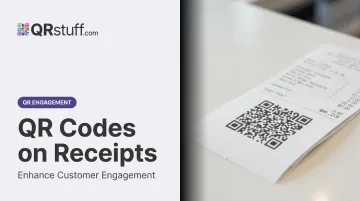
A receipt QR code is a scannable code — printed on a paper receipt or embedded in a digital one — that connects the customer to a specific destination immediately after a transaction.
This applies across all receipt formats:
- Paper receipts at point-of-sale terminals
- Email receipts sent as confirmation messages
- PDF invoices from e-commerce or service businesses
The QR code acts as a bridge between the physical transaction and the brand's digital ecosystem. What makes it valuable is the moment it occupies: right after a customer has committed trust and money. A well-placed QR code keeps that relationship active — directing them to a feedback form, a coupon, or a loyalty program sign-up instead of letting that window close.
Three Key Advantages of QR Codes on Receipts
Each advantage below connects directly to metrics businesses track: repeat revenue, customer acquisition cost, and campaign efficiency. These are operational outcomes, measurable against real numbers.
Advantage 1: Turning a One-Time Sale Into Repeat Revenue
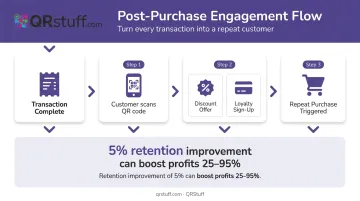
The receipt reaches a customer who has already purchased. That makes it the highest-intent marketing surface a business controls — and a direct channel to drive the next transaction.
In practice, a receipt QR code can direct customers to:
- A discount or coupon for their next purchase
- A loyalty program sign-up page
- A personalised landing page with related products
- A time-limited offer tied to their specific purchase
No search required. No navigation. One scan.
Why the economics matter: According to Harvard Business Review, acquiring a new customer costs 5–25x more than retaining an existing one, and a 5% improvement in retention can increase profits by 25–95%. A receipt QR code is a near-zero marginal-cost retention tool built into a document businesses are already producing.
The post-purchase window is psychologically optimal, too. The customer is satisfied, trust is established, and the barrier to the next action — scanning a code — is minimal.
KPIs this advantage influences:
- Repeat purchase rate
- Customer retention rate
- Loyalty program enrollment rate
- Average order value over time
- Customer lifetime value
When it matters most: Highest impact for businesses with frequent purchase cycles — cafes, grocery stores, convenience retailers — and for seasonal businesses that need to reactivate customers between purchase windows.
Advantage 2: Real-Time Customer Insights at the Point of Delivery
Every scan of a receipt QR code generates behavioural data. An otherwise anonymous paper transaction becomes a source of first-party customer intelligence — without requiring customers to log in or identify themselves.
When businesses use dynamic QR codes with built-in analytics, each scan is logged automatically. QRStuff's platform captures:
- Total and unique scans — distinguishing overall reach from distinct individuals
- Scan time and date — pinpointing peak engagement windows
- Device type and operating system — informing landing page design
- Geolocation at country and city level — enabling regional campaign targeting
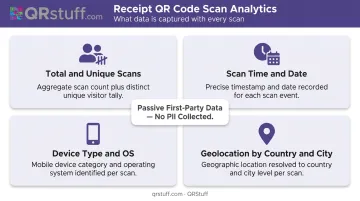
All of this happens passively. The customer scans, gets redirected to the destination, and the data populates the dashboard in real time — no PII collected, no user action required beyond the scan itself.
Why this data matters: Research from BCG found that companies linking first-party data sources can generate 2x incremental revenue and 1.5x cost-efficiency improvements. Receipt QR scans connect offline transactions directly to first-party behavioural signals — the kind that become harder to source as third-party cookies continue to decline.
Practically, this means a retail chain can see which store locations are generating post-purchase scans, which campaigns are being ignored, and what time of day drives the most engagement. That's actionable intelligence for budget allocation, not guesswork.
KPIs this advantage influences:
- QR scan rate
- Campaign conversion rate
- Geographic and time-based scan patterns
- Unique user engagement rate
- Cost-per-engagement
When it matters most: Most valuable for multi-location businesses running parallel campaigns across different markets. QRStuff's dashboard provides campaign tagging, geographic breakdowns, and CSV export — so businesses can compare performance across store locations and refine spend accordingly.
Advantage 3: Campaign Flexibility Without Reprinting Costs
The cost context first: A 50-roll case of thermal receipt paper runs $77–$100 at commercial vendors. For high-volume businesses printing hundreds of rolls per month, reprinting obsolete stock isn't just inconvenient — it's a direct, recurring cost.
Static QR codes make this problem worse. Change the campaign, and the code is obsolete, which means reprinting receipts, absorbing wasted inventory, and losing time. Dynamic QR codes eliminate that constraint.
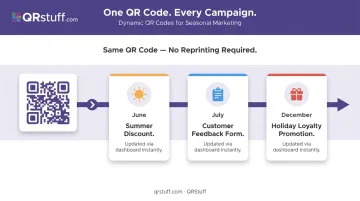
A restaurant can use the same receipt QR code to:
- Promote a summer discount in June
- Redirect to a customer feedback form in July
- Link to a holiday loyalty promotion in December
No new code. No reprinting. The update happens via dashboard and propagates instantly.
There's also a risk reduction angle. If a promotion underperforms, the QR code can be redirected to a new offer immediately — no wasted print run to absorb.
QRStuff's dynamic codes support unlimited destination changes. A single code can serve multiple sequential campaigns across the full life of a printed receipt, with updates applied instantly through the web dashboard and no technical knowledge required.
KPIs this advantage influences:
- Campaign update time
- Printing and reprinting cost
- Time-to-market for new promotions
- Campaign abandonment rate (promotions dropped due to logistical friction)
When it matters most: Highest impact for quick-service restaurants, large retail chains, and e-commerce businesses with frequent order confirmations — any operation where receipt volume is high and promotional cycles are short.
What Happens When Receipts Skip the QR Code
Without a QR code, a receipt is a dead end. The customer walks away with no prompt to return and no easy path back to your business.
The compounding consequences:
- Missed re-engagement. No mechanism exists to reconnect between purchases.
- Feedback goes uncollected. Service or product issues go undetected until they surface as reviews or churn. A recent BrightLocal survey found a large majority of consumers are open to writing reviews — but only when prompted and given an easy path to do so.
- Campaign spend becomes untrackable. Without scan data, there's no way to measure whether a print promotion drove any return. Nielsen's 2024 Annual Marketing Report found only 38% of global marketers measure traditional and digital marketing together for holistic ROI — a gap receipt QR analytics directly address.
- Competitor loyalty programmes fill the vacuum. Businesses using receipt QR codes for loyalty sign-ups and exclusive offers capture customers who might have stayed loyal.
How to Get the Most Out of Receipt QR Codes
A receipt QR code placed and forgotten delivers a fraction of its potential. Three consistent practices separate campaigns that drive real engagement from ones that go unscanned.
Three conditions for maximum value:
Use dynamic QR codes. Static codes lock destinations and provide no data. Dynamic codes — like those on QRStuff's Lite Suite and above — allow instant destination edits and capture real-time scan analytics. The Full Suite removes scan limits entirely, making it practical for high-volume retail and hospitality operations.
Always include a specific call-to-action. Ambiguous codes are ignored. Specific CTAs drive scans. Place a short instruction next to every code:
- "Scan for 15% off your next visit"
- "Scan to rate your experience"
- "Scan to join our rewards program"
Review analytics and act on them. Track which receipt campaigns generate scans and conversions. Identify drop-off points. Update destinations based on performance data, not assumption. QRStuff's dashboard presents this in real time — by date, location, device type, and unique users — and exports to CSV or PDF for deeper analysis.
For businesses printing receipts at scale, volume isn't a barrier. QRStuff's Full Suite supports batch processing of up to 500 QR codes, and the Enterprise tier offers unlimited bulk generation for large retail chains and quick-service restaurants.
Conclusion
The receipt is one of the few physical touchpoints a business controls at the exact moment a customer's satisfaction peaks. Most businesses waste it. Businesses that add a QR code don't just get a scan — they get a channel.
These advantages compound over time. Better retention data informs smarter campaigns. Dynamic flexibility eliminates wasted print spend. Repeat-purchase incentives delivered via receipt outperform cold outreach because the audience is proven buyers.
Receipt QR codes deliver more value the longer they run. As scan data accumulates and campaigns are refined against real behavioral evidence, the return on a near-zero marginal-cost tool grows with every transaction.
Frequently Asked Questions
What is the QR code on a receipt?
A QR code on a receipt is a scannable code printed or embedded on a physical or digital proof of purchase. When scanned with a smartphone, it connects the customer instantly to a digital destination — such as a discount page, feedback form, loyalty program, or product information.
Should I use a static or dynamic QR code on my receipt?
Use dynamic QR codes for receipts. They allow you to update the destination without reprinting, include scan tracking and analytics, and support multiple campaign types over time. Static codes are fixed at creation and provide no performance data — making them a poor fit for ongoing receipt campaigns.
Can I track who scans QR codes on my receipts?
Dynamic QR codes capture scan data passively — no customer login or identification required. QRStuff records total scans, unique users, device type, operating system, scan time, and geolocation at country and city level. Personally identifiable information (PII) is not collected or stored.
What should a QR code on a receipt link to?
The destination depends on your goal. Common options include:
- Discount or coupon pages to drive repeat purchases
- Customer feedback or review forms
- Loyalty program sign-up pages
- App download links, social media profiles, or product manuals
Dynamic codes let you change the destination as campaigns evolve.
Can QR codes on receipts work for small businesses?
Yes — receipt QR codes are particularly accessible for small businesses. They're low-cost to create, require no technical integration to start, and work on any existing receipt format, printed or digital. QRStuff's Lite Suite starts at $10/month and includes dynamic QR codes with scan analytics.
How big should a QR code be on a printed receipt?
A minimum of 2cm × 2cm is recommended for reliable scannability. As a practical guide, Nielsen Norman Group's 10:1 rule applies: for every 10cm of scanning distance, the code should be at least 1cm wide. For print, use SVG or EPS vector formats to maintain quality at any size — QRStuff exports both.