Dynamic QR codes fix both of these problems. The destination can be changed after printing, and every scan generates data: location, device type, time, and total volume. That combination — flexibility plus measurement — is what makes them genuinely useful across industries, not just a novelty.
This guide covers what dynamic QR codes are, how they work, real-world examples by sector, and how to decide which application makes sense for your business.
Key Takeaways
- Dynamic QR codes encode a short redirect URL, so the destination can be updated at any time without reprinting the code
- Every scan captures location, device type, time, and volume, giving offline print materials a real analytics layer
- Use cases span retail, hospitality, healthcare, marketing campaigns, events, and operational workflows
- Choosing the right use case comes down to content update frequency, scan tracking needs, and how long the printed material stays in use
What Are Dynamic QR Codes?
A dynamic QR code is a 2D barcode that encodes a short intermediary URL rather than a fixed destination. When someone scans it, their device hits a redirect layer, which forwards to whatever the current destination URL is. The physical code stays the same; the destination behind it is fully editable.
This is what makes the code "dynamic." The physical symbol on your packaging, signage, or direct mail stays identical. What lives behind it is fully editable.
How the Redirect Works
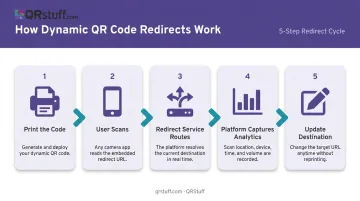
Here's what happens from scan to destination:
- Print the code with a short redirect URL encoded in the symbol
- User scans the code, and their device reads the redirect URL
- Redirect service routes the scan to the current destination
- Platform captures analytics: location, device, timestamp, and scan count
- Update the destination in the dashboard at any time — the next scan lands on the new URL automatically
That redirect layer also determines what type of content sits at the destination. QRStuff supports 40+ dynamic QR code types: URL redirects, vCard contacts, PDF file uploads, payment links, digital menus, feedback forms, and event pages. The format adapts to what each deployment actually needs, not just a basic website link.
Why Dynamic QR Codes Matter for Modern Businesses
Static QR codes encode a destination permanently. If the URL changes — a promotion expires, a page moves, a form is updated — the code breaks. The only fix is reprinting all physical materials. For anything with a long production cycle (product packaging, annual catalogs, trade show displays), that's an expensive problem.
Dynamic codes eliminate that cycle entirely. GS1's resolver standard explicitly supports updating redirect destinations without reprinting the encoded URI — making them the right choice for any printed asset whose content will evolve after it ships.
Updatability solves the reprinting problem. Tracking solves the measurement problem. Without scan data, print campaigns are invisible — you can't tell whether anyone scanned a shelf label, how many people responded to a direct mail piece, or which store location drove the most engagement.
According to the ANA's 2023 Response Rate Report, 82% of direct mail marketers used online tracking mechanisms — including QR codes — to measure response rates, up from 67% in the prior study. For marketing teams accountable to ROI, that's the difference between a line item and a measurable channel.
Dynamic QR Code Examples and Use Cases Across Industries
Dynamic QR codes aren't one-size-fits-all. Their value comes from how they're deployed. Here's how different sectors put them to work.
Retail and E-Commerce
Retailers embed dynamic QR codes on shelf labels, product packaging, hang tags, and in-store signage to connect shoppers with product pages, promotional offers, how-to videos, or loyalty sign-ups — all without reprinting when the offer changes.
The dynamic advantage here is straightforward: seasonal campaigns shift constantly. A shelf talker with a dynamic code can redirect from a summer sale landing page to a back-to-school promotion without touching the physical display.
GS1 US data shows 66% of consumers would scan a QR code on food packaging for freshness, ingredients, and shelf-life information — and 62% would spend more for access to detailed product information. Major brands including Puma, PepsiCo, and P&G have already moved toward QR-enabled packaging that supports dynamic content updates.
Best fit: Multi-location retailers and brands selling through third-party channels. A QR code on packaging can redirect to an Amazon product page, a brand app, or a regional promotion. Tracking scan volume by store location gives attribution data that static shelf materials never could.
Restaurants and Hospitality
Restaurants use dynamic QR codes for digital menus on table cards, updating content for daily specials, pricing changes, or seasonal dishes without any reprinting. Hotels place them on in-room cards and lobby displays to link guests to room service, amenity information, local guides, and booking pages.
The National Restaurant Association's 2024 Technology Landscape Report found 59% of full-service customers would use a QR code to access a menu, and 48% would use one to place an order. One 420-unit brand using QR codes on bills saved more than 1,000 combined customer and employee hours in a single week — roughly 30 seconds per transaction.
For chains and multi-property operations, the operational advantage compounds: update menu content or service hours once in the dashboard, and every location reflects the change immediately.
One limitation to flag: Guests without mobile data — international travelers, for instance — can't access redirect-based codes. Always pair codes with a clear CTA explaining what will load, and ensure Wi-Fi access is available where the code is posted.
Healthcare and Education
Both sectors rely on forms, portals, and resources that change frequently — making dynamic codes a practical fit:
- Healthcare providers place codes on waiting room signage, appointment cards, and intake materials to link patients to booking portals, intake forms, and telehealth links
- Educational institutions add them to syllabi, campus signage, and printed handouts to direct students to current course resources and registration portals
A static QR printed on a brochure pointing to a decommissioned URL breaks the workflow entirely. A dynamic code can be redirected to the live resource without any reprinting.
For healthcare specifically, HHS guidance states that HIPAA-regulated entities must comply with HIPAA Rules when using online tracking technologies — including the redirect and analytics layer of a dynamic QR platform. QRStuff is GDPR and SOC2 compliant, making it a suitable option for organizations that need to demonstrate data handling accountability.
Marketing, Advertising, and Print Campaigns
Marketing teams embed dynamic QR codes in print ads, direct mail pieces, billboards, product inserts, and branded merchandise to create trackable offline-to-digital touchpoints.
What makes this use case particularly strong:
- A direct mail piece sent to 50,000 recipients can be redirected mid-campaign from a general landing page to a personalised offer — without issuing new mail
- Seasonal campaigns reuse the same printed creative year over year by updating the destination each cycle
- Scan data (volume, geography, device type, time-of-day) makes it possible to compare print campaign performance against digital benchmarks
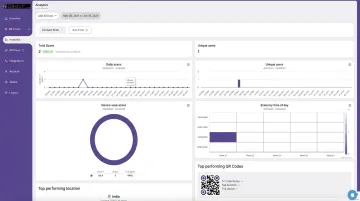
QRStuff's analytics dashboard captures total and unique scans, geolocation at country and city level, device and OS breakdown, and time/date patterns — updated in real time and exportable via CSV. That's enough data to calculate cost-per-engagement and build a proper attribution model for print.
Events, Trade Shows, and Direct Mail
Event organizers place dynamic QR codes on booth displays, attendee badges, banners, and printed programmes to direct traffic to live schedules, session materials, lead capture forms, and speaker information — all of which can be updated as event details shift.
The operational case is direct: if a session moves rooms or a speaker link changes, one dashboard update fixes the code for every attendee who scans thereafter. No reprinting thousands of programmes.
Best fit for trade show exhibitors: Teams using the same physical booth assets across multiple events throughout the year can update the destination to reflect event-specific landing pages, promotions, or follow-up sequences for each show — without touching the printed hardware.
How to Choose the Right Dynamic QR Code Use Case
The correct use case is determined by operational need. Three questions cut through the noise:
| Question | Dynamic Code Makes Sense If... | Static May Suffice If... |
|---|---|---|
| How often will the destination change? | Frequently — seasonal, event-driven, rotating content | Rarely or never |
| Is scan tracking required? | Yes — campaign reporting, attribution, ROI measurement | No — purely functional use |
| How long will the printed material circulate? | Long-run print (packaging, annual catalogs, booth displays) | Short-run or digital-only surfaces |
High-value dynamic use cases: Seasonal retail promotions, restaurant menus, healthcare intake forms, direct mail campaigns, trade show booth materials, event programs.
Cases where static may be sufficient: Permanent contact information, Wi-Fi credentials that never change, one-time event codes on temporary signage with no measurement requirement.
Once you've identified the right use case, tracking performance is what separates informed deployments from guesswork. QRStuff's analytics dashboard covers scan volume, geographic data, device breakdowns, and time-based insights across all paid tiers. Full Suite and Enterprise plans remove monthly scan limits and include CSV export for deeper campaign analysis.
What to Check Before Deploying Dynamic QR Codes
Choosing the right use case only gets you partway there — how you deploy and maintain the code determines whether it holds up in the real world.
Common Mistakes to Avoid
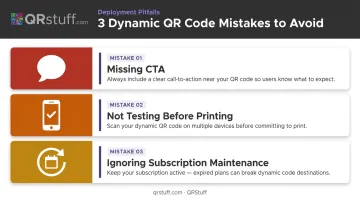
- Skip the CTA, lose the scan: A standalone QR code gives users no reason to engage. Always pair it with a short prompt — "Scan for today's menu," "Scan for product details," "Scan to register."
- Not testing before printing: Test across multiple devices, lighting conditions, and angles before committing to a print run. QRStuff documents a minimum size of 2 cm × 2 cm for close-range scanning, with the 10:1 distance-to-size rule for codes scanned from further away.
- Treating dynamic codes as maintenance-free: Dynamic codes depend on an active redirect service. If the subscription expires, the redirect breaks — and so does every printed code pointing to it.
Platform and Account Management
Those last two mistakes connect directly to provider selection. Dynamic QR codes on printed materials with multi-year lifespans — product packaging, booth displays, annual publications — depend entirely on the redirect service staying active, which makes choosing and managing the right platform a long-term cost decision.
Key factors to verify before committing to a provider:
- Uptime reliability: QRStuff maintains a 99.9% uptime guarantee across all paid plans, with a historical average of 99.968% since 2008
- Code longevity: On QRStuff's Full Suite and Enterprise plans, codes created under a paid subscription never expire — critical for long-run print assets
- Lapse protection: If a subscription lapses, codes drop to a 10-scan-per-month limit rather than breaking immediately, with a 30-day grace window before expiration on monthly plans
- Compliance documentation: For regulated industries, verify GDPR and HIPAA-relevant data handling policies before deploying
Frequently Asked Questions
What is the difference between a QR code and a dynamic QR code?
A standard (static) QR code encodes a fixed destination that cannot be changed after creation. A dynamic QR code encodes a short redirect URL that can be updated at any time — enabling real-time destination changes and scan tracking without reprinting the physical code.
Can I print a dynamic QR code?
Dynamic QR codes are specifically designed for print. The code itself prints like any standard QR code, but because it encodes a redirect URL rather than a fixed destination, the content it points to can be updated after printing without touching the physical material.
Do dynamic QR codes expire?
Dynamic QR codes don't expire on their own, but they rely on the redirect service staying active. On QRStuff's paid plans, codes never expire as long as the subscription remains active. If a subscription lapses, a grace period applies before codes stop functioning.
Can I track who scans my dynamic QR code?
Dynamic QR codes track scan volume, geographic location, device type, and time-of-day patterns. Individual identity is never captured — analytics are aggregated and anonymized, keeping the platform GDPR-compliant.
How do I update a dynamic QR code without reprinting it?
Log into your dashboard and update the destination URL. The next scan automatically routes to the new destination. Nothing about the printed code changes — the redirect updates instantly on the backend.
What industries benefit most from dynamic QR codes?
Retail, hospitality, healthcare, marketing and advertising, and event management see the highest return. These sectors share frequently changing content, long-run printed materials, and a strong need to measure offline engagement.