Sunrise 2027 is GS1's global initiative requiring retailers to upgrade point-of-sale systems to accept 2D barcodes by the end of 2027. For food and beverage companies, this isn't a distant IT problem. It's a packaging deadline, a regulatory alignment opportunity, and a consumer engagement shift happening simultaneously.
The pressure is coming from two directions: compliance timelines that are tightening faster than most packaging cycles allow, and consumers who increasingly expect to scan a code and instantly know what's in their food, where it came from, and whether the brand's sustainability claims hold up.
This article covers what GS1 Digital Link actually is, what Sunrise 2027 requires from F&B organizations specifically, and how forward-thinking brands are turning a compliance obligation into a measurable competitive advantage.
Key Takeaways
- GS1 Digital Link encodes product identity (GTIN, batch, expiry) into a web-based URL, stored in a 2D barcode — one scan serves retailers, regulators, and consumers simultaneously
- Sunrise 2027 targets global retail POS readiness for 2D barcodes by end of 2027 — F&B brands need to act now to stay ahead of packaging reprint cycles
- 75% of shoppers would switch to a brand offering deeper product information; 66% say they'd scan a QR code on food packaging
- Benefits extend well beyond compliance: allergen transparency, faster recalls, sustainability storytelling, and first-party consumer data
- Compliant platforms should support dynamic destinations, scan analytics, and bulk code generation to handle large SKU portfolios at scale
What Is the GS1 Digital Link Standard?
GS1 Digital Link is a globally standardized method for encoding product identifiers — such as a GTIN, batch/lot number, serial number, and expiry date — into a standard web URL (URI). That URL is then stored inside a 2D barcode like a QR code.
When someone scans it, the barcode doesn't just trigger a price lookup. It opens a web-based product identity that routes different users — shoppers, retailers, regulators — to different digital destinations from the same physical code.
Who Is GS1, and Why Does This Standard Matter?
GS1 is the neutral, not-for-profit organization that invented the barcode. Over 2 million companies use GS1 standards globally across 116 member organizations. The organization isn't selling a product — it sets the rules that make supply chains interoperable across industries and borders. That neutrality is precisely why the GS1 Digital Link standard carries weight: when GS1 sets a transition timeline, the entire retail ecosystem moves with it.
The current specification is GS1 Digital Link URI Syntax 1.6.0 (April 2025), with the GS1-Conformant Resolver updated to version 1.2.0 in January 2026.
Static vs. Dynamic: The Core Shift
Traditional 1D barcodes (UPC/EAN) are static. The data encoded at print time never changes. Update a formulation, add an allergen warning, or expire a promotion — and you're reprinting labels.
GS1 Digital Link removes that constraint entirely:
- The URL encoded in the barcode points to a live, updatable destination
- Brands can change what content consumers see — safety notices, promotions, seasonal content — without touching the physical packaging
- The same barcode simultaneously serves the retail POS (reading the GTIN for checkout) and consumers (accessing rich product information online)
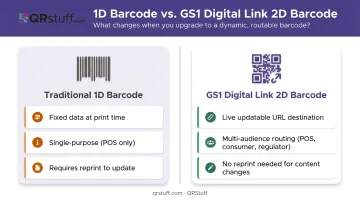
For food and beverage brands managing frequent label changes, regulatory updates, and multi-market SKUs, that flexibility has real operational and compliance value.
The Sunrise 2027 Mandate: What F&B Executives Need to Know Now
GS1's Ambition 2027 sets a clear goal: by the end of 2027, all retail POS systems should be capable of reading and processing a defined set of 2D barcodes with GS1 standards, alongside existing linear barcodes. This is a global industry POS-readiness target — not a single retailer's policy — which means the entire retail infrastructure is moving at once.
One critical nuance: the GS1 retail POS guideline specifies that linear barcodes should remain on packaging during the transition period — dual marking is required until at least 90% of POS scanning solutions can capture GTINs from GS1-compliant 2D barcodes. Brands shouldn't plan to remove UPC/EAN codes immediately.
Who Inside Your Organization Is Affected
GS1 Digital Link isn't an IT project. It cuts across multiple functions:
- Packaging and operations — coordinating label changes across every SKU and production line
- Compliance and regulatory — ensuring labeling accuracy and audit-readiness across markets
- IT and systems — integrating dynamic QR platforms with ERP and WMS infrastructure
- Marketing — building consumer engagement strategies around the new scan touchpoints
The organizations that struggle most treat this as a technical swap owned by one team. In practice, it requires cross-functional coordination from the first planning session.
The Cost of Waiting
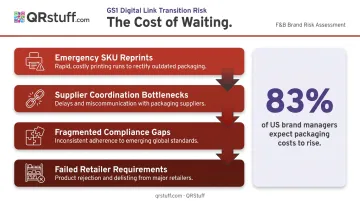
Packaging cycles in F&B typically run 12–18 months from design brief to shelf. A brand that waits until mid-2026 to start its GS1 Digital Link transition faces compressed timelines that create real operational problems:
- Emergency reprints across hundreds of SKUs simultaneously
- Supplier coordination bottlenecks when multiple packaging lines need concurrent updates
- Fragmented rollouts that create compliance gaps across product ranges
- Risk of failing to meet retailer requirements at shelf
These operational risks compound an already difficult cost environment. Packaging Digest reported in 2025 that 83% of 400 US brand managers expected packaging costs to rise — starting late layers premium reprint costs on top of that pressure.
Not Just a US Story
Sunrise 2027 is a global transition. GS1 member organizations across Europe, Latin America, and Asia-Pacific are aligned with the same 2027 timeline. F&B multinationals need strategies that account for different regional implementation rates, retailer readiness levels, and regulatory requirements — not just a US-centric rollout plan.
Strategic Benefits for F&B Brands
Compliance is the forcing function. But the brands getting ahead of Sunrise 2027 are doing so because the business case goes well beyond avoiding retailer penalties.
Consumer Transparency as a Trust Driver
Research from FMI and Label Insight found that 75% of grocery shoppers were more likely to switch to a brand that provides deeper product information beyond the physical label. 80% said they were more likely to be loyal to that brand, and 54% were willing to pay more.
A GS1 Digital Link QR code on packaging can instantly surface:
- Full ingredient lists and allergen declarations
- Nutritional data and dietary certifications
- Country of origin and farm-to-shelf provenance
- Recycling instructions and sustainability claims
Packaging stays uncluttered while the product record becomes as detailed as consumers need it to be.
First-Party Data at the Moment of Purchase
Every QR scan is a data event. Unlike third-party cookie tracking, scan data is collected at the point of physical product interaction — the most valuable moment in the purchase journey.
QRStuff's analytics platform captures scan timestamp, device type, geolocation (country and city), and unique vs. repeat scans — all without collecting personally identifiable information, maintaining GDPR compliance. For F&B brands, this means understanding where consumers actually engage with products, not just where they browse online.
The IAB's 2024 State of Data report found 71% of brands were growing or planning to grow first-party datasets — nearly double the proportion from two years earlier. A QR code on packaging is one of the few first-party data touchpoints a physical product brand actually controls.
That data advantage extends into operations, where the same barcode infrastructure can meaningfully change how brands respond to safety events.
Faster, More Precise Recall Management
The HHS OIG found in 2017 that FDA food recalls took a median 29 days and an average 57 days to initiate after FDA learned of the problem. At that pace, affected product stays on shelves — and in homes — for weeks.
GS1 Digital Link addresses this directly. Because the barcode encodes batch/lot number and expiry date alongside the GTIN, brands can:
- Identify precisely which batches are affected without broad product-level recalls
- Push updated safety communications through the scan destination in real time
- Notify consumers who scan affected products immediately, without reprinting
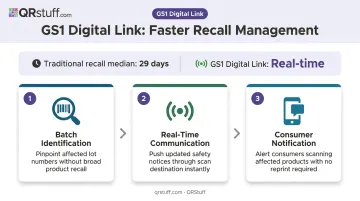
This also supports alignment with FDA FSMA Rule 204, which requires covered food businesses to provide Key Data Elements linked to Critical Tracking Events — with FDA proposing an updated compliance date of July 20, 2028.
Verifiable Sustainability Claims Without Label Clutter
More than half of environmental claims examined in EU markets were found to be vague, misleading, or unsupported by evidence. GS1 Digital Link gives brands a verifiable, updatable channel for those claims: sourcing reports, carbon data, third-party certifications, and recycling guidance — all accessible via scan, without crowding the physical label.
GS1 Europe has confirmed that GS1 Digital Link URI syntax can support EU Digital Product Passport data fields, positioning compliant brands for emerging regulatory requirements across key markets.
Real F&B Use Cases
Allergen Transparency in Real Time
A consumer with a nut allergy scans a packaged snack. Instead of trusting a printed label that may reflect a previous formulation, they access a live allergen declaration that the brand updated last week when a supplier change affected trace nut content — no reprint required.
That scenario isn't hypothetical. Creative Nature, a UK allergy-safe snacks brand, uses QR codes powered by GS1 to provide food allergy test results, recipes, and brand updates across their product range — including supply to 150 SPAR stores in Switzerland and Virgin Atlantic.
Beverage Authenticity and Brand Engagement
Coca-Cola Latin America implemented QR codes powered by GS1 Digital Link on reusable and refillable bottles, using unique identifiers to track bottle lifecycle. The programme supports Coca-Cola's goal of 40% refillable bottles by 2030, with RefPET bottles designed for up to 25 filling cycles before recycling.
Premium spirits brands are applying the same logic — using scan-at-consumption moments to confirm product provenance and reduce counterfeiting, which costs the spirits industry an estimated $1 billion annually.
Farm-to-Shelf Provenance for Organic and Fresh Products
A QR code on a bag of organic produce can connect consumers to the harvest date, farm location, and third-party certifications — the kind of verified provenance story that supports premium pricing and organic brand positioning. Parla Deli in Brazil became the world's first retailer to complete a POS scan of a 2D barcode using GS1 Digital Link, with reported benefits including 50% less food waste.
Cross-Market Regulatory Compliance
F&B brands selling across the US and EU face different mandatory labeling requirements under FDA rules and EU Regulation 1169/2011. A single GS1 Digital Link barcode addresses this by:
- Routing each user to jurisdiction-appropriate labeling based on their location
- Eliminating the need for separate physical label versions per market
- Allowing real-time updates when regulatory requirements change — no reprint required
How to Begin Your GS1 Digital Link Transition
Step 1: Audit Your Current Packaging Infrastructure
Before generating a single GS1 Digital Link code, you need a complete picture of:
- All active GTINs and SKUs currently in market
- Which barcode formats are in use across packaging lines
- Which print systems and supplier relationships will require updates
Most large F&B organizations discover during this audit that their product data structure is less centralized than expected — starting here is what makes the transition manageable.
Step 2: Choose a Platform That Supports GS1 Digital Link Standards
Not all QR code generators produce GS1-compliant links. The distinction matters at POS: a standard dynamic QR code using a short redirect URL is not the same as a GS1 Digital Link-encoded code that carries the GTIN in a structured URI format.
When evaluating platforms, look for:
- Native GS1 Digital Link QR code generation with GTIN encoding in the correct URI format
- Dynamic (updatable) destinations with no reprinting required
- Scan analytics capturing location, device, timestamp, and unique scans
- Bulk generation and API access for ERP/WMS integration at scale
- Enterprise-grade uptime guarantees and security certifications
QRStuff's GS1 Digital Link service generates Sunrise 2027-compliant codes and meets all the criteria above — Coca-Cola and PepsiCo are among the F&B brands already using it.
Step 3: Align Stakeholders and Set Phased Milestones
A workable transition structure for most large F&B organizations:
- Form a cross-functional steering group — packaging, compliance, IT, and marketing need to coordinate from day one
- Pilot on your top 20 SKUs first — prove the workflow before scaling
- Build to full SKU coverage by mid-2026 — leaving buffer before the 2027 deadline
- Communicate with retail partners early — shelf disruption from last-minute label changes is avoidable with advance notice
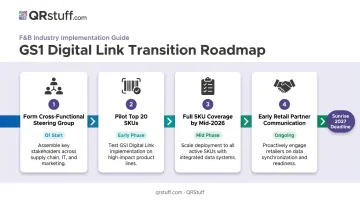
The GS1 Global and GS1 US Implementation Guides provide detailed technical roadmaps for this process and are the appropriate starting points for IT and packaging teams.
Frequently Asked Questions
What is the GS1 Digital Link standard?
GS1 Digital Link is a globally standardized format that encodes GS1 product identifiers — like a GTIN — into a web-based URL, which is stored in a 2D barcode such as a QR code. Anyone who scans it can access rich, real-time product information online, while retailers can simultaneously read the GTIN at POS checkout.
What is GS1 identification standard?
GS1 identification standards are a globally accepted system of unique product identifiers — including the GTIN for products, GLN for locations, and SSCC for shipping containers — enabling consistent, interoperable identification across industries and trading partners worldwide.
What are GS1 supply chain standards?
GS1 supply chain standards encompass barcodes, RFID tags, data synchronization protocols, and electronic data interchange formats. They allow manufacturers, distributors, and retailers to share accurate product and shipment data in a consistent, globally recognized format.
Is GS1 a global standard?
Yes. GS1 is maintained by a neutral not-for-profit organization with member bodies in over 100 countries, and its standards — including the barcode and GS1 Digital Link — are used by more than 2 million companies across 25+ industries worldwide.
What is a GS1 company prefix?
A GS1 company prefix is the unique identifier businesses obtain from GS1 to create their own GTINs and register products in the global identification system.
What does the Sunrise 2027 deadline mean for F&B brands?
Sunrise 2027 is GS1's target for major retailers globally to accept 2D barcodes at POS checkout by end of 2027. F&B brands must transition packaging from traditional 1D barcodes to GS1 Digital Link-enabled 2D codes to meet retailer requirements and maintain shelf access. Given typical packaging cycle lead times, early action is essential.