: Connected Consumer Experiences](https://file-host.link/website/qrstuff-qjtbbl/assets/blog-images/0106bb11-ccc1-4928-a507-1b7e94902f8f/1780333060903848_26135fb2ad9840eeb7a71440e51e126d/360.webp)
Introduction
Food packaging used to have one job: contain the product and meet label requirements. Now it's a digital touchpoint — connecting a shopper in a supermarket aisle to a brand's full story, complete ingredient data, sourcing certificates, and real-time promotional offers. All from a single scan.
The pressure driving this shift is real. Label space is finite, but consumer appetite for product information keeps growing. According to a 2024 GS1 US consumer survey, 79% of shoppers are more likely to buy products with a scannable barcode or QR code that provides the information they want.
FMI's 2024 grocery trends research found 37% of grocery shoppers now use their mobile phones in-store to compare prices and find product information — up 28 points since 2016.
This post covers what QR codes on food packaging actually do, the consumer experiences they enable, and why dynamic QR codes give food brands a genuine operational edge.
Key Takeaways
- QR codes turn static packaging into an interactive channel consumers can engage at point of purchase
- One scan can surface ingredients, allergen data, sourcing stories, recipes, and loyalty offers
- Dynamic QR codes allow content updates without reprinting — critical for recalls, compliance changes, and seasonal campaigns
- Built-in scan analytics show when, where, and how consumers engage with specific SKUs across markets
- Regulatory pressure around food traceability is growing; early adoption keeps brands compliant before mandates arrive
From Label to Touchpoint: What QR Codes on Food Packaging Actually Are
A QR code is a machine-readable square symbol that encodes a destination — a URL, a PDF, a video, a landing page — and can be scanned by any modern smartphone camera without a separate app or download.
This sets QR codes apart from traditional barcodes in one practical way: A barcode carries a product identifier readable only by retail scanners at the point of sale. A QR code is a two-way bridge: the same physical mark can send a consumer to a full digital experience while also carrying product identity data useful to retailers and supply chain systems.
Static vs. Dynamic: Why the Distinction Matters for Food
The technical difference is straightforward but the business implications are significant:
| Type | How It Works | Best For |
|---|---|---|
| Static QR | Destination is permanently encoded in the code itself | Stable, evergreen content that will never change |
| Dynamic QR | Encodes a short redirect URL; destination can be updated after printing | Promotions, compliance changes, recall communications, seasonal content |
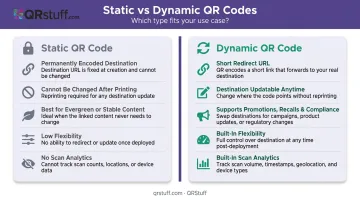
For food and beverage brands, static codes carry real risk. Formulations change, certifications update, campaigns expire, and sometimes products need to be recalled. A static code printed on 500,000 units cannot be changed. A dynamic code can be redirected from a dashboard in minutes — no reprinting required.
GS1 Digital Link: The Next Step
For brands planning packaging redesigns or those operating in regulated food categories, GS1 Digital Link offers a more strategic architecture. A GS1 Digital Link QR code embeds standard identifiers — GTIN, batch/lot number, expiry date — in a web-compatible URI. The result is a single code that processes at retail checkout and delivers consumer-facing digital content when scanned with a smartphone. QRStuff supports GS1 Digital Link QR codes, making it a practical option for brands planning Sunrise 2027-ready packaging.
The Connected Consumer Experiences QR Codes Make Possible
Delivering Product Information Consumers Actually Want
The fundamental problem QR codes solve on food packaging is space. A typical label can accommodate a fraction of the information modern consumers expect. A QR code removes that constraint entirely.
Behind a single scan, a brand can surface:
- Full ingredient lists in plain, searchable language
- Complete nutrition panels beyond the mandatory facts box
- Allergen flags with clear, prominent formatting
- Dietary certifications — gluten-free, non-GMO, organic, halal, kosher
- Preparation guides and how-to videos for unfamiliar products
FMI and NielsenIQ research from 2022 found 64% of shoppers would switch from their usual brand to one providing more in-depth product information beyond standard nutrition facts. That is a meaningful switching trigger, and most brands are leaving it unaddressed with printed labels alone.
For specialty foods, fresh produce, or products with unfamiliar preparation methods, QR-linked video tutorials add practical value. A consumer who knows how to prepare a product is less likely to return it.
Brand Storytelling and Sourcing Transparency
Sourcing transparency has moved from a niche concern to a mainstream expectation. 47% of consumers find it easier to discover sourcing or manufacturing information online than in-store, according to the same FMI research — which means the in-store information gap is large, and QR codes are a direct way to close it.
Food brands can use QR-linked content to deliver:
- Farm origin maps and producer profiles
- Virtual farm or facility tours
- Sustainability credentials with supporting data (carbon footprint, packaging recyclability)
- Ethical sourcing certifications with verification links
Mondelēz demonstrated this approach at scale with its SnackingRight pilot, placing QR codes on UK Cadbury, Oreo, and Barny packs to connect shoppers to sustainability information, Cocoa Life sourcing data, a recycling locator, and seasonal promotions — all from one code.
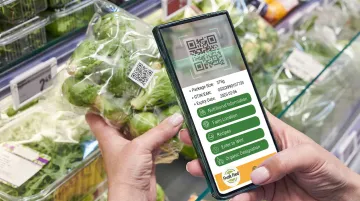
IBM research found 49% of consumers paid a premium for products branded as sustainable or socially responsible. For brands making sustainability claims, a QR code that links directly to sourcing data and certifications gives shoppers the verification they need to act on that preference.
Promotions, Loyalty, and Post-Purchase Engagement
The moment a consumer scans a QR code is one of the highest-attention moments a brand gets. The person is holding the product, actively seeking information — that's a level of engagement no ad placement replicates.
Brands can use that moment to:
- Drive loyalty program sign-ups directly from the pack
- Deliver digital coupons or limited-time offers
- Enable contest entries or product registration
- Redirect to personalized post-purchase content
Bero Brewing used QR codes inside beer packaging to power a loyalty rewards program and reported 500% ROI, according to Packaging Digest — a notable result, though one worth treating as a specific case outcome rather than a category benchmark.
For brands managing QR destinations through campaign-tagged URLs, scan data can also feed into retargeting workflows, keeping recent buyers engaged well past the point of purchase.
How QR Codes Build Consumer Trust Through Transparency
Meeting Regulatory Requirements for Disclosure
QR codes are not just a marketing tool in the food sector. In the food industry, they are also an accepted compliance mechanism.
Three regulatory frameworks now formally recognize or accommodate QR-based disclosure:
- U.S. NBFDS (USDA): Recognizes digital link disclosure as a valid method for communicating bioengineered food content. Mandatory since January 1, 2022; disclosures must include language such as "Scan here for more food information."
- FDA FSMA Food Traceability Final Rule: Establishes recordkeeping requirements for high-risk foods (leafy greens, shell eggs, fresh-cut produce, finfish, and others). QR codes provide a practical interface for displaying batch, lot, and traceability data to retailers and consumers. The compliance deadline is proposed for extension to July 20, 2028.
- EU Wine Labelling Rules (December 8, 2023): Formally permit nutrition and ingredient information to be delivered via QR code — the clearest official European precedent for digital food labelling.
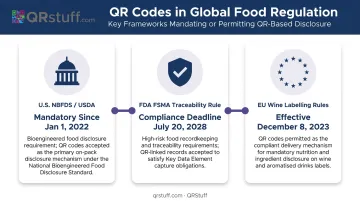
Brands adopting QR codes now are building infrastructure ahead of requirements that are still forming.
Allergen and Nutrition Transparency at Scale
That compliance readiness has a direct consumer-facing payoff — particularly for allergen information.
Printed allergen labels are fixed at the time of the packaging run. Formulations are not. When ingredient sourcing shifts, new cross-contamination research emerges, or a formulation changes mid-cycle, a dynamic QR code lets the brand update the allergen page immediately — without waiting for the next print run.
80% of consumers value allergen information, certifications, and similar transparency indicators, according to FMI research. A QR-delivered allergen page can be more detailed, clearer, and more current than anything achievable on a physical label.
Traceability and Recall Readiness
A dynamic QR code on packaging functions as a live communication channel in recall situations. The moment a recall is initiated, the destination behind the code can be updated to a dedicated recall notice — batch information, consumer instructions, return process — without any physical intervention on distributed product.
This capability matters at scale. The code is already printed, the infrastructure is already in place, and redirecting it to a recall notice is a dashboard action — not a logistics operation.
Why Dynamic QR Codes Are a Strategic Advantage for Food Brands
Dynamic QR codes function as a live packaging asset — one that stays active and adaptable long after the product leaves the factory.
Every unit on every shelf carries a live marketing and communication channel. The question is what to do with it.
Scenarios Where "Update Without Reprinting" Wins
| Scenario | What Changes | How Dynamic QR Responds |
|---|---|---|
| Regulatory text update | Disclosure language or linked content | Update destination immediately |
| Seasonal recipe campaign | Content behind the code | Swap to seasonal landing page |
| New sustainability certification | Credentials page | Add certification without reprint |
| Product recall | Entire destination | Redirect to recall notice instantly |
| Promotional campaign launch | Offer or contest page | Activate campaign on schedule |
Analytics That Actually Inform Packaging Strategy
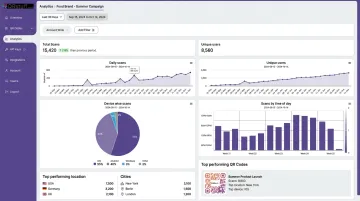
QRStuff's dynamic QR platform provides real-time scan analytics that give food brands genuine consumer behaviour data:
- Total and unique scans — distinguishes new audience from repeat engagement
- Scan time and date — identifies peak engagement windows and campaign timing
- Device type and OS — informs landing page design decisions (iOS vs. Android split)
- Geographic data at country and city level — shows which markets are most active by SKU
The dashboard populates in real time, with line and bar charts for trend analysis, daily and weekly views, and CSV export for integration with broader business intelligence tools. For food brands managing multiple SKUs, packaging has rarely generated this level of consumer engagement data before.
A/B Testing Packaging Content
Those analytics also open the door to something previously impossible with physical packaging: content testing. By switching the destination URL between variants — recipe content vs. sourcing story vs. promotional offer — and tracking scan and engagement data, brands can determine what actually drives consumer interaction.
QRStuff supports destination switching at any time after printing, and campaign-tagged URLs allow conversion outcomes to be compared across variants. One printed code supports multiple testable content strategies.
Well-placed QR codes with strong calls to action can achieve 7-8% scan rates, according to FoodNavigator-USA — while poorly positioned codes without context can fall below 0.5%. For brands with large distribution footprints, that gap represents a meaningful volume of consumer touchpoints. The difference is design and content strategy, both of which can be optimized post-print.
Best Practices for Adding QR Codes to Food Packaging
Size, Placement, and Contrast
Get the basics right before worrying about design:
- Minimum size: 2cm × 2cm for standard URL codes; follow GS1 X-dimension guidance for retail-compatible codes
- Placement: Flat, non-reflective surfaces away from folds, seams, and curves
- Contrast: Dark code on a light background; matte finishes scan more reliably than glossy ones
- Quiet zone: The white border surrounding the code is essential — never crop it
- Testing: Test on both iPhone and Android at actual print size, from multiple distances and angles, before approving final artwork
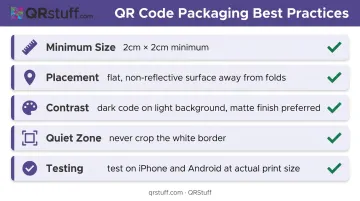
QRStuff recommends SVG or EPS formats for print production, as vector files scale without quality loss. For raster exports, 300 DPI minimum is required.
Writing a CTA That Earns the Scan
A QR code without context is easily ignored. The call to action adjacent to the code is what drives the scan — and scan rates vary enormously based on how specific and compelling that CTA is.
Effective food packaging CTAs:
- "Scan to see where this was grown"
- "Scan for allergen information"
- "Scan for local recycling guidance"
- "Scan for recipes"
Generic CTAs like "Scan for more info" underperform. The CTA should make the value exchange explicit in five words or fewer.
One Code, Multiple Options
Avoid placing multiple QR codes on a single package — it creates visual clutter and confusion. Instead, use a single code that leads to a multi-option landing page where consumers choose what they want to explore.
QRStuff's Multi-URL and Social Link Pages functionality supports this directly, allowing brands to build a mobile-friendly landing page with clearly labelled options (ingredients, recipes, sustainability, nutrition) — all accessible from one scan. Content can be updated through the dynamic code system without touching the packaging.
For brand consistency, QRStuff's custom design options allow food brands to incorporate brand colours, logo embedding, and custom module shapes into the QR code itself, so the code fits the packaging design rather than standing out as an afterthought.
Frequently Asked Questions
What is the QR code on food packaging?
A QR code on food packaging is a scannable square symbol that links consumers to digital content about the product — ingredients, nutrition information, sourcing details, recipes, or sustainability credentials — using a standard smartphone camera. No app is required.
What information can a QR code on food packaging contain?
A QR-linked page carries far more than any printed label can accommodate. Common content includes:
- Full ingredient and allergen lists
- Detailed nutrition facts and dietary certifications
- Supply chain traceability data
- Recipes and preparation videos
- Promotional offers and brand sourcing stories
Are QR codes on food packaging required by law?
Not universally, but QR codes are already an accepted compliance method under the U.S. National Bioengineered Food Disclosure Standard. Regulatory pressure around traceability and digital labeling is growing in both the U.S. and EU, making proactive adoption a practical decision for most food brands.
How do dynamic QR codes differ from static ones for food brands?
Dynamic QR codes allow brands to update the linked content at any time after printing — which matters when handling regulatory changes, seasonal campaigns, formulation updates, or recall communications. Static codes are permanently fixed and require new packaging to change.
How can food brands track consumer engagement through QR codes?
QRStuff's analytics dashboard tracks engagement in real time. Brands can monitor:
- Total and unique scans with timing breakdowns
- Device type and operating system data
- Geographic data at country and city level
Scan data exports as CSV for integration with broader reporting systems.
How big should a QR code be on food packaging?
A minimum of 2cm × 2cm is a reliable starting point for standard URL codes, though size should be calibrated to scanning distance and packaging surface. Test on multiple devices at actual print size before final approval. Place the code on a flat, high-contrast area away from folds or curves.