Introduction
Product packaging has always been a brand's most direct conversation with a consumer. What's changed is that the conversation can now continue long after the product leaves the shelf.
QR codes on packaging have moved well past simple URL redirects. In 2026, a single printed code can rotate seasonal content, feed first-party data into CRM systems, and satisfy regional compliance requirements — all without reprinting a label.
According to ResearchAndMarkets, the interactive QR packaging market reached USD 5.47 billion in 2026, up from USD 5.1 billion the previous year. That growth reflects a market where packaging is no longer just a container — brands that treat it as a static medium are leaving measurable revenue on the table.
This article covers the five trends shaping interactive packaging in 2026, what's driving them, and what brands need to build today to stay competitive through the rest of the decade.
Key Takeaways
- The interactive QR packaging market hit USD 5.47B in 2026 and is projected to reach USD 7.19B by 2030
- Dynamic QR codes let brands update destination content post-print, so one printed code can run unlimited campaigns without a reprint
- AR, NFC, and blockchain are the "beyond QR" layer gaining real traction in luxury, pharma, and F&B
- The EU Digital Product Passport (DPP) is making smart packaging a compliance requirement, with first operational DPPs due by February 2027
- Brands that build dynamic QR infrastructure now can turn physical packaging into a first-party data asset
Trend 1: Dynamic QR Codes Are Becoming the Primary Brand Channel on Packaging
Static vs. Dynamic: Why It Matters for Packaging
A static QR code embeds its destination directly into the visual pattern — once printed, it can never change. A dynamic QR code works through a redirect: the physical code points to a short URL, which forwards scanners to whatever destination you've set at that moment.
For packaging, this distinction is the difference between a label that's locked at print time and one that stays current for the life of the product. A brand that prints 500,000 units doesn't need to reprint when a promotion ends, ingredients change, or a new campaign launches. The code stays on the label; the experience behind it updates in seconds.
This "always fresh" content model is what makes dynamic QR codes genuinely useful for brand engagement — not just as a one-time information delivery mechanism, but as a persistent channel that brands actively manage.
What Brands Are Doing With Dynamic Codes
Leading packaging deployments treat the dynamic QR code as a content hub with a physical address:
- Seasonal promotions — swap out summer recipes for winter serving suggestions without a single reprint
- Product storytelling — rotate brand origin content, sustainability commitments, or founder stories
- Loyalty program entry — turn a scan into a rewards sign-up or points claim
- Instructional content — update how-to videos when product formulations change
- Regulatory compliance — update allergen or ingredient information to stay current
A 2025 GS1 US consumer survey found that 66% of consumers would scan a QR code on food packaging to access freshness, ingredient, and shelf-life information. A separate GS1 US finding showed 79% of consumers are more likely to purchase products with a scannable QR code that provides additional information.
Those numbers reflect a broad shift in how shoppers engage with physical products — and they translate directly into scan volume that brands can measure and act on.
Scale and Analytics
Platforms like QRStuff enable brands to deploy dynamic QR codes across packaging lines at scale. Real-time analytics include:
- Geographic scan breakdowns by region and country
- Device type segmentation (iOS vs. Android)
- Time-based scan patterns across campaigns
- Unique vs. repeat scanner identification
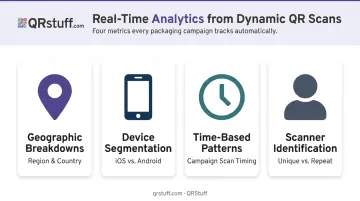
That data feeds directly into CRM systems, Meta Ads, Google Ads, or downstream analytics via API, turning a physical label into a first-party data source.
QRStuff supports 40+ QR code types relevant to packaging, including URL, loyalty, social media, vCard, and GS1 Digital Link. For brands managing multiple SKUs, bulk generation handles thousands of codes simultaneously, with SVG and print-ready formats for direct handoff to packaging production.
Trend 2: AR, NFC, and the Phygital Packaging Layer
What "Phygital" Actually Means
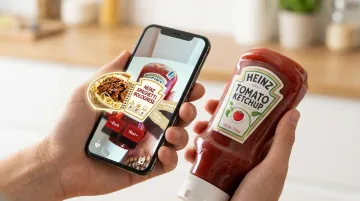
Phygital packaging is what happens when a physical product surface triggers a digital experience. Point your phone at a label and a 3D product demo appears. Tap a luxury handbag tag and its provenance history loads instantly. Scan a wine bottle and animated brand storytelling plays.
This is already happening, primarily in categories where product experience and trust are differentiators.
Grand View Research put the global AR packaging market at $354.9 million in 2024, projecting $510 million by 2030 at a 6.3% CAGR. Food and beverages already account for more than 36.4% of revenue share — the category with the most to gain from immersive packaging storytelling.
Where AR and NFC Are Gaining Ground
| Technology | Primary Categories | Key Use Case |
|---|---|---|
| AR overlays | F&B, spirits, cosmetics | Brand storytelling, product demos, virtual try-ons |
| NFC tap | Luxury goods, pharma | Authentication, provenance, exclusive content |
| QR + AR hybrid | FMCG, beverages | No-app experiences, promotional campaigns |
Coca-Cola's 2024 limited-edition Marvel packaging is a practical reference point: scannable QR codes unlocked AR character animations across more than 50 countries, blending collectability with digital engagement at mass scale.
The ROI Calculation
AR and NFC raise production costs noticeably compared to standard QR printing. NFC chips require physical integration into packaging materials; AR experiences require development investment upfront.
The brands seeing positive ROI tend to follow the same playbook:
- Layer AR or NFC on top of an existing QR infrastructure rather than replacing it
- Reserve premium formats for hero SKUs where differentiation justifies the cost
- Use QR codes across the broader product line to maintain scale
Trend 3: Blockchain-Backed Traceability and Anti-Counterfeiting
How It Works
A blockchain-verified QR code on packaging links each scan to an immutable record of that product's journey — origin, manufacturing steps, shipping, and retail chain. Unlike a standard product page, this record can't be edited retroactively. A counterfeit product can't replicate a verified blockchain entry, which makes the technology genuinely useful for authentication.
Real-world adoption has moved well beyond pilots. Two deployments from Nestlé illustrate the range:
- Mousline purée (with Carrefour) — consumers scan to trace the product from factory to store, including quality-control parameters and production dates
- Zoégas coffee — scannable access to blockchain-recorded origin data covering farmer details, harvest time, and roasting period
Regulatory Pressure Is Accelerating Adoption
Authentication capability alone doesn't explain how fast adoption is moving — regulation does. Three frameworks are pushing traceability from optional to required:
- EU food traceability — Regulation (EC) No 178/2002 requires traceability at all stages of production, processing, and distribution, with products adequately identified to facilitate it
- EU Falsified Medicines Directive — requires a unique identifier and anti-tampering device on medicine packaging; enforcement has been active since February 2019
- FDA Food Traceability Final Rule — covers foods on the Food Traceability List, with a compliance date proposed for July 2028
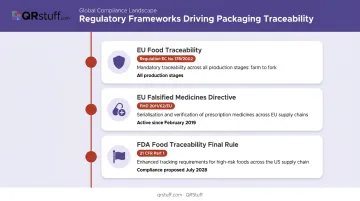
For pharma, serialized QR codes with blockchain verification are increasingly the mechanism that satisfies these requirements. For food brands, the combination of QR-accessible sourcing data and blockchain verification addresses both regulatory needs and what shoppers increasingly expect: the ability to see exactly where a product came from before they buy it.
Trend 4: AI-Powered Personalization Through Packaging QR Codes
The Personalization Layer
Dynamic QR codes generate scan data — location, device type, scan timing, and whether it's a first-time or returning scanner. When that data connects to a CRM or marketing automation system, it becomes the raw material for personalized content delivery.
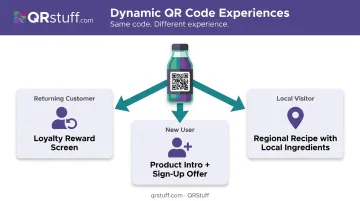
In practice, a single juice bottle with one printed code can deliver three completely different experiences:
- A returning customer scans and sees a loyalty reward
- A first-time scanner gets a product intro and sign-up offer
- A regional scanner sees a recipe using locally available ingredients
The physical code is the same on every bottle. The experience behind it adapts.
PwC's 2025 Customer Experience Survey found that 90% of consumers are willing to share some form of personal data to receive more personalized service, and 53% say sharing personal information is worth it for smoother brand interaction. That's a large pool of consumers already opted into the value exchange that personalized packaging experiences require.
Making It Work in Practice
Personalization at this level isn't turnkey — it requires:
- Cloud-connected dynamic QR infrastructure that can serve different destinations based on context
- Consent-based data capture at the point of scan or landing page
- CRM and marketing automation integration to segment audiences and trigger content rules
- API access for programmatic content management at scale
QRStuff's API supports real-time webhooks for scan events, programmatic code management, and integrations with Meta Ads, Google Ads, and platforms like Shopify — meaning scan data from packaging can feed ad targeting and product development analytics without manual exports.
The packaging surface, in this model, becomes a first-party data acquisition channel — particularly valuable as third-party cookies continue disappearing and other tracking options narrow.
Trend 5: Sustainability Compliance Is Making Smart Packaging Mandatory
The EU Digital Product Passport
The EU's Ecodesign for Sustainable Products Regulation (ESPR), adopted in 2024, introduces the Digital Product Passport as a mandatory data structure for product-specific sustainability and circularity information. The 2025–2030 working plan names steel, aluminium, textiles and apparel, furniture, tyres, and mattresses as priority categories.
GS1 has stated that first operational DPPs for prioritised products are scheduled to be accessible by February 2027 — which puts packaging decisions made today directly in the compliance window.
The delivery mechanism the industry has settled on is GS1 Digital Link: a standard that embeds a product's unique identifier and web links into a single QR code, allowing one physical code to handle retail POS scanning, consumer product information, and DPP data access simultaneously.
For brands managing complex product lines at scale, that capability needs to work at volume. QRStuff supports GS1 Digital Link QR code generation across subscription tiers, with Enterprise-level access supporting GTIN, batch, expiry, and serial data.
Compliance as a Trust Signal
Beyond the compliance requirement itself, sustainability data on packaging has become a genuine purchase influence factor. McKinsey's 2025 sustainable packaging research confirmed that consumers across all surveyed geographies include a segment willing to pay more for sustainable packaging.
The same QR code infrastructure that satisfies the DPP requirement can also deliver:
- Recycling guidance triggered at scan
- Material composition data for environmentally conscious buyers
- Return and takeback program links
One code. Two jobs: regulatory compliance and consumer trust.
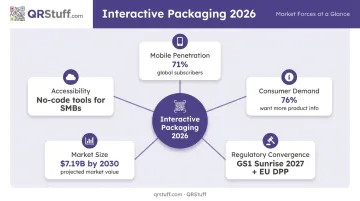
What's Driving Interactive Packaging Trends in 2026
Several converging forces are pushing interactive packaging from a nice-to-have into a baseline expectation for brands in 2026:
- Mobile penetration — GSMA's Mobile Economy 2025 reports 71% unique mobile subscriber penetration globally, with 6.5 billion subscribers projected by 2030. A QR code on packaging is only useful if the majority of consumers have a scanning device in their pocket. That condition is now met at mass scale.
- Consumer demand for information — GS1 US found 76% of shoppers want more product information because of rising food costs, and 71% are reading labels more frequently. Packaging that stays silent on product details is missing a clear consumer signal.
- Regulatory convergence — GS1 Sunrise 2027 (the global retail shift from 1D UPCs to 2D barcodes), the EU DPP, FDA traceability rules, and anti-counterfeiting regulations are all pointing in the same direction: digitally connected packaging that carries machine-readable and consumer-accessible data in a single code.
- Market size — the interactive QR packaging market is on track to reach $7.19 billion by 2030, per ResearchAndMarkets. Brands that treat packaging as a passive label are watching competitors use it as a direct consumer channel.
- Accessibility — cloud-based platforms, no-code QR management tools, and tiered pricing models have made dynamic QR packaging accessible to SMBs, not just enterprise CPG brands. What once required IT resource investment can now be deployed and managed without a development team.
Future Signals for Interactive Packaging
These aren't 2026 realities — they're developments worth tracking over the next one to three years:
- NFC-plus-QR hybrid tags — a single physical touchpoint that serves both tap and scan use cases, reducing the choice brands currently face between the two formats
- Temperature-sensitive smart labels — especially relevant in food and pharma, where cold-chain compliance and spoilage indicators add a new data layer to packaging
- AI-generated personalized packaging designs — variable packaging designs by consumer segment, produced at scale as digital printing costs continue to fall
- AR wearables — as smart glasses enter broader consumer use, packaging that triggers voice or spatial interactions becomes a practical near-term format
The clearest near-term convergence is between EU Digital Product Passport (DPP) compliance requirements and consumer engagement functionality. GS1 Digital Link already bridges both use cases: one code, one scan, serving regulatory data access and consumer storytelling simultaneously.
Brands building cloud-connected QR infrastructure today — with dynamic update capability and analytics — will be able to layer in NFC, DPP compliance, and AI personalization without rebuilding from the ground up.
Conclusion
Interactive packaging in 2026 is no longer a niche innovation. QR codes have become the foundational layer of a broader smart packaging ecosystem that now includes AR experiences, NFC authentication, blockchain traceability, AI-personalized content delivery, and sustainability compliance.
Brands gaining ground have invested in dynamic, data-connected packaging infrastructure — where a single printed code handles consumer engagement, regulatory compliance, and first-party data collection at once. Those still treating packaging as purely physical are getting left behind on all three fronts.
Building that infrastructure now pays forward. When DPP compliance deadlines hit, when personalization at scale becomes table stakes, or when hybrid NFC-QR tags move mainstream, companies with modular smart packaging systems can add each capability without starting over.
The practical starting point is simpler than most brands expect. A dynamic QR code platform with real-time analytics, editable destinations, and API access — like QRStuff — gives teams a live, manageable channel from day one. From there, the path to fuller smart packaging integration is an evolution, not a rebuild.
Key takeaways from 2026's interactive packaging landscape:
- QR codes are now infrastructure, not a feature — they anchor NFC, AR, and blockchain layers
- Dynamic codes that update destinations without reprinting are essential for compliance and agility
- First-party data collected through packaging scans is becoming a core marketing asset
- DPP regulations are accelerating adoption in the EU, with US categories likely to follow
- Brands building modular systems now will adapt faster as requirements shift
Frequently Asked Questions
Are QR codes still relevant in 2026?
More relevant than ever. QR codes are the backbone of smart packaging in 2026, with 66% of consumers saying they would scan a QR code on food packaging for product information, per GS1 US. The global interactive QR packaging market is projected to reach USD 7.19 billion by 2030.
What are the key packaging innovation trends for 2026?
Five trends are shaping packaging in 2026:
- Dynamic QR codes as persistent brand channels
- AR and NFC phygital experiences
- Blockchain-backed traceability and anti-counterfeiting
- AI-personalized packaging content
- EU Digital Product Passport compliance driving smart packaging adoption
What is the difference between static and dynamic QR codes on packaging?
Static QR codes link to a fixed URL that cannot be changed after printing. Dynamic QR codes use a redirect, so brands can update the destination at any time. One printed code can serve multiple campaigns, seasons, or regulatory updates without reprinting.
How can brands use QR code scan data to improve their marketing?
Dynamic QR platforms like QRStuff deliver scan analytics covering location, device type, timing, and unique vs. repeat engagement. That data integrates with CRM systems and ad targeting platforms via API, turning packaging into a first-party data acquisition channel.
What is GS1 Digital Link and why does it matter for packaging?
GS1 Digital Link embeds a product's unique identifier into a single QR code. One code handles retail POS scanning, consumer product information, and EU Digital Product Passport data access. It is the established global standard ahead of the Sunrise 2027 shift to 2D barcodes.
How do I get started with adding interactive QR codes to my product packaging?
Start with a dynamic QR platform like QRStuff that supports custom branding, content management, and scan analytics. Test on a single product line first, ensure landing pages are mobile-optimized, and update content regularly to drive repeat scans. Scale to bulk generation and API integration as volume grows.