The typical approach relies on post-visit email or SMS follow-ups. By the time those messages arrive, the customer has moved on, the inbox is crowded, and the motivation to write a few sentences about a meal or haircut has evaporated. The result: satisfied customers who never become published reviewers.
QR codes placed at physical touchpoints solve this problem at the source. Not by being clever technology, but by meeting the customer at the exact moment they're most likely to act — while their phone is already in their hand and the experience is still fresh.
This article covers what in-person review QR codes are, why they outperform traditional follow-up methods, and the specific practices that determine whether the strategy actually delivers results.
Key Takeaways
- QR codes at physical touchpoints remove the friction that causes most customers to abandon traditional review requests
- Reviews captured in the moment are higher in both volume and quality than those requested hours later by email
- One documented case shows response rates more than tripled after switching from a URL on receipts to a QR code
- Dynamic QR codes let businesses update destination links and track scan data without reprinting
- Placement, call-to-action clarity, and scan data review are what separate high-performing codes from ignored ones
What Is a QR Code for In-Person Review Collection?
A QR code for in-person review collection is a scannable code placed at a physical touchpoint — a receipt, counter card, packaging insert, or table tent — that takes a customer's phone camera directly to a review form or platform page. Customers skip the typing, searching, and navigating entirely.
Where it applies: Any business with face-to-face customer interactions can use these codes at the natural end points of a customer experience:
- Restaurants and cafés (table cards, receipts)
- Retail stores (checkout counters, shopping bags)
- Salons and clinics (service completion cards, invoices)
- Hotels (checkout folders, room cards)
- Trade service providers (job completion paperwork)
It's a delivery mechanism that cuts the steps between a satisfied customer and a published review. Fewer steps means more reviews, collected faster.
Key Benefits of Using QR Codes for In-Person Review Collection
Each benefit below targets a specific operational problem — review volume, submission rates, or the ability to measure what's working.
Benefit 1: Real-Time Capture at Peak Satisfaction
The timing problem with email follow-ups is straightforward: satisfaction fades. Research on experience-sampling shows that delayed responses produce significant decreases in positive affect, meaning customers asked to recall a positive experience hours later will describe it less positively than they would have in the moment.
QR codes solve this by appearing at the moment satisfaction peaks — right after checkout, after the meal, at invoice handoff. The customer scans, lands directly on the review page, and submits. The entire process takes under a minute.
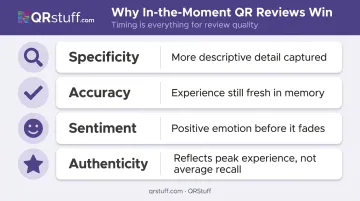
Why this matters for review quality, not just volume:
- In-the-moment reviews tend to be more specific and descriptive
- Details are accurate because the experience hasn't faded
- Positive sentiment is captured before it dilutes with time
- The review reflects peak experience, not a later average recollection
KPIs this affects: Review volume per month, average star rating, review recency (a local search ranking signal), and customer response rate.
Benefit 2: Higher Submission Rates Than Email or URL-Based Requests
According to Mailchimp's email marketing benchmarks, open rates across most consumer-facing industries sit between 17% and 20%, with click-through rates well below 2%. SMS performs better but carries friction of its own — many customers find unsolicited texts intrusive, and follow-up links require navigation steps that break the moment.
A QR code requires one action: a camera tap. No login, no copy-pasting, no hunting for the right business page.
The gap this creates is significant. A case documented by G2 shows a business that replaced a URL on customer receipts with a QR code saw their survey response rate more than triple by the time the program was complete. Lower required effort produces higher completion rates.
The connection to business growth:
- More reviews from existing customers build social proof without additional spend
- BrightLocal's 2024 Local Consumer Review Survey found that 83% of people asked to leave a review go on to do so — the barrier is the ask mechanism, not willingness
- A stronger review profile directly affects new customer conversion; 31% of consumers will only use a business with 4.5 stars or higher (BrightLocal)
KPIs this affects: Review submission rate, cost per review acquired, Google Business Profile engagement, and new customer conversion.
Benefit 3: Scan-Level Tracking Makes Review Collection Measurable
A verbal request or a printed URL generates zero data. A dynamic QR code generates scan data every time someone interacts with it — including when, from which device, and from which placement location.
This turns review collection from a passive activity into a measurable system.
How QRStuff's tracking works in practice:
- Assign unique QR codes to different placements (receipt, table card, packaging insert)
- Use campaign tags to filter and compare scan performance by placement
- View total and unique scans, device breakdowns, geographic data, and time-based patterns
- Export scan logs as CSV for deeper analysis or integration with other tools
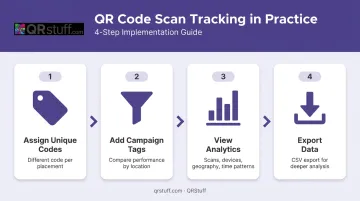
If one placement consistently outperforms others, scale it. If a placement generates scans but few reviews, the issue is likely the review form (too long, not mobile-optimized) — not the code itself. If a placement generates no scans at all, adjust the size, location, or call-to-action before writing it off.
Dynamic QR codes from QRStuff also allow businesses to update the destination URL without reprinting — so if you switch review platforms or update a Google Business Profile link, the physical codes on existing materials remain valid.
KPIs this affects: Scan-to-review conversion rate, cost-per-review by placement, scan volume trends, and time-to-review optimisation.
What Happens When Businesses Skip In-Person Review Collection
Businesses relying solely on post-visit email or SMS follow-ups face a predictable pattern: a burst of reviews at launch, then a slow trickle. By the time the request arrives, the customer's emotional window for leaving feedback has closed.
The compounding cost is competitive. While one business accumulates reviews slowly and unevenly, a competitor with a consistent in-person collection system builds review velocity over time. Google explicitly states that review count and score factor into local search ranking. Third-party local SEO research from Moz and Whitespark consistently identifies review recency and frequency as meaningful ranking signals.
This gap widens every month a business relies on delayed follow-ups instead of capturing feedback at the moment it matters.
The practical consequences at scale:
- Low review counts make businesses appear unestablished (9% of consumers will consider a business with 5 or fewer reviews)
- Isolated negative reviews carry disproportionate weight when the review count is thin
- Competitors who capture reviews systematically compound their advantage every month
- Recovery becomes harder as the gap widens
There's a scaling problem here too: as customer volume grows, the gap between satisfied customers and published reviews gets larger without a frictionless collection mechanism in place. More customers moving through the door doesn't fix a broken follow-up process — it just means more missed reviews.
Best Practices to Maximise Your QR Code Review Collection
QR codes work best when three variables are actively managed: placement, message clarity, and ongoing performance review. The practices below separate businesses that see a meaningful lift in reviews from those that print a code and see nothing change.
Place Codes at Natural Pause Points
The timing principle is simple: the code should appear within minutes of the positive experience, while the customer is still engaged and stationary.
High-performing placements:
- Receipt handoff (phone often already out for payment)
- POS counter card facing the customer during checkout
- Table tent at restaurants between ordering and leaving
- Packaging insert inside a box (opened at unboxing)
- Service completion invoice handed directly to the customer
Placements to avoid: Doors, walls people pass while moving, cluttered surfaces where the code competes with other content. If the customer has already mentally moved on, the code won't work regardless of quality.
Pair Every Code With a Specific Call-to-Action
A bare QR code generates far fewer scans than one with a direct, context-specific instruction. The message should tell the customer exactly what to do and acknowledge that it's fast.
Phrases like "Scan to share your experience — it takes 30 seconds" consistently outperform generic "Leave a review" text because they reduce perceived effort before the customer even scans. Test different messages across placements and let scan data tell you which performs better.
Prioritise Technical Quality Before Printing at Scale
A code that fails to scan on the first attempt damages trust and eliminates the review opportunity entirely.
Technical requirements before printing:
- Minimum size of 2cm x 2cm for close-range mobile scanning
- Dark pattern on a light background (never invert colours)
- Quiet zone margins preserved (never crop the white border around the code)
- 300 DPI minimum for raster formats; SVG/EPS for large-format applications
- Placed on flat, non-reflective, matte surfaces (avoid folds, seams, or glossy finishes)
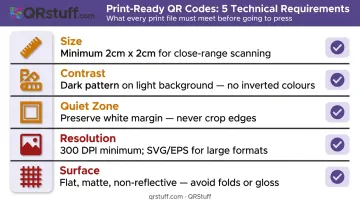
Test across multiple phone models and lighting conditions before committing to a print run.
Use Dynamic QR Codes for Flexibility and Tracking
Static QR codes lock in the destination URL permanently and provide no scan data. For review collection, that means you can't update the link if your platform changes, and you have no way to know if the code is working.
Dynamic QR codes solve both problems. QRStuff's dynamic codes use a redirect URL updatable through the dashboard at any time, without reprinting materials. This is useful when:
- Switching review platforms or updating a Google Business Profile link
- Testing different landing pages to see which drives more completions
- Managing codes across multiple locations from a central dashboard
QRStuff's paid plans (starting at £4/month for the Lite Suite) include dynamic QR codes with editable URLs and full scan analytics. The Free tier limits dynamic codes to 10 with a 30-day expiration, which works for testing but not for ongoing review collection.
Track Scan Data Monthly and Act on It
Scan data is only useful if it informs decisions. Review it at least monthly:
- Compare scan volumes by placement to identify highest-performing locations
- Calculate scan-to-review conversion rates using scan data alongside your review platform's incoming review count
- If scans are high but reviews are low, audit the review form (mobile optimisation and form length are the most common culprits)
- If scans are near zero, test a larger code size, different location, or stronger call-to-action before abandoning the placement
QRStuff's campaign tagging feature lets businesses organise codes by placement type and filter analytics accordingly , making cross-placement comparisons straightforward without manual tracking.
Conclusion
QR codes for in-person review collection work because they remove the single biggest barrier in review generation: friction. They deliver a frictionless, time-appropriate prompt at the moment customers are most motivated to respond.
The three advantages — in-the-moment capture, higher submission rates, and measurable scan data — reinforce each other. Tracking data sharpens placement decisions; iterating on messaging improves conversion rates. Each optimization cycle compounds on the last, steadily strengthening your review profile over time.
The QR code itself is just the entry point. What drives results is the system: consistent placement at natural pause points, clear calls-to-action, and regular performance review. Build that system, and a scannable code becomes a reliable, measurable part of how your business earns its reputation online.
Frequently Asked Questions
What are the benefits of using QR codes for in-person review collection?
QR codes remove friction by delivering review prompts at peak satisfaction moments — immediately after a service or purchase. They produce significantly higher submission rates than email or URL-based requests, and generate scan data that allows businesses to measure and optimize their strategy over time.
What is the recommended method for using QR codes to collect in-person guest reviews?
Place the QR code at a natural pause point — receipt, invoice, table card, or packaging insert — immediately after the customer experience. Pair it with a specific call-to-action, and use a dynamic code that allows destination URL updates and scan tracking without reprinting.
Should I use a static or dynamic QR code for review collection?
Dynamic QR codes are the better choice. They allow the destination URL to be updated without reprinting (critical when switching platforms or updating a Google Business Profile link) and enable scan tracking so businesses can measure performance by placement. Static codes offer neither.
Where should I place QR codes to get the most reviews?
The highest-performing placements are at natural pause points immediately after a positive experience: receipts, POS counters, table tents, product packaging inserts, and service invoices. These are moments when the customer's phone is often already in hand and satisfaction is fresh.
Can QR codes help improve my Google rating, not just review volume?
Yes. Capturing reviews immediately after positive experiences increases the proportion that reflect peak satisfaction. Over time, this raises average star ratings alongside volume — satisfied customers who wouldn't otherwise act are the ones QR codes consistently reach.
How do I know if my QR code review collection strategy is working?
Track scan volume per placement, scan-to-review conversion rate, and review velocity (reviews per week or month). QRStuff's dynamic QR code analytics surface placement comparisons and scan trends automatically, with CSV export available for deeper analysis.