Consumer expectations have shifted. People reach for their phones mid-aisle, mid-pantry, mid-purchase decision. FMI's 2024 grocery research found that 37% of grocery shoppers use mobile phones to compare prices and research products in-store — up 28 points from 2016.
QR codes bridge that gap. A small, scannable code on your packaging can unlock recipes, sustainability data, loyalty rewards, product reviews, and more — without adding a single word to your label design.
This post covers seven practical QR code ideas for CPG packaging, plus best practices to make sure consumers actually scan them.
Key Takeaways
- QR codes on CPG packaging can link to recipes, sustainability info, loyalty programs, reviews, traceability data, contests, and social profiles.
- Dynamic QR codes let brands update destination content without reprinting — critical for seasonal campaigns.
- One QR code linked to a multi-content landing page keeps packaging clean while maximizing consumer touchpoints.
- Scan analytics (volume, location, device type) give brands measurable visibility into packaging campaign performance.
- Minimum recommended size is 2cm x 2cm — always test across devices before going to print.
Why CPG Brands Are Adding QR Codes to Packaging
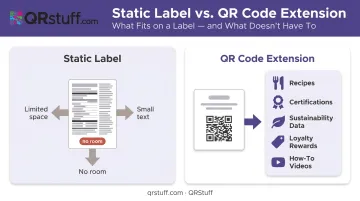
Physical labels have a hard limit. You can only fit so much text on a box before the design breaks down and the shopper tunes out. QR codes extend the label into a digital space — a single scannable element that surfaces detailed content without changing the physical design.
The adoption is already happening at scale. SmartLabel, operated by the Consumer Brands Association, covers over 1,000 brands and 100,000+ products across food, beverage, personal care, and household goods — all using QR codes to surface product information consumers want before they buy.
Two packaging trends are converging here: minimalist design and richer information delivery. Brands are stripping back label copy and routing deeper content — certifications, how-to videos, supply chain data — to a digital destination they can update without reprinting.
For food and beverage, personal care, and household goods brands alike, the real decision is no longer whether to add a QR code, but what to put behind it.
7 QR Code Ideas for Your CPG Packaging
1. Recipes and How-To Video Content
Linking packaging to a recipe page or video tutorial helps consumers picture the product in their daily lives — which directly reduces purchase hesitation. A baking ingredient brand that connects to a library of seasonal recipes isn't just providing information; it's giving shoppers a reason to buy more products in a single basket.
The format works across categories. Tanimura & Antle ran QR codes on their lettuce clamshell packaging linking to seasonal recipes and entertaining tips. Branston introduced QR codes on their condiment packaging in 2024 linking to recipe ideas, nutritional information, and an augmented reality video.
One print run can serve multiple campaign cycles. Swap summer grilling recipes for winter comfort food content without touching a single label. QRStuff's dynamic QR codes let brands update destination URLs at any time without changing the printed code, so recipe content stays current across seasons without additional print costs.
There's also a natural cross-sell opportunity. Recipe content can feature complementary products from the same brand, increasing average order value without paid promotion.
2. Sustainability and Recycling Information
Eco-conscious consumers want proof, not promises. A QR code can link to a brand's full sustainability story: sourcing practices, carbon footprint data, recycling guides, and third-party certifications.
The commercial case is well-documented. McKinsey and NielsenIQ research found that CPG products with ESG-related claims grew 28% over five years versus 20% for products without such claims, across 600,000 SKUs and 44,000 brands.
Transparency isn't just a values play — it's a sales driver.
Practical applications for this use case include:
- Recycling instructions specific to each packaging material
- Links to third-party sustainability certifications (FSC, Rainforest Alliance, B Corp)
- Composting or reuse tips for product containers
- Carbon offset or reduction data from supply chain audits
- Video content on sourcing and farming origins
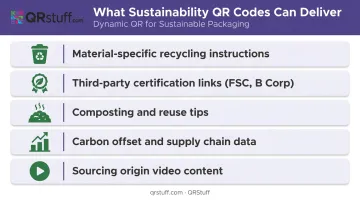
Mondelēz ran exactly this model across Cadbury, Oreo, and Barny packaging in the UK — using QR codes to connect consumers directly to sustainability initiatives and recycling guidance without printing a word more on-pack.
3. Loyalty Programs and Discount Coupons
The moment a consumer picks up your product — or finishes using it — is when brand excitement peaks. That's the moment to capture them in your loyalty ecosystem, and a QR code on packaging makes enrollment immediate.
Rather than asking shoppers to visit a website later (they won't), a QR code takes them directly to a loyalty sign-up or coupon page in seconds.
PepsiCo ran a real-world version of this with PepCoin in 2019: consumers scanned codes on snack bags and under bottle caps to earn cash back, with funds transferred once they hit a $2 balance. A simple mechanic that tied multiple SKUs together and incentivized repeat purchase.
The retention economics behind this approach are well-documented. According to Bain's Frederick Reichheld, a 5 percentage-point increase in customer retention can raise profits by 25% to 95%. Packaging-triggered loyalty enrollment puts that lever directly in front of consumers at the right moment.
QRStuff supports dedicated Coupon QR Codes alongside URL redirects to loyalty program pages — and because they're dynamic, the offer can be rotated without reprinting a single label.
4. Product Reviews and Customer Feedback
According to PowerReviews' 2023 research, 98% of shoppers say reviews are an essential purchase-decision resource, and 45% won't buy a product with no reviews available. Packaging is an underused channel for generating them.
A QR code with a simple CTA — "Tell us what you think" or "Leave a review" — catches customers when the product experience is still fresh. This use case runs in two directions:
- Collecting reviews: Directing customers to Google, Trustpilot, or a brand's own review platform immediately after use
- Surfacing existing reviews: Showing in-store shoppers a curated review page for products they're still deciding on
Both serve conversion. The first builds social proof over time; the second uses it in real time at the point of sale.
For feedback collection, QRStuff's Google Form QR Codes and URL QR codes can link directly to survey or review submission pages, making it straightforward to set up and update.
5. Product Authenticity and Traceability
For premium, health-conscious, or regulated CPG categories — supplements, specialty food, personal care — traceability is a differentiator. A QR code can connect consumers to the full supply chain story: ingredient origins, manufacturing location, batch numbers, third-party lab results, and certifications.
Nestlé demonstrated this with their Mousline purée range, enabling consumers to scan the on-pack QR code to access full product traceability data — a meaningful point of difference in a commodity category.
NIQ's 2024 transparency research confirms that product ingredients now rank alongside quality and value as one of the three most important consumer purchase considerations. Generic competitor packaging can't match a brand that shows its work.
QRStuff supports GS1 Digital Link QR codes — the standard for CPG traceability — which carry GTIN, batch, expiry, and serial data while linking consumers to product pages from the same code retailers scan at checkout.
That dual-purpose functionality is increasingly relevant as regulatory frameworks like the EU's Digital Product Passport (Regulation 2024/1781) require physical data carriers on products and packaging.
6. Contests, Promotions, and Augmented Reality Experiences
A QR code can do something no label copy can: start an experience. Directing consumers to a contest entry form, a limited-time giveaway, or a gamified brand interaction creates the kind of memorable moment that drives word-of-mouth and social sharing.
Coca-Cola ran a high-profile version of this in 2024 with their "Refresh Your Galaxy" limited-edition packaging — QR codes unlocked an augmented reality Star Wars experience, blending physical packaging with digital engagement in a way that turned the can itself into a conversation piece.
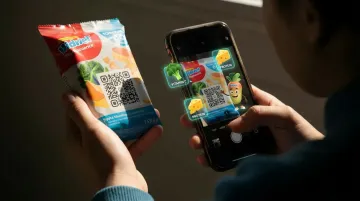
The AR opportunity is particularly strong for beauty, personal care, and novelty food brands:
- Virtual try-ons for beauty products
- Interactive filters for social sharing
- Immersive brand storytelling tied to seasonal campaigns
- 3D product demonstrations
Short CTAs on-pack are critical here. "Scan to enter" or "Scan to unlock your experience" gives consumers a clear reason to act. Without context, the code gets ignored.
7. Social Media Growth and Retargeting
A social media QR code on packaging consolidates all of a brand's social profiles into one scannable destination. Instead of asking consumers to search manually, one scan takes them to a page with links to every channel — Instagram, TikTok, YouTube, Facebook — turning buyers into followers from the first interaction.
QRStuff's Social Link Pages work exactly this way: a single code creates a central hub with buttons for each social profile, fully customizable and updatable without reprinting.
Beyond follower growth, dynamic QR codes enable retargeting. When a consumer scans and visits a brand's website, a pixel fires — Meta Pixel or Google Ads — enabling retargeted ads toward that audience. QRStuff supports both Meta Pixel and Google Ads integration, meaning packaging becomes a top-of-funnel asset that feeds paid media strategy with warm, product-qualified audiences.
Best Practices for Adding QR Codes to CPG Packaging
Size and Scannability
QRStuff recommends a minimum size of 2cm x 2cm (0.8" x 0.8") for simple URL codes on packaging. For print files, use vector formats (SVG or EPS) rather than raster files — they scale to any size without quality loss, which matters when one code needs to work across multiple pack formats.
Additional technical requirements:
- Contrast: Dark code on light background. Avoid inverted designs — many scanners struggle with light-on-dark
- Quiet zone: Never crop the white border surrounding the code — it's what scanners use to locate the code
- Surface: Flat, matte, non-reflective surfaces. Flexible or glossy packaging can distort the code on scan
- Testing: Test across multiple devices and lighting conditions before final print approval
One Code, One Destination (That Does Everything)
Placing multiple QR codes on a single package creates visual clutter and confuses consumers about which to scan. Instead, use one dynamic QR code linked to a well-designed landing page that houses everything — sustainability info, recipes, loyalty enrollment, reviews — in one place.
QRStuff's Multi-URL QR codes (Social Link Pages) do exactly this. One code, one scan, and the consumer lands on a hub with clearly labelled options. Because the code is dynamic, that hub can be updated at any time without touching the printed packaging.
CTA and Placement
A QR code without context is a missed opportunity. Every code on packaging needs a short, specific call-to-action:
- "Scan for recipes"
- "Scan to earn rewards"
- "Scan to verify authenticity"
Place the code somewhere prominent — front of pack or back panel — not buried beneath nutritional tables. Eye-level placement significantly improves scan rates.
Track Performance With Analytics
QR code scan data gives CPG brands direct visibility into packaging performance across SKUs, regions, and campaigns. QRStuff's real-time analytics dashboard tracks:
- Total and unique scans
- Device type (iOS vs Android)
- Geographic location (country and city level)
- Scan time and date with daily, weekly, and custom views
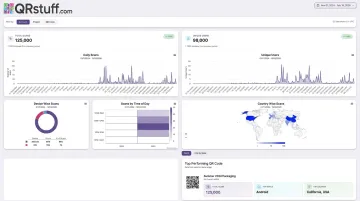
This data tells you which products are driving the most engagement, which regions are responding to a campaign, and whether a content update changed consumer behavior. For brands managing multiple SKUs, that insight pairs directly with QRStuff's bulk generation tools. The Full Suite supports 500 codes per batch; Enterprise plans offer unlimited generation, making it practical to deploy unique tracking codes across entire product lines.
Frequently Asked Questions
What is the QR code for food packaging?
A QR code on food packaging is a scannable code printed on labels or boxes that connects consumers to digital content such as nutritional information, recipes, allergen details, sustainability data, or promotions — without consuming extra space on the label. Dynamic codes can be updated anytime without reprinting.
Should I use static or dynamic QR codes on CPG packaging?
Dynamic QR codes are the better choice for packaging. Their destination URL can be updated at any time without reprinting , making them ideal for seasonal campaigns, rotating promotions, or post-print content updates. Static codes are fixed once printed and cannot be changed.
How big does a QR code need to be on product packaging?
QRStuff recommends a minimum of 2cm x 2cm (0.8" x 0.8") for standard URL codes. Always use vector formats (SVG or EPS) for print files, ensure strong contrast between the code and background, and test across multiple devices before approving final print.
How do I know if consumers are actually scanning my packaging QR codes?
Dynamic QR code platforms provide scan analytics including total scans, unique scans, device type, and geographic location. QRStuff's real-time dashboard makes this data available immediately after each scan, with CSV export for deeper analysis.
Can I use one QR code to share multiple types of content on my CPG packaging?
Yes. A single dynamic QR code can link to a landing page hosting recipes, loyalty enrollment, sustainability info, and reviews , keeping packaging clean while giving consumers access to everything in one scan.
Do QR codes on packaging expire?
Static QR codes never expire. Dynamic QR codes stay active while a QRStuff paid subscription is current. If a subscription lapses, codes remain active for 30 days (monthly plans) or one year (annual plans) before deactivating.