QR codes solve a specific problem that most holiday marketing tools can't: they turn any printed surface into an instant digital touchpoint. A window display, a gift tag, a Christmas card — all of them can deliver a coupon, a video, or a gift guide the moment someone points their camera at them.
This guide covers eight practical ways to use QR codes during Christmas 2026, how to choose between static and dynamic codes, what makes a holiday QR code worth scanning, and how to track results throughout the season.
Key Takeaways
- According to the NRF's 2025 holiday survey, holiday shoppers spent $890.49 per person — QR codes give you a direct channel into that spend
- Dynamic QR codes let you update destinations after printing — no reprinting needed when holiday offers change weekly
- The best placements: store windows, gift tags, direct mailers, product packaging, and event signage
- Every QR code needs a CTA beside it — codes without instructions get ignored
- Real-time scan analytics (total scans, device type, location) show exactly which placements drive the most holiday traffic
Why Christmas 2026 Is the Right Time for QR Code Marketing
The Revenue Scale Demands Better Touchpoints
NRF reported that 2025 holiday retail sales grew 4.1%, surpassing $1 trillion for the first time — and per-person spending hit $890.49 on gifts, decorations, food, and seasonal items. That's a massive pool of consumer intent, but it also means every retailer and brand is competing for the same wallet at the same time.
Discounts alone don't win that fight. The brands that capture attention connect physical touchpoints — packaging, signage, mailers — directly to mobile experiences shoppers can act on immediately.
Shoppers Live on Their Phones During the Holidays
Deloitte's 2025 Holiday Retail Survey found that 68% of holiday shoppers planned to use digital tools to compare prices and products. People research while standing in stores, check reviews before committing to a purchase, and bounce between physical and digital channels throughout December.
QR codes fit naturally into that behavior. A single camera tap bridges the gap between a physical display and a mobile landing page, with no URL to type and no app to download. That frictionless path matters when a shopper is standing in an aisle deciding between two products.
The Top Gift Categories QR Codes Can Support
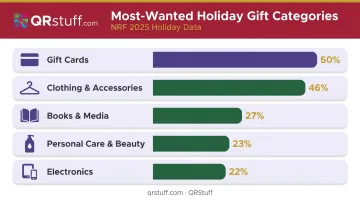
According to NRF's 2025 data, the most-wanted gift categories were:
- Gift cards — 50% of shoppers requested them
- Clothing and accessories — 46%
- Books and media — 27%
- Personal care and beauty — 23%
- Electronics — 22%
Experiences also featured heavily, with Deloitte reporting that 47% of consumers planned to give experiential gifts. QR codes can support every category on that list, connecting printed materials directly to gift card purchase pages, curated product collections, or experience booking flows.
8 Creative Ways to Use QR Codes for Christmas Marketing
Dynamic QR codes make every idea below more practical: you print once and update the destination as your offers evolve throughout the season. Here's how to deploy them across different touchpoints.
Unlock Exclusive Holiday Deals Through Scannable Promotions
A QR code on store signage, window displays, or printed flyers linked to a time-sensitive offer creates urgency without extra print runs. The destination can shift from a Black Friday bundle deal to a Christmas flash sale to a last-minute shipping promotion — no reprinting required.
QRStuff's dynamic codes support this directly: update the destination URL from your dashboard and the change takes effect immediately across all printed materials already in the field.
Add QR Codes to Gift Tags and Packaging
A small QR code on a gift tag or product box can unlock a personal video message, a festive playlist, or a digital greeting. QRStuff supports dedicated Video QR codes (accepting MP4, MOV, and WEBM uploads), YouTube QR codes for hosted content, and Spotify QR codes for playlist sharing — all available on paid plans with dynamic tracking.
Ordinary packaging becomes a shareable experience. Recipients can also be linked back to the brand's online store or loyalty program, extending the relationship past the unwrapping moment.
Drive In-Store Traffic with Window and Display QR Codes
Store windows are prime scan locations because shoppers pause there naturally. A QR code in a holiday window display can lead to a curated gift guide, a click-to-collect option for out-of-stock items, or a festive AR experience.
The real value: keeping the shopping journey alive after hours. A shopper walking past at 10pm can scan the window, browse the gift guide, and complete a purchase — no staff needed.
Include QR Codes in Christmas Cards and Direct Mailers
Printed holiday mailers get opened. Adding a QR code that leads to an exclusive offer or a personalized landing page turns a passive communication into a measurable touchpoint. QRStuff's analytics track:
- Total scans and unique users
- Device type and geographic location
- Time-based scan patterns
This gives direct mail campaigns the digital attribution they've traditionally lacked.
A QR-linked mailer that leads to a mobile-optimized holiday offer page connects both channels cleanly — and makes every send measurable.
Run a Christmas Scavenger Hunt or Giveaway
QR codes placed across store locations, shopping center zones, or social media posts can power a festive scavenger hunt where each scan reveals a clue, discount, or contest entry. QRStuff supports campaign tagging and individual tracking per code, so you can monitor engagement at each checkpoint separately.
Foot traffic, social sharing, and repeat December visits all follow — with every checkpoint tracked from one dashboard.
Simplify Holiday Event RSVPs and Check-Ins
For restaurants, retailers, or brands hosting Christmas events, a QR code on an invitation or promotional poster can capture RSVPs instantly. QRStuff offers a dedicated Event QR Code type and supports linking to Google Forms, Typeform, or any custom RSVP URL. Available on paid plans starting with the Lite Suite.
Attendees get a frictionless sign-up; organizers get real-time registration data without paper lists or manual follow-ups.
Share Digital Gift Guides and Wishlists
A QR code linked to a branded, mobile-optimized gift guide helps indecisive shoppers discover relevant products fast. Retailers can create category-specific pages — "Gifts Under $50," "For Him," "For Her" — and update them dynamically as inventory changes throughout the season.
The same printed code pointing to a general gift guide in early December can redirect to a "Last-Minute Gifts" page on December 22nd — no reprint needed.
Reward Loyal Customers with Post-Purchase Digital Content
A QR code on a receipt or product box can unlock real post-purchase value. QRStuff supports several data types specifically suited for this:
- PDF QR codes — deliver assembly instructions or product guides on scan
- Coupon QR codes — drop January discounts or loyalty rewards directly to buyers
- Website URL codes — route customers to loyalty sign-up pages or branded content
- Social Link Pages — consolidate multiple resources into one scannable destination
This extends the customer relationship past checkout and sets up retention heading into Q1.
Dynamic vs. Static QR Codes: Which Is Right for Your Christmas Campaign?
The Core Difference
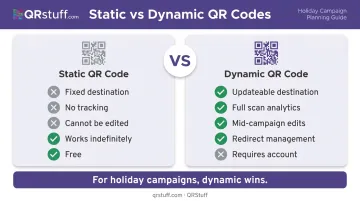
Static QR codes permanently encode a destination URL into the code pattern. Once printed, the destination cannot be changed and no scan data is recorded. They're permanent and work indefinitely, but offer zero flexibility or tracking.
Dynamic QR codes route through a short redirect link. The destination can be updated at any time through a dashboard — the printed code image stays identical. They also record every scan event, capturing time, location, device type, and unique vs. repeat visitors.
That distinction matters most when something changes mid-campaign — and in holiday marketing, something always does.
Why Dynamic Codes Win for Holiday Campaigns
When a product sells out, a flash sale ends, or a shipping deadline passes, static codes leave you reprinting materials or sending customers to a dead page. Dynamic codes eliminate that problem. The same code printed on 10,000 gift bags can point to a Black Friday deal in November, a Christmas promotion in December, and a New Year sale in January — no reprint required.
QRStuff's Dynamic Code Tiers
| Plan | Dynamic Codes | Scan Limit | Analytics |
|---|---|---|---|
| Free (with account) | 10 codes | 50 scans/code | Basic |
| Lite Suite ($4/mo) | 50 codes | 200 scans/code | Full |
| Full Suite ($15/mo) | 250 codes | Unlimited | Full |
| Enterprise ($185/mo) | 1,000 codes | Unlimited | Full + API |
For most holiday campaigns, the Full Suite covers everything you need. Enterprise adds bulk generation (500+ codes), API access, and white-label options — the right fit for large retail chains or agencies managing multi-brand campaigns across dozens of locations.
How to Design Christmas QR Codes That Actually Get Scanned
Technical Basics That Can't Be Skipped
Before adding any festive styling, the code must be physically scannable:
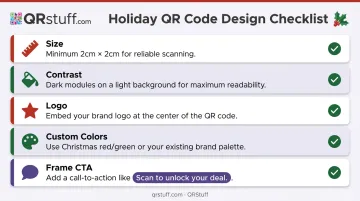
- Minimum size: 2cm × 2cm (0.8" × 0.8") for simple URLs
- Quiet zone: A four-module-wide white border on all sides — never crop it
- Contrast: Dark code on a light background; avoid light-on-dark (older scanners struggle)
- Resolution: 300 DPI minimum for print; use SVG or EPS for banners and large signage
- Page speed: Google data shows 53% of mobile users abandon pages that take more than 3 seconds to load — your landing page matters as much as the code
QRStuff exports in PNG, JPG, TIF (up to 600 DPI), and vector formats including SVG, EPS, PDF, and DXF. Vector formats are available on all paid tiers and recommended for any print application larger than a business card.
Holiday Customization That Increases Scan Rates
Shoppers scan codes that feel deliberate. QRStuff's generator lets you customize:
- Logo embedding at the center with automatic error correction adjustment
- Custom colors — red/green for Christmas, brand palette for consistency
- Custom frames with text like "Scan for your gift message" or "Scan to unlock your deal"
Frame text like "Scan to unlock your gift" outperforms bare codes because it answers the shopper's unspoken question: why should I bother? Short, benefit-led prompts consistently drive higher scan rates than generic or unlabeled codes.
Placement and CTA Rules
Good design gets attention; placement determines whether someone actually scans. Put the call to action directly adjacent to the code — not on the back of the packaging, not buried in the footnotes.
Best placement locations by material:
- Gift tags: Center-front, above or below the greeting text
- Product packaging: Eye-level on the front panel
- Direct mailers: Top-fold so it's visible before the piece is fully opened
- In-store signage: Comfortable scan height (approximately chest to eye level)
- Window displays: Center panel, away from reflective edges
Measuring and Managing Your Christmas QR Code Campaign with QRStuff
Set Up Tracking Before Anything Goes Live
Add UTM parameters to every QR code destination URL before printing. This connects QR scan traffic to your existing Google Analytics account, giving clean attribution separate from email, paid search, and social.
QRStuff supports full UTM passthrough — the platform records its own scan analytics simultaneously, so you get both QRStuff's scan-level data (location, device, time) and GA4's behavioral data (bounce rate, conversions, session depth) in parallel.
Use Google's GA4 Campaign URL Builder to generate tagged URLs before creating your codes.
What QRStuff's Dashboard Shows
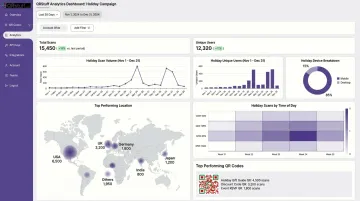
For every dynamic QR code, the analytics dashboard tracks:
- Total scans and unique scans — separates reach from repeat engagement
- Scan time and date — identifies peak engagement windows
- Device type and OS — iOS vs. Android, mobile vs. desktop
- Geographic location — country and city level
- Daily, weekly, and custom date range views
Data exports as CSV, PDF, or Excel for team reporting. Enterprise users can pull scan data programmatically via API.
The Mid-Campaign Advantage
When a promoted product sells out or a flash sale ends, update the QR destination immediately from the dashboard. The printed code stays valid, redirecting to a relevant alternative rather than a dead page. This keeps customer experiences seamless throughout December without any print intervention.
Post-Christmas QR Code Lifecycle
The campaign doesn't end when the holiday does. Redirect QR code destinations to:
- A New Year sale page
- A January loyalty offer
- An email sign-up for 2027 campaigns
This extends the ROI of holiday print runs into Q1 with zero additional production cost.
Review your campaign analytics in early January. Compare scan volume by placement, device breakdown, and geographic concentration to identify what worked — then build your 2027 brief from real data.
Frequently Asked Questions
What sells most during Christmas?
Gift cards top the list at 50% of requested gifts, followed by clothing and accessories (46%), books and media (27%), beauty products (23%), and electronics (22%). QR codes can link directly to gift card purchase pages, category-specific product collections, or experience booking flows from any printed touchpoint.
Can I update a QR code after it's already been printed?
Yes — but only if you're using a dynamic QR code. Dynamic codes store a redirect link that can be updated at any time via your QRStuff dashboard, without changing the printed code image. Static QR codes permanently encode their destination and cannot be edited after creation.
Where should I place QR codes for maximum holiday impact?
The highest-performing placements are store windows, in-store displays, gift tags, product packaging, Christmas cards, direct mailers, and event signage. Every code needs a clear call to action placed directly beside it — without one, most shoppers won't engage even if they notice the code.
Do customers need a special app to scan a Christmas QR code?
No. iPhones running iOS 11 and above scan QR codes natively through the built-in Camera app. Android devices running 8.0 (Oreo) and above handle scanning through the default camera or Google Lens.
How do I track the performance of my holiday QR code campaign?
Dynamic QR codes provide built-in analytics covering scan counts, unique users, device type, geographic location, and time-of-day patterns. Adding UTM parameters to destination URLs brings that scan data into Google Analytics for full campaign attribution across all channels.
What's the difference between static and dynamic QR codes for Christmas marketing?
Static codes lock in a fixed destination with no tracking — once printed, they can't be changed or measured. Dynamic codes allow destination updates, real-time analytics, and mid-campaign adjustments, making them the practical choice for any multi-week holiday campaign where offers or inventory will shift.