According to Fleetio's 2026 State of Fleet Management survey, 30.8% of fleet professionals still rely on spreadsheets to track operations — a manual approach that creates real exposure as fleets grow. QR codes are not a marketing tool in this context. They are a practical bridge between a physical asset sitting in a yard and the digital records that govern how it's assigned, maintained, and kept compliant.
This article covers why QR code fleet tracking matters, the three operational benefits that justify implementation, what goes wrong without it, and the setup practices that separate programs that stick from ones that quietly fail.
Key Takeaways
- Each vehicle or asset gets a unique QR code — one scan opens its full data profile with no login or dispatcher call required
- Core benefits: faster asset identification, on-demand maintenance and compliance records, and better parts inventory accuracy
- Use dynamic QR codes: static codes require reprinting every time data changes, and that cost adds up quickly across a fleet
- Placement standards, durable label materials, and workflow integration determine whether adoption sticks long-term
- Fleets above 250 assets call for an enterprise-grade platform with bulk generation and API integration
What Is QR Code Fleet Tracking?
QR code fleet tracking is the practice of assigning unique, scannable codes to vehicles, trailers, tools, and components so any team member with a smartphone can instantly pull up that asset's full data profile.
In practice, codes go on driver-side door jambs, trailer landing-gear posts, parts bins, tool cages, and high-value equipment — anywhere a physical asset needs a digital identity that field staff can access without calling the office.
QR codes aren't a replacement for GPS or fleet management software. They don't track real-time location. Instead, they serve as the access point between a physical asset and the records that govern it:
- Maintenance history and service schedules
- Compliance documents and inspection reports
- Driver assignments and handoff logs
- Component-level part numbers and warranty data
GPS handles continuous location. QR codes handle the documentation layer — instantly, from any smartphone, no office call required.
Key Benefits of Using QR Codes for Fleet Tracking
The benefits below map to outcomes fleet managers actually measure: time per inspection, compliance readiness, parts accuracy, and cost per asset managed.
Benefit 1: Instant Vehicle Identification and Driver Verification
The most immediate gain is eliminating the time spent confirming which vehicle is which, who was last assigned, and whether registration and insurance are current.
Each vehicle carries a QR code on the driver-side door jamb linking to a live profile: VIN, license plate, fuel type, assigned driver, insurance details, and last inspection date. No app required. No login screen. No call to dispatch.
That friction compounds quickly across a fleet:
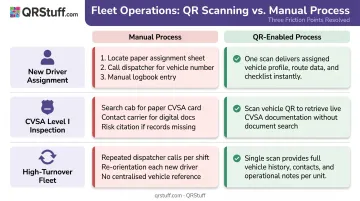
- A new driver taking a vehicle on short notice normally means verifying assignment, checking documentation, and logging the handoff — three separate steps that each create delay
- During a CVSA Level I inspection, the driver must produce the license, medical certificate, record of duty status, vehicle inspection reports, and periodic inspection certificates on the spot — a QR scan surfaces all of it in seconds
- High-turnover fleets face this problem constantly: ATA reported a 91% truckload driver turnover rate in 2019, meaning "who has what vehicle" is a recurring question, not an occasional one
KPIs impacted: vehicle assignment time, driver onboarding speed, documentation accuracy, compliance readiness at roadside inspections
Impact is highest in high-turnover environments, multi-depot operations, and shift-based fleets where vehicles change hands daily.
Benefit 2: On-Demand Maintenance History and Compliance Records
A mechanic scanning a vehicle's QR code before lifting the hood sees the last oil change, open recalls, brake inspection dates, and what the previous technician flagged — before any diagnostic work begins. A driver at a roadside stop scans the door jamb and produces digital compliance documentation in seconds.
Fleetio's 2026 data shows the maintenance mix is 40.1% unscheduled work — nearly half of all service events are reactive. When technicians don't have immediate access to a vehicle's service history, they're diagnosing without context, which extends repair time and increases repeat visits.
The compliance numbers reinforce that urgency:
- CVSA's 2025 International Roadcheck found an 18.1% vehicle out-of-service rate across 56,178 inspections — brake systems and tires were the top failure categories
- FMCSA penalty schedules allow up to $4,812 per recordkeeping violation for carriers who can't produce required documentation
- Fleetio's data also shows a 6.7-day average delay from work request to work start, partly driven by slow access to asset information
KPIs impacted: PM completion rate, repeat repair frequency, roadside inspection duration, audit pass rate, technician time-to-diagnosis
For regulated fleets in transportation, utilities, and construction — where compliance documents must be current and immediately producible — this is the highest-stakes benefit on the list.
Benefit 3: Improved Parts, Tool, and Asset Inventory Accuracy
QR codes extend beyond vehicles to every asset in the fleet ecosystem: parts bins, tools, spare components, trailers, and shared equipment.
Three touchpoints show how this works day-to-day:
- A technician scans a parts bin QR before pulling a filter — the system deducts the item from inventory and logs it against the work order
- A driver scans a diagnostic tool at check-out, creating a timestamped record of who has it and where it was last used
- A scan at check-in confirms return and updates availability status — no manual entry required
Inaccurate spare parts inventory doesn't just create frustration — it stops maintenance the same way a missing raw material stops production. Manual logging errors (wrong vehicle assignments, forgotten part pulls, unlogged tool movements) erode fleet budgets without showing up as a visible line item.
For fleet operators managing large inventories, dynamic QR codes solve a specific problem: when a bin is reorganized or a tool moves to a different depot, the linked record updates without reprinting. QRStuff's dynamic codes allow destination and content changes at any time, keeping the physical label accurate without replacement.
KPIs impacted: inventory accuracy rate, stock-out frequency, equipment loss per quarter, month-end reconciliation time, parts cost per vehicle
Construction, utilities, and logistics fleets managing large tool inventories alongside vehicles will see the most measurable return here.
What Happens When Fleet QR Tracking Is Missing
Fleet management without scan-based tracking works fine at small scale. It breaks down around 50 vehicles.
Without scan-based asset identification:
- Vehicle records diverge across depots because different staff update different systems inconsistently
- Missed PM intervals accumulate silently — no one flags that a vehicle's service date passed until something fails
- Tool accountability disappears; equipment goes missing and reconstruction from memory is rarely conclusive
- Compliance documentation gaps create audit exposure, with per-violation fines that add up fast
The scaling problem is the real issue. A spreadsheet approach that is barely manageable for a 10-vehicle fleet becomes actively harmful at 50. Fleetio's own data puts the average work-start delay at 6.7 days — a number that worsens when technicians spend time locating records before they can even assess a vehicle.
Dispute resolution is another hidden cost. When a maintenance event is questioned or equipment goes missing, a fleet with no scan-based audit trail reconstructs events from incomplete logs. A fleet with QR-based records has timestamped scan history, device data, and geographic context, which cuts investigation time and limits liability exposure.
Best Practices for Getting the Most Out of Fleet QR Codes
Establish Placement Standards Before Printing Anything
Define where codes go on each asset class before a single label ships:
- Powered vehicles: driver-side door jamb
- Trailers: landing-gear post or front panel
- Parts bins: front face at eye level
- Tools and equipment: side panel near handle or grip point
Document the standard. Every driver and technician should know exactly where to look on every asset type without being told.
Use Dynamic Codes for All Fleet Applications
Static QR codes encode data permanently. When a vehicle moves depots, gets reassigned, or receives a service update, the code is out of date and the label needs reprinting. At fleet scale, that's a recurring cost that compounds quickly.
Dynamic codes (like those generated through QRStuff) store the destination record in a database. The physical label stays the same; the linked information updates through the dashboard.
QRStuff's Full Suite supports up to 250 dynamic codes, suitable for mid-sized fleets. The Enterprise tier covers up to 1,000, with bulk generation of 500+ codes in a single batch for large-scale deployments.
Match Label Materials to the Operating Environment
| Placement | Material | Expected Lifespan |
|---|---|---|
| Exterior vehicle panels | Industrial polyester with laminate | 12+ years |
| Heavy equipment, harsh conditions | Etched anodized aluminum | 20+ years |
| Interior, protected locations | Weatherproof vinyl | 8–10 years |
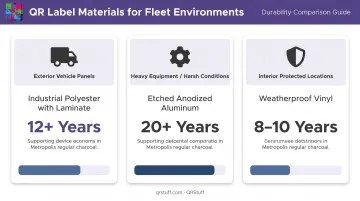
The wrong material in the wrong environment produces unreadable codes within weeks. Specify materials by asset class at the start, not after your first label failure.
Build Scanning Into Existing Workflows
Adoption is the single most common failure point in QR fleet programs. The fix is simple: scanning must replace a step drivers already take, not add a new one.
- Pre-trip inspection starts with a QR scan
- Tool check-out requires a scan
- Work order creation begins with a scan
When scanning replaces an existing step rather than creating a new one, adoption happens immediately and holds over time.
Conclusion
QR code fleet tracking delivers measurable value across the operations that matter most: faster asset identification at the vehicle, on-demand access to records that close compliance gaps, and inventory accuracy that cuts the cost of lost time and equipment.
A QR system maintained with updated dynamic codes and durable labels builds an audit trail that becomes more valuable over time — as the fleet ages and assets accumulate more service events, that history pays dividends during audits, insurance reviews, and resale.
The fleets that see the strongest return treat scanning as a standard workflow step, the same way they treat pre-trip inspections. They review scan data regularly and act on what it shows: which assets are overdue for service, which are sitting idle, and where driver check-ins are being skipped. That review cycle is what turns a labeling system into a genuine operational tool.
Frequently Asked Questions
Can I use QR codes for fleet tracking?
Yes. QR codes are well-suited for fleet tracking because each vehicle or asset gets a unique code linking to its full data profile. Any smartphone camera reads the code natively — no specialized hardware or app download required.
What is a fleet management QR code?
A fleet management QR code is a unique scannable label attached to a vehicle, trailer, tool, or component that, when scanned, opens that asset's digital record — including identification details, maintenance history, compliance documents, and driver assignments.
Do QR codes replace GPS tracking for fleet management?
No — they serve different purposes and work best together. GPS provides continuous real-time location for powered vehicles. QR codes provide instant access to asset data on any asset — including non-powered equipment and tools — at a fraction of the hardware cost.
What is the difference between static and dynamic QR codes for fleet use?
Static codes encode data permanently and must be reprinted every time information changes. Dynamic codes link to a database record that updates anytime without reprinting. For fleet assets that change hands, move between depots, or carry regularly updated records, dynamic codes are the right choice.
What happens if a QR code label gets damaged on a vehicle?
The underlying digital record is unaffected by physical label damage. A replacement label reprints and reattaches immediately. Industrial-grade materials — polyester with laminate or anodized aluminum — are chosen specifically to minimize this risk in fleet environments.
Do drivers need to download a special app to scan fleet QR codes?
No. Modern iOS and Android devices scan QR codes natively through the built-in camera. The linked asset profile opens directly in a mobile browser — no app installation or extra training required.