Many packaging designers treat the quiet zone as an aesthetic margin, applying a fixed millimetre value and moving on. That approach works until print size changes, QR version changes, or a verifier grades the symbol — at which point a quiet zone that "looked fine" fails measurement.
This article covers exactly what the 4-module requirement means under ISO/IEC 18004 and GS1 General Specifications, how to calculate its physical dimensions using the X-dimension, what properties it must maintain, and what happens when it is violated.
Key Takeaways
- The quiet zone is a mandatory blank margin surrounding all four sides of a GS1 QR code — required to be at least 4 modules wide on every side
- Each module is the smallest square unit in the QR code grid — 4 modules wide equals 4 × X-dimension (minimum 1.584 mm, maximum 3.96 mm for retail POS)
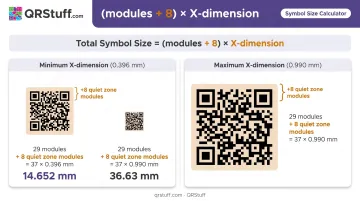
- Total symbol size (including quiet zone) = (number of modules across + 8) × X-dimension
- A 29-module code at minimum X-dimension works out to: 37 × 0.396 mm = 14.652 mm
- The quiet zone must be uniform on all four sides, free of all marks, and maintain sufficient reflectance contrast
- The most common error: applying a fixed millimetre margin instead of recalculating from the X-dimension whenever the X-dimension changes
What the GS1 QR Code Quiet Zone Represents
The quiet zone is a mandated clear area surrounding all four sides of a QR code. It must be entirely free of any printed content — modules, text, graphics, borders, or marks of any kind. Its purpose is to give scanning devices a clear, high-reflectance boundary they can use to locate the code and distinguish its outer edge from adjacent label content.
QR code decoders locate a symbol by detecting three finder patterns: distinct squares positioned in three corners of the code. The quiet zone provides a guaranteed region of high reflectance that lets the decoder identify where the symbol ends and the label begins — before it attempts to parse any data. Without it, the decoder cannot reliably anchor its reading grid.
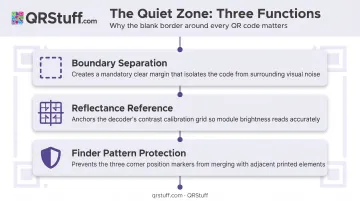
The quiet zone serves three specific functions:
- Separates the symbol boundary from surrounding label content
- Provides a high-reflectance reference that anchors the decoder's reading grid
- Prevents adjacent graphics or text from interfering with finder pattern detection
The requirement traces back to ISO/IEC 18004:2024, the international QR code symbology standard. GS1 adopts this requirement directly and enforces it for GS1 QR Code applications through the GS1 General Specifications (Release 26.0), primarily in sections 5.7/5.7.2 for symbology basics and section 5.12.3.1 for retail POS symbol specification tables.
The quiet zone is external to the symbol's data-carrying matrix. It is not counted as part of the module grid used for encoding, and it carries no data. GS1 explicitly states that symbol size excludes the surrounding 4-module quiet zones — the quiet zone exists solely as a scanning aid.
Why 4 Modules?
The 4-module minimum is specified in ISO/IEC 18004 and adopted by GS1 as the required quiet zone for GS1 QR codes. GS1 General Specifications state this as a 4X requirement — meaning 4 times the X-dimension on every side.
No publicly accessible GS1 or ISO document provides a statistical rationale for why 4 modules was chosen over 3 or 5. The 4-module rule should be treated as a standards requirement, not a tested threshold with a published failure rate. The minimum reflects a practical balance: compact enough for retail packaging constraints, yet sufficient for reliable multi-device scanning performance.
How the 4-Module Requirement Translates to Physical Dimensions
The 4-module rule only has a physical measurement when multiplied by the X-dimension — the width of one printed module. Without knowing the X-dimension of the specific QR code being produced, it is impossible to state the quiet zone width in millimetres.
GS1's Permitted X-Dimension Range
GS1 General Specifications section 5.12.3.1 (Tables 5-45 and 5-46) defines the X-dimension range for GS1 QR codes at retail point of sale:
| Parameter | Value |
|---|---|
| Minimum X-dimension | 0.396 mm |
| Target X-dimension | 0.495 mm |
| Maximum X-dimension | 0.990 mm |
This range governs not just quiet zone size but the entire printed symbol. The resulting quiet zone at each extreme:
- At minimum X (0.396 mm): 4 × 0.396 = 1.584 mm per side
- At maximum X (0.990 mm): 4 × 0.990 = 3.96 mm per side
The X-dimension choice depends on print process resolution, substrate type, and scanning environment. Smaller packaging with high-resolution print may use a smaller X-dimension; lower print quality or handheld scanning warrants a larger one. Either way, the quiet zone width is always 4 × X-dimension — the formula doesn't change, only the inputs do.
Calculating Total Symbol Size Including Quiet Zone
GS1 UK guidance presents the total symbol size formula as:
(horizontal module count + 8) × X-dimension
The "+8" accounts for 4 modules of quiet zone on each opposing pair of sides (4 left + 4 right = 8 added to width; 4 top + 4 bottom = 8 added to height).
Worked example using a 29-module QR code:
| X-dimension | Calculation | Total size |
|---|---|---|
| 0.396 mm (minimum) | (29 + 8) × 0.396 | 14.652 mm × 14.652 mm |
| 0.990 mm (maximum) | (29 + 8) × 0.990 | 36.63 mm × 36.63 mm |
GS1 QR codes are available in 40 sizes, ranging from 21×21 to 177×177 modules, increasing by 4 modules per side for each successive size. As the data payload increases and the QR version increments, the module count grows. The quiet zone, however, stays fixed at 4 modules regardless of version. Its physical size only shifts when the X-dimension changes. Recalculate total symbol dimensions whenever either the module count or X-dimension is updated.
Key Technical Properties the GS1 Quiet Zone Must Satisfy
Meeting the 4-module count is necessary but not sufficient. The quiet zone must also satisfy specific physical and optical properties. A 4-module margin filled with a light texture or gradient can still fail, even though it appears to meet the module count requirement.
Uniformity Across All Four Sides
The quiet zone must be exactly 4 modules wide on all four sides simultaneously — not an average, not a minimum on two sides. QR code decoders scan in multiple orientations. Any side with an undersized quiet zone can cause decode failure regardless of the other three sides being compliant.
This is a common error inherited from 1D barcode practice, where only the leading and trailing quiet zones matter. For 2D QR codes, the top and bottom margins carry equal scanning weight. All four sides are enforcement surfaces.
Reflectance, Color, and Contrast
The quiet zone does not need to be white. It must have sufficiently high reflectance relative to the code's dark modules to allow the scanner to distinguish the symbol edge. A light label background that maintains the required print contrast ratio is acceptable under GS1 guidance.
That acceptability is quantified. GS1 General Specifications require quality assessment using ISO/IEC 15415, with a minimum grade of 1.5/12/660 for GS1 QR codes. Under ISO/IEC 15415 grading, Symbol Contrast measures the reflectivity difference between the brightest and darkest modules: an A grade requires 70% or higher contrast.
What to avoid in the quiet zone:
- Gradients or colour transitions
- Textures or patterned backgrounds
- Overlapping design elements, even faint ones
- Hairline rules or watermarks
Scanner optics interpret reflectance variation as potential code content. Even subtle marks can trigger false boundary detection.
Scaling vs. Cropping
Because the quiet zone is defined in modules rather than millimetres, it scales proportionally when the QR code image is resized uniformly. The module-count requirement is always preserved during uniform scaling.
The protection breaks down with cropping. Cropping a QR code image file removes actual pixel rows from the margin, physically reducing the quiet zone below 4 modules regardless of what the original file contained. QRStuff embeds the full required quiet zone into every generated output file. Even so, cropping during layout placement is the most common way it gets removed post-generation. The quiet zone is part of the image itself — never crop it.
Common Misinterpretations of the 4-Module Rule
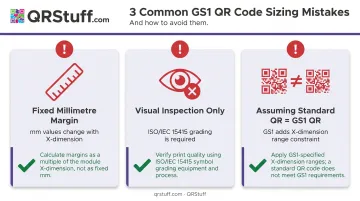
Three mistakes appear repeatedly in packaging and retail production workflows:
1. Hardcoding a fixed millimeter margin
Designers who set a static margin — "always leave 2 mm of white space" — may comply at one print size but fail at a smaller one. The module count governs the spec, not the absolute distance. It must be recalculated for every combination of QR module count and X-dimension.
2. Using visual inspection as a compliance check
A label that looks fine can still fail verification if the module-count margin falls below 4 when measured against the printed X-dimension. Validation requires barcode verification equipment or software grading symbol quality against ISO/IEC 15415. GS1's minimum grade requirement (1.5/12/660) is a measurement standard — visual estimates don't satisfy it.
3. Assuming standard QR and GS1 QR rules are identical
Both reference the same ISO/IEC 18004 4-module rule, but GS1 adds a second constraint: the X-dimension must fall within the permitted range for the target application. A code with a correct 4-module quiet zone can still be non-compliant for GS1 retail POS use if its X-dimension falls outside 0.396 mm–0.990 mm. Quiet zone and overall symbol size are both compliance parameters — satisfying one doesn't excuse the other.
Implications of Violating the Quiet Zone Requirement
An insufficient quiet zone causes the decoder's boundary-detection algorithm to misidentify the finder pattern edge or miss the symbol entirely. The outcome is a null read, a misread, or an error flag — each one effectively the same as printing no code at all.
For GS1 QR codes on retail packaging, compliance means passing barcode verification against ISO/IEC 15415. A quiet zone violation puts the symbol's minimum grade at risk, which can result in:
- Retailer rejection of the label or product batch
- Required reprints of all affected packaging
- Non-compliance with GS1 General Specifications
The cost asymmetry matters here. Unlike a dynamic QR code's destination URL — which can be updated without reprinting — the quiet zone is a physical print attribute on every label. Correcting it means a full reprint run across every affected unit. Verifying quiet zone compliance before committing to print is the only practical point of intervention.
Frequently Asked Questions
What is the quiet zone in a QR code?
The quiet zone is the mandatory blank margin surrounding all four sides of a QR code, required to be completely free of marks, graphics, and text. It allows scanning devices to detect the code boundary and distinguish the symbol from adjacent label content.
What does "4 modules" mean as a physical distance in a GS1 QR code?
Four modules translates to a physical distance by multiplying the module count by the X-dimension (the width of one module). At GS1's minimum POS X-dimension of 0.396 mm, this equals 1.584 mm per side, scaling upward to 3.96 mm at the maximum X-dimension of 0.990 mm.
Does the quiet zone need to be white in a GS1 QR code?
White is not required — the zone must simply have sufficiently high reflectance and contrast relative to the dark modules. It must be completely free of patterns, gradients, textures, or any marks that reduce reflectance uniformity.
Can I place a logo or text in the GS1 QR code quiet zone?
No marks, text, logos, borders, or design elements of any kind may appear within the quiet zone. Even a hairline rule or faint watermark within this margin risks scan failure.
What happens if a GS1 QR code fails the quiet zone requirement at retail?
A quiet zone violation puts the symbol's ISO/IEC 15415 verification grade at risk, which can trigger retailer rejection and a full reprint of all affected labels. As a physical print attribute, there is no correction path short of reprinting.
Is the quiet zone requirement the same for GS1 QR codes as for standard QR codes?
Both reference the same ISO/IEC 18004 4-module rule. GS1 QR codes add one further constraint: the X-dimension must fall within the permitted range for the application (0.396 mm–0.990 mm for retail POS), so the quiet zone's physical dimensions are also subject to GS1 compliance.