Introduction
Consumer attention is harder to capture than ever. Budgets are stretching across more channels, yet only 38% of global marketers measure traditional and digital marketing together, according to Nielsen's 2024 Annual Marketing Report. That gap is where physical marketing spend goes untracked — printed, distributed, and never measured.
QR codes appear on menus, packaging, and storefronts across every industry — but if you're using them without tracking, destination testing, or a plan for when the offer changes, you're not running a strategy. You're running a guess.
That's a missed opportunity with measurable consequences.
This guide covers the practical growth outcomes QR codes produce when deployed with intention: how they turn physical assets into measurable marketing channels, what data they generate that print alone never could, and how dynamic codes cut campaign costs without reprinting.
Key Takeaways
- QR codes bridge offline touchpoints and online experiences, turning physical assets into measurable marketing channels
- Dynamic QR codes let businesses update destinations without reprinting, keeping campaigns current at no additional print cost
- Scan analytics reveal where, when, and how customers engage — insights that print alone can't provide
- Strategic, multi-touchpoint deployment compounds results; isolated codes used once generate minimal return
- The entry point is low: static codes are free, and dynamic codes with analytics start at £4/month
What Are QR Codes?
A QR code is a scannable visual pattern that instantly connects a mobile device to a URL, payment portal, contact card, file, or any other digital destination. No app required, no manual typing needed.
In a business context, they appear on product packaging, restaurant menus, retail signage, receipts, direct mail, business cards, and event materials. QRStuff, for example, supports 40+ QR code types, including:
- Website URLs and landing pages
- vCard contacts and digital business cards
- WiFi credentials
- Payment links
- Event registrations
- Google Review prompts
- File uploads
The technology itself isn't the point. What matters is what happens after the scan — the action a customer takes that generates revenue, builds loyalty, or produces data you can act on. A QR code is only as valuable as the destination it serves and the offer waiting on the other side.
Key Advantages of QR Codes for Business Growth
The three advantages below focus on commercial and operational impact. Each connects directly to outcomes businesses actually track: customer acquisition, conversion rate, marketing cost, and campaign intelligence.
Advantage 1: Turning Every Physical Surface Into an Active Marketing Channel
Traditional print marketing has a structural problem: it dead-ends. A flyer with a phone number, a business card with a website address, a yard sign with a URL — none of these generate trackable customer actions. A QR code changes that.
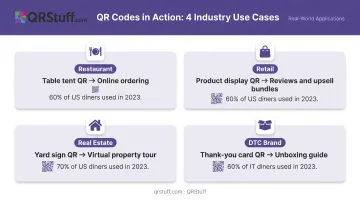
Every physical asset with a QR code becomes a live marketing channel. Consider how this plays out across industries:
- A restaurant adds QR codes to table tents linking to an online ordering system — 60% of US diners used QR code menus in 2023, per Statista
- A retailer places codes on product displays linking to reviews and upsell bundles
- A real estate agent puts a code on a yard sign linked to a virtual tour
- A DTC brand includes a code on thank-you cards linking to an unboxing guide
The scale of this opportunity is significant. Statista projects 99.5 million US smartphone users will scan QR codes in 2025 — that's a substantial consumer base already in the habit.
The commercial case is straightforward: one printed QR code can drive thousands of digital interactions over its lifetime, at no additional distribution cost. And unlike a phone number or URL in print, every scan is trackable and attributable to the specific physical placement that generated it.
KPIs this affects:
- Website traffic from offline sources
- Conversion rate from physical marketing
- Cost per customer touchpoint
- Lead volume from print campaigns
This advantage is highest-impact for businesses with significant physical presence — retail, hospitality, restaurants, healthcare, and events — where moving customers from offline discovery to online action is a persistent challenge.
Advantage 2: Real-Time Campaign Analytics That Print Marketing Can't Provide
Print marketing has historically been difficult to measure. USPS acknowledges this directly: direct mail has had less accessible performance data than most digital channels, and QR codes are one of the mechanisms that make mailer engagement trackable.
Dynamic QR codes generate scan-level data on every interaction: scan volume, device type, geographic location, and time of day. Assign a unique code to each physical placement, and you have placement-level attribution across your entire campaign — whether that's a mailer, in-store signage, packaging, or an event badge.
QRStuff's analytics dashboard makes this practical. It shows total and unique scans, operating system breakdowns, city-level geographic data, and time-based trends across daily, weekly, or custom date ranges. Campaign tagging allows businesses to filter and compare performance across different campaigns or run A/B tests. Scan data exports to CSV for integration with external reporting tools.
The competitive implication is real. According to Salesforce research, 72% of high-performing marketers could analyze marketing performance in real time, compared to just 61% of underperformers. Attribution capability correlates with marketing performance — and QR codes extend that real-time intelligence into physical channels that previously generated none.
KPIs this affects:
- Campaign attribution accuracy
- Cost per conversion
- A/B test cycle time
- Customer geographic insights
- Media spend efficiency
Analytics capability is highest-value for businesses running multi-location campaigns, seasonal promotions, or testing new markets. Knowing which physical placement is driving scans — and which isn't — is the difference between scaling confidently and reallocating budget based on guesswork.
Advantage 3: Cost-Effective Flexibility Through Dynamic QR Codes
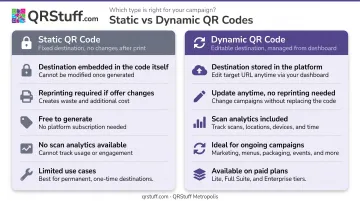
Static QR codes embed the destination directly into the code itself. Once printed, the destination is fixed — if the offer changes, the page moves, or the link breaks, the printed code becomes useless and reprinting costs accumulate.
Dynamic QR codes solve this entirely. The code contains a short redirect URL; the final destination lives in the platform and can be updated at any time from the dashboard. The physical code never changes — the destination can.
The practical application is straightforward:
- A hospitality brand prints QR codes on menus, in-room cards, and packaging once — then updates the linked content for seasonal promotions without reprinting anything
- A museum discovers a typo after printing 40 exhibit labels — they fix the destination URL in minutes, with no reprint required (a scenario QRStuff customer Henry Osei from Oakdale History Museum described directly)
- A retailer running monthly promotions updates the landing page destination rather than reprinting hundreds of product display cards
US marketers spent $37.3 billion on direct mail in 2024, per Winterberry Group — with postage alone accounting for roughly half of a typical direct-mail campaign cost. Dynamic QR codes don't eliminate print spend, but they prevent the additional expense of reprinting when campaigns evolve.
Beyond cost, there's a customer experience argument. Contentsquare's 2024 Digital Experience Benchmark Report found that digital frustration affected 39.6% of visits and that mobile conversion rates dropped 6.4% in 2023. A broken or outdated link in a print asset is a direct source of that frustration — one that dynamic codes eliminate.
KPIs this affects:
- Print and reprint marketing spend
- Campaign agility (speed to update)
- Link integrity rate
- Customer experience quality
The examples above — hospitality, retail, museums — share one thing: their content changes faster than their print budgets allow. Dynamic codes close that gap.
What Happens When Businesses Ignore QR Codes
Skipping QR codes isn't neutral. The costs are specific and measurable:
- Offline assets become dead-ends. Flyers, signage, and packaging generate no trackable path to conversion. Spend is unaccountable.
- Competitors build attribution data you'll never recover. Every scan a competitor tracks is another data point shaping smarter budget decisions — while yours stays guesswork.
- Campaign materials go stale faster. Without dynamic codes, every offer change or link update requires a reprint — raising costs and increasing the likelihood customers encounter broken or outdated content.
- Mobile-first customers disengage. There is no frictionless path from physical touchpoint to digital action. Contentsquare data shows mobile friction directly suppresses conversion rates.
- Offline spend stays invisible in performance reporting. Nielsen reports only 38% of marketers measure traditional and digital marketing in an integrated way — meaning most businesses can't account for what their physical assets actually generate.
Each of these gaps widens the longer physical assets run without tracking. The businesses closing that gap now will have months of attribution data on their competitors by the time the rest catch up.
How to Get the Most Value from QR Codes
QR codes deliver compounding returns when applied consistently and reviewed regularly. Three conditions determine whether deployment succeeds or stagnates:
1. Deploy across multiple touchpoints, not in isolation. A single QR code on one mailer produces limited data and minimal impact. A coordinated campaign — with unique codes per placement (mailer, signage, packaging, receipt) — produces comparative performance data and clearer conversion attribution. QRStuff supports 40+ QR code types and bulk generation up to 500 codes on the Full Suite plan, making multi-touchpoint campaigns operationally practical.
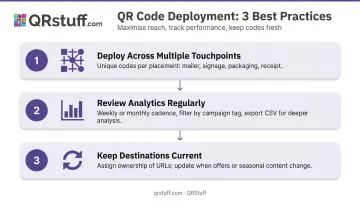
2. Review analytics regularly and act on them. Scan data is only valuable if it informs decisions. Set a weekly or monthly review cadence: which placements are driving scans, which aren't, and what the geographic breakdown suggests about customer concentration. Use campaign tagging in QRStuff to filter by initiative and compare placements. Export to CSV when deeper analysis is needed.
3. Keep destinations current — don't set and forget. Assign someone ownership of destination URLs. Update them when offers change, landing pages are revised, or seasonal content rotates. A QR code printed six months ago can still drive a current experience — but only if someone is actively managing where it points.
All three conditions are easier to maintain with the right plan in place. QRStuff ranges from a free tier (5 static codes, 10 dynamic codes with 30-day expiry) up to Enterprise at £185/month, which includes unlimited dynamic codes, bulk processing, and dedicated account management. For most small and mid-sized businesses, the Full Suite at £15/month covers 250 dynamic codes, unlimited scans, and full analytics.
Conclusion
QR codes grow businesses by doing three things simultaneously: expanding the reach of physical marketing, generating actionable customer data, and enabling campaigns that stay current without constant reprinting.
The businesses seeing the strongest results aren't using QR codes as a novelty tactic. They treat them as a systematic part of customer acquisition and engagement — deploying codes across every relevant touchpoint, reviewing scan data regularly, and updating destinations proactively to keep campaigns accurate.
The barrier to entry is low, and the data advantage compounds over time. Platforms like QRStuff make it straightforward to deploy dynamic codes, track scan performance, and update destinations without reprinting — so the gap between businesses using QR codes strategically and those that aren't will only widen.
Frequently Asked Questions
Are QR codes effective on social media?
Generally, no. Users viewing social media posts are already on their phones and cannot scan a code displayed on the same screen. A direct hyperlink performs far better in digital environments. Reserve QR codes for print, signage, and physical materials where a clickable link isn't possible.
How do QR codes help increase sales for a business?
QR codes reduce friction between discovery and purchase by connecting customers directly to product pages, payment portals, or promotional offers from physical touchpoints. That shorter path — from shelf display or receipt to checkout page — eliminates the steps where potential buyers typically drop off.
What is the difference between static and dynamic QR codes for business?
Static codes have a fixed destination that cannot be changed after printing. Dynamic codes allow businesses to update the linked content at any time through a dashboard, with no reprinting required. For ongoing marketing use, dynamic codes are far more practical and cost-effective.
What types of businesses benefit most from QR codes?
Businesses with significant physical presence benefit most — retail, restaurants, hospitality, healthcare, real estate, and events. These industries face a recurring challenge: converting offline customer interactions into measurable digital actions, which is precisely the problem QR codes solve.
How do I track the performance of my QR codes?
QRStuff's analytics dashboard shows scan volume, device type, geographic location (country and city level), and time-based data. Use campaign tagging to compare placements and export CSV data for integration with other reporting tools.
How much does it cost to use QR codes for business marketing?
Static QR code generation is free on QRStuff. Dynamic codes with analytics start at £4/month (Lite Suite), which includes 50 dynamic codes with no expiration. The cost offsets quickly through reduced reprint expenses and improved attribution across physical campaigns.