Most teams make the same mistake: they grab the first free tool they find, print thousands of materials, and later discover the platform lacks dynamic editing, the analytics are buried behind a paywall, or the codes go dead the moment the subscription lapses. By then, the materials are already in the field.
This guide compares five of the most widely used QR code marketing platforms in 2026 — evaluated on the criteria that matter for real marketing operations: code type variety, analytics depth, bulk capabilities, security and compliance, and what happens to your codes if you ever need to cancel.
Key Takeaways
- Dynamic QR codes (editable after printing) are non-negotiable for any campaign with physical materials in the field.
- The five platforms here each win a distinct use case — picking based on feature lists alone will lead you wrong.
- QRStuff leads on code variety (25+ types), enterprise compliance (GDPR + SOC2), and value — with 495,000+ businesses including Coca-Cola, Walmart, and Marriott on the platform.
- Uniqode's 2026 State of QR Codes report found 98% of marketers see positive results from QR codes, yet only 12% track revenue contribution.
- Use the comparison tables below to match your team's actual priority to the right tool.
What to Look for in a QR Code Marketing Platform
Static vs. Dynamic: The Foundational Decision
Static QR codes encode a destination permanently. Once printed, that's it — you can't change where they point, and you get zero scan data. Dynamic QR codes work through a redirect layer: the code's pattern stays the same while the destination URL can be updated at any time, and every scan gets logged.
For any campaign involving printed materials — packaging, signage, direct mail, event collateral — dynamic codes aren't optional. They prevent dead links when destinations change, and they're the only way to track campaign performance after materials leave the building.
The Five Criteria That Actually Separate Platforms
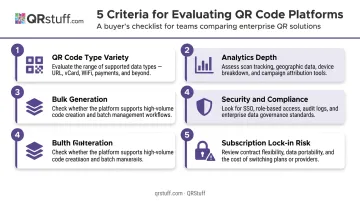
1. QR code type variety The range of data types a platform supports (URL, vCard, WiFi, payments, events, files, GS1 Digital Link) determines whether it can serve as your single platform across campaign types, or whether you'll need multiple tools.
2. Analytics depth Total scan counts are table stakes. The data that actually drives decisions includes:
- Unique vs. repeat scans
- Device type breakdowns
- City/country-level geographic data
- Time-of-day reporting
- UTM parameter passthrough to GA4
3. Bulk/batch generation Running a product launch or event with hundreds of unique codes means manual creation is a non-starter. Check both the batch size limit and whether the feature is locked to higher tiers.
4. Security and compliance posture Healthcare, finance, and large retail organizations need GDPR and SOC2 compliance at minimum, plus 2FA, SSO, and role-based access controls. Without them, regulated industries face real audit and data liability exposure.
5. Subscription lock-in risk What happens to active redirects if you cancel or downgrade? Some platforms disable dynamic codes within 30 days. Others limit scans per month. Ask this before committing to any platform running long-term print campaigns — not after codes start returning 404s.
Common Selection Mistakes
- Evaluating only the free tier without testing the paid features you'll actually need
- Choosing based on design quality without verifying analytics depth
- Ignoring print-quality export formats — SVG or PDF is required for large-format printing
- Not checking cancellation policies before committing to a platform with long-running print campaigns
Best QR Code Marketing Platforms in 2026
These five platforms were evaluated hands-on across code variety, analytics, customization, security, pricing, and scalability. Each earns its spot for a distinct use case.
QRStuff — Best for QR Code Type Variety and Enterprise Compliance
QRStuff has been operating since 2008 and now serves over 495,000 businesses and creators worldwide — from local restaurants to Fortune 500 companies including Coca-Cola, Walmart, Amazon, and Marriott International. That customer range reflects a platform stress-tested across industries and at genuine enterprise scale.
The platform's standout differentiator is code type depth. QRStuff supports 40+ QR code types, a broader catalog than most competitors, including:
- Web & contact: URLs, vCard, digital business cards, WhatsApp, Google Reviews
- Social & media: Facebook, Instagram, LinkedIn, TikTok, file uploads (PDF, audio, video)
- Payments: Venmo, Bitcoin, UPI, EPC
- Connectivity & retail: WiFi credentials, events, GS1 Digital Link for packaging
On compliance, QRStuff holds both GDPR and SOC2 certifications. Enterprise features include 2FA, SSO via SAML 2.0 and OpenID Connect, password-protected codes, role-based access controls, and a dedicated account manager with 24/7 support.
The analytics dashboard tracks total scans, unique scans, device type (iOS vs. Android vs. desktop), city and country-level geographic data, and scan time, all exportable to CSV or PDF.
Cancellation policy: Full Suite subscribers' codes never expire even after subscription ends, though a 10 scan/month limit applies per code post-cancellation. Enterprise subscribers have no pre-set scan limits.
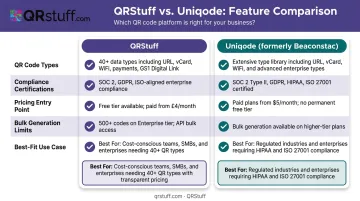
| QR Code Types | 40+ types including GS1 Digital Link, payments, social media, events, files |
| Dynamic Codes | Yes — editable after printing with real-time scan tracking |
| Analytics | Total/unique scans, device type, city/country, time-of-day, UTM support |
| Bulk Generation | Up to 500 codes/batch on Full Suite; unlimited on Enterprise |
| Security | GDPR + SOC2 compliant, 2FA, SSO (SAML 2.0), password protection |
| API Access | Enterprise tier only |
| Pricing | Free $0 / Lite $10/mo / Full Suite $25/mo / Enterprise $250/mo |
| Best For | Marketing teams and enterprises needing broad code type coverage, compliance, and scalability |
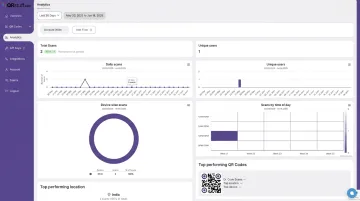
Dynamic codes and basic analytics unlock at the Lite tier ($10/month). Bulk generation (500 codes/batch) and SOC2 compliance activate at Full Suite ($25/month). API access, unlimited batch processing, SSO, white-label, and dedicated support require the Enterprise plan ($250/month).
Uniqode (formerly Beaconstac) — Best for Enterprise Team Management
Uniqode rebranded from Beaconstac in January 2024 and has since positioned itself squarely at enterprise QR code management. Its compliance stack is notably comprehensive: GDPR, SOC2 Type II, HIPAA, and ISO 27001:2022 , making it one of the few platforms genuinely suited for healthcare and highly regulated environments.
The platform's enterprise strengths are in team governance: granular user permission controls, SAML-based SSO with Microsoft Entra ID integration, and CRM integrations with Salesforce, HubSpot, Zapier, GA4, Meta Ads, and Google Ads. Uniqode earns a 4.8/5 from 472 G2 reviews, reflecting strong enterprise user satisfaction.
The main trade-off is pricing accessibility. Meaningful marketing features — multi-user access, SSO, advanced analytics — sit behind higher-tier plans, and onboarding complexity can slow down smaller teams.
| QR Code Types | Dynamic QR codes, bulk CSV generation |
| Analytics | Advanced dashboards with filtering, export, GA4 and retargeting integrations |
| Security | GDPR, SOC2 Type II, HIPAA, ISO 27001:2022, SSO, SAML |
| Pricing | From $9/mo (basic paid); Core plan $49/mo |
| Best For | Large organizations needing compliance certifications, SSO, and centralized multi-team management |
QR Tiger — Best for API Integration and Developer-Led Workflows
Engineering teams building QR code generation into existing software workflows will find QR Tiger the most practical fit. Its REST API comes with full documentation and tiered request limits: 500 requests on Regular, up to 10,000 on Premium. Bulk generation supports up to 3,000 codes per batch on Advanced and Premium plans.
The platform also supports Facebook Pixel retargeting integration on dynamic codes , which enables remarketing campaigns triggered by physical QR scans. QR Tiger documents 16+ primary QR code solution types, though the full list across their platform reaches approximately 20 distinct options.
The interface is functional but cluttered for non-technical users, and pricing escalates quickly at higher usage tiers.
| QR Code Types | 16+ primary types; ~20 total solutions |
| API | REST API; 500 requests (Regular) to 10,000 requests (Premium) |
| Bulk Generation | Up to 3,000 codes/batch on Advanced and Premium |
| Retargeting | Facebook Pixel integration on dynamic codes |
| Pricing | Free / Regular $7/mo / Advanced $16/mo / Premium $37/mo (annual billing) |
| Best For | Development and engineering teams needing programmatic, API-driven QR code generation |
Bitly — Best for Teams Already Using Link Management
Bitly started as a link management platform and added QR code functionality later, and that distinction matters. If your team already uses Bitly for branded short links and UTM tracking, the QR integration is seamless and consolidates tools. The unified dashboard covers both short links and QR codes with consistent analytics and custom domain support.
For anyone considering Bitly as a standalone QR platform, the limitations are real:
- Analytics history is gated by plan (30 days on Core; 1 year with city-level breakdowns on Premium)
- QR creation is capped at 5 codes/month on Core and 200 on Premium
- Specialty types like vCard, WiFi, or payment QR codes are not confirmed features
| QR Code Types | URL-based QR codes (specialty types not confirmed) |
| Analytics | 30 days (Core) to 2 years (Enterprise); city-level and device-type on Premium+ |
| QR Creation Limits | 2/month (Free) to 200/month (Premium) |
| Pricing | Free / Core $10/mo / Growth $29/mo / Premium $199/mo (annual billing) |
| Best For | Teams already invested in Bitly's link management ecosystem |
Flowcode — Best for Design-First Print Campaigns
Visual quality is Flowcode's core differentiator. Every Flowcode is dynamic by default, and the design tools (custom shapes, brand-safe templates, advanced logo and HEX customization, high-resolution print exports) are the most polished of any platform here. The company claims trust from over 75% of Fortune 500 companies and has enterprise partnerships in direct mail and broadcast media.
Free tier analytics cover up to 500 scans with device, time, and date data. Pro Plus ($25/month annually) extends to 6,000 scans and adds advanced geolocation. Full analytics and CRM integrations activate at the Growth tier.
On cancellation, Flowcode's policy is notably different from others: if you downgrade to Basic, only your two most recently created codes are retained in the account — other codes continue to scan to their last destination, but metrics are capped at 500 scans. Deleted codes can be reactivated by resubscribing.
| QR Code Types | All-dynamic codes; design-focused; fewer specialty data types |
| Design | Custom shapes, brand templates, HEX customization, print-optimized exports |
| Analytics | 500 scans (Free) to 10,000+ scans (Growth); geolocation on Pro Plus+ |
| Pricing | Free / Pro Plus $25/mo / Growth $250/year / Enterprise custom |
| Best For | Brands running print-heavy campaigns where visual design is a brand requirement |

How We Chose These Platforms
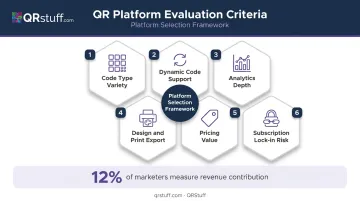
Platforms were assessed across six criteria:
- QR code type variety — how many distinct data types are natively supported
- Dynamic code support — whether dynamic codes are available and at what tier
- Analytics depth — device breakdown, geographic data, unique vs. repeat scans, UTM support
- Design and print export quality — SVG/PDF availability, customization depth
- Pricing value — what features unlock at each tier relative to cost
- Subscription lock-in risk — what happens to active redirects if a plan lapses or is cancelled
eMarketer's reporting highlights that while QR code adoption is near-universal among marketers, only 12% actually measure revenue contribution — so analytics depth was weighted heavily here. For enterprise and regulated-industry buyers — healthcare, finance, large retail — security and compliance posture (GDPR, SOC2, password protection, 2FA) carried additional weight. In those sectors, these aren't optional.
The most common selection mistakes we observed:
- Prioritizing a generous free tier without testing the paid feature set needed at scale
- Choosing based on design quality without checking analytics depth
- Skipping the cancellation policy review before committing to a platform with long-running print campaigns in the field
Conclusion
Each platform here has a legitimate use case:
- QRStuff — broadest code type variety, GDPR + SOC2 compliance, best pricing value for marketing teams
- Uniqode — enterprise team governance, HIPAA + ISO 27001, best for regulated industries
- QR Tiger — developer API depth, retargeting integration, best for engineering-led workflows
- Bitly — seamless for existing Bitly users; limited as a standalone QR platform
- Flowcode — strongest print design tools for brands where visual QR quality matters
The right choice comes down to your operational requirements — not just features on a pricing page. Before committing, verify analytics depth at your target plan tier, what happens to active codes if you downgrade or cancel, and whether the platform can handle your campaign volume over the next 12–24 months.
For marketing teams that need wide code type coverage, GDPR + SOC2 security, and analytics that hold up at scale, QRStuff has served over 495,000 businesses since 2008. See QRStuff's plans and pricing to find the tier that fits your campaign requirements.
Frequently Asked Questions
What is the difference between static and dynamic QR codes for marketing?
Static QR codes encode a destination permanently — once printed, the destination cannot be changed and no scan data is collected. Dynamic QR codes route through a redirect that can be updated at any time, enabling destination changes without reprinting and unlocking scan analytics including device type, location, and time-of-day reporting.
Can I update a QR code's destination after it has already been printed?
Only dynamic QR codes support post-print destination updates. The QR pattern itself stays unchanged while the redirect URL is updated in the platform dashboard — making dynamic codes essential for any campaign where printed materials will be in the field for an extended period.
How do I track QR code scans for a marketing campaign?
Tracking requires a platform with dynamic QR codes and a native analytics dashboard. Key metrics to look for: total scans, unique vs. repeat visitors, device type, geographic location, and time-of-day data. UTM parameter support is worth confirming separately if you need attribution inside GA4.
What happens to my QR codes if I cancel my subscription?
Platform cancellation policies differ widely: QRStuff Full Suite codes never expire post-cancellation (though a 10 scan/month limit applies per code), QR Tiger's dynamic codes stop working immediately, and Flowcode retains only two codes on downgrade. Always verify this policy before committing to any platform running long-term print campaigns.
Which QR code marketing platforms are best for enterprise or regulated-industry use?
QRStuff (GDPR, SOC2) and Uniqode (GDPR, SOC2 Type II, HIPAA, ISO 27001:2022) carry the strongest verified compliance certifications. Beyond credentials, prioritize SSO, 2FA, role-based access controls, and API access when evaluating enterprise fit.
Do I need a separate analytics tool, or is QR scan tracking built into these platforms?
Most dedicated QR platforms include native scan analytics at the paid tier, covering total scans, device type, and location. For deeper attribution, confirm UTM parameter support and native integrations — QRStuff, for example, connects directly with Meta Pixel, Google Ads, and Google Sheets.