Introduction
Counterfeit medicines are not a hypothetical risk. According to the WHO, at least 1 in 10 medicines in low- and middle-income countries are substandard or falsified, costing healthcare systems an estimated $30.5 billion annually. The patient toll is severe — modeled estimates link falsified antimalarials alone to 116,000 additional deaths per year in sub-Saharan Africa.
That risk has pushed regulators and manufacturers to make packaging do more than identify a product. QR codes have become a practical response.
This article focuses on what QR codes measurably improve in pharmaceutical packaging — anti-counterfeiting, patient safety, regulatory compliance, and supply chain traceability — and the compliance and safety risks that arise without them.
Key Takeaways
- Serialized QR codes give each drug unit a unique digital identity, making authentication verifiable at any point in the supply chain
- Dynamic QR codes allow safety warnings and usage instructions to be updated without reprinting packaging, which matters most when contraindications change after distribution
- Regulatory mandates are active: India requires QR codes on its top 300 drug formulations, and the FDA has proposed formal digital patient medication information frameworks
- Medication non-adherence causes an estimated 125,000 US deaths annually — accessible, scan-linked drug information directly addresses a documented patient safety gap
- Skipping QR codes means accepting measurable gaps in drug authentication, patient safety, and targeted recall capability
What Are QR Codes on Pharmaceutical Packaging?
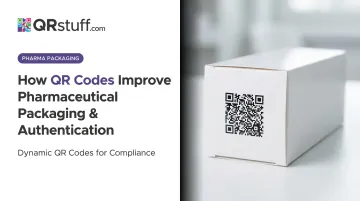
QR codes are two-dimensional codes that any smartphone camera can scan — no dedicated hardware required. On pharmaceutical packaging, they create a direct link between a physical product and a digital information layer.
They appear in multiple places across the pharma supply chain:
- Folding cartons and secondary packaging
- Blister pack foils and primary labels
- Vials, ampoules, and unit-dose packaging
- Prescription labels and dispensing containers
Two QR code types are used in pharma applications:
| Type | How It Works | Best Use Case |
|---|---|---|
| Static QR code | Permanently encodes a fixed URL into the code pattern | Reference materials unlikely to change |
| Dynamic QR code | Points to a short redirect URL that can be updated post-printing | Drug information, safety warnings, recall notices |
Dynamic codes are particularly valuable here — a printed insert can't be updated after it leaves the factory, but a dynamic QR code can. Each scan can surface real-time product verification, current drug information, supply chain traceability, and patient support resources tied to that specific batch or lot.
Key Advantages of QR Codes in Pharmaceutical Packaging
The three advantages below map directly to operational risks, regulatory obligations, and patient safety outcomes that pharmaceutical manufacturers track.
Anti-Counterfeiting and Product Authentication
When QR codes are serialized — meaning each unit carries a unique code rather than one code per product type — every package gets a distinct digital identity. Scanning it checks the unit against a central database, confirming lot number, manufacturing date, and authenticity. A duplicated or tampered package fails that check.
Peer-reviewed research confirms that overt markers like holograms and distinguishing features on blister foils have been mimicked by counterfeiters with a high level of accuracy. Digital verification backed by a live database is significantly harder to replicate at scale.
When authentication QR codes are most critical:
- High-value medications and Schedule II controlled substances
- Products distributed across multiple countries or channels
- Markets with known counterfeit supply chain activity
- Medications frequently targeted by bad actors (injectable GLP-1 drugs like semaglutide, for example, have seen active FDA counterfeit seizure actions in 2023 and 2025)
KPIs this addresses:
- Counterfeit incident detection rate
- Supply chain verification speed
- Recall identification precision
- Enforcement-action exposure
The FDA's Drug Supply Chain Security Act (DSCSA) requires trading partners to notify FDA within 24 hours of determining a product is illegitimate — a timeline that serialized QR code verification directly supports.
Patient Safety and Medication Adherence
Printed drug inserts have a fundamental problem: only 19% of patients read a paper patient information leaflet in full. The same study found that over 80% of patients were willing and able to scan QR codes for medicine information, and over 96% found digital leaflets easy to read and navigate.
That gap matters enormously. Medication non-adherence is estimated to cause 125,000 deaths annually in the US, with 33% to 69% of medication-related hospital admissions attributable to patients not taking medicines as directed.
QR codes on packaging address this by connecting patients directly to:
- Up-to-date dosage instructions in readable formats
- Video tutorials for self-administration (injectables, inhalers)
- Multilingual resources for patients with language barriers
- Side effect guidance structured for comprehension, not legal coverage
- Safety warnings that can be updated in real time if contraindications change
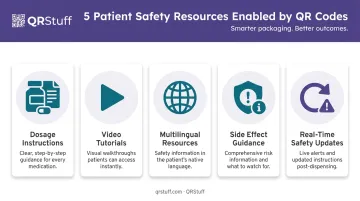
That last point is where dynamic codes prove their worth in pharma. If new contraindications are identified after a product reaches pharmacy shelves, a dynamic QR code lets manufacturers update that information immediately — no reprint required, no recall triggered, and no patients acting on outdated guidance.
When this advantage matters most:
- Complex self-administration medications (titrated injectables, combination inhalers)
- Polypharmacy patients: the share of US adults taking 5+ prescription drugs rose from 8.2% in 1999–2000 to 17.1% in 2017–2018, and reaches 44.1% among adults over 65
- Products distributed through mail-order or low-touch pharmacy channels where pharmacist counselling is limited
Regulatory Compliance and Supply Chain Traceability
In a growing number of markets, QR codes on pharmaceutical packaging are now a legal requirement.
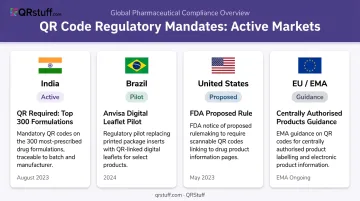
Active mandates and regulatory developments:
- India: Amendments to the Drugs Rules (G.S.R. 823(E), November 2022) require manufacturers of the top 300 Schedule H2 drug formulation brands to print or affix a QR code on primary or secondary packaging, with implementation from August 1, 2023. A separate mandate (G.S.R. 20(E), January 2022) covers Active Pharmaceutical Ingredients from January 2023
- Brazil: Law No. 14.338/2022 addresses digital medicine leaflets; Anvisa approved a digital leaflet pilot in 2024 linking QR codes to approved packaging information
- US: FDA published its Patient Medication Information proposed rule in May 2023, signalling that digital labelling frameworks for prescription drugs are under active regulatory development
- EU/EMA: EMA guidance covers mobile scanning technologies including QR codes for centrally authorised products, noting digital features complement (but do not replace) printed package leaflets
Beyond mandates, GS1 Digital Link provides a standardised framework for encoding a drug's GTIN, batch/lot number, expiration date, and serial number within a single QR code. Every scan event can be logged and verified from manufacturing through dispensing — which is what genuine chain-of-custody documentation requires.
KPIs this addresses:
- Regulatory audit pass rates
- Serialization compliance percentage
- Recall response time and precision
- Supply chain scan event coverage
What Happens When QR Codes Are Missing
Removing QR codes from pharmaceutical packaging isn't a passive choice — it creates documentable gaps with direct consequences:
- No authentication mechanism at the point of dispensing or patient use — counterfeit products enter the supply chain without any verification layer on the package itself
- Printed inserts cannot be updated post-distribution — patients and providers may act on incorrect dosage or contraindication information, increasing adverse event exposure
- Recalls become broader and slower — without unit-level serialization, manufacturers must execute whole-batch pulls rather than targeted unit recalls, driving up cost and causing unnecessary product removal
- Regulatory gaps accumulate — as India, Brazil, and other markets enforce QR mandates, packaging without compliant codes can fail import and distribution requirements
- Patient engagement is lost — patients with literacy barriers, language differences, or visual impairments are underserved by static printed inserts alone, and medication errors increase accordingly
That last gap carries serious weight given current prescribing realities. Nearly half of US adults over 65 are managing five or more prescription drugs simultaneously — a population that depends on clear, accessible, up-to-date information at the point of use. Packaging that can't deliver that directly increases the risk of dosing errors and missed contraindication warnings.
How to Get the Most Value from QR Codes on Pharma Packaging
QR codes deliver their full value in pharma only when implemented with the right technical foundation. Getting that foundation right comes down to four operational decisions.
Use Dynamic Codes, Not Static
Static codes that point to a fixed URL are a liability in pharma applications. If drug information changes — new contraindications, updated dosage guidelines, a recall notice — a static code cannot be updated. Dynamic codes solve this: the printed code stays the same, but the destination can be updated instantly without reprinting a single label.
For pharmaceutical companies, this means a single code can serve product launch, post-market updates, and active recall communications across the entire distributed stock.
Serialise Per Unit, Not Per Product
One QR code per product type is insufficient for authentication. Serialized, unique-per-unit codes are what make verification meaningful, and regulators increasingly expect exactly that standard.
Platforms like QRStuff support GS1 Digital Link QR codes that encode GTIN, batch/lot number, expiration date, and serial number within a single scan. Bulk generation capabilities handle large-scale packaging runs, and API integration connects directly to manufacturing execution systems.
Treat Scan Analytics as Operational Data
Scan data from distributed pharmaceutical packaging is post-market intelligence. Three data streams are particularly valuable:
- Geographic scan patterns — surface distribution anomalies and identify unexpected regional activity
- Scan frequency by time period — tracks patient engagement with drug information over a product's lifecycle
- Unique vs. repeat scan events — distinguishes first-time access from ongoing adherence support use
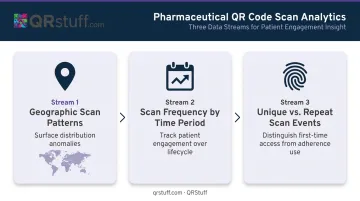
This data belongs in a pharmacovigilance workflow, not ignored.
Maintain the Authentication Infrastructure
A QR code is only as reliable as the database behind it. Assigning unique codes per unit, maintaining a live registry of valid codes, and reviewing scan data regularly are what separate a compliance asset from a cosmetic addition to packaging.
For regulated environments, enterprise features — audit logs, role-based access controls, SSO, GDPR and SOC2 compliance — form the governance layer that makes any QR code implementation defensible to regulators. These aren't optional extras; they're the baseline for operating in a regulated market.
Conclusion
QR codes improve pharmaceutical packaging at three specific points: product authentication, patient safety, and regulatory traceability. When implemented correctly — with serialized codes, dynamic destinations, and active scan data management — they create a system that is substantially harder to compromise than physical security features alone.
The regulatory timeline is not theoretical. India's mandates are already live. Brazil's pilot programmes are running. The FDA's Patient Medication Information proposed rule signals direction. Manufacturers operating in multiple markets cannot assume current packaging will meet tomorrow's distribution requirements.
The patients most dependent on clear drug information — older adults managing multiple medications, people self-administering complex therapies, non-English speakers — are failed by static printed inserts. QR codes on packaging exist because that gap is documented, measurable, and preventable.
Platforms like QRStuff support pharmaceutical packaging workflows with dynamic QR codes that let manufacturers update destination URLs without reprinting, paired with real-time scan analytics and GS1 Digital Link compatibility for supply chain traceability.
Frequently Asked Questions
What is the QR code on a medicine box?
The QR code on a medicine box links physical packaging to a digital information layer containing usage instructions, dosage details, batch authentication data, and safety warnings. Unlike printed inserts, this content can be updated after the product has left the manufacturing facility.
How do I get a QR code for pharmaceutical packaging?
Pharmaceutical manufacturers can generate QR codes through a platform like QRStuff, choosing between static or dynamic codes based on their use case. For most pharma applications, dynamic codes are the right choice — see the question below for why.
Is a QR code mandatory on pharmaceutical packaging?
Mandates vary by market. India requires QR codes on its top 300 drug formulation brands and all Active Pharmaceutical Ingredients. Brazil has run digital leaflet pilots with QR code requirements. The FDA has proposed digital labelling frameworks for the US market. Verify current requirements for your specific market and product category before finalising packaging.
Can pharmaceutical QR codes be updated after printing?
Yes. Dynamic QR codes allow the destination URL or linked content to be updated without changing the printed code. This makes them the right choice for pharma packaging, where drug information, safety warnings, or recall notices may need to change after product enters the supply chain.
How do QR codes help prevent counterfeit medicines?
Serialized QR codes give each unit a unique digital identity verified against a manufacturer database at the point of scan. If the same code is scanned twice, the second scan fails verification, flagging a likely counterfeit. Patients, pharmacists, and distributors can authenticate a product using nothing more than a smartphone.
Are pharmaceutical QR codes compliant with FDA and privacy regulations?
Compliance depends on implementation. The QR code itself is neutral; the platform hosting it must meet applicable standards. Look for GDPR and SOC2 compliance, data encryption, and audit logging. Where patient scan data is collected, HIPAA considerations apply and should be reviewed with your compliance team.