Introduction
QR codes quietly sat unused for decades — then the pandemic hit, and everything changed. Restaurant menus disappeared overnight, replaced by table-mounted squares. Contactless became a necessity, not a preference. And critically, smartphone cameras learned to scan natively without a separate app, removing the last real friction barrier for consumers.
The scale of adoption is striking: according to U.S. Census Bureau data, 89 million U.S. smartphone users scanned a QR code in 2022 — a 26% increase from 2020 — with every test participant rating scanning "extremely easy."
QR codes bridge physical surfaces and digital experiences. Print a code once and it can deliver video, forms, menus, or real-time data. Use a dynamic QR code — one where the destination URL updates without reprinting — and that printed surface becomes an updatable channel you can redirect at any time.
This article covers 50 creative, categorized uses, organized by business function: marketing and lead generation, customer experience, retail and hospitality, branding and packaging, events and operations, and specialized industries. Jump to the sections most relevant to your business and take what applies.
Key Takeaways
- QR codes convert any physical surface into a measurable digital touchpoint
- Dynamic QR codes let you update destinations post-print — essential for campaigns and menus
- Retail packaging, restaurant operations, and print advertising have the strongest verified ROI data
- QR use cases span every business function — from vCard contacts and WiFi access to loyalty enrollment and payments
- With 40+ code types, QRStuff lets you manage every use case from a single dashboard
QR Codes for Marketing, Sales & Lead Generation
QR codes turn offline touchpoints into measurable digital actions. Every flyer, receipt, and billboard becomes trackable — and dynamic codes let you pivot campaign destinations mid-run without touching the printed material.
Capturing Leads & Building Your List
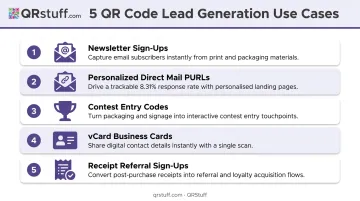
Newsletter sign-ups: Place codes on menus, flyers, and brochures. Scanning goes directly to a pre-filled subscribe form, eliminating manual entry.
Personalized direct mail QR codes (PURLs): Each recipient gets a unique URL. Research published in Survey Practice found QR plus URL produced an 8.31% response rate vs. 7.00% for URL-only — a meaningful lift for mailed campaigns.
Contest and giveaway entry codes: On packaging or in-store signage, a scan captures contact data instantly — no forms to fill out by hand.
vCard QR codes on business cards: Scanning auto-populates the recipient's phone contacts with your full details. QRStuff's vCard format encodes name, title, phone, email, website, address, and more — far more likely to stick than a paper card at the bottom of a bag.
Receipt QR codes for referral or loyalty sign-ups: Turns a transactional moment into a growth mechanism. Customers who just paid are warm; that's a good time to ask.
Driving Traffic & Conversions
Social media profile codes: Place on any print material to eliminate the friction of "search for us on Instagram." QRStuff supports dedicated code types for Instagram, Facebook, LinkedIn, TikTok, YouTube, and more.
Discount and coupon codes in direct mail or OOH advertising: QR tracking tells you which physical placement drove the conversion — the measurement gap traditional print has always had.
QR codes in TV and radio ads: Coinbase's 2022 Super Bowl spot ran a bouncing QR code for 60 seconds and generated more than 20 million landing-page hits in one minute, pushing the app from 186th to 2nd in the App Store. TV QR can be powerful — just make sure your infrastructure can handle the spike.
Outdoor and transit advertising codes: Link to product pages or appointment booking. A JCDecaux outdoor campaign for Prestige Flowers using a QR as the primary creative was scanned nearly 8,000 times.
Cross-sell inserts inside shipments: A code in the box directs customers to related products with a purchase incentive, turning packaging into a sales channel at zero incremental media cost.
QR Codes for Customer Experience & Engagement
The strongest QR code deployments share one trait: customers get exactly what they need, exactly when they need it. These use cases focus on the touchpoints where speed and convenience have the biggest impact.
Self-Service & Information Access
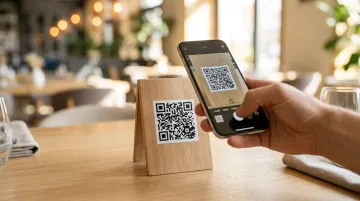
11. Restaurant digital menus: Codes on tables replace printed menus and allow instant updates for specials, sold-out items, and pricing changes. National Restaurant Association data shows 59% of full-service customers would access a menu this way.
12. Contactless ordering and payment: Works at tables, stadium seats, or hotel rooms. NRA research shows First Watch saved 30 seconds per transaction and over 1,000 combined customer and employee hours in a single week by enabling QR bill payment.
13. Product information codes on packaging: Link to how-to videos, user manuals, spec sheets, and care instructions — content that would never fit on a physical label.
14. WiFi access codes: In cafes, hotels, and retail stores, a scan auto-connects guests without password fumbling. QRStuff's WiFi QR codes support WPA, WPA2, WEP, and open networks.
15. Self-guided tour codes: At museums, wineries, factory showrooms, or real estate developments, a code next to each exhibit delivers the story behind it on demand.
Loyalty, Feedback & Two-Way Engagement
16. Loyalty program enrollment codes: Place at checkout counters or on packaging so customers scan to join and receive an instant welcome reward. McDonald's Bahrain enables points collection via a QR code in its app's digital loyalty card.
17. Customer feedback and review codes: On receipts, table tents, or follow-up mailers. The shorter the path from "paid" to "reviewed," the higher the completion rate.
18. Augmented reality (AR) experiences: Coca-Cola and Marvel used on-pack QR codes to unlock AR animations across more than 30 Marvel characters in over 50 countries. Coca-Cola's 2025 "Share a Coke" campaign used packaging QR codes as the gateway to a personalized digital hub.
19. Virtual tour codes for high-consideration decisions: Real estate listings, hotel rooms, and university campuses use these to let prospects explore before committing to a visit.
20. Event ticket QR codes: Handle contactless check-in and validation at the door, cutting queue times and eliminating paper ticket fraud.
QR Codes for Retail, Food & Hospitality
These environments have the strongest public evidence for QR code ROI — reduced staff workload, faster service, richer product information, and upsell opportunities that weren't previously possible.
In-Store & On-Product Uses
21. Retail price tags and shelf displays — Link to extended specs, customer reviews, and comparison tools. Particularly effective for electronics, appliances, and specialty goods where information drives the decision.
22. Car dealership window codes — After-hours shoppers can access vehicle specs, pricing, and financing options without waiting for a salesperson. Nissan has used QR codes on vehicle window stickers for exactly this purpose.
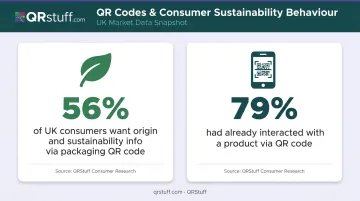
23. Ethical sourcing and transparency labels — GS1 UK research found 56% of UK consumers would find it useful to access origin and sustainability information through a packaging QR code, and 79% had already interacted with a product via QR code. Brands that ignore this are leaving a meaningful engagement channel untapped.
24. Wine and spirits bottle codes — Link to vineyard stories, tasting notes, and pairing suggestions. The EU now requires nutritional and ingredient information on wine labels, making QR codes a practical compliance solution.
25. Food and beverage packaging codes — Recipes, nutritional data, allergy information, and sourcing details. More depth than any label allows.
26. Coffee cups and takeaway packaging — Links to loyalty programs, social channels, or the brand's sustainability story. Even a disposable cup can drive loyalty signups or social follows at scale.
Hospitality & Food Service Operations
27. Hotel in-room digital compendiums — Scan to access room service menus, local attraction guides, spa booking, and express checkout. No reprinting required when hours, pricing, or offerings change.
28. Stadium and arena seat ordering — Fans order food and drinks delivered to their seat. Eliminates concession line time and increases per-visit spend.
29. Bike share, scooter share, and locker rentals — Scan to unlock, pay, and access instructions. The entire rental experience — from payment to instructions — runs through a single scan.
30. Bar and venue coasters and napkins — Links to drink menus, specials, or a curated playlist. A coaster costs pennies and reaches every table in the venue.
QR Codes for Branding, Print & Packaging
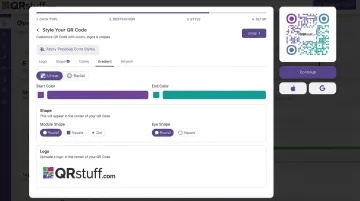
Branded QR codes go far beyond black squares. Codes built with your logo, brand colors, and custom patterns reinforce visual identity while staying fully scannable. QRStuff's customization engine supports color gradients, logo embedding, and custom module shapes, with automatic error correction to maintain scan reliability.
Put that design capability to work across every printed surface your brand touches.
Print Marketing & Brand Materials
31. Branded business cards and stationery — Link to a portfolio, LinkedIn profile, or booking page. It's a simple way to extend the conversation beyond the card itself.
32. Magazine and newspaper print ads — Link to video content, product demos, or a dedicated landing page. Print advertising becomes measurable for the first time when scan data tells you which issue or placement performed.
33. Branded promotional merchandise — Tote bags, mugs, and apparel with QR codes linking to a social feed or loyalty program. Instead of a single impression, the item keeps working every time someone scans it.
34. Product unboxing and post-purchase content — QR codes inside or on packaging linking to unboxing videos, brand story content, or an ambassador community. Nestlé UK trialed accessible QR codes on KitKat and Quality Street packaging specifically to serve shoppers with sight loss — proof that packaging QR codes serve functional purposes, not just marketing ones.
35. Apparel and clothing tags — Link to care instructions, sustainability commitments, or the product's design story. Brands with strong sustainability stories find this especially effective — the tag becomes part of the product narrative.
36. Movie, event, and launch posters — Direct scanners to trailers, ticket purchase pages, or countdown landing pages.
37. Restaurant menus and ingredient cards — Link to chef story videos, sourcing details, or brand origin content. Diners who scan are already engaged — give them something worth watching.
QR Codes for Events, Networking & Business Operations
Events are paperwork-heavy by default. QR codes cut through that — replacing badge exchanges, printed programs, and manual check-in processes with faster, trackable digital flows. Dynamic codes matter most here, since event details and operational destinations change constantly.
Events & Networking
38. Conference and trade show name badges: Attendees scan to save contact info directly to their phones — no business card fumbling, no lost connections after the show floor closes.
39. Trade show booth lead capture: Visitors download brochures, watch demos, or enter a prize draw with one scan. Every interaction becomes a qualified lead with contact data already attached.
40. Wedding and event invitation RSVP codes: Guests confirm attendance, select meal preferences, and add the event to their calendar in one flow. QRStuff's Event QR codes support name, date, time, timezone, and location fields out of the box.
41. Conference session schedules and slide downloads: One code per session replaces a 40-page printed program and gets updated materials into attendees' hands without a reprint.
Business Operations & Internal Use
42. Building permits and construction site signage: New York City embedded QR codes on 200,000+ permits, linking each one to project information, inspection records, and contractor details — accessible on-site without a phone call.
43. Employee onboarding materials: Welcome packs with QR codes link directly to training videos, HR policies, and org charts. New hires find what they need in seconds rather than digging through shared drives.
44. Inventory, equipment, and asset tracking: Each asset carries a code linking to its maintenance records, service history, and current status. For construction, utilities, and facilities teams tracking equipment across multiple sites, this replaces manual logs entirely.
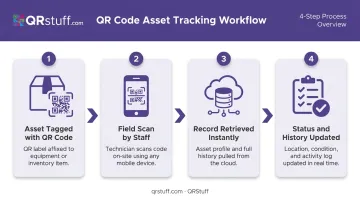
45. Delivery packaging and shipping labels: A code on the box links directly to real-time tracking. Customers stop hunting for a tracking number buried in their inbox — the answer is on the package.
46. Corporate lobbies and reception areas: Visitor sign-in, meeting schedules, or guest WiFi access — all accessible via a single code at the front desk.
47. Petition and community feedback campaigns: Any poster or flyer becomes a direct submission channel. Supporters scan to sign or submit feedback without needing a URL, app, or printed form.
QR Codes for Healthcare, Education & Real Estate
These industries share a common need: deliver detailed, trusted information quickly while reducing administrative burden. For sensitive contexts, QRStuff's password-protected codes (available on Lite, Full, and Enterprise plans) add access control where public-facing codes aren't appropriate.
Healthcare & Education
48. Hospital and clinic applications — QR codes in waiting rooms handle patient check-in and pre-appointment forms before staff involvement. On prescription labels, codes link to medication information, dosage instructions, and refill requests — replacing confusing small-print leaflets. Always confirm compliance with labeling regulations before deploying codes on prescription packaging.
49. Museums, landmarks, and educational settings — QR codes on exhibits and walking trail signage link to videos, audio guides, and extended resources. Visitors engage longer when self-guided audio and visual content is a scan away — no app download required. In classrooms and libraries, codes link to supplementary reading, course materials, and campus event schedules.
Real Estate & Property
50. "For Sale" and rental property signs — Link to full listings, virtual video walkthroughs, floor plans, neighborhood data, and agent contact or booking pages. Available 24/7. On commercial property signage, codes can link to investor decks, project timelines, and planning documents. In open homes, visitors scan to save property details and request a follow-up — no paper forms required.
Frequently Asked Questions
What should I not put in a QR code?
Avoid encoding very long or complex URLs, which make the code dense and harder to scan reliably. Never store sensitive personal data — passwords, financial information — directly inside the code. For content that changes frequently, use a dynamic QR code rather than a static one, which is permanently fixed at creation.
Can I update a QR code after it has been printed?
Static QR codes cannot be changed once printed. Dynamic QR codes (like those on QRStuff's paid plans) allow the destination URL to be updated at any time without reprinting, making them the right choice for campaigns, menus, and signage that evolve.
How do I track who scans my QR code?
You need a dynamic QR code platform. These provide dashboards showing total scans, unique users, device types, geographic locations, and time-based data. QRStuff's analytics update in real time and support campaign tags for comparing performance across multiple placements.
What is the best size for a QR code on printed materials?
The standard minimum is 2cm × 2cm (0.8″ × 0.8″) for close-range scanning on items like business cards and packaging. For signage viewed from a distance, apply the 10:1 rule — a code scanned from 3 metres away should be at least 30cm wide. Always test before mass printing, and use vector formats (SVG or EPS) for large-scale prints.
Do QR codes expire?
Static QR codes never expire. Dynamic QR codes require an active subscription; on QRStuff, they stay active as long as your plan is maintained. If a subscription lapses, codes expire after 30 days (monthly) or 1 year (annual), but all account data is preserved and restored upon renewal.
What types of content can a QR code link to?
QR codes can encode URLs, vCards, plain text, PDFs, images, videos, WiFi credentials, payment links (PayPal, Venmo, Bitcoin, UPI), social media profiles, calendar events, app store links, and more. QRStuff supports 40+ content types, covering virtually any business application.