Introduction
Most members who abandon workout plans don't quit because they lost motivation. They quit because the plan disappeared the moment they needed it—standing in front of an unfamiliar machine, trainer occupied elsewhere, printed sheet left in the car.
That's the delivery problem in fitness programming. A well-designed workout plan has zero value if a member can't access it at the right moment.
Research on novice exercisers shows that only 17% reported regular attendance at all 3, 6, and 12-month checkpoints—a dropout pattern that starts well before most facilities intervene. The gap isn't always programming quality. It's often access and confidence.
QR codes solve that delivery problem directly. This article covers three specific advantages: on-demand access at the point of need, real-time content updates without reprinting, and scan analytics that reveal which plans members actually use.
Key Takeaways
- Give members instant access to workout plans, video demos, and form guides — no trainer required
- Update linked content anytime with dynamic QR codes, without reprinting a single sign
- Track which plans members actually use to make smarter programming decisions over time
- QR-enabled facilities reduce trainer bottlenecks and gain real visibility into member engagement
- Place codes consistently, audit content regularly, and act on scan data to get full value from the system
What Are QR Codes for Workout Plans?
A QR code for a workout plan is a scannable code placed on or near fitness equipment—cable machines, weight stations, resistance machines, outdoor trail signs, personal trainer handouts—that links directly to a routine, video demonstration, or training guide on a member's phone.
They're a delivery mechanism, not a replacement for programming. Their job is to close the gap between a written or digital plan and a member's ability to follow it correctly, in the moment, without waiting for a trainer.
Where they're typically placed:
- On treadmill consoles and cardio equipment
- At individual weight and resistance stations
- On outdoor fitness trail signage
- In printed onboarding packets for new members
- On locker room bulletins and class schedules
The content behind each code varies by context. Video QR codes work well for exercise demonstrations, PDF QR codes suit downloadable training guides, and URL QR codes connect members to any web-based workout content. QRStuff supports all three formats, so gyms and trainers aren't limited to a single delivery method.
Personal trainers can build programs where clients scan to view videos, reps, and session notes. This gives trainers scan-tracking data while keeping members on plan between sessions.
Key Advantages of QR Codes for Workout Plans
The three advantages below focus on measurable, operational outcomes—member independence, content update efficiency, and program engagement data—each tied directly to cost, retention, or session quality.
Advantage 1: On-Demand Access at the Point of Need
A member walks up to a cable machine. They have a plan, but they're unsure about setup. The trainer is busy with another client. Their options: guess, skip the exercise, or wait.
A QR code on the machine eliminates all three. One scan surfaces the exact information they need—proper setup, suggested rep ranges for their goal, common form errors to avoid—before the first set.
Why this matters beyond convenience:
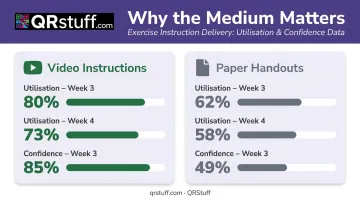
A randomized controlled trial comparing video exercise instructions with paper handouts found significantly higher utilization rates in the video group: 80% vs. 62% in week 3 and 73% vs. 58% in week 4. Confidence was also higher: 85% vs. 49% at week three. The medium matters. Members who can watch a demonstration are more likely to complete the exercise and do it correctly.
The retention connection is direct. Members who feel competent during workouts return more often. Those who feel lost—especially new members in their first 90 days—cancel. On-demand plan access reduces the intimidation that drives early dropout, particularly in facilities with high equipment-to-staff ratios where floor coverage is limited.
This advantage has the highest impact:
- During peak hours when trainers are managing multiple members simultaneously
- During new member onboarding phases when confidence is lowest
- In outdoor fitness installations where no staff is present at all
Cities including San Diego County, Raleigh (NC), Wichita (KS), and Hesperia (CA) have already deployed QR fitness trails in public parks, demonstrating that scannable workout guidance functions reliably with no staff on site.
KPIs to track:
- Member plan adherence rates
- New member onboarding satisfaction scores
- Trainer time freed from repetitive instruction
- Equipment-related incident reports
Advantage 2: Real-Time Workout Plan Updates Without Reprinting
A gym runs a 4-week strength program. The cycle ends. Staff need to replace every printed card and poster at every station before members show up Monday morning using an outdated plan.
Dynamic QR codes make this a non-problem. The printed code on the weight station sign stays exactly the same. Only the destination URL changes—updated in QRStuff's dashboard in minutes. Members scanning Monday see the new 6-week hypertrophy program. Nothing on the physical sign has changed.
The operational cost angle:
A single 18×24 poster at Staples runs $22.99. At FedEx Office, mounted posters are $40.99 each. For a facility with 30 exercise stations, one program refresh means hundreds of dollars in print costs—before accounting for staff time to design, order, and replace materials. Dynamic codes eliminate that spend entirely for every update after the first print run.
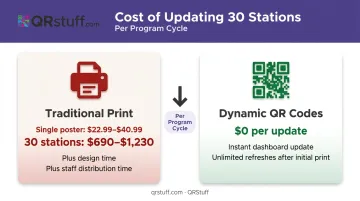
For multi-location operators, the math compounds fast. QRStuff's dynamic QR codes support live URL editing across all active codes simultaneously, making program rollouts manageable whether you're updating one facility or dozens.
Additional operational benefits:
- Respond to member feedback without a production bottleneck
- Align seasonal programs (summer cut, winter bulk) without reprinting
- Push instructor-change updates immediately when class leadership shifts
- Personal trainers can update individual client plans across their entire roster from one dashboard
KPIs to track:
- Print cost per program cycle (before vs. after dynamic QR adoption)
- Content accuracy rate across active codes
- Speed of program rollout from decision to member-facing deployment
- Staff time spent on material updates
Most critical for: Multi-location operators managing rotating monthly challenges, facilities running seasonal programming cycles, and personal trainers with large client rosters who need to push updates instantly.
Advantage 3: Scan Analytics That Show Which Plans Members Actually Use
Most gyms measure program success through membership renewals or class attendance. Neither tells you whether the workout plans themselves are being used. A plan could be ignored by 90% of members for six months, and nothing in a standard reporting dashboard would flag it.
Scan analytics fill that blind spot.
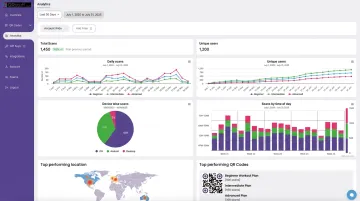
Every scan of a workout plan QR code generates trackable data. QRStuff's analytics dashboard captures:
- Total and unique scans per code — distinguishing repeat users from new engagements
- Scan time and date — revealing peak usage windows and identifying when members need the most guidance
- Device type and OS — useful for optimizing the linked content for the dominant platform
- Geolocation at country and city level — relevant for multi-site operators comparing cross-location engagement
What this looks like in practice:
A gym manager reviewing scan data notices the leg press QR code is scanned far less than upper-body stations. That's a signal—either the plan content doesn't match member goals, the code placement is poor, or members aren't being directed toward leg training in their onboarding. None of it would have surfaced from attendance data alone.
Health & Fitness Association data reports average annual health club attrition of 28.6%. That's a retention problem with no single cause—but programs members don't use can't help address it. Scan data creates a direct line between content quality and member behavior.
The QRStuff dashboard presents data in line and bar charts, supports custom date ranges and campaign tagging for filtering by program or location, and exports to CSV, Excel, or PDF for quarterly programming reviews.
KPIs to track:
- Plan scan frequency by station and time of day
- Unique vs. returning scanner counts
- Low-engagement stations flagged for content review
- Correlation between high-scan plans and member retention rates
Most valuable for: Facility managers making quarterly programming decisions, personal trainers optimizing their plan library, and multi-site operators needing cross-location performance comparisons.
What Happens When QR Codes Are Missing from Workout Programming
Facilities relying entirely on printed sheets, verbal trainer instruction, or static signage face predictable operational consequences:
- Inconsistent plan execution — Members interpret printed plans differently, skip unfamiliar exercises, or use equipment incorrectly—with no way to identify why training outcomes vary.
- Trainer bottlenecks — Floor staff spend peak hours re-explaining the same exercises repeatedly, leaving less capacity for higher-value coaching. New members feel stranded; experienced members wait.
- Rising reprint costs and outdated content — Every program update requires new materials. In the interim, members follow plans that no longer reflect the facility's current programming standards, eroding trust.
- No visibility into engagement — Without scan data, operators can't distinguish between plans members value and plans they ignore. There's no basis for evidence-based improvement.
- Scaling problems — As membership grows or new locations open, the inability to update and track workout plans digitally caps programming quality across the board.
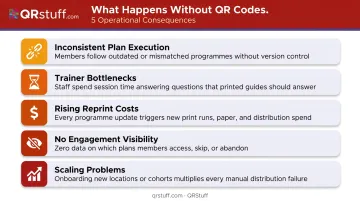
Each of these gaps is addressable through a single infrastructure change: attaching a dynamic QR code to every workout plan, piece of equipment, and posted program in the facility.
How to Get the Most Value from QR Codes in Workout Plans
QR codes deliver consistent results when placement, content, and data use are all working together. Miss one, and the system becomes a novelty. Get all three right, and the value compounds over time.
Apply Them Consistently
- Place codes at every relevant exercise station, not just select equipment
- Standardize placement height and lighting for reliable scanning
- Include QR codes in new member onboarding materials to establish the habit from day one
- QRStuff's Full Suite supports bulk generation of up to 500 codes in a single batch—practical for equipping an entire facility at once
Review Content on a Schedule
Stale content is the most common reason scan rates drop. Build audits into your programming calendar before members notice.
- Monthly audits for rotating programs (challenges, seasonal plans)
- Quarterly audits for evergreen content
- Treat scan drop-offs as a signal to review content immediately—not at the next scheduled audit
- Low-scan codes usually point to content problems, not awareness gaps
Act on What the Data Shows
- Retire plans that generate no engagement across multiple cycles
- Expand formats (video vs. PDF, beginner vs. advanced splits) that drive high repeat scans
- Use time-of-day scan patterns to identify when members need more guidance vs. when they're working independently
- Share filtered scan reports with programming staff before each new cycle—QRStuff's dashboard exports directly to Excel or PDF for team review
Conclusion
QR codes for workout plans address three real friction points at once: members can't access their plan when they need it, that plan goes stale without a reliable update process, and no one knows whether members are actually using it.
These benefits reinforce each other. Consistent access builds the habit of checking plans before each session. Dynamic updates keep that content worth returning to — and analytics show exactly which exercises, formats, or programs members engage with most.
For gyms and fitness operators ready to close that gap, a dynamic QR code platform like QRStuff makes it straightforward to deploy, update, and track workout content — without reprinting a single poster.
Frequently Asked Questions
Do members need a special app to scan QR codes for workout plans?
No. Most modern smartphones on iOS (iPhone) and Android scan QR codes natively through the built-in camera app—no third-party app required. Members simply point their camera at the code and tap the notification that appears.
Can QR codes link to different workout plans for different fitness levels?
Yes. Each QR code links to a unique URL, so a beginner plan, intermediate plan, and advanced plan can each have their own code at the same station. QRStuff also supports conditional routing, allowing a single code to direct different users to different content based on conditions such as device type or scan count.
How do I update the workout content linked to a QR code without reprinting it?
Dynamic QR codes allow you to change the destination URL at any time through the QRStuff dashboard. The printed code stays the same; the linked content updates instantly.
Are QR codes for workout plans suitable for outdoor fitness installations?
Yes. QR codes work well on outdoor fitness signage when printed on weatherproof, laminated materials with high contrast and positioned at eye level. San Diego County's QR Fitness Trail across seven park locations is a working example of this at scale.
How can I tell which workout plans members are actually using?
QRStuff's analytics dashboard tracks scan frequency, time of day, device type, and location for every dynamic QR code. This data shows which plans members are actively using and which are being skipped, giving you clear direction for program adjustments.
Can QR codes replace a personal trainer for workout guidance?
No—they supplement trainers, not replace them. QR codes handle on-demand access to pre-built plans and demonstrations, freeing trainers to focus on personalized coaching, form correction, and higher-complexity client interactions where their expertise is genuinely needed.