eMarketer projected US smartphone users scanning QR codes to reach 99.5 million by 2025, up from 83.4 million in 2022. Brands that treat QR codes as a genuine marketing channel — not just a link delivery mechanism — are capturing customer attention at exactly the right moment.
This guide covers actionable, creative QR code ideas across coupons, engagement campaigns, and industry-specific tactics, plus the practical tips you need to make them actually work.
Key Takeaways
- Dynamic QR codes let you update destinations, track every scan, and run multiple campaigns from a single printed asset
- A compelling CTA paired with your QR code is the single biggest driver of scan rates
- The best placements match moments of peak customer attention — receipts, packaging, storefront windows, and event signage
- Separate QR codes per placement or campaign reveal which channels drive the most engagement
- QRStuff supports 40+ destination types with real-time analytics starting at the Lite Suite tier
Why QR Code Promotions Actually Work
They Eliminate Friction at the Right Moment
A customer standing in front of your product display or holding your receipt is already engaged. Asking them to "visit our website" loses them — they have to remember the URL, open a browser, and type it in later. A QR code collapses that entire sequence into one scan.
That bridge between physical touchpoint and digital action is the core mechanic. It captures intent at the moment it exists, rather than hoping the customer acts on it later.
Measurability Most Print Media Can't Match
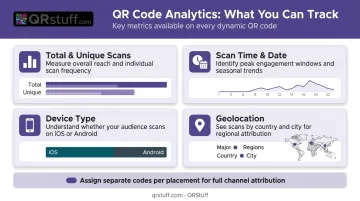
Unlike a billboard or flyer, a QR code tied to a dynamic destination gives you a full data trail. QRStuff's analytics dashboard tracks:
- Total and unique scans — distinguishing reach from individual engagement
- Scan time and date — identifying peak engagement windows
- Device type — iOS vs. Android breakdowns that inform landing page design
- Geolocation — country and city-level data for regional campaign insight
Create separate QR codes for each placement — flyer, packaging, receipt — and the dashboard tells you exactly which channel drove results. That's a level of attribution most offline media simply can't offer.
Cost Efficiency Through Dynamic Codes
Static QR codes lock in a destination at creation. Dynamic codes use a short redirect URL, meaning the printed code never changes but the destination can be updated at any time.
That flexibility has real cost implications. If a promotion ends early or a landing page URL changes, you update the destination — not the print run. One museum professional using QRStuff noted the feature "saved us once already" after catching a typo post-print.
For seasonal campaigns and time-sensitive promotions, those avoided reprints add up fast.
Dynamic QR codes are available on QRStuff's Lite Suite and above.
Creative QR Code Ideas for Coupons, Deals, and Conversions
Exclusive Discount Reveals
Instead of printing a coupon code directly on a flyer, have customers scan to "unlock" the offer. This creates a micro-engagement moment — the act of scanning adds perceived value to the deal. It also lets you track redemption by placement, so you know whether the flyer, the shelf talker, or the receipt drove the conversion.
Burger King demonstrated this mechanic effectively with their QR Whopper campaign, embedding a moving QR code in TV commercials that led to a free Whopper offer — and tracked which spots generated the highest engagement.
Flash Sale Activations on Receipts and Packaging
Add a QR code to post-purchase receipts or product packaging that links to a time-sensitive landing page. The customer just bought something, so their intent is high. A "scan to save on your next order" prompt captures that momentum before it fades.
Capri Sun used front-of-pack QR codes for a sweepstakes that generated over 579,000 landing page views — showing that product packaging is underused real estate for promotional QR codes.
Seasonal and Limited-Drop Campaigns
Create a unique QR code for each campaign — holiday promotions, back-to-school specials, limited drops — each pointing to its own dedicated landing page. This approach also yields side-by-side performance data showing which seasonal campaign drove the most scans and conversions.
QRStuff's campaign tagging feature organizes codes by initiative and lets you compare scan performance across campaigns directly in the dashboard. Key capabilities include:
- Tag and group codes by campaign type (seasonal, product launch, event)
- Compare scan volume and conversion rates side by side
- Identify top-performing placements without manual reporting
QR Codes on Direct Mail With Personalised URLs
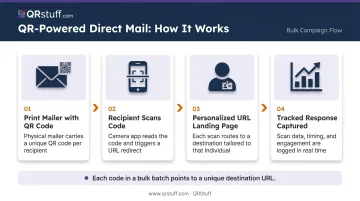
Pair a QR code on a mailer with a personalised URL (PURL) that greets the recipient by name and presents a tailored offer. USPS confirms QR codes can drive recipients to personalised URLs where campaign responses are measurable — a direct attribution capability that generic direct mail simply doesn't offer.
QRStuff's bulk generation tool handles PURL campaigns at scale, with each code in a batch pointing to a unique destination URL and tracked independently.
Creative QR Code Ideas for Engagement and Experience
QR-Powered Scavenger Hunts and Contests
Place QR codes across multiple locations — stores, events, posters — where each scan reveals a clue or unlocks a prize entry. The format rewards participation, drives foot traffic between locations, and generates social sharing as participants recruit friends.
Glossier and Shopify ran a geo-gated shoppable treasure hunt for a new product launch, using QR code access at select locations to build exclusivity and buzz simultaneously.
Behind-the-Scenes and Exclusive Content Access
QR codes on product packaging or in-store displays can unlock video content — brand origin stories, how-it's-made footage, founder messages — that deepens brand connection beyond what the label alone can convey. Coca-Cola used this on cans to link customers to a music portal, a tactic confirmed by Ball's packaging documentation.
The content has to feel genuinely exclusive to work. A link to your homepage defeats the purpose.
Feedback and Review Collection at Peak Satisfaction Moments
A customer finishing a great meal, unboxing a new purchase, or checking out of a hotel is at peak satisfaction. That's exactly when a QR code on a receipt, table tent, or packaging insert should appear — linking directly to a Google Review page or feedback survey.
QRStuff's Google Reviews QR code type creates a direct link to your Google Business Profile review page. The platform's documentation notes placement on receipts and packaging consistently drives higher response rates because you capture feedback while the experience is still fresh.
Loyalty Program Enrollment
Rather than asking customers to download an app or remember a URL at home, a QR code can enrol them instantly. QRStuff supports app store QR codes that auto-detect the user's operating system and direct them to the correct store — no friction, no wrong download.
High-traffic placement works best. Common spots include:
- Checkout counters and point-of-sale terminals
- Product packaging and unboxing inserts
- Fitting rooms and dressing areas
- Hotel elevator panels and keycards
Each location catches customers at a moment of engagement, eliminating paper forms entirely.
Industry-Specific QR Code Promotion Ideas
Retail and E-commerce
Storefront windows for after-hours browsing: A QR code on your window display converts foot traffic into sales even when the store is closed. QRStuff's retail documentation specifically supports this use case — codes link to product landing pages where customers can browse, purchase, or save an item for later. The same tactic works for out-of-stock items: scan the display tag to find it online or at another location.
In-store "scan for a surprise deal" signage: Place QR codes near entrances, checkout counters, and fitting rooms with an element of mystery. Amazon Style proved the concept at scale: customers scan apparel display tags to see sizes, colors, and ratings, then route items directly to a fitting room. That approach let the store stock more than double the styles of a traditional retail format.
Restaurants and Hospitality
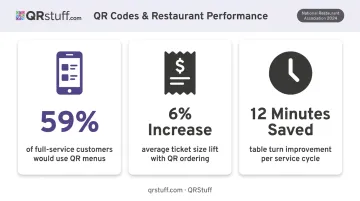
The National Restaurant Association's 2024 Technology Landscape Report found 59% of full-service customers would use a QR code to pull up a menu on their smartphone. Restaurants using QR-based ordering have seen average ticket sizes increase by 6%, and table turns improve by up to 12 minutes.
Beyond menus, QR codes on table tents, hotel key card sleeves, and room welcome cards link to:
- Limited-time chef specials or combo deals
- Spa and dining package promotions
- Loyalty programme sign-up pages
- Post-stay review forms
Events and Trade Shows
QR codes on name badges, booth displays, and conference signage replace paper business cards and lead forms with a scannable, instantly exportable lead list. Platforms like Stova and Cvent confirm QR badge scanning as standard lead capture practice at trade shows.
For exhibitors, QRStuff supports:
- Form QR codes linked to lead capture or demo request pages
- vCard QR codes for instant digital contact exchange
- PDF QR codes for brochures and product catalogues
- Giveaway entry pages to drive booth engagement
Tips for Running a Successful QR Code Campaign
Always Give People a Clear Reason to Scan
A bare QR code with no label is a missed opportunity. "Scan to unlock 20% off" outperforms an unlabeled code every time. The value exchange needs to be visible before someone commits to scanning. Mystery can work when the payoff is implied ("Scan for a surprise"), but ambiguity without a clear reward will kill scan rates.
Use Dynamic QR Codes to Stay Flexible
Static codes lock in a destination permanently. Dynamic codes let you:
- Update the destination URL without reprinting
- A/B test landing pages by routing different scan cohorts
- Schedule URL changes for campaign timing
- Pull real-time analytics on every scan
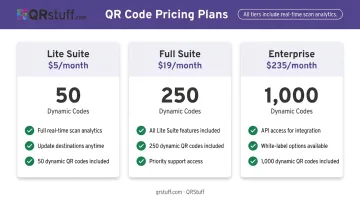
QRStuff's dynamic codes are available from the Lite Suite ($5/month), which includes 50 dynamic codes with full analytics. The Full Suite ($19/month) expands to 250 codes, and Enterprise ($235/month) supports 1,000 codes with API access and white-label options.
The same printed asset can serve multiple sequential campaigns — just swap the destination in the dashboard.
Design for Real-World Scannability
| Design Element | Guidance |
|---|---|
| Minimum size | 2cm × 2cm for simple URLs |
| File format | SVG or EPS for print; PNG at 300 DPI minimum |
| Contrast | Dark code on light background — never invert |
| Quiet zone | Never crop the white border surrounding the code |
| Placement | Flat, non-reflective surface at eye level |
Test your QR code in real conditions before launch — different lighting, distances, and angles — not just on your desktop screen.
Adding a logo or brand colors reinforces trust and can increase scan rates. QRStuff supports custom color and logo branding on all paid plans.
Frequently Asked Questions
How do I promote my QR code?
Pair every QR code with a compelling CTA and a clear incentive — a discount, exclusive content, or contest entry. Place codes where your audience naturally pauses: receipts, packaging, in-store signage, or social posts. Use dynamic codes to track which placements drive the most scans and optimize future campaigns accordingly.
What type of QR code is best for marketing promotions?
Dynamic QR codes are the right choice for any promotional campaign. They allow you to update the destination URL after printing, enable real-time scan tracking (total scans, device type, location), and can be branded with logos and colors — none of which is possible with static QR codes.
Where should I place QR codes to maximise scans?
Focus on high-dwell, high-attention moments: checkout counters, product packaging, receipts, event signage, storefront windows, and direct mail. The best placements align with when a customer is most likely to act — right after a purchase, mid-browse, or during a natural pause in their journey.
How do I track whether my QR code promotion is working?
Use dynamic QR codes to access scan analytics covering:
- Total and unique scans
- Geographic location (country and city)
- Device type and scan time
Assign separate QR codes per placement or campaign so the dashboard shows you exactly which channel drove engagement.
Do QR codes for promotions need to be redesigned for each campaign?
No. With dynamic QR codes, the printed design stays the same — only the destination URL changes. The same physical asset (a window decal, packaging label, or direct mail piece) can serve multiple sequential campaigns, saving reprinting costs and keeping your branding consistent everywhere it appears.