That question has real regulatory teeth. When a dynamic QR code with scan tracking is active, the generator typically logs IP addresses, approximate location, device type, and timestamps. Under GDPR, that's personal data. And under GDPR Articles 83(4) and 83(5), non-compliance can result in fines up to €20 million or 4% of global annual turnover — whichever is higher.
Choosing the wrong platform isn't just a feature mismatch. It's a liability.
This guide covers what GDPR compliance actually means for QR platforms, which security features matter most, and what to verify before committing to any generator.
Key Takeaways
- QR scan data (IP addresses, location, device type, timestamps) qualifies as personal data under GDPR Article 4 — your QR platform is a regulated data processor
- Verify these before committing: GDPR/SOC2 certifications, SSO, role-based access, password-protected codes, and dynamic redirect control
- GDPR Article 28 requires a signed Data Processing Agreement (DPA); any platform that won't provide one fails the compliance test
- Free generators rarely meet enterprise compliance standards and often monetise scan data through third-party advertising
- Platforms with Fortune 500 clients and long compliance track records are far more likely to hold active, audited certifications
What Makes a QR Code Generator "Secure and GDPR Compliant"?
A secure QR code generator protects two distinct things: the account data of the businesses using it, and the personal data of everyone who scans a code. Those are separate problems that require separate controls.
Why GDPR Is Triggered by QR Tracking
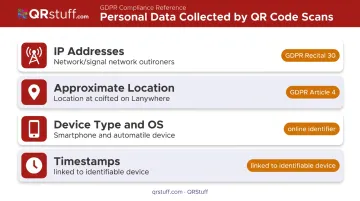
When you deploy a dynamic QR code with scan analytics enabled, the generator collects data about each scan event. That typically includes:
- IP addresses — explicitly named as an online identifier in GDPR Recital 30
- Approximate location derived from IP — covered under GDPR Article 4's definition of personal data
- Device type and operating system — functions as an online identifier when linked to a scan profile
- Timestamps — personal data when tied to an identifiable IP address or device
EDPB Guidelines 2/2023 confirm that URL tracking, IP-based tracking, and persistent identifiers fall within ePrivacy and GDPR obligations. The moment your QR platform collects any of these data points, it becomes a data processor — and your business becomes the data controller responsible for ensuring that processing is lawful.
The Free vs. Paid Security Gap
Free QR generators are built around different economics. Many monetize through advertising, which requires behavioral data from scanners. That conflicts directly with GDPR's data minimisation and purpose limitation principles. They also rarely offer the compliance documentation businesses in regulated industries need, such as Data Processing Agreements (DPAs), audit reports, and erasure workflows.
A missing DPA alone can expose your business to regulatory action — under GDPR Article 28, you're required to have a written contract with every data processor you use.
GDPR Compliance: What It Actually Means for Your QR Platform
"GDPR compliant" on a vendor's homepage means nothing without substance behind it. Here's what to actually verify.
Data Processing Agreements (DPAs)
Under GDPR Article 28, any third-party platform processing personal data on your behalf must be bound by a formal contract. A DPA must cover:
- Subject matter, duration, and purpose of processing
- Confidentiality and security obligations
- Sub-processor controls
- Assistance with data subject rights
- Deletion or return of data at contract end
- Audit rights
If a QR platform won't provide a DPA, it cannot legally process personal data on behalf of EU-facing campaigns. Request this document before signing up — not after.
Data Minimisation
GDPR Article 5(1)(c) requires data to be "adequate, relevant, and limited to what is necessary." In practice, this means asking two questions:
- Does the platform collect individual-level scan profiles by default, or is aggregate reporting available?
- Can granular tracking be disabled or scoped down for campaigns that don't require it?
A platform with no opt-down from per-scan tracking gives you less control over your compliance posture.
Right to Erasure
When a user requests deletion of their data under GDPR Article 17, your QR platform must be able to act on it. Ask vendors directly: can you delete scan records tied to a specific IP address or scan profile upon request?
The processor's obligation under Article 28 includes assisting with exactly this. Verify the vendor has a documented erasure process — not just a policy statement.
Data Residency and Transfers
GDPR restricts transfers of EU resident data outside the EEA without appropriate safeguards. Ask vendors:
- Where are scan logs stored and processed?
- If outside the EEA, are Standard Contractual Clauses (SCCs) in place?
QRStuff's privacy documentation confirms that scan data is stored on servers in Europe, with SCCs in place for any international transfers. Platforms that store data exclusively in the US or don't specify residency create additional compliance obligations you'll need to address.
Consent and Transparency
If your QR code leads to a landing page that collects form responses or sets cookies, the platform must not obstruct cookie consent banners or privacy notices. For marketing campaigns, a QR scan often triggers the first data collection touchpoint — meaning consent infrastructure needs to be intact from the moment someone scans, not just when they submit a form.
Key Security Features to Look For
Certifications alone don't guarantee a secure platform. Evaluate these technical and governance controls together.
Compliance Certifications: GDPR, SOC2, ISO 27001
Each certification signals something specific:
- GDPR compliance — the platform meets EU data privacy law requirements for how personal data is collected, stored, and processed
- SOC2 — an independent audit by a CPA firm verifying the platform's security, availability, and confidentiality controls, as defined by the AICPA SOC framework
- ISO/IEC 27001 — a certified information security management system (ISMS) meeting the internationally recognised ISO standard
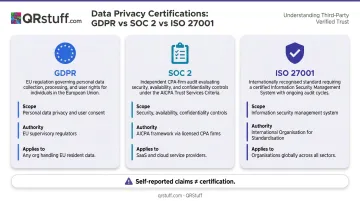
Self-reported "we take security seriously" claims are not certifications. Ask for the auditor's name, the audit date, and whether the certification is current.
Platforms serving Fortune 500 clients in regulated sectors are more likely to maintain active, third-party-verified certifications — not just badge imagery on a marketing page.
SSO and Role-Based Access Controls
Credential-based attacks are the leading cause of breaches. The Verizon 2024 Data Breach Investigations Report found stolen credentials were used in 77% of confirmed web application breaches. IBM X-Force 2024 data shows attacks using valid credentials increased 71% year-over-year.
For QR code platforms with shared team dashboards, this matters:
- SSO (via SAML 2.0 or OpenID Connect) ties access to your company's identity infrastructure — when an employee leaves, access is revoked at the identity provider level, not manually
- Role-based access controls (RBAC) prevent unauthorised changes to live campaign codes by restricting who can edit vs. view vs. administer
QRStuff's SSO capability, available on the Enterprise plan and supporting SAML 2.0 and OpenID Connect, addresses both of these requirements.
Password Protection and Encryption
Password-protected QR codes add access control at the scan level — useful for internal documents, financial materials, or restricted content where you need to limit who can reach the destination. The platform should also enforce:
- TLS/HTTPS across all redirect chains (flag any generator serving redirects over HTTP)
- Encryption at rest (AES-256 is the standard)
Check the redirect chain, not just the destination URL. A secure landing page means nothing if the redirect itself is unencrypted.
Custom Domain Control
When a QR generator uses a shared redirect domain — something like qr.io/abc123 — you don't own that domain. If the provider shuts down, changes ownership, or the domain lapses, every printed code pointing to it breaks. In a well-documented example, Heinz had to apologise in 2015 after a promotional QR code on ketchup bottles redirected to an adult website when the campaign URL registration lapsed.
Custom domains (qr.yourbrand.com) solve this. Your brand controls the redirect, scanners see a familiar URL, and you keep that control even if you switch providers. QRStuff supports custom short URL domains on Full Suite and Enterprise plans.
Dynamic QR Code Management
Static QR codes permanently encode a destination URL. If that URL is compromised or becomes incorrect, you can't fix it without reprinting everything.
Dynamic codes let you update the destination after printing — no reprint required. From a compliance standpoint, this also matters for GDPR Article 5(2) accountability: the ability to respond to incidents, correct redirects, and maintain records of processing activities. Look for platforms that offer redirect management with change logging.
Key capabilities to verify:
- Editable destinations — update the redirect target without changing the printed code
- Change logging — an audit trail showing who changed what and when
- Incident response readiness — supports GDPR Article 5(2) accountability requirements
How QRStuff Helps You Stay Secure and GDPR Compliant
QRStuff has been operating since 2008, serving over 250,000 businesses worldwide — including Fortune 500 companies across retail, healthcare, hospitality, and finance such as Coca-Cola, Walmart, JP Morgan, and Marriott International. Sustained compliance investment over 16+ years looks different from a certification badge added to a pricing page.
The table below shows how QRStuff's features address each security and compliance criterion:
| Security Criteria | QRStuff Feature |
|---|---|
| GDPR compliance | GDPR-compliant platform with documented user rights and erasure process at qrstuff.com/erasure |
| SOC2 compliance | SOC2 certified as part of enterprise security framework |
| Data residency | Servers in Europe; appropriate safeguards for international transfers |
| SSO | SAML 2.0 and OpenID Connect on Enterprise plan |
| Role-based access | RBAC for team permission management on Enterprise plan |
| Password protection | Available on paid plans for scan-level access control |
| Encryption | AES-256 at rest, TLS 1.2+ in transit |
| Custom domains | Custom short URL domains on Full Suite and Enterprise plans |
| Dynamic codes | Real-time redirect editing without reprinting |
| 2FA | Available from Lite Suite upward |
| Uptime | 99.9% SLA; actual historical performance at 99.968% since 2008 |

For enterprise deployments in regulated industries, QRStuff provides additional support beyond the core platform:
- Dedicated account managers and 24/7 priority support
- API access for QR code creation and updates at scale
- Bulk processing for large-volume campaigns
- Onboarding consultation covering security requirements, platform configuration, and team training
Healthcare providers and financial institutions with specific compliance obligations will find the onboarding process particularly relevant, as it's scoped to regulated-industry needs from the start.
Conclusion
Picking a QR code generator based on design options or scan limits makes sense for simple use cases. For any business deploying QR codes that track scanner data — especially in EU-facing campaigns or regulated sectors — GDPR compliance, security certifications, and access controls belong at the top of the evaluation criteria, not as an afterthought.
That stakes aren't abstract. CNIL's €40 million fine against CRITEO shows exactly how regulators approach marketing analytics that processes personal data without proper controls — and QR scan analytics sit squarely in that category. As enforcement activity increases across EU data protection authorities, the gap between compliant and non-compliant platforms will only widen.
Which means the evaluation doesn't end at sign-up. Revisit your platform's compliance documentation periodically: GDPR guidance evolves, DPA terms should be reviewed at renewal, and certifications carry expiry dates. Treat compliance as a recurring audit item, not a box you check once.
Frequently Asked Questions
Which QR code generator is safe?
A safe QR code generator offers GDPR and SOC2 compliance, SSO, role-based access controls, password protection, custom domain support, and encrypted redirect chains. Free generators rarely meet these standards for business or enterprise use.
Are QR codes HIPAA compliant?
QR codes themselves don't carry a HIPAA status: compliance depends entirely on the platform managing them. Healthcare providers should use a generator that explicitly supports HIPAA requirements, encrypted data handling, and Business Associate Agreements (BAAs).
Does GDPR apply to QR code scan data?
Yes. If your QR generator tracks IP addresses, location, device type, or timestamps, that constitutes personal data under GDPR Article 4 — making the platform a data processor with obligations including data minimisation, lawful basis for processing, and support for the right to erasure.
Can free QR code generators be GDPR compliant?
Most free generators lack the compliance infrastructure GDPR requires: no DPA, no documented erasure process, and business models that often rely on monetizing scanner behavioral data through advertising. That last point conflicts directly with GDPR's data minimization and purpose limitation requirements.
What is the difference between GDPR and SOC2 for QR code generators?
GDPR is an EU regulation governing how personal data — including scan data — is collected, stored, and processed. SOC2 is a US-based auditing framework verifying a platform's internal security controls through independent assessment. Both are relevant: GDPR protects your users' data rights, SOC2 confirms the platform's infrastructure has been independently vetted.
What data does a QR code generator collect when someone scans a code?
Dynamic QR generators typically collect scan timestamps, approximate geographic location (derived from IP address), device type, and operating system. QRStuff presents this as anonymized, aggregated analytics rather than individual PII profiles. Even so, this data qualifies as personal data under GDPR, requiring appropriate consent mechanisms and retention controls.