Introduction
Walk into almost any café, kopitiam, or mid-range restaurant in Malaysia today, and the ritual is the same: sit down, find the QR code on the table, scan it with your phone, and browse the menu. What started as a pandemic-era workaround is now the default dining experience across the country — and most customers expect it.
DOSM's 2025 ICT survey recorded 99.6% individual mobile phone usage and 98.3% internet usage among Malaysians — making QR menus one of the most universally accessible digital tools a restaurant owner can deploy.
This guide covers everything Malaysian F&B operators need to know: the difference between static and dynamic QR codes, the real business benefits, a step-by-step setup process, and how to handle Malaysia-specific considerations around language, payment integration, and customer resistance.
Key Takeaways
- QR code menus replace printed menus with a scannable, mobile-accessible digital version.
- Dynamic QR codes let you update prices, items, and availability instantly without reprinting.
- For Malaysian restaurants, this means lower printing costs, faster table turnover, and native support for Touch 'n Go, GrabPay, and DuitNow.
- Older diners may resist QR menus — keep physical backups on hand.
- QRStuff supports dynamic QR codes with custom branding, scan analytics, and instant dashboard updates.
Why QR Code Menus Are Taking Off in Malaysia
The Digital Infrastructure Is Already There
Malaysia's mobile penetration sits at 97.1% household internet access, and the government's MyDIGITAL Blueprint is targeting 875,000 MSMEs adopting eCommerce by 2025. F&B businesses are specifically named as a sector to bring online — meaning QR menus fit squarely into an existing national push.
MDEC reported that approved digital investments under Malaysia Digital reached RM163.6 billion in 2024 — up 250% from 2023. Restaurants still running on printed menus alone are operating against that current.
Practical Business Pressures Driving Adoption
Beyond policy, restaurant operators are adopting QR menus for practical reasons:
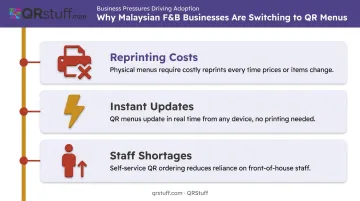
- Reprinting costs — One Bayan Lepas operator told The Star that replacing 20 to 30-page hardcover menus was expensive enough to justify switching entirely to QR codes.
- Instant updates — Daily specials, sold-out items, and seasonal menus (Ramadan, CNY) can be changed from a phone in seconds.
- Staff shortages — Mamak eateries across Malaysia have adopted digital ordering and payment tools in direct response to manpower pressure, as reported by The Star.
The Post-Pandemic Normalisation
By 2020, contactless dining shifted from novelty to expectation. Customers who learned to scan QR codes at hawker stalls and casual restaurants carried that habit into every dining setting. Today, a George Town café and a hotel restaurant operate under the same assumption: customers arrive ready to scan.
Static vs Dynamic QR Code Menus: What You Need to Know
Static QR Codes: Fixed and Limited
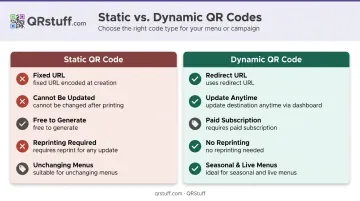
A static QR code encodes a fixed URL directly into its pattern at the moment of creation. Once printed, it cannot be changed. If your menu URL changes, or you update your PDF, the old printed code becomes useless and you need to reprint everything.
Static codes work for restaurants with:
- Menus that never change
- Very limited budgets
- Simple one-page menu PDFs hosted at a permanent URL
They're also free to generate. That permanence, though, is exactly the problem for most restaurants.
Dynamic QR Codes: The Better Choice for Most Restaurants
A dynamic QR code uses a short redirect URL. The printed code always points to that redirect, and you control where the redirect sends customers — from a dashboard, at any time, without touching the physical code.
This architecture means:
- Update your menu PDF → same QR code, new content
- Change a price → live instantly
- Swap a Ramadan menu for a regular menu → done in seconds
- Run off-peak promotions → change the destination and change it back
Platforms like QRStuff support dynamic QR codes that link to any external URL: your own website, a hosted PDF, a Google Drive link, or a Canva-published menu page. You can switch destinations anytime without reprinting a thing.
A Practical Example
Picture a Saturday lunch rush. Your kitchen runs out of Nasi Lemak Ayam. With a static QR code, every customer at every table still sees it listed and some will try to order it. With a dynamic code, you update availability from your phone in under a minute — and no one orders a dish you can't serve.
Why Dynamic Codes Are Worth the Cost
Dynamic QR codes require a paid subscription to a management platform. Free static generators produce codes that never update. For any restaurant that updates its menu more than once a year or runs seasonal specials, reprinting laminated or hardcover menus will cost far more than an annual platform subscription.
Benefits of QR Code Menus for Malaysian Restaurants
QR menus deliver practical advantages across cost, speed, accuracy, and data — here's how each one plays out for Malaysian operators.
Lower Printing Costs, Instant Updates
Reprinting laminated or hardcover menus is expensive in Malaysia, particularly for multi-page menu books with food photography. Moving to a QR-linked digital menu eliminates this recurring cost entirely. Menu changes — price updates, new dishes, seasonal specials — happen from a dashboard rather than a print shop.
Faster Service and Better Table Turnover
A Bayan Lepas operator told The Star that QR menus directly reduced customer waiting times and improved peak-hour table turnover. During lunch and dinner rushes, even shaving a few minutes off the time between seating and ordering meaningfully increases the number of covers a restaurant serves.
Higher Average Spend
Lightspeed's platform data found that customers using digital ordering platforms spent 25% more per transaction than card-paying customers, with QR or digital menu customers generating up to 30% higher spend in some cases. These are vendor benchmarks rather than Malaysian-specific data, but the pattern holds. Customers browsing at their own pace, seeing food photography, and encountering upsell prompts tend to order more.
Improved Order Accuracy
One Malaysian diner quoted in The Star noted that QR menus help with customization and reduce miscommunication. When a customer selects spice level, dietary preferences, and add-ons through a digital interface, that information reaches the kitchen exactly as entered — no miscommunication through a busy server.
Analytics for Smarter Decisions
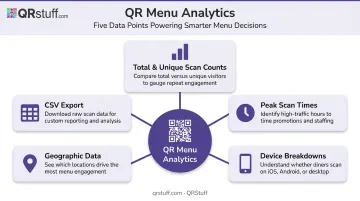
This benefit is underused by most operators. QRStuff's dynamic QR codes, for example, provide:
- Total and unique scan counts — how many people viewed the menu versus how many were repeat visitors
- Peak scan times — identify your actual lunch and dinner rush windows
- Device breakdowns — iOS vs. Android, mobile vs. desktop
- Geographic data — city-level data useful for multi-branch operations
- CSV export — for deeper analysis in spreadsheet tools
For a restaurant group managing multiple outlets, this data helps with menu engineering, staffing decisions, and promotional timing.
How to Create a QR Code Menu for Your Restaurant
Step 1 — Build Your Digital Menu
Before you generate a QR code, you need something to link it to. Options include:
- A PDF menu hosted via a platform or cloud storage
- A dedicated webpage on your restaurant's website
- A menu-building platform with mobile-optimised layouts
- A QRStuff landing page — a branded, categorised menu page you build directly within the platform, no separate hosting needed
Whichever format you choose, prioritise:
- Mobile-first layout (most scans happen on phones)
- High-quality food photography
- Prices clearly listed in Malaysian Ringgit (RM)
- Multilingual labelling relevant to your area (BM, English, Mandarin, Tamil)
Step 2 — Generate a Dynamic QR Code
QRStuff supports three approaches for restaurant menus: uploading a PDF, linking to an external URL, or building a branded landing page. All three use dynamic codes. That means you can update the destination anytime without reprinting a single table card.
Customisation options include:
- Adding your restaurant logo (upload PNG or SVG; the platform scales it automatically)
- Choosing brand colours for foreground, background, and corner shapes
- Adjusting dot patterns and frame styles
- Adding text like "Scan for Menu" in BM or English
A branded QR code reinforces your restaurant's identity at the first touchpoint — before the food even arrives.
Step 3 — Test Before Printing
Once your code is generated, test it across multiple devices before you commit to print. Check:
- Scan speed on 4G and typical café WiFi
- Menu load time on mobile data
- Display on both Android and iOS
- Font size readability on smaller screens
Step 4 — Print and Place Strategically
With testing done, move to print — and choose materials suited to Malaysia's humidity. Recommended options:
- Laminated table tents
- Acrylic stands with tabletop inserts
- Waterproof vinyl stickers with UV-resistant laminate
Placement tips:
- Tables (primary placement)
- Entrance or cashier counter for walk-ins
- Brief instructions in BM and English next to each code for unfamiliar diners
For restaurants with multiple tables, QRStuff's bulk generation feature lets you produce table-specific codes from an Excel upload — all at once, all uniquely labelled.
Step 5 — Monitor and Refine
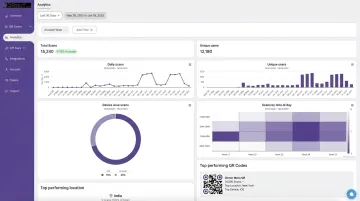
Launching is just the start. Check your analytics dashboard regularly to spot what's working and what isn't:
- Which times generate the most scans? (Adjust staffing accordingly)
- Are customers scanning but not completing orders? (Menu UX issue)
- Multi-branch managers: compare scan volumes by location
Malaysia-Specific Considerations: Language, Payments, and Customer Acceptance
Multilingual Menus for a Multicultural Market
Malaysia's ethnic breakdown (Malay 58.1%, Chinese 22.4%, Indian 6.5%) means a single-language menu leaves part of your dining room underserved. For most restaurants, BM and English is the minimum. Mandarin is strongly recommended for Chinese-majority areas and tourist-heavy locations like George Town and Petaling Jaya.
The tourist angle matters too. In 2024, Malaysia's foreign visitor numbers and their F&B spending make a strong case for multilingual menus:
- 37.96 million foreign visitors arrived in 2024
- RM17.2 billion spent specifically on food and beverage (16.1% of total visitor expenditure)
- Top source markets: Singapore, Indonesia, and China
Mandarin and English together cover the vast majority of those visitors.
Local Payment Integration
BNM's Annual Report recorded 3.0 billion DuitNow QR transactions in 2024, double the 1.5 billion the year prior, with nearly 3 million registered DuitNow QR touchpoints across Malaysia. The average e-money transaction for food and beverages reached RM43.
For restaurants enabling payment through their QR menu, the essential integrations are:
- Touch 'n Go eWallet — the most widely used wallet in Malaysia (94% of e-wallet users)
- GrabPay and MAE — second and third most used
- DuitNow QR — covers most bank apps and wallets via a single QR
- FPX — for direct online banking transfers
- Credit/debit cards — still expected by many diners
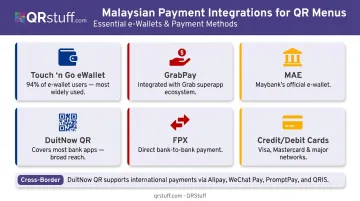
For tourist-facing restaurants, DuitNow QR supports cross-border payments from Alipay, WeChat Pay, PromptPay (Thailand), QRIS (Indonesia), NETS (Singapore), and UnionPay — covering the majority of foreign visitors to Malaysia.
Handling Generational Resistance
QR menus are not universally loved. Malaysian social media threads document real frustration from older diners who find the process has too many steps, small fonts, or feels impersonal — and these concerns are worth building your rollout around.
Practical solutions:
- Keep physical menus available as a backup — never go QR-only
- Print scanning instructions clearly in BM and English next to every code
- Train staff to help hesitant diners without making it awkward
- Position QR menus as a convenience option, not a cost-cutting replacement for human service
Frequently Asked Questions
How much does it cost to make a QR code restaurant menu in Malaysia?
A basic static QR code linking to a PDF menu can be free. Dynamic QR code platforms with analytics and real-time updates charge a monthly or annual subscription — Qashier (a Malaysia-based POS platform) starts at around RM40/month, while QRStuff's Lite Suite, which includes 50 dynamic codes with analytics, starts at approximately RM45/month (£4/month). Annual plans typically offer around 10% savings.
Can foreigners pay by QR code in Malaysia?
Yes, if their home payment app supports cross-border QR. DuitNow QR accepts inbound payments from Alipay, WeChat Pay, PromptPay (Thailand), QRIS (Indonesia), NETS (Singapore), and UnionPay. Visitors from China, Singapore, Indonesia, and Thailand can generally pay by scanning a DuitNow QR code with their home app.
What is the difference between a static and dynamic QR code menu?
Static QR codes encode a fixed destination — if anything changes, you reprint. Dynamic QR codes use a redirect that you control from a dashboard, so the same printed code works even after you've updated your menu 20 times. Dynamic codes are the right choice for any restaurant that updates its menu.
Do I need an app to scan a QR code menu in Malaysia?
No. Both Android and iOS smartphones scan QR codes natively through the default camera app, which opens the menu directly in a browser. No third-party scanner app is required.
Can I update my QR code menu without reprinting?
Yes — this is the key advantage of dynamic QR codes. Update prices, swap dishes, or change your entire seasonal menu from an online dashboard. The physical QR code on your tables never needs to change.
Are QR code menus suitable for mamak stalls and hawker centres?
They can work well in structured settings, but mamak and hawker environments require some thought. WiFi reliability, fast-paced ordering culture, and mixed digital literacy among customers all matter. A practical starting point is a simple QR code linking to a visual menu — no mandatory self-ordering required — so customers can browse while staff take orders the traditional way.