Fashion brands are increasingly treating garments as digital touchpoints, not just physical products. This guide covers what QR codes on clothing actually are, the most impactful use cases, the tangible benefits for apparel brands, how to create and print them correctly, and the technical best practices that determine whether they get scanned or ignored.
Key Takeaways
- QR codes on clothing connect physical garments to digital content — no app required, just a smartphone camera
- Dynamic QR codes let you update linked content anytime — no reprinting, no new labels
- Top use cases: care instructions, supply chain transparency, anti-counterfeiting, and marketing campaigns
- Print at 2 cm × 2 cm minimum and use Error Correction Level H to survive washing and wear
- A clear call-to-action (CTA) on the label dramatically improves scan rates
What Are QR Codes on Clothing?
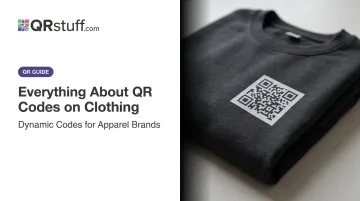
QR codes on clothing are scannable two-dimensional barcodes placed on hang tags, woven care labels, swing tags, or printed directly onto garments. A smartphone camera reads the code in seconds and directs the user to whatever digital content the brand has linked — a webpage, video, care guide, or social profile — with no app required on modern iOS or Android devices.
The content behind the code is entirely up to the brand. One label might link to a wash-care video. Another might verify product authenticity. A third might open an AR styling experience. The physical label stays the same; the digital destination is what changes.
Static vs. Dynamic QR Codes for Clothing
In fashion, this distinction carries real consequences — garment labels can't be reprinted mid-season.
Static QR codes encode the destination permanently. Once printed, the linked content cannot be changed. If the product page moves, the campaign ends, or the sustainability data updates — the label is obsolete.
Dynamic QR codes store a short redirect URL instead. The physical code never changes, but the destination it points to can be updated at any time from a dashboard. For fashion brands, this is the only practical choice because:
- Collections rotate seasonally
- Product pages get updated or migrated
- Sustainability and compliance data must stay current throughout a garment's multi-year lifecycle
- Promotional campaigns start and end
QRStuff's dynamic QR codes support unlimited destination updates after printing. The platform's 99.9% uptime guarantee matters here too, since a garment bought today may sit in a customer's wardrobe for years — the scan experience needs to hold up long after the launch campaign ends.
Top Use Cases for QR Codes on Clothing
Care Instructions and Product Information
Physical care labels have a hard constraint: space. Legal requirements, multiple languages, and fabric composition information already crowd a small woven label.
A QR code removes that constraint entirely. Brands can link to:
- Full wash-and-care video guides
- Size-and-fit charts for different body types
- Detailed fabric composition and material sourcing
- Recycling and end-of-life guidance
- Multilingual instructions for international markets
That single scan can serve a customer in Tokyo and another in Toronto — from the same label, without a reprint.
Supply Chain Transparency and the EU Digital Product Passport
Consumers want to know where their clothes come from. QR codes give brands a direct channel to show them — factory locations, labor certifications, material sourcing, and environmental footprint data — without cramming it onto a label.
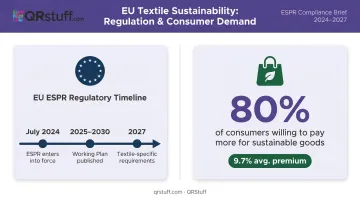
For EU-market brands, this is now a regulatory requirement in the making. The EU's Ecodesign for Sustainable Products Regulation (ESPR), which entered into force in July 2024, establishes the framework for Digital Product Passports (DPPs) for physical products sold in the EU.
Textiles and apparel are identified as a priority category in the Commission's 2025–2030 ESPR working plan, with textile-specific requirements indicated for 2027.
The commercial case is just as strong. PwC's 2024 Voice of the Consumer Survey, covering more than 20,000 consumers across 31 countries, found that 80% of consumers said they would pay more for sustainably produced goods, with an average premium of 9.7%. QR-linked transparency data addresses this purchasing behavior.
QRStuff supports GS1 Digital Link QR codes — the format specifically designed for DPP compliance — enabling brands to encode a product's GTIN while simultaneously linking to sustainability and supply chain data from the same code that retail POS systems already scan.
Brand Authentication and Anti-Counterfeiting
Serialized QR codes give every individual garment a unique digital fingerprint. Rather than one shared code for an entire product line, each item gets its own code linked to a verification page. A customer — or customs authority — can scan the label and confirm authenticity on the spot.
Ralph Lauren's implementation is the clearest large-scale proof point: their 2023 Global Citizenship & Sustainability Report confirms Digital Product IDs deployed on more than 220 million Polo products for authentication and consumer engagement.
The scale of the problem justifies the investment. According to EUIPO and OECD's Mapping Global Trade in Fakes 2025 report, global trade in counterfeit goods reached USD $467 billion in 2021, representing 2.3% of world trade — with clothing, footwear, and leather goods consistently among the top counterfeited categories.
QRStuff's Enterprise tier supports bulk serialized QR code generation and API integration, making per-garment authentication scalable for high-volume fashion operations.
Marketing Campaigns, Promotions, and Social Media Growth
Every garment that leaves a store becomes a potential marketing channel — if it has a QR code. Brands link clothing tags directly to:
- Exclusive discount codes for repeat purchases
- New collection lookbooks and editorial content
- Loyalty reward program enrollment
- Social media profiles for follower growth
- Post-purchase review requests
Dynamic codes make this even more practical: a summer campaign code becomes an autumn campaign code without any physical change to the label. QRStuff's analytics dashboard tracks total scans, unique scans, geographic distribution, device type, and time-based patterns — giving brands actual data on which collections drive post-purchase engagement.
Interactive Experiences and Brand Storytelling
The most memorable clothing QR codes go beyond information — they build a connection between the wearer and the brand's story.
Cecilie Bahnsen's "Edition" capsule collection is a frequently cited example. As reported by British Vogue, each dress's QR code opened a portal to the garment's full history: the first sketch, fabrication details, the step-by-step making process, and responsible care information. The code transformed the label into a narrative.
Other brands use QR codes to launch AR try-on experiences, behind-the-scenes production videos, or designer interviews. Done well, these experiences extend the brand relationship well past the point of purchase — turning a label scan into genuine engagement.
Key Benefits for Fashion Brands
QR codes on clothing aren't just a novelty — for fashion brands, they create measurable advantages across sales, operations, and customer trust.
| Benefit | What It Means in Practice |
|---|---|
| Bridges physical to digital | Every garment becomes a sales channel — reorder links, matching accessories, new collections |
| Measurable ROI | Dynamic QR analytics replace guesswork with scan data by geography, device, and time |
| Builds consumer trust | QR-linked sustainability data directly addresses the purchasing priorities of modern shoppers |
| Reduces operational costs | Update campaign content without reprinting a single label — no waste, no logistics overhead |
| Anti-counterfeiting at scale | Serialized codes protect brand equity and give customers a simple authenticity check |
On the adoption side, Bitly's 2025 survey of 250 marketers found that 93% increased their QR code usage over the prior 12 months, with 88% reporting that consumer sentiment toward QR codes had become more positive. For fashion brands, that shift in sentiment means a tagged garment now has a genuine shot at driving a scan — not just sitting unnoticed on a care label.
How to Create QR Codes for Clothing Labels
Step 1 — Choose the right QR code type
Match the code type to the specific goal on each label:
- URL QR codes — product pages, care guides, lookbooks
- Social media QR codes — follower growth and community building
- Feedback QR codes — post-purchase reviews and customer insights
- Bulk/serialized QR codes — per-garment traceability and anti-counterfeiting
- GS1 Digital Link — EU Digital Product Passport compliance
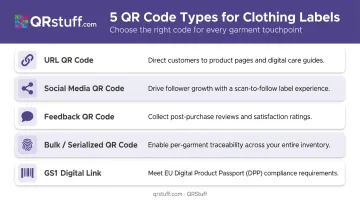
QRStuff supports 40+ code types, so you can match the exact data type to each label's purpose — from hang tags to sewn-in care labels.
Step 2 — Customize the design to match your brand
Plain black-and-white codes get scanned. Branded codes get scanned more. QRStuff's customisation tools support:
- Logo upload (automatically centered, scaled, and error-corrected)
- Custom colors and gradient effects
- Module and eye shape variations
- Frame text for CTAs like "Scan for care guide" or "Verify authenticity"
Step 3 — Download in the correct format for print
- SVG or EPS (vector) for professional label printing — scales to any size without quality loss
- High-resolution PNG at minimum 300 DPI for standard digital and small-format print
- Never crop the quiet zone (the white border surrounding the code) — scanners need it to locate the code boundaries
Step 4 — Test before committing to mass production
- Scan from 10–20 cm — the natural distance a customer holds their phone from a garment tag
- Test on the actual substrate: woven label, hang tag, or printed paper
- Check under varied lighting, including dim fitting-room conditions
- Verify the linked content loads correctly on both iOS and Android
QRStuff's dynamic QR codes let you update the destination after garments are already in circulation. Swap in new sustainability data, rotate seasonal promotions, or update compliance information without recalling or reprinting a single item.
Best Practices for QR Codes on Clothing
Placement and Sizing
Location and size directly determine whether a code gets scanned.
| Placement | Best For | Minimum Size |
|---|---|---|
| Woven inner label (collar/side seam) | Care instructions, authentication | 2 cm × 2 cm |
| Hang tag or swing tag | Marketing, lookbooks, social follows | 3–4 cm |
| Printed design (back/sleeve) | Event merch, campaign codes | 3 cm+ |
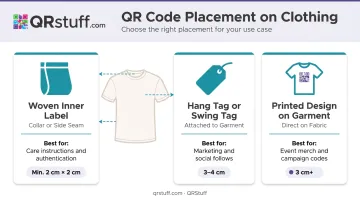
Never print smaller than 1.5 cm — this causes reliable scanning failures on budget and older smartphones.
Color Contrast and Error Correction Level
Always maintain strong contrast between the code modules and the background. Dark on light is standard. Light-on-dark inversions are possible but require testing — many older scanners struggle with them.
Clothing QR codes also face degradation that packaging codes don't — sewing, washing, ironing, and folding all take a toll. QRStuff automatically selects the appropriate error correction level based on design complexity, including Level H (30% damage tolerance) when logos are added or customization increases code density. This keeps the code scannable as the garment ages.
Always Include a Clear Call-to-Action
A QR code without context gets ignored. A single line of frame text changes that completely.
Effective CTAs for clothing labels:
- "Scan to verify authenticity"
- "Scan for full care guide"
- "Scan for styling tips"
- "Scan to discover the story"
Keep the CTA to one short phrase — specificity drives more scans than a generic "Scan me."
Frequently Asked Questions
How do you scan a QR code on clothing?
Open your smartphone's native camera app — no separate app needed on modern iOS or Android — and point it at the QR code on the label or tag. When a notification appears, tap it to access the linked content.
Do QR codes work on clothing?
Yes — when three conditions are met: minimum size of 2 cm × 2 cm, strong color contrast between the code and its background, and placement on a flat surface away from seams and heavy folds that distort the pattern.
What is the QR code on a clothing tag?
A clothing tag QR code links to content the brand has configured — typically care instructions, fabric and origin details, sustainability data, brand story content, or promotional offers. One code can serve multiple purposes through a single landing page.
What size should a QR code be on a clothing label?
Minimum 2 cm × 2 cm for inner labels scanned at close range, and 3–4 cm for hang tags where customers may hold the tag further away. Anything smaller than 1.5 cm will cause consistent scanning failures on budget and older devices.
Can QR codes on clothing survive washing?
Woven fabric labels survive hundreds of wash cycles. Paper hang tags are meant to be removed before first wear. For QR codes printed or heat-pressed directly onto fabric, high error correction tolerance — applied automatically by QRStuff — keeps them scannable as the print wears over time.
What should I link my clothing QR code to?
Match the destination to your goal: care instructions for customer service, a sustainability page for transparency, social profiles for brand building, discount codes for conversion, or an authentication page for anti-counterfeiting. Dynamic QR codes let you change the destination at any time without reprinting the label.