Introduction
Most marketers treat QR codes like a shortcut — slap one on a flyer, hope someone scans it, move on. The problem isn't the technology. It's the execution.
With nearly 99.5 million US smartphone users projected to scan QR codes in 2025, up from 83.4 million in 2022, the audience is there. What's missing for most brands is a strategy that gives people a real reason to scan — and a destination worth arriving at.
This article organizes practical QR code marketing ideas by channel: retail and packaging, events and hospitality, and digital lead generation. You'll also find guidance on design, placement, and analytics — the factors that separate a high-performing QR campaign from a forgotten square on a shelf.
Key Takeaways
- QR codes drive engagement when they deliver clear value: a discount, exclusive content, or an instant action like saving a contact or joining a WiFi network.
- Organizing ideas by channel (retail, events, digital) helps you choose what fits your business context.
- Dynamic QR codes let you update destinations after printing, keeping campaigns flexible without reprinting costs.
- Scan analytics by placement, device, and time turn QR codes into a measurable performance channel.
Why QR Codes Are a Marketer's Secret Weapon
The friction problem that killed early QR codes is gone. Both iPhone and Android now scan QR codes natively through the built-in camera — no app download required. That single change shifted QR codes from a tech novelty to a standard consumer behaviour.
The numbers back this up. A YouGov survey found that 75% of US consumers are willing to use QR codes more in the future, and 55% had already used one at a restaurant, bar, or store in the prior three months. In the UK, GS1 research found that three in five adults use QR codes in daily life, with grocery shopping as the most common context.
The Physical-to-Digital Bridge
What makes QR codes genuinely useful for marketers is the bridge they create between physical touchpoints and trackable digital experiences. A product on a shelf, a postcard in a mailbox, a sign at a trade show — these are one-way channels. Add a QR code and they become two-way, measurable, and updatable.
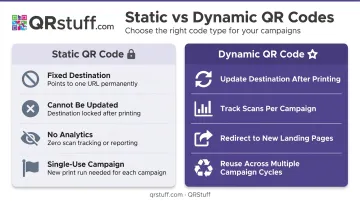
Dynamic QR codes — available through platforms like QRStuff — take that updatability further. The destination URL can change after the code is already printed, which means:
- Swap a summer promotion for a fall sale without reprinting labels
- Track scan performance for each campaign separately
- Redirect traffic to new landing pages as products or offers change
- Reuse existing printed materials across multiple campaign cycles
For brands running seasonal campaigns across physical materials, that's a meaningful operational advantage.
QR Code Ideas for Retail, Packaging, and In-Store Engagement
Retail is where QR codes deliver some of their strongest results. The customer is already holding your product or standing in front of your display — scan intent exists. Your job is simply to give them a reason worth acting on.
Exclusive Discounts and Instant Rewards
On-pack QR codes that unlock a coupon, loyalty points, or a sweepstakes entry give shoppers a reason to scan at the moment of purchase. Coca-Cola's 2025 "Share a Coke" relaunch does exactly this: on-pack codes direct consumers to a digital hub with customizable packaging and an interactive "Memory Maker" experience, spanning 120+ countries to bridge physical products with digital engagement.
For retailers, the same principle applies at shelf level. A QR code on a product display linking to a discount or loyalty sign-up converts passive browsing into an active brand interaction.
Product Transparency and Storytelling
Consumers want more information than a label can hold. GS1 US research from 2025 found that 66% of US adults would scan a QR code on food packaging to access freshness, ingredient, and shelf-life information — and 76% wanted more product data because of rising food costs.
QR codes on packaging can link to:
- Sourcing stories and farm-to-shelf traceability
- Ingredient breakdowns and allergen details
- Sustainability certifications
- How-to-use videos or recipes
QRStuff supports GS1 Digital Link QR codes specifically built for this use case — encoding a product's GTIN while simultaneously linking to consumer-facing transparency pages, sustainability data, and supply chain information.
Dynamic Landing Pages for Seasonal Promotions
Here's a tactic most retailers overlook: print one QR code and update where it points throughout the year. A spring promotion becomes a summer sale, which becomes a holiday bundle — all driven by the same printed code on the shelf, tag, or insert.
QRStuff's dynamic QR codes handle this through a short redirect URL that sits between the printed code and the final destination. Change the destination in the dashboard and the printed code updates instantly. No reprints, no wasted stock.
Post-Purchase Engagement
The transaction doesn't have to end at the register. A QR code on a receipt, packaging insert, or hang tag opens the door to:
- Google reviews (QRStuff offers a dedicated Google Review QR code type)
- Social follows and UGC submissions
- Product registration
- Reorder links
Placing a QR code on a packaging insert with a clear incentive — "Scan to register your product and get 15% off your next order" — turns a completed sale into the start of a repeat-purchase cycle.
QR Code Ideas for Events, Restaurants, and Live Experiences
Live environments are where QR codes shine, because they solve a real logistical problem: getting the right information to the right person at the right moment, without printing 500 copies of something that might change.
Contactless Menus With Upsell Potential
The pandemic normalized QR menus. What's changed since is the opportunity to make them do more than display a static PDF. The National Restaurant Association's 2024 Technology Landscape Report found that 59% of full-service customers are comfortable pulling up a menu via QR code.
A well-built QR menu can include:
- Chef recommendation videos
- Wine and beer pairing suggestions
- Real-time daily specials (updated without reprinting)
- Allergen filters and nutritional details
The same report noted that First Watch's QR payment system saved 30 seconds per transaction — translating to over 1,000 combined customer and employee hours saved.
Scan-to-Enter Contests and Live Engagement
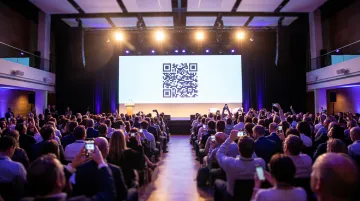
At events, QR codes on booth signage, stage screens, or printed programs enable instant contest entries, audience polls, and giveaways — all while capturing first-party contact data. Every scan that converts to an entry becomes an email address or phone number you own.
Coinbase demonstrated the ceiling of this format at the 2022 Super Bowl: a 60-second ad showing nothing but a bouncing QR code generated 20 million landing page hits in one minute and moved the Coinbase app from No. 186 to No. 2 in the App Store. You don't need a Super Bowl budget to replicate the core mechanic — a contest entry code on event signage or a stage screen produces the same first-party data capture at a fraction of the cost.
Event Wayfinding and Real-Time Updates
Conference organizers and trade show teams deal with a recurring problem: printed schedules become outdated the moment a session moves or a speaker cancels. QR codes on name badges, signage, and printed programs that link to a live schedule page solve this without requiring reprints.
Useful applications include:
- Speaker bios and session descriptions
- Room maps and wayfinding
- Session feedback forms
- Last-minute schedule change notifications
With dynamic QR codes, the linked page can be updated in real time. Attendees scan the same code from their badge all day and always get current information.
Gamification and Scavenger Hunts
Placing QR codes at multiple locations across a venue or trade show floor creates a scan-to-reveal experience — participants collect clues, unlock content, or earn prizes as they move through the space. This drives dwell time and increases booth visits organically.
The format works across event types:
- Trade shows: reward booth visits with cumulative prize entries
- Festivals and pop-ups: give attendees a structured route through the venue
- Brand activations: tie each scan location to exclusive content or discounts
QR Code Ideas for Digital Campaigns and Lead Generation
QR codes are one of the few tools that convert physical impressions into owned digital audiences. That matters more now than it did three years ago.
Email List Building From Physical Touchpoints
A QR code in a storefront window, on product packaging, or in a print ad can link to a mobile-optimized sign-up form — making list growth passive and continuous. The key variable is the incentive: "Scan for 10% off your first order" outperforms "Join our newsletter" every time.
QRStuff supports linking directly to sign-up forms. Since every QR scan happens on a smartphone, a mobile-optimized destination isn't optional — it's the baseline.
AR-Triggered Experiences
QR codes can trigger augmented reality activations without requiring a separate app download. Jones Soda's Reel Labels campaign — covered by Packaging Dive in 2024 — used WebAR-powered labels where customers scan a QR code and point their phone at the can to see branded video content appear directly on the packaging. The campaign recorded 20,000+ label scans and interactions.
QRStuff offers a dedicated Augmented Reality QR code type that works through Web AR — no app required — supporting virtual try-ons, 3D product demos, and branded interactive experiences.
First-Party Data Collection
AR experiences capture attention — but the real payoff is the data that follows. As third-party tracking becomes less reliable, IAB's State of Data 2024 found that 71% of brands are actively growing first-party datasets — nearly double the rate from two years prior. QR codes are one of the lowest-friction ways to collect consented audience data.
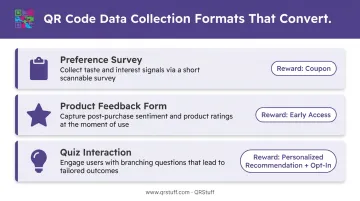
Effective formats include:
- Preference surveys with a coupon reward
- Product feedback forms with early access as the incentive
- Quiz-style interactions that end with a personalized recommendation and an opt-in
Vague "help us improve" language doesn't convert — participants need to know exactly what they're getting in return.
Direct Mail Activation
A QR code on a postcard or mailer transforms a one-way broadcast into a measurable interaction. Link to a time-sensitive offer, a personalized landing page (PURL), or a video that can't be included in the physical piece. The scan data tells you which recipients engaged, when, and on what device — information a plain postcard can never provide.
How to Make QR Code Marketing Actually Work
Ideas only matter if the execution holds up. Three factors determine whether a QR campaign performs or gets ignored.
Always Include a Clear Call-to-Action
A bare QR code has a low scan rate. The text around it does the persuading. "Scan for 20% off" performs. "Scan here" does not. The CTA should state exactly what the person gets, not just that scanning is possible.
Examples that work:
- "Scan to watch the full recipe"
- "Scan to enter to win"
- "Scan for today's specials"
- "Scan to register your product"
Design and Placement Rules That Matter
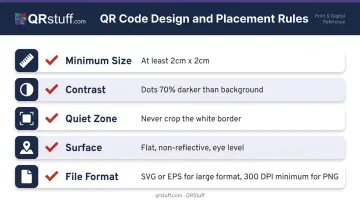
Poor design and bad placement are the most common reasons QR codes fail in the field. Follow these guidelines:
- Minimum size: At least 2cm x 2cm (0.8" x 0.8") for simple URLs; larger for complex data
- Contrast: Dots must be at least 70% darker than the background — dark on light, not the reverse
- Quiet zone: Never crop the white border around the code; scanners need it to identify the pattern
- Surfaces: Flat, non-reflective, at eye level — avoid curved, glossy, or folded placements
- File format: Use SVG or EPS for large-format printing; minimum 300 DPI for PNG
Test every code on multiple devices and in the actual lighting conditions where it will be deployed before committing to a print run.
Use Analytics to Optimise, Not Just Report
Scan data is where QR marketing becomes a performance discipline rather than a guessing game. QRStuff's analytics dashboard (Lite Suite tier and above) tracks total and unique scans, geographic data at country and city level, device and OS breakdowns, and time-of-day patterns.
What to do with that data:
- Identify which placements drive the most scans and prioritise those locations
- Compare scan times to promotional windows to see if campaigns are reaching people at the right moment
- A/B test CTA language by routing different dynamic codes to variant landing pages and comparing results
- Export CSV data to cross-reference scan volume with conversion events in your CRM
Campaigns that use scan data this way consistently outperform those that treat QR codes as a set-and-forget tactic.
Frequently Asked Questions
What are some unique QR code marketing ideas?
Beyond basic URL links, standout approaches include AR-triggered product experiences, multi-location scavenger hunts at trade shows, and UGC submission portals tied to a hashtag challenge. Personalized direct mail with dynamic QR codes — routing each recipient to a customized landing page — consistently drives strong engagement as well.
How do you make a QR code more engaging?
Pair it with a specific CTA that states the value upfront ("Scan for 20% off" rather than "Scan here"), link to genuinely useful content rather than a generic homepage, and use dynamic codes so the destination stays relevant over time.
What should a QR code link to for the best results?
The destination should match the context. In retail, link to a discount or product story. At events, link to a contest entry or live schedule. In direct mail, link to a personalized offer or time-sensitive promotion. Every destination should be mobile-optimized.
How can I track whether my QR code marketing is working?
Use dynamic QR codes with built-in analytics to monitor: scan volume, unique vs. repeat scans, device type, location, and time of day. Then compare performance across placements and CTAs to find what drives results and where to invest more.
Do QR codes still work for marketing in 2025?
Yes. GS1 US found in 2025 that 66% of US adults would scan a QR code on food packaging for product information. With nearly 99.5 million US smartphone users projected to scan QR codes this year, consumer adoption is firmly mainstream.