Introduction
QR code marketing has come a long way from slapping a black-and-white square on a flyer and hoping someone scans it. Today's most effective campaigns use them to tell brand stories, build loyalty programs, capture first-party data, and turn physical surfaces — packaging, billboards, concert screens, even drone formations — into interactive brand experiences.
The scale is hard to ignore. Nearly 100 million US consumers are projected to scan QR codes in 2025, and 93% of marketing professionals increased their QR usage over the past 12 months, according to Bitly's 2025 trends report.
This post covers real campaign examples from recognizable brands, the campaign types driving the most engagement, and a practical framework for building your own. Whether you're a brand manager, agency strategist, or small business owner, you'll find models here worth borrowing.
Key Takeaways
- QR codes connect physical touchpoints to measurable digital actions that printed URLs simply can't match
- The best campaigns pair a clear value exchange with a mobile-optimized destination
- Dynamic QR codes let you update destinations and track performance without reprinting
- Creative placement matters as much as the code itself
- Real-time scan analytics replace guesswork with campaign intelligence
Why QR Code Campaigns Outperform Traditional Marketing
Print advertising has one fundamental problem: once it's out in the world, you have no idea what happens next. A billboard generates impressions you can estimate but never confirm. A flyer gets picked up or ignored with no record either way.
QR codes change that equation entirely.
Closing the Physical-to-Digital Gap
Every QR scan is a voluntary, trackable action. A consumer sees your packaging, your window display, or your transit ad — and chooses to engage. That moment generates data a static ad never could: which location drove the scan, what device was used, what time it happened, and whether the same person scanned again.
That's a different class of marketing altogether — one where physical media generates the same accountability as a paid digital campaign.
The Analytics Advantage
Dynamic QR codes — the kind worth using for any serious campaign — collect:
- Scan volume (total and unique)
- Device type (iOS, Android, desktop)
- Geographic location (country and city level)
- Time-of-day and date patterns
- Referring source (when digitally shared)
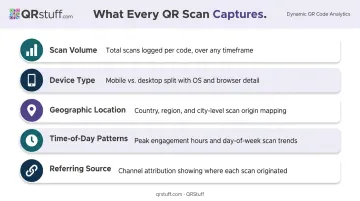
That data loop lets marketers A/B test placements, compare campaign performance across regions, and optimize offers in real time — without reprinting a single piece of material.
Zero Consumer Friction
Pew Research Center reports that 91% of US adults owned a smartphone in 2025. With native QR scanning built directly into iOS and Android cameras, there's no app to download, no account to create. Scanning requires nothing from your audience. That means the only friction left is yours to control: the placement, the call to action, and where the code lands.
Creative QR Code Campaign Examples That Actually Worked
The examples below are grouped by campaign type — not just a roster of brand names. The goal is to help you identify which model fits your own marketing context.
Retail and In-Store Engagement
Nike's House of Innovation on Fifth Avenue used QR codes placed at the base of mannequins, letting shoppers scan to see exactly what the mannequin was wearing — colors, sizes, and availability — and connect directly to the Nike app for in-store services. Physical browsing and digital personalization merged, turning the store into a discovery tool rather than just a fulfillment point.
IKEA embedded QR codes in printed catalogs, giving customers instant access to 3D visualizations, assembly guides, and product videos. The IKEA Museum confirms the initiative was a deliberate experiment in reducing the gap between inspiration and purchase decision — addressing the shopper uncertainty that kills conversion between catalog and cart.
Product Packaging and Transparency
Patagonia replaced multi-card hang tags with serialized QR codes connected to digital product profiles. According to Retail TouchPoints, the Spring 2023 rollout was projected to divert 174,000 pounds of paper waste from landfills — while giving customers direct access to supply chain stories, CO₂ impact data, and fair-trade certifications. A functional label became a values narrative.
SmartLabel — the CPG industry's shared QR transparency platform — demonstrates what happens at scale:
- Over 106,000 products from more than 1,000 brands carry SmartLabel codes
- Generates approximately 22 million consumer interactions annually
- Users spend more than 90 seconds on average on a SmartLabel page — longer than most digital ads hold attention
Out-of-Home and Billboard Campaigns
Innocent Drinks (owned by Coca-Cola) ran a QR campaign on London metro billboards offering a seeds giveaway in exchange for consumer data. The campaign gathered over 25,000 form submissions and exceeded its first-party data targets by 5,000%, according to Marketing Dive. The mechanic was simple: scan, enter your details, receive something free. The value exchange drove everything.
Shake Shack launched a White Truffle Menu campaign across 500 digital billboards in Manhattan, Brooklyn, and Queens. Scanning the QR code sent users to a landing page where they could dig for prizes — including a $2,000 cash offer and menu promo codes. The campaign created urgency through limited-time framing and drove measurable mobile engagement at scale.
Events and Experiential Marketing
Beazley, the specialist insurance brand, formed a scannable QR code using 400 drones over London's skyline. Covered by Business Insider and Insurance Times, the activation generated substantial earned media while capturing leads from anyone who scanned the aerial display. Few traditional OOH formats deliver both spectacle and a direct response mechanism in the same placement.
Live events consistently deliver higher scan rates than retail environments. Attendees have opted in, gathered in one place, and are actively paying attention — making them far more likely to act on a scan prompt. Brands that place QR codes on concert screens, event programs, or wristband packaging funnel that attention directly into product waitlists, social ecosystems, and loyalty sign-ups.
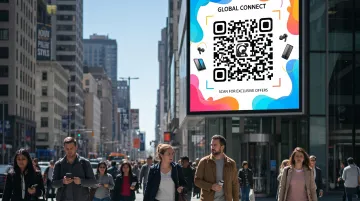
Unexpected Places Brands Are Winning with QR Codes
The most effective QR placements often show up where consumers don't expect them — and the surprise itself increases engagement.
Surprising Placements That Work
- Shipping box exteriors — the unboxing moment is peak brand engagement; a QR linking to a personalized thank-you or how-to video extends that experience
- Clothing care labels — replacing hard-to-read fabric instructions with interactive styling guides or wash tutorials
- Loyalty receipt backs — a QR linking to a rewards sign-up while the purchase is still fresh
- Business cards — pointing to a live portfolio or booking page rather than a static website
Social Media Growth and Review Generation
Brands are using QR codes on in-store signage, packaging, and receipts to bypass the friction of manual searching and direct customers straight to a social profile follow or WhatsApp Business connection. One scan gets the job done in seconds.
For review generation, QR codes on table tents, receipts, or product inserts with a clear "leave a review" CTA drive significantly higher response rates than email follow-ups. BrightLocal's 2024 Local Consumer Review Survey found that 65% of consumers who were asked to leave a review actually did so — the ask is the variable, and a QR code makes it frictionless.
Recruitment: McDonald's France #reQRuitement
McDonald's France and Publicis launched a recruitment campaign that embedded scannable QR codes within iconic menu item shapes — burgers, fries — placed at bus stops and train stations. Young candidates could scan and apply directly from familiar visual triggers. With 80% of McDonald's France's 75,000 employees under 30, context-relevant placement made the creative memorable and the application path immediate.
What Separates a Good QR Campaign from a Great One
Most QR campaigns fail not because of the code — but because of the decisions surrounding it.
Dynamic Over Static — Always
Static QR codes have a fixed destination baked into the pattern itself. Once printed, they cannot be changed. If a URL breaks, a promotion ends, or a product page moves, the code becomes a dead end. Reprinting 50,000 packaging units isn't an option.
Dynamic codes solve this. The destination lives in a redirect, not in the code pattern. You can update it instantly: swap a seasonal offer for a permanent product page, fix a post-launch error, or run A/B tests across different placements without reprinting a single physical asset.
Give Users a Clear Reason to Scan
Scan rates rise sharply when the benefit to the user is immediate and obvious. The Innocent Drinks campaign worked because it offered a free gift. A packaging QR linking to a care guide works because it solves a real problem. A receipt QR linking to a loyalty sign-up works because it delivers tangible future value.
A QR code with no stated benefit (no CTA, no reason to scan) will not get scanned.
Design and Placement Fundamentals
- Minimum size: At least 2 × 2 cm (0.8 × 0.8 in) for reliable short-distance scanning
- 10:1 rule: Scanning distance should be no more than 10× the code's physical size
- Contrast is critical: Avoid placing codes on mirrored, glossy, or low-contrast surfaces
- Branded codes: Custom colors, shapes, and logo embedding align the code with your visual identity — available on paid tiers of platforms like QRStuff
Mobile-First Destination
Google's mobile speed research shows 53% of mobile visits are abandoned when a page takes more than three seconds to load, and a one-second improvement can lift conversions by up to 27%. A slow or desktop-formatted landing page destroys conversion regardless of how strong the scan incentive was.
Measure, Iterate, Improve
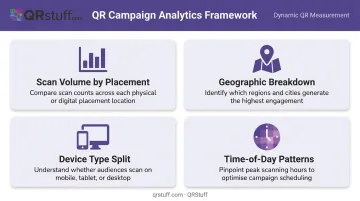
Without analytics, you're making decisions blind. Tracking key metrics lets you identify what's working and reallocate budget in real time — not just at campaign end. Focus on:
- Scan volume by placement (billboard vs. packaging vs. receipt)
- Geographic breakdown to spot regional performance gaps
- Device type to confirm your landing page renders correctly
- Time-of-day patterns to optimize when and where codes appear
Start Your Own QR Code Marketing Campaign with QRStuff
QRStuff is built for results-focused QR marketing, and has been since 2008. The platform supports 40+ QR code types, giving marketers the flexibility to match code format to campaign goal.
Marketing-relevant types include:
- URL, landing page, and video links
- Social media profiles (Instagram, TikTok, LinkedIn, WhatsApp, and more)
- Google Review codes for direct review generation
- Coupon and loyalty codes
- vCard and digital business cards
- WiFi, event, and payment codes
Campaign-Enabling Features
| Feature | What It Does |
|---|---|
| Dynamic QR codes | Update destinations post-print without reprinting materials |
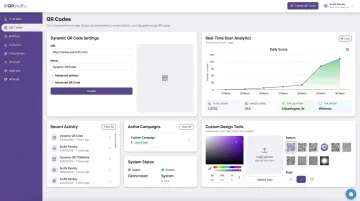
| Real-time analytics | Scan volume, device type, city-level geography, time patterns, unique vs. repeat scans |
| Custom design tools | Brand colours, shapes, logo embedding, gradient effects, AI styling |
| Bulk generation | Enterprise tier supports unlimited batch creation |
| Campaign tagging | Filter and compare performance across campaigns or A/B tests |
| CSV export + API | Integrate scan data with your existing BI tools |
Coca-Cola, IKEA, Walmart, and other Fortune 500 brands use QRStuff — and the same feature set is available to teams of any size. GDPR and SOC2 compliance apply from the Full Suite plan upward, which matters for regulated industries and enterprise procurement sign-off.
Plans start with a free tier (10 dynamic codes, limited analytics) and scale through Lite Suite and Full Suite up to Enterprise for high-volume, multi-location operations. See current pricing at qrstuff.com.
Frequently Asked Questions
How do you promote a QR code in marketing?
Place QR codes at high-attention physical touchpoints — packaging, signage, billboards, receipts — and always pair them with a clear CTA and a stated reason to scan. A code that appears without context or a visible benefit will not get scanned; the surrounding creative does as much work as the code itself.
What makes a QR code marketing campaign successful?
Three factors drive results:
- Value exchange: Give users a reason to scan — a discount, exclusive content, or free gift
- Fast mobile destination: The landing page must load in under three seconds
- Dynamic codes with tracking: So you can measure performance and iterate without reprinting
How do I track the performance of my QR code marketing campaign?
QRStuff's real-time dashboard tracks scan volume, unique vs. repeat scans, device type, city-level geography, and time-of-day patterns. Data is viewable in-dashboard or exportable as CSV for your existing analytics stack.
What should a QR code link to for the best marketing results?
Match the destination to the moment: product pages and how-to videos for packaging, exclusive offers for out-of-home, app download pages for retail, and social profiles for loyalty campaigns. The destination must be relevant to where and why the consumer scanned.
Are dynamic or static QR codes better for marketing?
Dynamic codes are almost always the right choice for marketing. With QRStuff, the destination updates without reprinting and every scan is tracked. Static codes are fixed and untrackable — fine for permanent one-off uses, but unsuitable for any campaign that needs measurement or iteration.
How do small businesses use QR codes in marketing campaigns?
Start simply: a QR on your menu linking to a loyalty sign-up, on receipts directing to a Google Review page, or on business cards pointing to your portfolio. The key is pairing each code with one specific, measurable goal — not trying to do everything at once.