The choice isn't trivial. According to the National Restaurant Association's 2024 Technology Landscape Report, 59% of full-service customers would use a QR code to access a menu. Yet a 2025 Toast survey of 850 US adults found that 81% still prefer physical menus — with just 1% favoring QR codes outright.
That gap tells you everything. This isn't a simple upgrade decision. It's a choice that affects your printing budget, staff workflow, customer satisfaction, and brand experience depending on who walks through your door.
This article breaks down both formats honestly so you can make the right call for your specific restaurant.
Key Takeaways
- QR menus are digital menus accessed by scanning a code; paper menus are printed and placed directly at the table
- QR menus cut print costs and allow instant updates; paper menus need no device and serve all age groups equally
- Preference splits sharply by age — Millennials lean QR, Baby Boomers strongly prefer paper (95% in one survey)
- Most restaurants do best with a hybrid: QR as the default, paper available on request
- Your best choice depends on menu change frequency, customer demographics, and dining segment
QR Menus vs Paper Menus: Quick Comparison
| Factor | QR Menus | Paper Menus |
|---|---|---|
| Cost | Low per-update cost; may require platform subscription | Recurring print and design costs per reprint |
| Updates | Instant, real-time changes across all tables | Requires full redesign and reprint |
| Hygiene | No shared physical touchpoint | Requires sanitization between each use |
| Accessibility | Requires smartphone, battery, and connectivity | Works for every customer, no device needed |
| Brand experience | Flexible, photo-rich, multilingual capable | Tactile quality reinforces premium positioning |
| Environmental impact | Reduces paper waste from reprints | Ongoing paper and ink disposal |
What Are QR Code Menus?
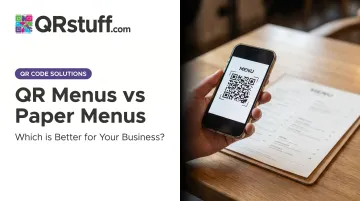
A QR code menu is a scannable code — placed on a table, table tent, or printed card — that sends customers directly to a digital menu on their phone. No app required.
Static vs Dynamic: Why the Distinction Matters
Not all QR menus work the same way, and the difference is significant.
- Static QR codes link to a fixed URL or PDF. Change the menu? You're generating a new code and reprinting. For restaurant use, static codes carry most of the same limitations as paper.
- Dynamic QR codes use a redirect URL. The physical code stays identical, but you update the destination — menu content, pricing, daily specials — through a dashboard. No reprinting required.
For restaurants, dynamic codes are the version that actually delivers operational value.
What Dynamic QR Menus Can Do
Beyond eliminating print runs, dynamic QR menus open up capabilities paper can't match:
- Real-time updates — pull a sold-out dish or change a price across every table simultaneously
- Photo-rich presentations — show customers what they're ordering, not just text descriptions
- Multilingual support — serve international guests or diverse neighborhoods without printing multiple menu versions
- Allergen information — display dietary flags at the point of decision
- Scan analytics — track which items get the most attention, peak browsing times, and device breakdown by location
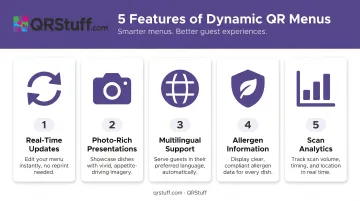
Scan analytics deserve particular attention. QRStuff, for example, surfaces total scans, unique visitors, geographic data, device type, and time-of-day breakdowns — the kind of customer behaviour data paper menus can never generate.
Where QR Menus Perform Best
- Fast-casual and casual dining with frequent menu changes
- Bars and breweries rotating seasonal taps
- Multi-location chains needing consistent, simultaneous updates
- High-volume restaurants prioritizing table turnover
What Are Paper Menus?
Paper menus are physical, printed formats (ranging from laminated single-page cards to multi-page bound books) that customers hold and browse without any technology requirement.
Where Paper Still Holds Ground
Paper menus aren't just a legacy format. They carry genuine advantages that QR codes don't automatically replace:
- Universal accessibility — no smartphone needed, no Wi-Fi dependency, no battery anxiety
- Instant to use — customers pick it up and start reading, no friction
- Tactile experience: the physical weight, material quality, and design signal hospitality before the food arrives
A 2016 peer-reviewed study of 265 participants found that heavier physical menus increased diners' perceptions of restaurant scale and anticipated service quality. In fine dining, the menu is part of the product.
The Honest Limitations
Paper menus come with real operational costs that add up:
- Requires a full reprint cycle for any price change, new dish, or seasonal swap
- Per-unit cost — standard menus run $0.50–$3.00 per printed menu; premium laminated versions reach $5–$10 each, and those costs recur every time the menu changes
- Hygiene risk — a 2013 study found bacteria levels up to 100 CFU/cm² on restaurant menus, with Salmonella and E. coli transferable from menu surfaces to fingertips for up to 24 hours
- No data — paper menus tell you nothing about customer browsing behavior or item popularity
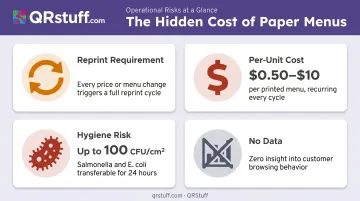
A 100-seat restaurant reprinting quarterly can spend $200–$600 per cycle on menus alone — before design fees or staff time spent sanitizing between covers.
QR vs Paper Menus: Which Is Better for Your Restaurant?
There's no universal answer. The right format depends on four things: how often your menu changes, who your customers are, what kind of dining experience you deliver, and your cost priorities.
Choose QR Menus If:
- Your menu changes frequently — seasonal items, daily specials, rotating taps
- Your customer base skews younger or is generally tech-comfortable
- You're managing multiple locations and need consistent, simultaneous updates
- Reducing recurring print costs is a business priority
- You want actionable data on what customers browse and order
With a platform like QRStuff, restaurants can create dynamic QR code menus that link to hosted digital menus or external ordering platforms — and update that content instantly without touching the physical code. The Lite Suite covers up to 50 dynamic codes with real-time editing and scan analytics, which handles most single-location restaurants comfortably.
Choose Paper Menus If:
- You operate in fine dining or a premium segment where the tactile menu is part of the experience
- Your customer base includes a significant proportion of older diners — 90% of adults 55+ prefer physical menus according to Toast's 2025 survey
- Your venue has unreliable Wi-Fi or limited mobile connectivity
- Your menu changes infrequently enough that reprinting costs stay manageable
The Case for a Hybrid Model
The data points toward a middle path. The NRA's 2024 figures show QR willingness at just 30% among Baby Boomers in full-service settings. At the same time, Millennials show 78% willingness. A QR-only policy excludes a meaningful share of diners; paper-only leaves operational efficiency and data on the table.
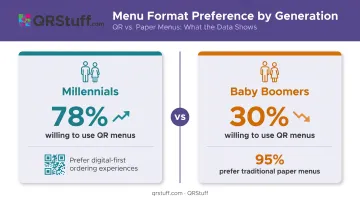
The practical solution is QR as the default with paper available on request. Train staff to offer paper menus proactively — before customers have to ask. This captures the operational benefits of digital menus while ensuring no guest feels stranded.
A Real-World Cost Reference
Marriott Aruba's resort implemented QR code menus across its 8 restaurants using a dynamic QR platform, and estimated approximately $150,000 in savings from reducing paper menus and signage. The savings figure includes broader signage beyond menus, so it's not a direct restaurant-only benchmark — but it shows how quickly paper costs compound at volume.
The restaurants getting the most out of digital menus aren't the ones who went QR-only — they're the ones who matched the format to their actual customers and built in a fallback for everyone else.
Frequently Asked Questions
What type of menu do most restaurants use?
Most restaurants use a mix of both formats. QR adoption grew significantly during the pandemic and remains widespread in casual dining, while printed menus remain standard in full-service and fine dining. The NRA found 59% of full-service customers would use QR menu access — significant uptake, but not a full displacement of paper.
Are QR code menus cheaper than paper menus?
Over time, yes. Printed menus cost $0.50–$3.00 per unit (up to $5–$10 for premium), and that expense repeats every reprint cycle. QR menus run on a platform subscription but eliminate per-update printing costs — the more often your menu changes, the more you save.
What are the downsides of QR code menus?
The main friction points are smartphone dependency, connectivity reliance, and the reduced tactile experience. Approximately 14% of diners find QR menus somewhat difficult to use, and 26% cite small text as a frustration. For restaurants with older guest demographics, QR-only menus carry real accessibility risk.
Can restaurants use both QR and paper menus at the same time?
Yes — for most restaurants, a hybrid approach is the right call. QR codes handle the default experience for tech-comfortable guests while paper menus remain available on request. The key is training staff to offer paper proactively rather than waiting for customers to ask.
How do I create a QR code menu for my restaurant?
Choose a dynamic QR code platform — QRStuff supports hosted menu pages, PDF uploads, and dynamic URL linking. Generate a dynamic code linked to your menu, customize the design with your branding, then place it on tables. With a dynamic code, you can update menu content anytime through the dashboard without reprinting.
Do customers prefer QR menus or paper menus?
Overall preference still favours paper — 81% in Toast's 2025 survey. But the split is pronounced by age: Millennials show 78% willingness to use QR menus, while Baby Boomers sit at just 30%. Satisfaction is consistently highest when restaurants offer both and let customers choose.