Introduction
A survey of 183 chief enrollment officers found that 95% consider the campus tour critical to enrollment decisions — and nearly 80% say on-campus visits produce a matriculation rate of 30% or greater. Few touchpoints in higher education carry that kind of weight.
Yet most tours still rely on the same tools they did 20 years ago — printed maps, scripted guides, and paper brochures that expire the moment a program changes. For a generation of prospective students who expect information on demand, that gap is costly.
QR codes fill that gap. Placed at the right stops, they give prospective students instant access to content a 90-minute walk can't cover — faculty profiles, virtual lab walkthroughs, scholarship links — while giving admissions teams scan-level data they've never had access to before.
This guide covers how QR codes work in practice on campus tours, the specific enrollment advantages they create, and what admissions teams risk by skipping them.
Key Takeaways
- QR codes give prospective students instant access to videos, maps, and program pages from any campus location — no app download needed.
- Dynamic QR codes let universities update linked content instantly without reprinting a single sign.
- Scan analytics reveal which buildings and programs generate the most interest — intelligence no paper tour can provide.
- Universities already using QR-based self-guided tours include Dickinson College (26 locations) and Chatham University.
- QR-based tours connect visit engagement to enrollment data — giving admissions teams insight no traditional tour format can match.
What Are QR Codes for Campus Tours?
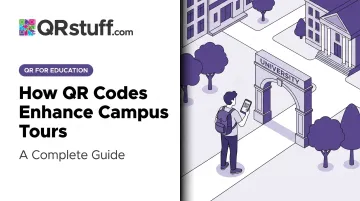
A QR code for a campus tour is a scannable code placed at a key campus location — a building entrance, residence hall lobby, athletic facility — that connects a visitor's smartphone to digital content the moment they scan it. No app download required, no login, no friction.
The content can take many forms: a faculty spotlight video outside the engineering building, a virtual room walkthrough at the residence halls, a Google Maps pin at a hard-to-find lecture hall, or a contact form at the admissions office.
Two Main Use Cases
1. In-person tour enhancement — codes placed at physical locations during guided or self-guided visits, expanding what a tour guide can cover in a fixed time window.
2. Virtual tour extension — codes printed on recruitment mailers or brochures that give remote or international prospects access to a digital campus experience from wherever they are.
In both cases, the QR code is the bridge — connecting a prospective student standing outside a science building to the content that makes them want to study there.
Key Advantages of QR Codes for Campus Tours
Advantage 1: Richer, Self-Paced Engagement That Goes Beyond What a Guide Can Cover
A guided tour covers a fixed route in a fixed time. A prospective biology student and a prospective business student get the same scripted walk — and both leave with gaps.
QR codes change that. Placed at buildings, residence halls, labs, and dining areas, they let visitors go deeper on what matters to them. Scan the engineering building: watch a two-minute faculty spotlight and a virtual lab walkthrough. Scan the student center: read about clubs, intramural sports, and housing options. The guide doesn't have to cover any of it in real time.
Dickinson College already runs a self-guided QR code campus tour across 26 locations, linking visitors to videos and photo galleries at each stop. Chatham University's self-guided QR tour lets prospective students explore at their own pace and access student stories and academic program information independently. These aren't pilots — they're operational recruitment tools.
Why engagement depth matters:
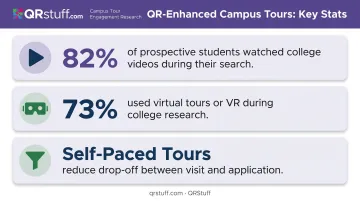
- RNL's 2023 E-Expectations survey found 82% of prospective students watched college videos and 73% used virtual tours or VR during their college search — and found both helpful. QR-linked tour content fits how students already research.
- Self-paced access lets visitors spend more time on programs they care about and skip what's irrelevant — a more personally resonant experience than any scripted group walk.
- Prospective students who leave with unanswered questions are more likely to stall between visit and application. Content available on demand reduces that drop-off.
Best fit for: large group tours where personalization isn't possible; self-guided visits outside official hours; high-volume open days where guides are stretched.
Advantage 2: Operational Efficiency and Elimination of Costly Print Dependency
Traditional tours generate paper — and a lot of it. Truman State University's 2025 admissions print and mail RFP lists quantities including 160,000 senior-search pieces, 150,000–180,000 postcard mailings, and 8,000 viewbooks. That's one mid-sized institution. Every program update, building rename, or event schedule change means a reprint — and dynamic QR codes eliminate that entirely.
A code printed on a building sign today can be updated online tomorrow — pointing to a new program page, a revised campus map, or a current open day schedule — without touching the physical code. The sign stays. The content changes. Staff don't need to reprint, redistribute, or collect outdated materials.
The operational shift this creates:
- Admissions staff reclaim time previously spent on repetitive wayfinding queries and material logistics
- That time redirects to higher-value work: counseling prospective students, managing yield campaigns, and having conversations that actually move applications forward
- Dynamic codes from a platform like QRStuff can be updated instantly from a web dashboard — no developer, no reprinting, no delay
This matters most for: campuses with ongoing renovation projects or seasonal programming; institutions running high-volume recruitment seasons where staff-to-visitor ratios are already strained; universities with sustainability commitments that want to reduce paper output.
Advantage 3: Scan Analytics That Turn Campus Tours Into Enrollment Intelligence
Unlike paper brochures, every QR code scan generates usable data. When prospective students scan codes at specific campus locations, universities learn exactly which buildings and programs are generating interest — in real time. A QR code outside the business school scanned three times more than the one outside the arts centre during a spring open day is a clear signal: invest more in business program storytelling and follow-up outreach.
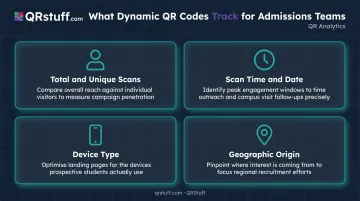
QRStuff's analytics dashboard gives admissions teams exactly this kind of visibility. Each dynamic QR code logs:
- Total and unique scans — distinguishing new visitors from return engagement
- Scan time and date — identifying peak engagement windows during tour events
- Device type — iOS vs. Android, mobile vs. desktop, for content optimization
- Geographic origin — country and city level, useful for international recruitment strategy
Data is available in real time, visualised in line and bar charts, and exportable to Excel or PDF for reporting.
What this enables in practice:
- Identify which campus areas drive the most interest and which need better content
- Segment follow-up email campaigns based on what prospective students actually engaged with
- Connect physical tour activity to downstream digital enrollment funnels
- Justify or reallocate recruitment investment based on evidence, not assumption
AACRAO's strategic enrollment management guidance notes that data-proven investments can lower the overall cost of yielding students and eliminate underperforming vendor contracts. Scan analytics from campus tours feed directly into that kind of evidence-based decision-making.
Who benefits most: institutions running multiple tour events across a semester who need aggregate data to optimize programming; universities investing in enrollment marketing who need to connect physical visit activity with digital campaign performance.
What Happens When Campus Tours Skip QR Codes
Without QR codes, the costs are operational and strategic.
Engagement gaps:
- Prospective students leave tours with unanswered questions and no easy way to revisit what they saw — the gap between visit and application widens
- Tour content is one-size-fits-all, with no mechanism to personalise delivery at scale
- Large group visits compress complex decisions into a single shared experience that serves no one particularly well
Operational friction:
- Printed maps and brochures become outdated quickly, creating confusion about building locations, program details, or event schedules — undermining the credibility a campus visit is meant to establish
- Staff field the same wayfinding and information questions repeatedly instead of focusing on meaningful enrollment conversations
Invisible performance:
- Universities lose all ability to measure which campus experiences are driving applications versus which are falling flat
- Without scan data, there is no way to improve tour performance between recruitment seasons — just guesswork
These gaps matter more than they might seem. According to BHDP Architecture research, 95% of enrollment officers consider the campus tour a decision-critical moment in the recruitment funnel. A tour that can't be measured, personalised, or improved season over season isn't just a missed opportunity — it's a structural weakness in the enrollment process.
How to Get the Most Value from QR Codes on Campus Tours
QR codes deliver results when placed strategically — not scattered across campus as an afterthought.
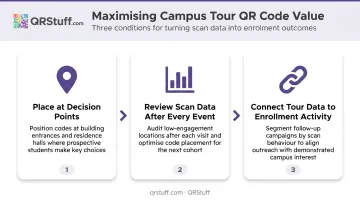
Three conditions determine whether they actually improve tour outcomes:
Place them at decision points, not everywhere. Building entrances, residence hall lobbies, athletic facilities, and signature academic spaces are where prospective students pause and engage. Each code should link to content specific to that location — not a generic university homepage. Use dynamic QR codes (available through QRStuff's Full Suite or Enterprise tiers) so content can be updated each recruitment season without reprinting signage.
Review scan data after every tour event. Which codes were scanned most? At what times? From which devices or regions? Low-engagement locations need better content, not more codes. High-engagement locations signal where prospective student interest is strongest — and where follow-up investment should go.
Connect tour data to downstream enrollment activity. Use scan data to segment follow-up email campaigns, personalize program outreach, and prioritize application nurture sequences. A prospective student who scanned the engineering building three times during open day should receive different follow-up than one who scanned the arts center once.
For universities beginning implementation, QRStuff supports bulk generation of codes for all tour stops in a single batch, university-branded customization with institutional colors and logos, and GDPR-compliant data handling — including institutions recruiting from outside the US.
Conclusion
The case for QR codes on campus tours is straightforward: they make tours more engaging for prospective students, reduce operational overhead, and generate enrollment intelligence that a paper-based walkthrough simply cannot.
Scan data from one recruitment season sharpens the next. Content updates take effect instantly — no reprints, no lag. And every personalized touchpoint strengthens the connection between a prospective student and a campus they visited once.
Universities already treating the campus tour as a conversion asset — not just a hospitality function — are adding QR codes not as a technology experiment, but as standard practice. The difference between a scripted group walk and a QR-enhanced tour isn't theoretical — it shows up in yield rates, follow-up engagement, and deposit decisions.
Frequently Asked Questions
What are QR codes for virtual campus tours?
QR codes for virtual campus tours are scannable codes placed at campus locations — or on print and digital recruitment materials — that link prospective students to videos, 360° tours, program pages, or audio guides. Prospects can access this content on demand, whether touring in person or exploring remotely.
How do you set up QR codes for a self-guided campus tour?
Identify your key tour stops, then create dynamic QR codes linked to location-specific content — videos, maps, program pages, or contact forms. Place the codes at those locations with a clear scan prompt, and use an analytics-enabled platform to track engagement and update content each recruitment season without reprinting.
What content should QR codes link to on a campus tour?
The most effective codes link to location-specific content: faculty spotlight videos at academic buildings, virtual room tours at residence halls, club and activity information at student centers, accessible route maps at major pathways, and application or contact forms at the admissions office.
Do students need an app to scan QR codes on a campus tour?
No app is required — most iPhones (iOS 11+) and Android devices (8.0+) scan QR codes directly through the native camera. For older devices, QRStuff offers a free browser-based scanner at qrstuff.com/scan with no download needed.
Can QR codes on campus tours track how many prospective students engage?
Dynamic QR codes with analytics tracking log scan volume, timing, device type, and geographic origin — giving admissions teams real data on which campus areas and programs generate the most interest. Static QR codes do not offer this tracking capability.
What is the difference between static and dynamic QR codes for campus tours?
Static QR codes link to fixed content that cannot be changed after printing — suitable for permanent locations like the library. Dynamic QR codes let you update the linked destination without reprinting, making them ideal for tour content that changes each recruitment season.