Introduction
Healthcare billing teams are caught between three converging pressures: patient payment responsibility has grown sharply (patient collections increased 133% from 2011 to 2024), staff bandwidth is stretched thin, and patients now expect the same digital convenience from medical bills that they get from retail checkout.
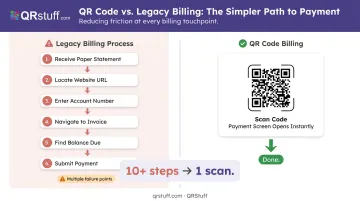
Legacy billing processes weren't built for this. A paper statement arrives, the patient intends to pay, and then friction takes over — finding the website, locating an account number, navigating to the right page. Research shows paying a single healthcare bill can involve 10 or more distinct steps. Most patients don't abandon payment out of unwillingness. They abandon it because the process is cumbersome.
That friction is where QR codes intervene. Placing a scannable code on a billing document cuts the payment path from 10+ steps to one — scan, land on the payment page, done. The result shows up directly in accounts receivable aging, administrative overhead, and patient satisfaction scores.
This article covers the concrete operational advantages of QR codes in healthcare billing: what they fix, what they improve, and how to deploy them effectively.
Key Takeaways
- Scan to pay instantly — QR codes on paper or digital statements eliminate manual URL entry and drop patients directly onto their payment screen
- Scans carry patient context into the portal, cutting data entry errors and preventing misapplied payments
- One scan gives patients charge breakdowns, FAQs, and payment plan options — no call to the billing office required
- Use dynamic codes — updatable destinations mean no reprinting when your payment portal URL changes
- Scan analytics sharpen follow-up — knowing who scanned but didn't pay replaces broad reminder blasts with targeted outreach
What Are QR Codes in Healthcare Billing?
A QR code is a machine-readable square that encodes a URL or action. When a patient points their smartphone camera at it, they're taken directly to a destination — no typing, no searching, no account number hunting.
In healthcare billing specifically, QR codes appear on:
- Printed paper statements mailed to patients
- Emailed digital bills and e-statements
- In-clinic invoices at checkout
- Discharge paperwork
The QR code acts as an access layer — it bridges the physical billing document to the digital payment experience. It doesn't replace your billing platform, EHR, or payment processor. What it does eliminate is the friction that causes patients to set a bill aside and forget it.
Static vs. Dynamic QR Codes in Billing
Two types of QR codes exist, and choosing the wrong one can leave you with broken links on thousands of printed statements.
| Type | What It Does | Billing Implication |
|---|---|---|
| Static | Encodes a fixed URL permanently | If your portal URL changes, the code breaks |
| Dynamic | Uses a redirect that can be updated anytime | Change the destination without reprinting |
For healthcare billing, dynamic QR codes are the only practical choice. Payment portal URLs change during system migrations or vendor switches. With dynamic codes, you update the destination URL in your dashboard and every statement already in circulation continues to work.
Key Advantages of QR Codes for Healthcare Billing
The three advantages below map directly to outcomes billing teams measure: collection speed, administrative accuracy, and patient satisfaction. Each connects to KPIs healthcare finance leaders track every cycle.
Faster, Frictionless Payment Collection
The problem: 71% of providers report it takes more than 30 days to collect payments after a patient encounter, yet 62% of consumers say they prefer to pay medical bills online. The gap between preference and reality is a process problem, not a willingness problem.
What QR codes change: Instead of patients navigating a provider's website, entering an account number, and hunting for the right invoice page (a process researchers documented at 10+ steps), a single scan opens a pre-populated payment portal showing their balance, account details, and payment options. Card entry is the only remaining action.
Payment delay is largely behavioral. A shorter path to payment means higher completion rates — intent disappears between steps when the process drags. QR codes compress that path significantly.
KPIs directly affected:
- Days in accounts receivable (A/R)
- Patient payment conversion rate
- Percentage of statements resulting in same-week payment
- Outstanding patient balance aging
When this matters most: High-volume outpatient clinics and practices where patient-responsibility balances represent a significant share of revenue — particularly as privately insured hospital bill repayment fell from 53.8% in 2021 to 46.1% in 2023.
Reduced Billing Errors and Administrative Overhead
The problem: Manual payment processes introduce error at every step — patients mistype account numbers, land on the wrong payment page, or submit payments that get misapplied. Nearly 45% of consumers reported spending up to one month on healthcare billing corrections, according to U.S. Bank's 2023 Healthcare Payments Insight Report.
What QR codes change: When a QR code encodes the specific invoice URL, the payment portal opens with the correct patient context already loaded. There's no account number to mistype, no page to search for. The patient lands exactly where they need to be.
This has two downstream effects for billing staff:
- Fewer inbound calls — "I can't find my account" and "the website isn't working" calls drop when patients scan directly to their invoice
- Fewer correction cycles — misapplied payments require manual reconciliation, delay close cycles, and erode patient trust; pre-populated portals reduce misapplication at the source
Both effects add up. CAQH's 2023 Index found manual administrative transactions cost an average of $5.43 more per transaction than electronic equivalents — and that gap compounds across thousands of monthly statements.
KPIs directly affected:
- Billing error rate
- Staff hours spent on billing inquiries
- Payment misapplication rate
- Cost-per-transaction for patient collections
When this matters most: Practices processing thousands of statements monthly, where even a 1–2% error rate generates significant administrative rework — and during billing system migrations, where dynamic QR codes can redirect scans to the new portal without reprinting a single statement.
Enhanced Transparency and Patient Trust
Only 22% of consumers always know what they owe before a provider visit, and billing confusion is a primary driver of delayed payment. Patients who don't understand a charge don't pay it — they call to dispute it, delay it, or ignore it.
A QR code doesn't have to point only to a payment screen. It can link patients directly to:
- Itemized charge breakdowns
- Explanation of benefits summaries
- FAQs about common billing questions
- Available payment plan options
A paper statement that once triggered a call to billing becomes a navigable self-service experience. Instead of calling to dispute a line item, patients scan and find an explanation. The dispute-before-payment pattern — which delays collections — gets interrupted before it starts.
The retention dimension matters too. 72% of consumers under 35 have switched providers or are willing to switch for a better payment experience. Billing transparency has become a patient experience metric, not just a finance metric.
KPIs directly affected:
- Billing dispute rate
- Patient satisfaction scores
- Percentage of patients who engage with payment plan options
- Repeat patient retention rate
When this matters most: Specialty practices with complex billing — oncology, cardiology, surgical centers — and practices serving price-sensitive populations where payment plan visibility directly affects collection rates.
What Happens When Practices Ignore QR Code Billing
Paper-only, manual billing workflows don't just stall revenue — they erode it cycle by cycle.
Here's what that looks like in practice:
- Patients receive a statement, face friction, and delay payment — then billing teams spend staff time on follow-up calls and restatements that first-cycle QR payment would have prevented
- A/R ages as unresolved balances stack up; the benchmark for A/R over 90 days is less than 15% of claims, and many practices are already above it
- Repayment rates for bills over $1,000 were below 35% for privately insured patients in 2023 — and the longer a balance sits, the harder it becomes to collect
- Manual processes don't scale; as statement volume grows, error rates and staff burden grow proportionally
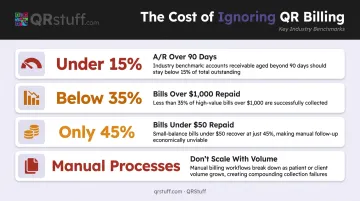
The pattern holds even at the low end of the billing spectrum. Repayment for bills under $50 was only 45% in 2023 — not because patients can't afford them, but because the act of paying is inconvenient enough to skip. Small balances, easy to ignore, quietly accumulate into meaningful write-offs.
QR code billing doesn't solve every collection challenge. What it does is remove the process friction that causes otherwise-willing patients to delay or abandon payment — friction that is measurable, specific, and costing practices real revenue on every billing cycle.
How to Get the Most Value from QR Codes in Healthcare Billing
Deploying QR codes on billing statements is straightforward. Getting compounding returns from them requires a few deliberate choices.
Use Dynamic Codes — Always
If your payment portal URL changes (during a vendor switch, system migration, or even a domain update), a static QR code becomes a broken link on every statement you've already distributed. Dynamic codes route through a redirect, so you update the destination once and every outstanding code stays functional. For high-volume billing operations, this is critical.
Treat Scan Data as Billing Intelligence
Scan analytics tell you which statements generated engagement. QRStuff's real-time scan tracking gives billing teams actionable data across four dimensions:
- Total scan volume and unique user counts
- Device type breakdowns (iOS, Android, desktop)
- Geographic data by region or ZIP code
- Time-based patterns showing peak payment activity
Patients who scanned but didn't complete payment are identifiable through UTM parameters and goal tracking on the payment portal. That narrows follow-up outreach from broad reminder campaigns to targeted contact with the patients most likely to convert.
QRStuff's infrastructure is GDPR and SOC2 compliant, relevant for healthcare organizations managing sensitive billing workflows. The platform doesn't store personally identifiable information from scans — compliance for the billing data itself sits with the destination payment portal.
Optimize the Destination, Not Just the Code
The QR code gets patients to the payment screen. What they find there determines whether they complete payment. The destination must be:
- Mobile-optimized — most scans happen on smartphones; a desktop-formatted portal loses patients immediately
- Fast-loading — slow load times at this stage are payment abandonment triggers
- Pre-populated — patients shouldn't need to re-enter account details they've already confirmed by scanning
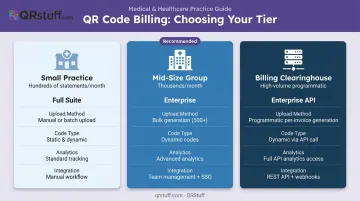
For practices running high statement volumes, QRStuff's Enterprise tier supports bulk QR code generation via API, enabling unique per-invoice codes to be embedded directly into billing system output.
Match the Tool to the Volume
| Practice Size | Recommended Approach |
|---|---|
| Small practice (hundreds of statements/month) | Full Suite plan; manual or batch upload |
| Mid-size group (thousands/month) | Enterprise tier with bulk generation |
| Billing clearinghouse | Enterprise API for programmatic per-invoice code generation |
Conclusion
QR codes in healthcare billing address the three outcomes billing teams track every cycle: how fast patients pay, how often errors need correction, and how patients experience the billing process.
The compounding effect is real. As more patients pay via QR, scan data accumulates — sharpening follow-up targeting and lowering cost-per-collection over time. Across thousands of monthly statements, the administrative savings from fewer errors, fewer restatements, and fewer inbound billing calls add up fast.
QR code billing works best as a continuous process: deployed consistently, reviewed against KPIs, and supported by a platform built to handle the volume. One-time experiments don't generate the data needed to improve — consistent deployment does, and the difference shows up in the numbers within a few billing cycles. Platforms like QRStuff provide the dynamic QR codes, scan analytics, and bulk generation capabilities that make this kind of ongoing, measurable deployment practical for healthcare billing teams.
Frequently Asked Questions
How do you get a QR code for payments?
Generate one through a QR code platform like QRStuff by linking the code to your payment portal URL. Dynamic QR codes are strongly recommended — they allow you to update the destination without regenerating or reprinting the code if your portal URL changes.
How are QR codes used in healthcare?
Common applications include patient billing and payment collection, patient identification and wristbands, medication tracking, appointment scheduling, and access to health records. Billing and payment collection tend to deliver the clearest, most measurable ROI for revenue cycle teams.
Are QR codes on medical bills HIPAA compliant?
QR codes don't store protected health information — they encode a URL. HIPAA compliance responsibility falls on the payment or patient portal the code links to, which must meet Security Rule requirements for any PHI accessed or transmitted through it.
Can QR codes reduce patient payment delays in healthcare?
Yes. QR codes remove the steps between receiving a bill and completing payment, directly reducing friction-related delay. Research consistently identifies the multi-step payment process as a primary driver of delayed balances — fewer steps means higher same-cycle completion rates.
What information can a QR code on a hospital bill contain?
The QR code itself typically encodes only a URL. The richness of information — charge itemization, account balance, payment plan options, FAQs — lives on the destination page, which the healthcare provider controls and can customize for their patients.
What types of payments can patients make by scanning a QR code on a medical bill?
Patients can typically pay via credit or debit card, digital wallets, bank transfer, or payment plans — depending on what the linked portal supports. The QR code itself is payment-method agnostic; it simply provides access to whatever options the provider's billing system offers.