QR codes give retailers a direct mechanism for bridging that gap — turning a passive shelf browser into an engaged, informed buyer without requiring staff intervention or an app download. This article covers the measurable advantages QR codes deliver in retail and the specific promotion strategies that produce results.
Key Takeaways
- 64% of shoppers have scanned a QR code on a product while shopping in-store, making placement on packaging and shelf displays a proven tactic
- QR codes convert in-store browsing intent into trackable digital actions: product pages, coupons, loyalty sign-ups, and more
- Dynamic QR codes let retailers update destination URLs without reprinting — no new print runs needed for seasonal or rotating campaigns
- Real-time scan analytics — location, device, and timing data — replace guesswork with measurable campaign results
- The highest-impact placements are shelf displays, product packaging, checkout counters, and storefront windows
What Are QR Codes in Retail?
A QR code is a scannable square barcode that instantly sends a smartphone camera to a specific URL, coupon, product page, or digital experience — no app required. Most modern iPhones and Android devices scan them natively through the built-in camera.
In retail, they appear on:
- Shelf tags and display stands
- Product packaging and labels
- Receipts and checkout printouts
- Window signage and storefront decals
- Print advertising and promotional mailers
QR codes are a conversion tool — they turn passive in-store browsing into a trackable action with a measurable outcome. Each scan captures intent that would otherwise disappear at the shelf.
Key Benefits of QR Codes for Retailers
The benefits below connect directly to outcomes retailers measure: conversion rates, average order value, customer retention, and campaign ROI.
Bridging the Physical and Digital Shopping Experience
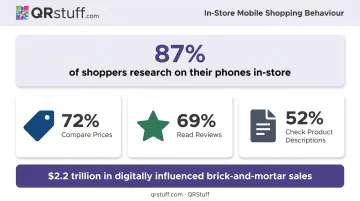
According to 1WorldSync's 2023 research, 87% of shoppers research products on smartphones while physically in a store — with 72% comparing prices, 69% reading reviews, and 52% checking product descriptions. That phone is already in their hand — and QR codes determine whether that intent converts in your store or at a competitor's checkout.
QR codes act as a direct link between the shelf moment and the digital content shoppers want. A customer scanning a code next to a skincare product can immediately access ingredient breakdowns, reviews, and application guides at the point of decision.
This solves the showrooming problem directly. When customers get the information they need before they leave, they don't need to "check online later" — a journey that frequently ends at a competitor's checkout. Deloitte's research found that digitally influenced brick-and-mortar sales reached $2.2 trillion, representing 64 cents of every in-store dollar spent.
Where this matters most:
- High-consideration categories: electronics, furniture, appliances, skincare
- Stores with limited floor staff where customers can't easily flag down help
- New product launches where packaging space limits the information available
KPIs it affects: In-store conversion rate, time-to-purchase, product return rate (customers who bought with full information return less)
Running Measurable, High-Converting Promotions
QR codes can deliver coupons, limited-time discounts, BOGO offers, and loyalty sign-ups directly to a customer's phone at the exact moment they're standing in front of a product.
The context separates QR promotions from generic email blasts or print circulars. A QR promotion is:
- Contextual — triggered by a specific product or physical location
- Personal — redeemable on the customer's own device
- Trackable — every scan is logged with time, location, and device data
Chain Store Age reported that 74% of consumers were likely to scan QR codes during Black Friday and Cyber Monday shopping, with 56% scanning specifically for promotional offers. That's a high-intent audience actively looking to act on a deal.
Digital coupons have also overtaken print circulars in redemption volume. Inmar's Promotion Industry Analysis found digital load-to-card reached 29.3% of all redemption volume, surpassing print for the first time.
For retailers, higher redemption rates translate directly to more conversions per promotional dollar spent.
Where this matters most:
- Seasonal sales: Black Friday, holiday campaigns, clearance events
- Product launches where urgency drives early adoption
- Loyalty program rollouts where sign-up friction needs to be removed
KPIs it affects: Coupon redemption rate, promotional conversion rate, average basket size, customer acquisition cost
Real-Time Analytics That Inform Better Decisions
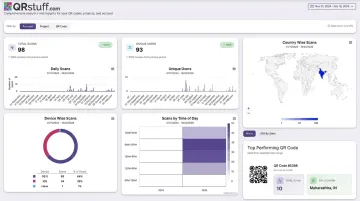
Every scan of a dynamic QR code generates data: when it happened, where, on what device, and how often. For retailers running multiple displays across multiple locations, this is the difference between knowing what's working and guessing.
QRStuff's platform delivers real-time analytics including:
- Total and unique scan counts — distinguishing reach from repeat engagement
- Geographic data at country and city level — critical for multi-location retailers comparing regional campaign performance
- Device and OS breakdowns — useful for optimizing landing page experiences
- Time and date of scans — revealing peak engagement windows
Instead of waiting for end-of-campaign reports, retailers can check the dashboard mid-campaign and reallocate attention to placements that are producing scans. If a code near a display has high scan volume but low post-scan conversion, the issue is the landing page — not the QR code. Analytics make that distinction visible.
For campaigns where the destination needs to change — a new promotion, an updated URL, a seasonal offer — dynamic QR codes let retailers update the destination instantly without touching the printed material. QRStuff supports this across its Full Suite and Enterprise tiers, with UTM parameter support and Google Analytics integration for retailers who need to connect scan data to on-site behaviour.
Where this matters most:
- Multi-location retailers running regional campaigns with different offers
- Seasonal promotions with strict deadlines and rotating content
- Any campaign where budget accountability is required
KPIs it affects: Scan rate, campaign conversion rate, cost-per-acquisition, return on promotional spend
Proven QR Code Promotion Strategies for Retail
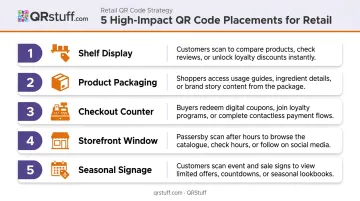
These five placements represent the highest-impact locations in retail environments, each tied to a specific customer moment.
In-Store Displays and Product Shelving
Place QR codes directly on shelf tags or display stands to deliver reviews, comparison guides, or how-to content. This gives shoppers the information they need to buy with confidence.
Best used for high-consideration products or new arrivals where packaging alone doesn't give customers enough to buy with confidence. A shopper evaluating two competing appliances will make a faster, more confident decision when one of them links directly to a video demo and user reviews.
Product Packaging
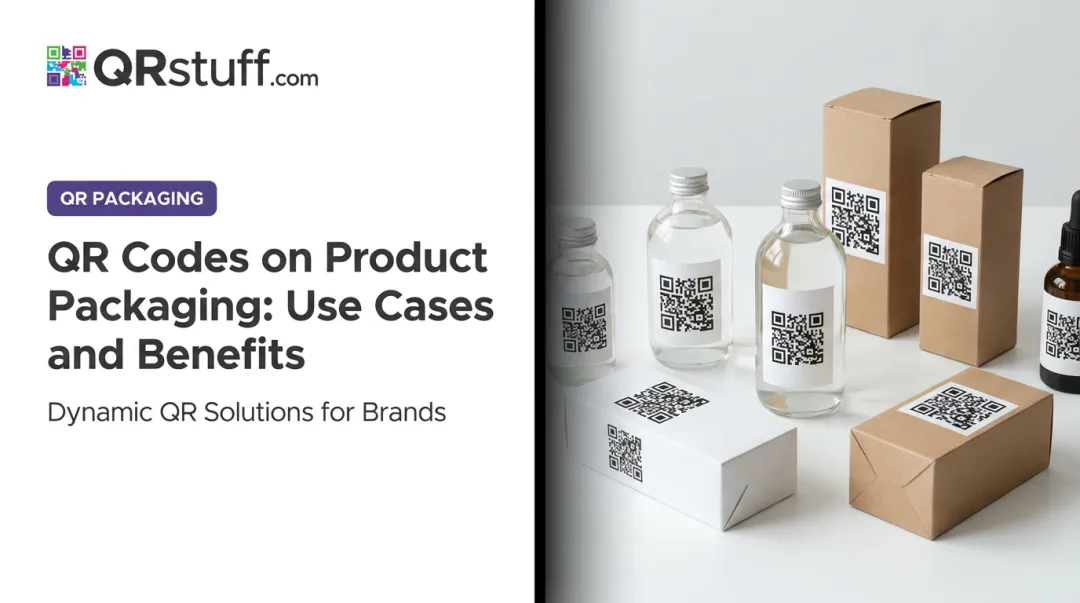
Packaging QR codes have longevity that shelf displays don't — they travel home with the customer and remain scannable long after purchase. Link to:
- Usage instructions or tutorials
- Ingredient or materials information
- Warranty registration
- Loyalty program enrollment
- Review submission pages
Post-purchase engagement through packaging codes builds retention and generates the social proof that influences the next customer at the shelf. IKEA uses QR codes on packaging to offer guided content and product inspiration, keeping the brand relationship active beyond the initial sale.
Checkout Counter Campaigns
The checkout area is a high-attention zone. Customers are stationary, phones are accessible, and the purchase decision is already made — making it the ideal moment for a next-step action.
Checkout QR codes work well for discounts on the next visit, loyalty program sign-ups, short post-purchase surveys, and digital receipts with embedded offers. Each action is low-friction — one scan while waiting completes it.
Marigold's 2024 research found 43% of consumers expected to rely more on loyalty program benefits before making purchases compared to the prior year. Checkout is where that enrollment happens most naturally.
Storefront and Window Displays
Window QR codes capture browsers who pass by outside trading hours. Link to the online store, a current promotion, or a "save this deal for later" landing page so intent doesn't evaporate overnight.
Zara's window display QR codes (confirmed in Inditex's 2018 annual report) showed that physical-to-digital engagement doesn't require a customer to walk through the door. Nike's House of Innovation took it further, letting shoppers scan codes on in-store mannequins to browse products, check sizes, and request items brought directly to them — no sales associate needed.
Seasonal and Time-Sensitive Promotions
Dynamic QR codes are purpose-built for seasonal campaigns. Print the code once on signage; update the destination as offers rotate from pre-sale to main sale to clearance — no reprints required.
This is particularly effective for Black Friday, holiday campaigns, and product launches where promotional terms change frequently and printing timelines are tight. QRStuff's dynamic codes update destination URLs in real time through the dashboard, keeping every scan pointed at the current offer.
What Happens When Retailers Skip QR Codes
The cost of inaction isn't abstract. With 87% of shoppers using smartphones to research products in-store, and 69% of mobile searchers comparing prices with nearby stores, retailers without QR codes are leaving customers to find answers elsewhere — often at a competitor.
Without trackable codes, promotional spend goes unmeasured. There's no way to determine which display, location, or offer drove actual conversions, making budget decisions reactive rather than informed.
The competitive gap is widening fast. Chain Store Age reported that nearly 60% of retail marketers used QR codes in 2024 holiday campaigns, with over 40% of non-users actively planning adoption.
GS1 US has set a 2027 target for retailers to accept 2D barcodes at checkout. At that point, QR code infrastructure becomes a baseline requirement — stores without it will face operational friction, not just a marketing disadvantage.
Retailers skipping QR codes also send a signal to younger shoppers who expect to interact digitally while browsing in person. That friction — however small — can be enough to push a purchase online or toward a competitor who makes the experience seamless.
The risks, taken together:
- Lost conversions: Shoppers research in-store but buy elsewhere when answers aren't immediately available
- Unmeasured spend: No scan data means no way to attribute which displays or promotions actually drove sales
- Compliance pressure: GS1's 2027 2D barcode mandate makes QR infrastructure a business necessity, not a strategic option
- Perception gap: Mobile-native shoppers notice when a store's experience feels behind
How to Get the Most from Your Retail QR Code Strategy
A few well-placed codes with clear calls-to-action will consistently outperform a dozen codes with no defined purpose. Each code needs to tell the customer exactly what they'll get by scanning it: "Scan for 20% off," "Scan to see how this works," "Scan to join our rewards program."
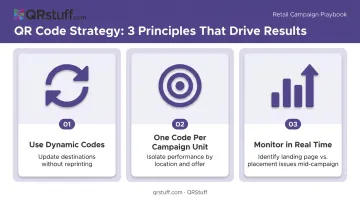
Three principles that separate effective strategies from average ones:
If the offer, URL, or product information might change, static codes create a reprint problem. QRStuff's dynamic codes let you update destinations in real time through the dashboard — the printed material stays intact no matter how many times the campaign evolves.
One code per location, per campaign, per product makes it possible to compare performance and identify what's actually driving scans. Without this separation, your analytics data becomes noise.
Don't wait until a campaign ends to review performance. A high scan rate with low post-scan conversion points to a landing page problem. A low scan rate from a high-traffic location means the code placement or call-to-action needs work. QRStuff's dashboard surfaces this data in real time, and UTM integration feeds it directly into Google Analytics for full-funnel visibility.
The retailers who get the most from QR codes treat them as trackable, adjustable tools — not static print elements. That shift in approach is where the real performance gains happen.
Conclusion
QR codes have earned a permanent place in retail because they solve real problems at the point of purchase: missing product context, untraceable promotions, and campaigns that run on gut feel instead of data.
The advantages build on each other when applied consistently. Better product information at the shelf means fewer lost sales. Trackable promotions improve with every iteration because you know what's actually working — and real-time scan data tells you where to put the next pound of budget.
Treat QR codes as an ongoing channel, not a one-time print job. Update destinations when offers change, test placements against each other, and use scan data to sharpen every future campaign. With dynamic codes, none of that requires reprinting — the code stays the same, the content evolves.
Frequently Asked Questions
Are QR codes safe to use for retail promotions?
QR codes are safe when generated by a reputable platform. Retailers should link codes to HTTPS-secured pages, use a platform with documented security compliance (QRStuff is GDPR and SOC2 compliant), and avoid URL shorteners that obscure the final destination from scanners.
How do you use QR codes for retail promotions?
Create a dynamic QR code linked to a promotion, coupon, or landing page, then place it on signage, packaging, receipts, or storefronts with a clear call-to-action. QRStuff's coupon QR code type handles this directly and allows offer updates without reprinting.
What types of QR codes work best for retail promotions?
Dynamic QR codes are the right choice for retail promotions: they allow linked content to be updated without reprinting and provide full scan analytics. Static QR codes are only appropriate for fixed, permanent content that will never change.
Where should I place QR codes in my retail store?
The highest-impact locations are shelf displays next to the product, checkout counters, storefront windows, and product packaging. Each placement should align with a specific customer action — information access, promotion redemption, or loyalty enrollment.
Do customers need an app to scan a QR code?
No separate app is needed. The built-in camera on any modern iPhone or Android device scans QR codes natively, making it easy for any shopper to scan.
How do I measure whether my QR code retail campaign is working?
Dynamic QR codes track scan volume, timing, location, and device type. Monitor scan rate, conversion rate, and coupon redemption rate, then connect QRStuff's UTM support to Google Analytics for full-funnel visibility.