That's a problem. Not because branded QR codes look nicer, but because what a QR code looks like directly affects whether consumers stop to scan it, whether they trust what they're scanning, and whether the experience deepens or undermines their relationship with your brand.
This article breaks down the specific, measurable advantages of brand-consistent QR codes — covering consumer trust, brand recall, campaign analytics, and what happens when businesses ignore the issue entirely.
Key Takeaways
- Brand-consistent QR codes embed your logo, colors, and visual identity directly into the code — instantly recognizable before scanning
- Branded codes reduce scan hesitation and build consumer trust, where QR phishing is a real and growing concern
- Consistent branding across deployments builds cumulative scan data, making performance benchmarks more reliable over time
- Generic or inconsistent QR codes fragment your analytics, suppress scan rates, and waste brand impressions
- Brand consistency in QR codes works as an ongoing standard, not a one-time setup choice
What Is Brand Consistency for QR Codes?
Brand consistency in QR codes means every code your business deploys uses the same visual elements: your brand colors, logo placement, module and eye shapes, frame text, and overall style. The result is a code that consumers recognize as yours before they ever scan it.
This applies across every surface where QR codes appear:
- Product packaging and labels
- Print ads and direct mail
- Event signage and trade show booths
- In-store displays and window clings
- Business cards and branded materials
- Email campaigns with embedded or linked codes
Brand consistency does more than look polished. Done right, each code reinforces recognition, builds trust, and contributes to measurable campaign performance.
QRStuff supports this across all 40+ code types — letting businesses apply brand colors, logos, shapes, frames, and gradient effects so every code reads as part of the same campaign, not a one-off template.
Key Benefits of Brand-Consistent QR Codes
Benefit 1: Higher Consumer Trust and Scan Confidence
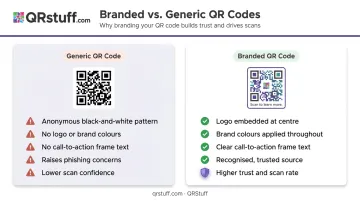
Generic black-and-white QR codes create a trust gap. Consumers see an anonymous square with no indication of who it belongs to or where it leads — and in an environment where QR phishing is actively growing, that ambiguity costs scans.
The threat is real: Cofense reported a 331% increase in QR-code active threat reports in 2023, and the FBI's Internet Crime Complaint Center warned that cybercriminals are actively tampering with physical QR codes to redirect victims to malicious sites. An unbranded code doesn't just look unprofessional. It looks suspicious.
Brand-consistent QR codes close this gap. A recognizable logo, familiar brand colors, and a clear call-to-action frame ("Scan for Offer" or "Scan to Learn More") communicate legitimacy before the scan happens.
The broader trust data reinforces why this matters. McKinsey research found that 87% of North American consumers would not do business with a company if they had concerns about its security practices.
That skepticism extends directly to unmarked QR codes, particularly in healthcare, financial services, and food and beverage, where brand authority determines whether consumers engage at all.
KPIs impacted: Scan rate, unique scans per campaign, conversion rate from offline to online, consumer confusion incidents
When it matters most: At highest impact when QR codes appear in new markets or on new product lines where the brand has little existing physical presence — and the QR code itself is the first brand interaction a consumer encounters.
Benefit 2: Stronger Brand Recall and Repeat Engagement
Every QR code scan is a brand interaction. When the code visually matches the rest of your brand experience, it reinforces memory and recognition. When it doesn't, it creates a disconnected moment that works against the brand — even if the scan completes successfully.
Consistent QR code branding creates a compounding effect. Consumers who see the same visual style across packaging, signage, and ads begin to associate the branded code with the brand's broader promise. That familiarity makes them more likely to scan in future encounters, even without a specific prompt.
The research on brand consistency backs this up. Lucidpress's State of Brand Consistency report, which surveyed over 450 marketing professionals, found that brands estimated a 10–20% increase in revenue from maintaining consistent brand presentation. The same report found 77% of companies regularly dealt with off-brand content — meaning inconsistency is the default, not the exception.
Each scan of a branded QR code also functions as a brand impression, even when the consumer doesn't complete the intended conversion. The visual identity registers regardless — building familiarity that pays off across future touchpoints.
KPIs impacted: Return scan rate, loyalty program enrollment via QR, content engagement metrics (dwell time, video completion), unaided brand recall in post-campaign surveys
When it matters most: Multi-touchpoint campaigns — product packaging, event marketing, print ads — where the same customer encounters QR codes across different formats. Consistent branding ties the experience together into a single coherent campaign rather than a series of disconnected interactions.
Benefit 3: Cleaner Analytics and Cross-Channel Attribution
When QR codes look different across campaigns — or are visually indistinguishable from each other — accurate attribution becomes nearly impossible. Marketers end up with scan data they can't act on because they can't isolate which channel, audience, or creative drove the result.
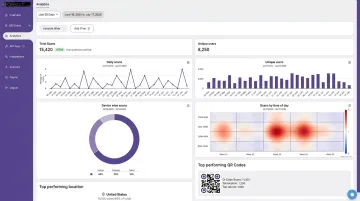
Brand-consistent QR codes, combined with dynamic QR tracking, solve this. Each code is visually identifiable to its campaign context while feeding scan data — location, device type, time, unique users — into a unified dashboard. The result is attribution that's accurate and actionable, not approximate.
The Capri Sun case illustrates what a well-executed, trackable QR campaign can yield: on-pack QR codes for a sweepstakes generated 579,000+ landing page views and 28,000+ sweepstakes submissions, making it a top-three performing code across the Kraft Heinz portfolio. That kind of result requires both brand presence (so consumers trust and scan) and technical tracking (so the results can be measured and replicated).
That technical tracking side is where the platform infrastructure matters. QRStuff's real-time analytics dashboard captures this data for every dynamic QR code:
- Scan volume and unique vs. repeat user counts
- Geographic distribution down to city level
- Device type and operating system breakdown
- Time-of-day patterns for campaign optimization
Codes can also be updated to new destinations without reprinting, a direct cost saving for packaging, events, and long-running print campaigns where content changes.
KPIs impacted: Scan attribution accuracy, campaign ROI, cost-per-scan, unique user identification across channels, time-to-insight for marketing optimization
When it matters most: Brands running QR codes across multiple simultaneous campaigns — product packaging, events, and print ads — where isolating performance by channel requires each code to be both visually and technically distinct.
What Happens When QR Code Branding Is Ignored
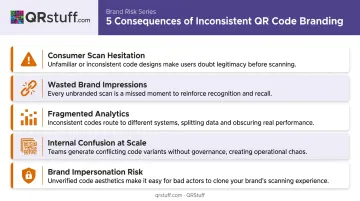
Generic or inconsistent QR code deployment creates compounding problems that get harder to fix the longer they go unaddressed.
- Consumer scan hesitation: An unbranded code in a high-awareness phishing environment is an unknown risk. Consumers increasingly skip codes they can't attribute to a recognizable brand.
- Wasted brand impressions: Every scan of a generic code is a missed opportunity to reinforce visual identity. The interaction happens, but the brand gets no credit for it.
- Fragmented analytics: When codes look identical across campaigns, marketers can't accurately attribute scans by channel, audience, or creative — making optimization guesswork.
- Internal confusion at scale: As QR code deployment grows across products, regions, and teams, inconsistent design makes it difficult to identify which code belongs to which campaign.
- Higher exposure to brand impersonation: Generic codes are easier to replicate and exploit. Branded codes with recognizable visual elements are harder to fake convincingly.
Once codes have been printed on physical materials, fixing branding problems means reprinting packaging, signage, and collateral — a costly and operationally disruptive process. The longer inconsistent practices continue, the more expensive the correction becomes.
How to Get the Most Value from Brand-Consistent QR Codes
Brand consistency in QR codes works best when three conditions are in place:
Establish it as a brand standard, not a one-time decision. Define a QR code style guide that specifies approved colors, logo placement, frame text, module shapes, and minimum size requirements. Apply it across every deployment — packaging, signage, digital, events — without exception.
Use dynamic codes with real-time analytics. Static codes work for permanent destinations, but campaigns with changing content or measurable goals require dynamic codes. Track which branded codes perform best by channel, location, and audience, then use that data to refine placement and content strategy.
Act on what the data tells you. Scan data from branded QR codes should feed directly into campaign planning: which formats drive the most scans, which audience segments engage most, and where placement can be improved in the next production cycle. Analytics only create value when they change decisions.
For enterprise teams managing QR codes at scale, QRStuff's centralized dashboard supports this model. Bulk generation, role-based access controls, project organization, CSV export, and API access give teams the tools to apply and enforce brand standards consistently across thousands of codes.
Conclusion
Brand-consistent QR codes aren't a cosmetic upgrade — they're how you turn a generic utility into a recognized, trusted interaction at every touchpoint. The payoff is functional: more scans, better data, and stronger customer relationships.
Each scan of a consistently branded QR code reinforces recognition, generates reliable performance data, and deepens the customer relationship. Those returns compound as brand familiarity grows.
Treating QR code brand consistency as an ongoing standard — with a defined style guide and regular performance reviews — is what drives measurable engagement over time. Brands that skip this step deploy codes. Brands that commit to it build equity.
Frequently Asked Questions
Why is consistent brand identity important?
Consistent brand identity builds recognition and trust across every customer touchpoint, which directly shapes purchasing decisions, loyalty, and revenue. QR codes are now a high-frequency brand touchpoint — consistency reinforces recognition, while mismatched designs leave customers questioning the source.
What are the benefits of QR codes for business?
QR codes bridge physical and digital experiences, enable trackable marketing campaigns, and capture first-party behavioral data. Dynamic QR codes also reduce reprint costs by allowing destination updates without changing the physical code.
Do branded QR codes scan better than standard black-and-white codes?
Modern QR codes include built-in error correction that accommodates logo embedding and color customization without compromising scannability. QRStuff automatically applies a high error correction level when logos are added — and scan rates are higher when people recognize the code as coming from a brand they trust.
Can I add my logo and brand colors to a QR code?
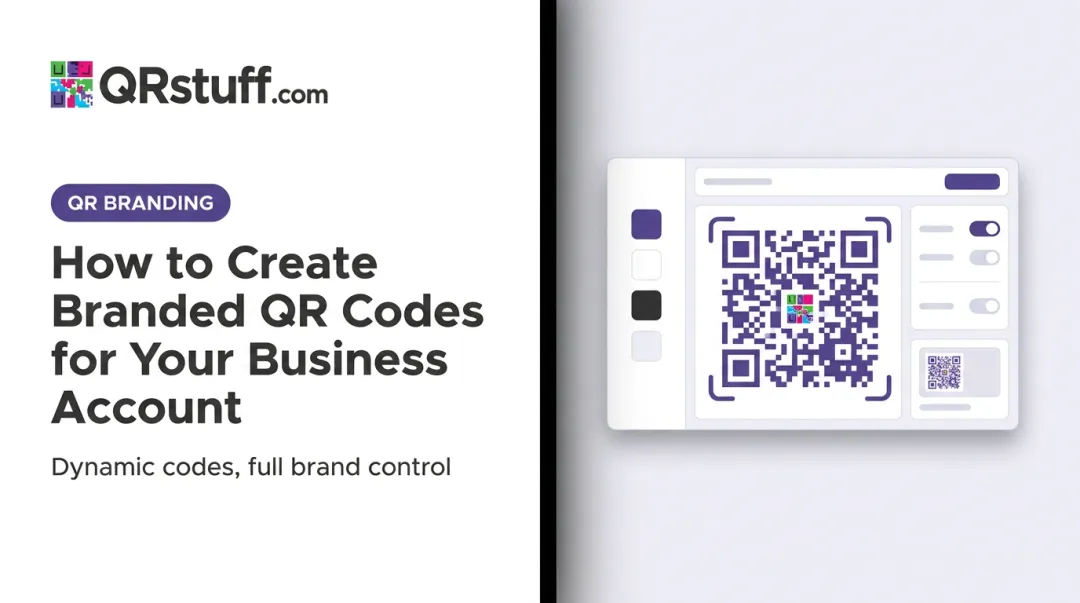
Yes. QRStuff allows businesses to embed logos, apply brand colors, customize module and eye shapes, add gradient effects, and include call-to-action frame text — all while maintaining full scannability across all 40+ supported code types.
What makes a QR code look professional and trustworthy?
A professional QR code includes brand colors, a logo, a clear call-to-action frame, and appropriate sizing for its medium. Together, these elements signal intentional design rather than an auto-generated placeholder, which directly affects whether someone chooses to scan.
How do I maintain QR code brand consistency across multiple marketing materials?
Three steps make this manageable:
- Build a QR code brand style guide that defines approved colors, logos, and frame text
- Use a centralized platform like QRStuff to generate and store all codes to the same standard
- Conduct regular audits to confirm deployed codes match your guidelines across all channels