This isn't a fringe preference. According to the National Restaurant Association's 2024 Technology Landscape Report, 57% of limited-service customers are comfortable accessing a menu by QR code, and 52% would place an order that way. Meanwhile, 41% of restaurant operators planned to invest in contactless ordering or payment systems in 2024 — a clear signal that infrastructure investment is accelerating.
For restaurants, retailers, hotels, and event venues, QR ordering and contactless payment are now core POS infrastructure. Businesses that get this right gain measurable advantages in order volume, labor efficiency, and guest retention. Those that don't risk looking outdated to customers who've already moved on.
Key Takeaways
- QR ordering now covers the full guest journey — order, pay, tip, and split — all without a staff touchpoint
- Contactless payment is now an expectation: U.S. consumers averaged 11 mobile payments per month in 2024, up from a clear preference just two years prior
- Dynamic QR codes allow real-time menu updates, promo swaps, and scan analytics — no reprinting required
- Labor costs at 36.5% of sales are pushing full-service restaurants toward self-ordering fast
- Juniper Research forecasts QR payment spend will grow from $5.4 trillion in 2025 to $8 trillion by 2029
QR Code Ordering Goes Full-Service
Beyond the Digital Menu
QR ordering started as a pandemic-era workaround — a way to replace laminated menus with a web link. That phase is over. In 2026, a well-implemented QR ordering system handles the entire guest interaction:
- Browse: Guests view the full menu with photos, descriptions, and dietary filters
- Customise: Modify orders (no onion, extra sauce, swap sides) without flagging down a server
- Reorder: Add items to an open tab mid-meal
- Pay: Split bills, apply tip, and complete payment — all from their phone
- Engage: Leave a Google review or complete a satisfaction survey immediately post-payment
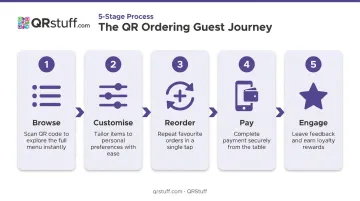
The result is a transaction layer that runs without staff involvement, freeing your team to focus on service issues, special requests, and table experience.
Multi-Industry Adoption
Restaurants led early adoption, but QR ordering has spread across sectors where speed and hygiene overlap:
- Hotels: Room service menus, pool bar ordering, concierge information, and contactless check-in/out via in-room QR codes
- Stadiums and arenas: In-seat concessions with QR codes reducing queue pressure at concession stands
- Retail: Product information, loyalty rewards, and checkout prompts accessible from shelf-edge codes
- Healthcare and education: Patient check-in, campus dining, and event ticketing
This cross-sector spread matters because it normalises the behaviour. Guests who use QR ordering at a stadium on Saturday expect the same option at a restaurant on Sunday.
The Revenue Case
Toast reports that restaurants adding Mobile Order & Pay see a 10–12% average increase in processing volume — driven by unhurried browsing and automated upsell prompts. When guests order at their own pace without feeling rushed, they're more likely to add a starter, upgrade a drink, or order dessert.
That revenue lift depends on one design decision above all others: app-free access. Modern QR ordering systems open directly in the guest's mobile browser — no download required. That one design decision cleared the friction that derailed earlier QR adoption and made the experience accessible across all age groups.
QRStuff takes this approach further, generating codes that link directly to ordering pages, digital menus, or payment flows — no app install required on the guest's end.
Contactless Payment Becomes the Default POS Experience
The Numbers Behind the Shift
U.S. consumer payment behaviour has fundamentally changed. Federal Reserve data from 2025 shows consumers averaged 11 mobile phone payments per month in 2024, up from just 4 in 2018. For adults aged 18–24, mobile phones accounted for 45% of all payments.
This reflects infrastructure maturity, not a passing trend. Mobile wallets work reliably, biometric authentication is standard, and NFC readers are in virtually every modern terminal. For most consumers, paying by phone is simply faster than any alternative.
Static vs. Dynamic QR Payments
Not all QR payment codes work the same way at the POS level:
| Type | How It Works | Best For |
|---|---|---|
| Static QR | Fixed destination, same code every time | Tip jars, donation boxes, fixed-price items |
| Dynamic QR | Unique per transaction, pre-filled with order amount and merchant details | Restaurant checkouts, retail POS, high-volume venues |
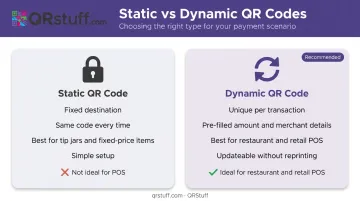
Dynamic QR codes are the preferred standard for commercial POS environments. They arrive pre-loaded with the exact transaction amount, reduce manual entry errors, and generate unique codes per payment, so a code used for Table 4's dinner cannot be replicated or reused.
Platforms like QRStuff support dynamic QR code creation across multiple payment types — including PayPal, Venmo, UPI, and EPC (SEPA for European transactions) — with the ability to update payment destinations without reprinting physical materials.
Speed as a Business Metric
Visa's Economic Empowerment Institute research puts contactless card transactions at 7.8 seconds versus 14.8 seconds for contact card payments. That's nearly half the time per transaction.
At a 200-cover restaurant during a Friday dinner service, or a stadium concession stand processing 400 orders per hour, that difference compounds quickly. Fewer seconds per transaction means shorter queues, higher throughput, and more revenue captured during peak windows, with no additional staffing required.
Security That Earns Consumer Trust
Early contactless hesitancy centred on security. The infrastructure has since addressed those concerns at multiple layers:
- End-to-end encryption protects data in transit and at rest
- Tokenisation means card data never touches the merchant's system directly
- Biometric authentication (Face ID, fingerprint) adds a second layer to mobile wallet approvals
- Transaction-specific dynamic codes expire after use and cannot be replayed
For businesses generating payment QR codes through platforms like QRStuff, GDPR compliance and HTTPS-protected payment destinations are standard requirements — ensuring the code itself doesn't become a security liability.
AI, Personalization, and Dynamic QR Solutions Reshaping POS
Personalization at the Moment of Scan
McKinsey research finds 71% of consumers expect personalized interactions from businesses — and 76% get frustrated when that doesn't happen. QR-based ordering and payment platforms are now the delivery mechanism for that personalization at the transaction level.
When a returning guest scans a table QR code, an AI-enabled system can surface:
- Their previous order history and favourite items
- Active loyalty points balance and eligible rewards
- Personalized upsell suggestions based on past preferences
- Targeted offers or seasonal promotions relevant to their profile
That all surfaces while the guest is seated, menu in hand, and ready to decide — exactly when it matters.
Dynamic Codes as Operational Infrastructure
The real operational power of dynamic QR codes isn't in the initial setup — it's in what happens afterward. Operators can make real-time changes through a web dashboard without touching a single physical code:
- Update menu prices instantly (no reprint required)
- Mark items unavailable when stock runs out
- Swap promotional offers between breakfast, lunch, and dinner service
- Redirect payment destinations if processor settings change
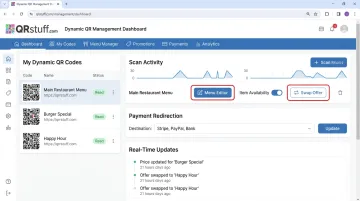
QRStuff's dynamic QR codes pair this flexibility with real-time scan analytics — capturing scan time, device type, geographic location (country and city level), and unique versus repeat scans. For a multi-location operator, this data shows which venue's codes drive the most engagement, which menu sections get the most attention, and when peak scanning periods occur — informing both placement decisions and campaign timing.
Post-Payment Engagement Loops
That operational visibility extends beyond the transaction itself. With QR-initiated payment, operators can trigger immediate post-payment engagement while the experience is still fresh:
- Prompt Google Reviews while guests are still at the table — before the experience fades
- Send quick feedback forms that capture sentiment in under 60 seconds
- Drive social sharing to Instagram or TikTok with a branded hashtag built into the post-payment screen
QRStuff supports native Google Review QR codes and feedback form functionality, giving operators a direct line from completed payment to public reviews, repeat visits, and measurable word-of-mouth.
What's Driving These Trends
Three forces are accelerating QR and contactless adoption simultaneously — and they reinforce each other.
Labor Cost Pressure
Restaurant operators are squeezed on margins. The NRA's 2025 analysis found median labor costs hit 36.5% of sales for full-service restaurants in 2024 — and operators running at a loss carried labor burdens of 42.9% of sales. For limited-service, the median was 31.7%.
QR self-ordering doesn't replace hospitality — it removes transactional friction from staff workflows, allowing the same headcount to handle higher covers without service quality degrading.
Consumer Behavior That Stuck
Post-pandemic hygiene habits established contactless payment as a default for many consumers. Mastercard reported in 2021 that 74% of consumers intended to keep using contactless payments after the pandemic — and the Federal Reserve's observed data confirms the follow-through. Mobile payment frequency more than doubled between 2018 and 2024 (Federal Reserve).
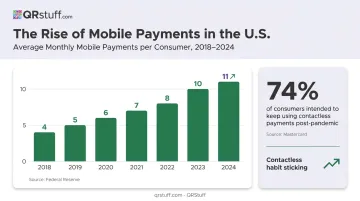
That expectation is now a baseline: venues without a scan-to-pay or scan-to-order option don't read as traditional — they read as behind the curve.
Infrastructure Maturity
Smartphone penetration, reliable 4G/5G coverage, and the standardization of Apple Pay and Google Pay have removed the technical barriers that made early contactless rollouts uneven. Guests no longer need to download a specific app, learn a new interface, or trust an unfamiliar payment brand — the tools are already on their phones.
Future Signals for QR Ordering and Contactless POS
Where the Market Is Heading
Juniper Research forecasts QR payment spend growing from $5.4 trillion in 2025 to $8 trillion by 2029 — a 48% increase. That's not a niche technology trajectory; it's mainstream financial infrastructure.
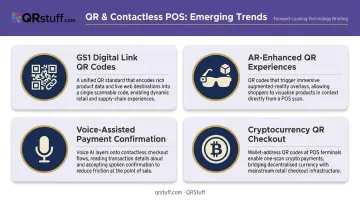
Several emerging developments will shape how QR codes evolve within POS environments over the next few years:
- GS1 Digital Link QR codes: Already supported by QRStuff, these encode a product's GTIN in a structured URI format, scannable at retail POS checkouts and compliant with Sunrise 2027 standards. Enterprise retailers are deploying these on shelf labels and packaging to connect product scanning to live inventory systems.
- AR-enhanced QR experiences: Scanning a code to view a 3D dish preview or virtual product model is in early deployment at high-end restaurants and boutique hotels, particularly in luxury hospitality and premium retail
- Voice-assisted payment confirmation: Accessibility-focused implementations that allow payment confirmation via voice command rather than screen tap
- Cryptocurrency QR checkout options: QRStuff already supports Bitcoin QR codes, and stablecoin payment options are beginning to appear in checkout flows targeting tech-forward audiences
The Strategic Case for Acting Now
Operators who build their POS infrastructure on dynamic, analytics-enabled QR codes today aren't just solving a 2026 problem. They're creating the connective layer that links ordering, payment, loyalty, and customer data — a foundation any future technology (AR, voice, IoT inventory triggers) can plug into.
QRStuff's Enterprise tier supports this at scale, with:
- Unlimited batch processing and 1,000+ dynamic codes
- Full API access for programmatic code generation and management
- White-label capabilities for fully branded scan experiences
- Real-time scan analytics across every deployed code
For businesses managing QR infrastructure across multiple locations, that centralised visibility and flexibility is what separates a scalable QR strategy from an unmanageable patchwork of one-off codes.
Frequently Asked Questions
Are QR codes used for contactless payments?
Yes. QR codes are one of the primary contactless payment methods in use today. A customer scans a merchant's QR code to initiate payment through their banking app or digital wallet, completing the transaction without touching a shared terminal.
Are QR codes still popular in 2025?
The NRA's 2024 data shows majorities of both full-service and limited-service restaurant customers are comfortable using QR codes for menus and ordering. Usage has grown steadily since the pandemic, and 41% of operators planned contactless ordering or payment investment in 2024 alone.
What is the difference between static and dynamic QR codes for payments?
Static codes always point to the same destination, making them useful for fixed-price scenarios or tip prompts. Dynamic codes are generated per transaction with pre-filled payment amounts — more secure and accurate for high-volume POS environments where transaction details change with every order.
Do customers need to download an app to use QR code ordering?
No. Modern QR ordering systems open directly in the guest's mobile browser — no app download required. This browser-native design is a primary reason QR adoption has accelerated across all age groups after earlier attempts stalled due to app friction.
How do QR code payments integrate with existing POS systems?
Most platforms offer API integrations that route orders automatically to kitchen display screens or printers, with payment data syncing in real time. QRStuff's RESTful API supports programmatic QR code generation and management, though verifying compatibility with your specific POS vendor before implementation is always advisable.
What industries benefit most from QR contactless payment solutions?
Restaurants led early adoption, but strong results are now appearing across retail checkout, hotels and resorts, stadium and festival concessions, healthcare check-in, and education campuses — anywhere speed, hygiene, and self-service convenience reduce friction for both customers and staff.